
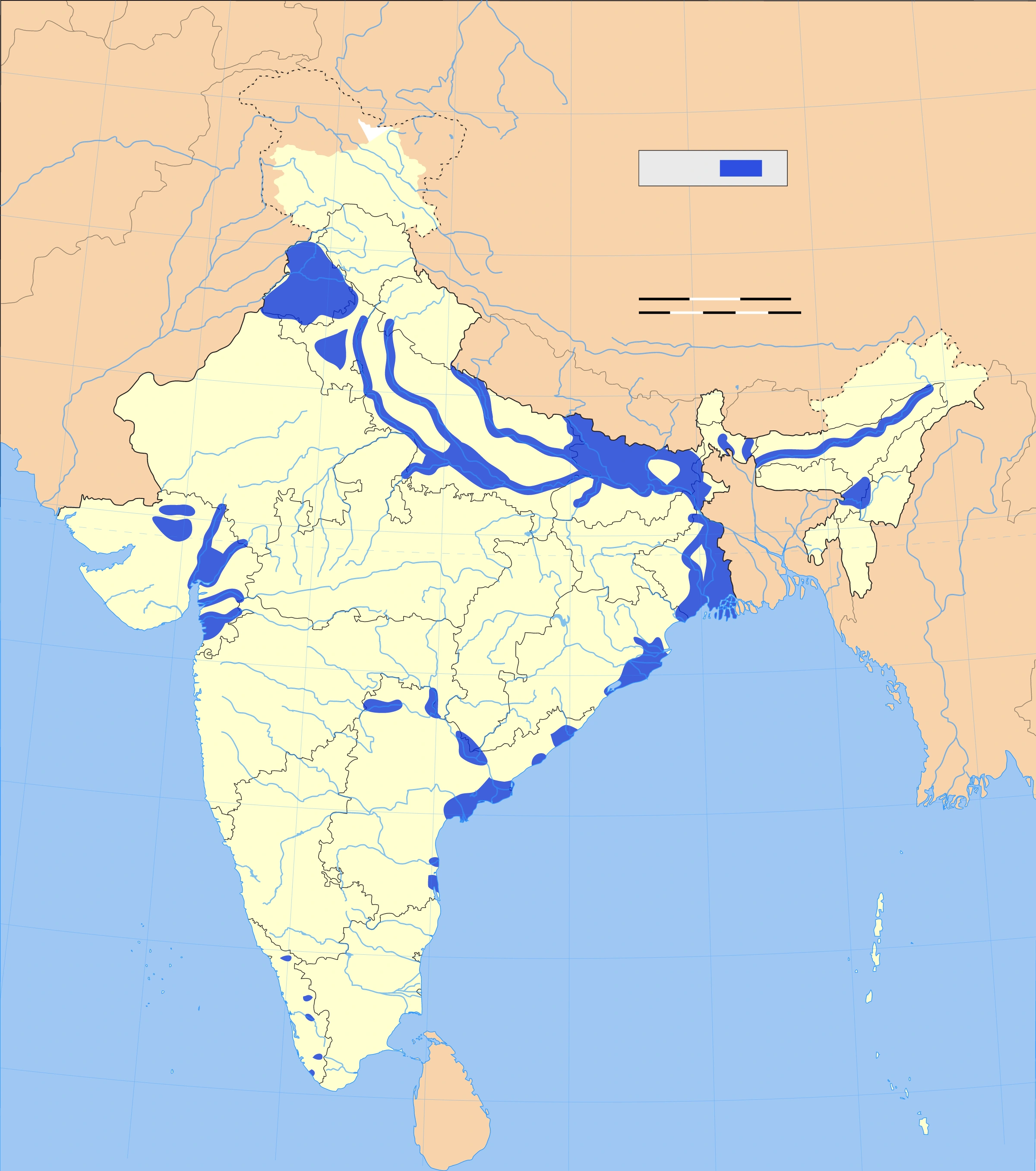
Map study
India flood-prone reference zones: relate plains to major river systems and monsoon rainfall. Not a live forecast or parcel-level risk map.
- Read the source legend and reference date before interpreting the map.
- Use spatial patterns to support topic revision; verify current official boundaries, designations and warnings separately.
Credit: Planemad · CC BY-SA 3.0 · sourceConverted to WebP on an opaque white background; proportionally resized without cropping. Original cartography and legend retained.
1. Meaning and place within disaster risk reduction
Disaster response refers to measures undertaken directly before, during or immediately after a disaster to save lives, reduce health impacts, ensure public safety and meet affected people’s basic subsistence needs. It includes warning dissemination, evacuation, search and rescue, emergency medical care, shelter, food, drinking water, sanitation and restoration of essential services. Its immediate objective is to stabilise the situation and prevent avoidable deaths and suffering.
Response differs from preparedness, which develops capabilities through planning, training, stockpiling and exercises. It also differs from mitigation, which reduces potential impacts through measures such as floodplain regulation or earthquake-resistant construction. These phases nevertheless overlap: an evacuation drill is preparedness, while evacuation following a cyclone warning is response. Temporary restoration of a damaged water supply may simultaneously support response and early recovery.
Response contributes to disaster risk reduction by preventing cascading losses. Rapid isolation of a damaged electricity network can prevent electrocution during floods; safe water provision can reduce disease transmission in crowded shelters. However, response cannot substitute for risk-sensitive development. Repeated rescue operations in encroached floodplains reveal unresolved exposure and vulnerability, rather than a sustainable risk-reduction strategy.
- Judge performance through outcomes such as timely assistance, preventable mortality and equitable access, not merely the number of personnel deployed.
- Use a multi-hazard approach because one event can trigger fires, chemical releases, landslides, infrastructure failures or disease risks.
2. Institutional responsibilities and command arrangements
India’s response system combines local action with state leadership and Union support. District administrations coordinate frontline operations with police, fire services, health departments, local bodies and line agencies. The District Disaster Management Authority, chaired by the District Magistrate, Collector or Deputy Commissioner, has statutory planning, coordination and implementation responsibilities. Panchayats and urban local bodies are especially important for identifying vulnerable households, managing shelters and maintaining local services.
At the state level, the government coordinates inter-district resources and requests additional assistance when necessary. The Ministry of Home Affairs is the principal Union-level coordinating ministry for disaster management, while ministries and technical agencies perform assigned functions. The National Disaster Management Authority provides policy and guidelines; it should not be confused with the operational National Disaster Response Force. State response forces, fire and emergency services, civil defence organisations and trained volunteers complement specialist national teams.
NDMA’s Incident Response System guidelines provide a structured arrangement for managing incidents. The Responsible Officer assigns command responsibilities, while an Incident Commander directs operations through appropriate operations, planning and logistics functions. Emergency Operations Centres support information management, resource mobilisation and inter-agency coordination. Clear authority, defined reporting relationships and manageable spans of control reduce duplication and prevent parallel command structures.
- Differentiate the National Disaster Response Force from the National Disaster Response Fund; both are commonly abbreviated as NDRF.
- Armed forces can provide vital transport, engineering, medical and rescue support when requisitioned, but civilian administration retains its disaster-management responsibilities.
Operational response sequence with continuous reassessment
- 1. Receive warning or incident report and verify available information
- 2. Activate command arrangements and Emergency Operations Centres
- 3. Disseminate actionable warnings, evacuate and mobilise resources
- 4. Conduct search and rescue, triage and emergency treatment
- 5. Assess needs and deliver inclusive relief
- 6. Restore critical services and transition to recovery
- 7. Review performance and incorporate lessons into preparedness
3. Operational sequence: warning, rescue and essential relief
Response begins with credible risk information translated into actionable instructions. Forecasting and monitoring agencies include the India Meteorological Department for cyclones and weather hazards, the Central Water Commission for flood forecasting, and the Indian National Centre for Ocean Information Services for tsunami warnings. Messages should state the threatened area, expected timing, likely impacts and required action. Sirens, mobile alerts, community radio, public announcements and volunteers provide redundancy when individual communication channels fail.
Evacuation requires safe routes, accessible transport, functioning shelters and arrangements for people needing assistance. Search and rescue must follow hazard-specific safety procedures: floodwater may conceal electrical hazards, while collapsed buildings may be structurally unstable. Incident information should guide the deployment of boats, specialist teams, medical personnel and equipment. Medical triage prioritises patients according to urgency and treatment needs, followed by stabilisation, referral and tracking.
Relief must address food, water, sanitation, hygiene, shelter, essential medicines and protection together. Rapid needs assessments should capture both visible damage and less visible deprivation, including interrupted medication, separated families and lost assistive devices. Restoring roads, telecommunications, electricity, hospitals and water systems enables other response activities. Dead-body management requires dignity, identification and appropriate public-health precautions; disaster deaths do not automatically imply an epidemic risk.
- Repeated situation reports should record affected locations, unmet needs, access constraints, available resources and emerging hazards.
- The first 72 hours are often operationally critical, but rescue possibilities and assistance needs must be assessed continuously rather than governed by a rigid cutoff.
| Function | Primary purpose | Example |
|---|---|---|
| Mitigation | Reduce potential disaster impacts | Retrofitting a hospital against earthquakes |
| Preparedness | Build readiness for effective action | Training rescue teams and conducting evacuation drills |
| Anticipatory response | Protect people before imminent impact | Evacuating coastal settlements after a cyclone warning |
| Immediate response | Save lives and meet urgent needs | Search and rescue, triage and emergency water supply |
| Early recovery | Restore basic functioning and reduce dependence on relief | Reopening schools and restoring local livelihoods |
4. Inclusive, ethical and accountable response
Equal relief packages do not necessarily produce equitable outcomes. Children, pregnant women, older persons, persons with disabilities, migrants and socially marginalised groups may face different barriers. Shelter planning should include accessible toilets, lighting, privacy, menstrual hygiene supplies, breastfeeding support and safe spaces for children. Information must be understandable across local languages and available through accessible formats, including audio and visual communication.
Response should protect dignity and avoid discrimination. Loss of identity documents should not obstruct urgent life-saving assistance. Relief registration, family tracing and beneficiary databases require safeguards against unnecessary disclosure of personal information. Transparent distribution criteria, public information boards and accessible grievance mechanisms reduce exclusion and diversion. Community participation also improves accuracy because residents often know isolated settlements, informal routes and households requiring support.
Volunteers and donations require coordination rather than spontaneous deployment into unsafe areas. Untrained rescuers can become casualties, while unsolicited supplies may congest transport and storage facilities. Authorities should communicate verified needs and assign safe tasks. Psychosocial first aid, reliable public communication and responder welfare are essential: trauma, exhaustion and misinformation can undermine both individual recovery and operational effectiveness.
- Apply the do-no-harm principle: avoid locating camps in hazard zones or creating unsafe sanitation and protection conditions.
- Provide for livestock and companion animals where feasible; fear of losing animals and livelihoods can discourage evacuation.
5. Capacity gaps, financing and transition to recovery
India faces uneven local capacity, difficult terrain, rapidly expanding cities and fragile infrastructure. Common response constraints include weak last-mile connectivity, incomplete resource inventories, incompatible communication systems and inadequate urban search-and-rescue capacity. Emergency plans may overlook informal settlements or compound events, such as flooding during a health emergency. These weaknesses require regular multi-agency exercises, pre-positioned supplies, mutual-aid arrangements and community-level training, including initiatives such as Aapda Mitra.
The State Disaster Response Fund is the principal state-level funding mechanism for immediate relief for notified disasters under applicable norms. The National Disaster Response Fund supplements state resources in disasters of a severe nature through prescribed procedures. Such assistance is not equivalent to full compensation for every loss. Effective financial management requires rapid release, documented expenditure, transparent procurement and audit without allowing paperwork to obstruct urgent action.
Response should transition into recovery through repeated needs assessments, restoration of public services and livelihood support. Temporary shelters need safe exit pathways towards durable housing; emergency repairs should not lock communities into unsafe reconstruction. After-action reviews should compare plans with actual performance and assign responsibility for corrective measures. Useful indicators include warning reach, evacuation coverage, rescue time, service downtime and unresolved complaints. Thus, effective response is both an immediate humanitarian obligation and a source of learning for future risk reduction.
- Strengthen local first responders because communities frequently act before external assistance arrives.
- Combine technology such as GIS and satellite imagery with ground verification; dashboards cannot replace reliable field information.
Real-world case studies
Cyclone Phailin, Odisha and Andhra Pradesh, 2013
Before Phailin made landfall near Gopalpur on 12 October 2013, authorities evacuated roughly one million people across threatened areas. Forecasting, cyclone shelters, community mobilisation and pre-positioned response teams helped limit deaths compared with the catastrophic Odisha super cyclone of 1999. The lesson is that successful response begins before impact and depends on sustained investments in preparedness.
Kerala floods, 2018
During the August 2018 floods, Kerala’s fishers used boats and local navigation skills to rescue stranded residents, working alongside official agencies and other volunteers. The episode demonstrated the operational value of community capabilities when roads and conventional access fail. It also underlined the need to integrate volunteers through communication, safety equipment, task allocation and recognition rather than relying on improvised coordination.
Previous year questions
No source-linked PYQ is available here yet. Use the practice questions below.
Practice questions
Practice MCQ 1
Which of the following most clearly constitutes disaster response rather than preparedness?
- A. Preparing a district resource inventory before the monsoon
- B. Conducting an annual mock evacuation exercise
- C. Moving coastal residents to shelters following an imminent cyclone warning
- D. Training volunteers in first aid during normal conditions
Practice MCQ 2
Consider the following statements: 1. The National Disaster Management Authority and the National Disaster Response Force have identical operational roles. 2. An Emergency Operations Centre supports information management and resource coordination. 3. Community volunteers can contribute to response before specialist teams arrive. Which statements are correct?
- A. 1 and 2 only
- B. 2 and 3 only
- C. 1 and 3 only
- D. 1, 2 and 3
Practice MCQ 3
Which approach best reflects the do-no-harm principle in emergency relief?
- A. Establishing camps wherever vacant land is available, irrespective of flood exposure
- B. Requiring replacement identity documents before providing urgent drinking water
- C. Distributing identical supplies without assessing differing household needs
- D. Assessing site safety, accessibility and protection risks before opening shelters
Mains practice · Effective disaster response is a test of governance rather than merely a rescue operation. Discuss with reference to coordination, inclusion and local capacity in India. Suggest measures to link response with long-term disaster risk reduction. Answer in 250 words.
- Define response and explain its overlap with preparedness and early recovery.
- Outline district and state leadership, Union support, specialist forces and Incident Response System arrangements.
- Discuss warning-to-action gaps, disrupted lifelines, fragmented information and uneven local capacity.
- Explain inclusive evacuation, accessible shelters, transparent relief and grievance redress.
- Use Phailin and Kerala’s fisher-led rescues as examples.
- Recommend trained local responders, interoperable communications, exercises and needs-based logistics.
- Conclude with after-action reviews and risk-sensitive restoration to prevent repeated vulnerability.
Further reading
- India Code: Disaster Management Act, 2005, as amended.
- National Disaster Management Authority: National Disaster Management Plan, 2019.
- National Disaster Management Authority: National Disaster Management Guidelines—Incident Response System, 2010.
- Ministry of Home Affairs, Disaster Management Division: Current SDRF and NDRF guidelines and assistance norms.
- UNDRR: Sendai Framework for Disaster Risk Reduction 2015–2030.
- Sphere Handbook, 2018: Humanitarian Charter and Minimum Standards in Humanitarian Response.
Preparing for UPSC Civil Services? Get classroom teaching, answer-writing evaluation and mentorship at Pragnya IAS Academy, Ashok Nagar — see why aspirants choose us for IAS coaching in Hyderabad.