
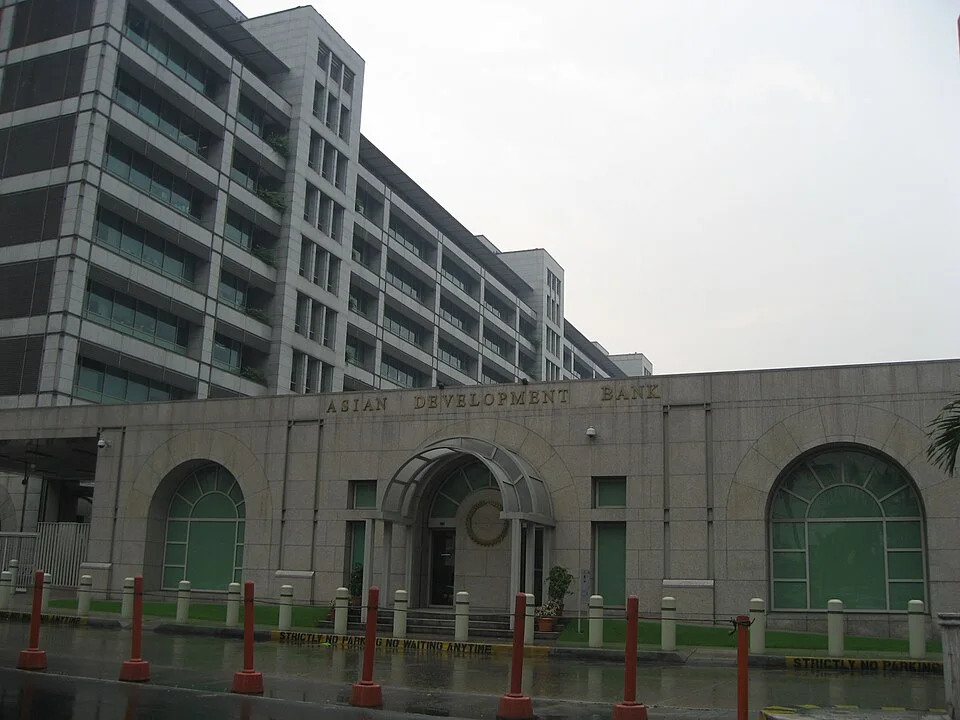
Asian Development Bank headquarters entrance in Metro Manila, Philippines, as identified in the source metadata.
Credit: Eugene Alvin Villar (seav) · CC BY-SA 4.0 · sourceResized and converted to WebP; uncropped.
1. Identity, mandate and place in the external sector
The Asian Development Bank is a treaty-based international financial institution created to foster economic growth and cooperation in Asia and the Pacific. Its establishment reflected the region’s need for long-term development finance, infrastructure and technical expertise. Although regional in focus, it is not restricted to Asian shareholders: non-regional developed countries also contribute capital and participate in governance.
ADB is a multilateral development bank, not a central bank, commercial bank or regional monetary authority. It does not issue a common currency or determine members’ monetary policies. Its central function is to mobilise and channel resources into development. Its operations cover transport, energy, water and sanitation, urban development, education, health, finance and public-sector management.
In international economics, ADB illustrates how multilateral institutions address financing gaps, cross-border externalities and development risks. Long-gestation infrastructure may be difficult to finance solely through private markets because of uncertain revenues, high initial costs or regulatory risks. ADB combines finance with project preparation, institutional capacity-building and policy advice. Its development objectives also encompass poverty reduction, climate resilience, gender equality and regional integration.
- Regional mandate does not mean exclusively regional membership.
- Development lending is distinct from the IMF’s primary role in macroeconomic stability and balance-of-payments support.
Timeline
1966
ADB established; India participates as a founding member.
1974
Asian Development Fund established.
1986
ADB begins lending operations in India.
2001
SASEC programme established with ADB support.
2017
ADF lending operations combined with Ordinary Capital Resources; ADF becomes grant-only.
2. Membership, ownership and governance
India joined ADB as a founding member in 1966. Other shareholders include developing regional economies, advanced regional economies and non-regional countries. Membership figures can change, so aspirants should verify the latest total from ADB’s official membership page rather than assume that an older textbook figure remains current.
The Board of Governors is ADB’s highest decision-making body. Each member appoints a governor and an alternate governor, usually drawn from senior government officials. The Board delegates much operational authority to the resident Board of Directors, which has 12 members: eight represent regional members and four represent non-regional members. The President chairs the Board of Directors and manages ADB’s business under its direction.
Voting is not based on one country, one vote. A member’s voting power combines basic votes with votes linked to its capital subscription. Consequently, shareholding matters for institutional influence, although capital shares and voting shares are not identical. Japan and the United States are the largest shareholders. India is an important shareholder as well as a major borrower, illustrating that ownership and borrowing are not mutually exclusive roles.
- ADB’s President is elected by the Board of Governors.
- ADB is not an ASEAN institution; its geographic scope is wider than Southeast Asia.
Simplified ADB project cycle
- 1. Country strategy and project identification
- 2. Preparation and feasibility assessment
- 3. Appraisal and due diligence
- 4. Approval and financing agreement
- 5. Implementation, procurement and disbursement
- 6. Completion review and evaluation
3. Resources, financing instruments and development safeguards
ADB’s Ordinary Capital Resources comprise resources supported by subscribed capital, reserves and borrowings. ADB raises substantial funds by issuing bonds in international capital markets. Shareholder backing and prudent financial management support its creditworthiness, allowing it to mobilise long-term resources for development. Paid-in capital is actually contributed; callable capital is a contingent shareholder commitment that can be called under specified conditions to meet ADB’s obligations.
ADB provides sovereign financing to governments and government-guaranteed entities, and nonsovereign financing without a sovereign guarantee, including support for private enterprises and eligible public entities. Its instruments include loans, grants, equity investments, guarantees and technical assistance. Project lending finances defined investments; policy-based lending supports agreed policy and institutional reforms. Guarantees and cofinancing can help mobilise additional public or private capital rather than replace it.
The Asian Development Fund originally financed both concessional loans and grants. From 1 January 2017, its lending operations were combined with the Ordinary Capital Resources balance sheet. ADF subsequently became a grant-only facility, while concessional lending is provided through Ordinary Capital Resources. Thus, identifying all concessional ADB loans as present-day ADF loans is incorrect.
Financing eligibility and terms depend on factors such as income, creditworthiness and debt-distress risk. Approval is not automatic: economic viability, procurement, financial management, environmental and social risks, and implementation capacity matter. Borrowers remain responsible for implementation under agreed arrangements. Foreign-currency loans can also expose borrowers to exchange-rate risk, while weak project design may create debt without adequate development returns.
- A concessional loan remains repayable; a grant generally does not require repayment.
- Technical assistance may finance feasibility studies, institutional reforms, training and project preparation.
| Institution | Headquarters | Principal orientation |
|---|---|---|
| ADB | Manila | Development in Asia and the Pacific |
| AIIB | Beijing | Infrastructure and sustainable development |
| New Development Bank | Shanghai | Infrastructure and sustainable development in emerging market and developing countries |
| IMF | Washington, D.C. | Monetary cooperation, surveillance and balance-of-payments assistance |
4. ADB and India
Although India was a founding member, ADB began lending operations in India in 1986. Its assistance has supported national and state-level priorities in transport connectivity, electricity transmission and distribution, renewable energy, urban services, industrial corridors and skills development. The Department of Economic Affairs, Ministry of Finance, is the principal government interface for India’s engagement with ADB.
ADB financing typically complements domestic budgetary resources rather than substituting for them. Projects may involve central ministries, state governments, utilities and specialised implementing agencies. The development contribution includes not only finance but also better project appraisal, procurement systems, monitoring and institutional capacity. However, land acquisition delays, resettlement concerns, implementation bottlenecks and cost overruns can reduce benefits.
ADB also supports regional cooperation through the South Asia Subregional Economic Cooperation programme, established in 2001. Its members are Bangladesh, Bhutan, India, Maldives, Myanmar, Nepal and Sri Lanka. SASEC promotes practical cooperation in transport, energy, trade facilitation and economic corridors. For India, improved border infrastructure and logistics can connect domestic production centres with neighbouring markets and lower trade costs.
- A regional connectivity project can create benefits beyond the territory of the borrowing country.
- Assess success through service quality, inclusion and economic returns, not merely loan commitments or kilometres constructed.
5. Current relevance and Prelims distinctions
ADB’s Strategy 2030 seeks a prosperous, inclusive, resilient and sustainable Asia and the Pacific while continuing efforts to eradicate extreme poverty. Its priorities include climate action, liveable cities, rural development and food security, governance, gender equality and regional cooperation. This broad agenda means ADB is neither exclusively an infrastructure lender nor solely an institution for poverty-focused grants.
Climate finance includes mitigation, such as clean energy, and adaptation, such as flood-resilient infrastructure and drought preparedness. Evaluation should consider additionality: whether ADB provides finance, expertise or risk-bearing capacity that would otherwise be unavailable on reasonable terms. Debt sustainability, transparent procurement and credible environmental and social protections remain important.
For Prelims, focus on institutional identity. ADB is headquartered in Manila, AIIB in Beijing, and the New Development Bank in Shanghai. ADB’s flagship economic publication is the Asian Development Outlook; the IMF publishes the World Economic Outlook. Membership in one development bank neither automatically confers membership in another nor prevents simultaneous participation in several institutions.
- ADB, AIIB and the New Development Bank are separate institutions with different founding agreements.
- Not every ADB-supported operation is a sovereign loan, and not every recipient qualifies for grants.
ADB: Regional Development Finance and India
The Asian Development Bank (ADB), established in 1966 and headquartered in Manila, is a multilateral development bank serving Asia and the Pacific. The headquarters image provides institutional context, not evidence of project outcomes. ADB mobilises capital and expertise for development through loans, grants, guarantees, equity investments and technical assistance. Its membership includes regional and non-regional economies: a regional mandate does not mean exclusively Asian membership. Voting power reflects a combination of basic votes and shareholding-linked votes, rather than equal voting power for every member.
India is a founding member and a borrower from ADB. Its engagement includes infrastructure, urban services, energy and other development priorities. Sovereign operations involve governments or government guarantees, while nonsovereign operations can support eligible private-sector entities without sovereign guarantees. For Mains, assess projects through development additionality, debt sustainability, procurement quality, environmental and social safeguards, and implementation capacity. Institutional presence or financing approval alone cannot establish successful delivery; that requires project-level evidence and evaluation.
- Financing windows: ordinary capital resources support regular lending and concessional lending; the Asian Development Fund provides grants to eligible poorer and vulnerable members. Do not equate all ADB assistance with concessional finance.
- Institutional distinction: ADB, AIIB and the New Development Bank are separate development banks. The IMF primarily addresses macroeconomic stability and balance-of-payments needs.
- External-sector link: foreign-currency borrowing can finance productive investment but creates repayment obligations and exchange-rate exposure; evaluate project returns alongside fiscal and external-debt risks.
Real-world case studies
Visakhapatnam–Chennai Industrial Corridor
In 2016, ADB approved $631 million in loans and grants for corridor development in Andhra Pradesh. Support combined infrastructure with policy and institutional reforms, illustrating how development finance can address industrial connectivity and the investment environment together.
India’s COVID-19 response
In April 2020, ADB approved a $1.5 billion loan to support India’s pandemic response, including disease containment and social protection. This demonstrates that its operations extend beyond conventional infrastructure projects.
Previous year questions
No source-linked PYQ is available here yet. Use the practice questions below.
Practice questions
Practice MCQ 1
Consider the following statements about ADB: 1. India is a founding member. 2. Membership is confined to Asia and the Pacific. 3. Its headquarters is in Manila. Which statements are correct?
- A. 1 and 2 only
- B. 2 and 3 only
- C. 1 and 3 only
- D. 1, 2 and 3
Practice MCQ 2
Following the restructuring effective in 2017, which statement correctly describes ADB’s financing arrangements?
- A. ADF provides only market-rate loans.
- B. ADF is grant-only, while concessional lending is provided through Ordinary Capital Resources.
- C. Ordinary Capital Resources cannot finance concessional lending.
- D. All ADB assistance is provided as grants.
Practice MCQ 3
Consider the following: 1. Sovereign loans 2. Equity investments 3. Guarantees 4. Technical assistance. Which can ADB provide?
- A. 1 and 4 only
- B. 1, 2 and 3 only
- C. 2 and 4 only
- D. 1, 2, 3 and 4
Mains practice · How does ADB contribute to India’s development and regional integration? Discuss the safeguards needed to maximise the benefits of multilateral development finance. Answer in 250 words.
- Explain long-term finance, technical expertise and mobilisation of additional capital.
- Discuss infrastructure, urban services, climate resilience and SASEC connectivity.
- Use the Visakhapatnam–Chennai Industrial Corridor as an example.
- Assess debt sustainability, exchange-rate exposure and implementation capacity.
- Recommend transparent procurement, environmental and social protections, and outcome-based evaluation.
Further reading
- ADB official website: About ADB, Members and the Agreement Establishing ADB.
- ADB official website: Asian Development Fund and Ordinary Capital Resources.
- ADB: Asian Development Outlook and latest Annual Report.
- ADB: Strategy 2030 and India Country Partnership Strategy, 2023–2027.
- Department of Economic Affairs, Ministry of Finance: Annual Report, multilateral institutions coverage.
- SASEC official website: Programme overview and member countries.
- https://commons.wikimedia.org/wiki/File:Asian_Development_Bank_headquarters.jpg
Preparing for UPSC Civil Services? Get classroom teaching, answer-writing evaluation and mentorship at Pragnya IAS Academy, Ashok Nagar — see why aspirants choose us for IAS coaching in Hyderabad.