

The World Bank
Credit: Shiny Things · CC BY 2.0 · source

Mount Washington Hotel, Bretton Woods, New Hampshire.
Credit: King of Hearts · CC BY-SA 4.0 · source
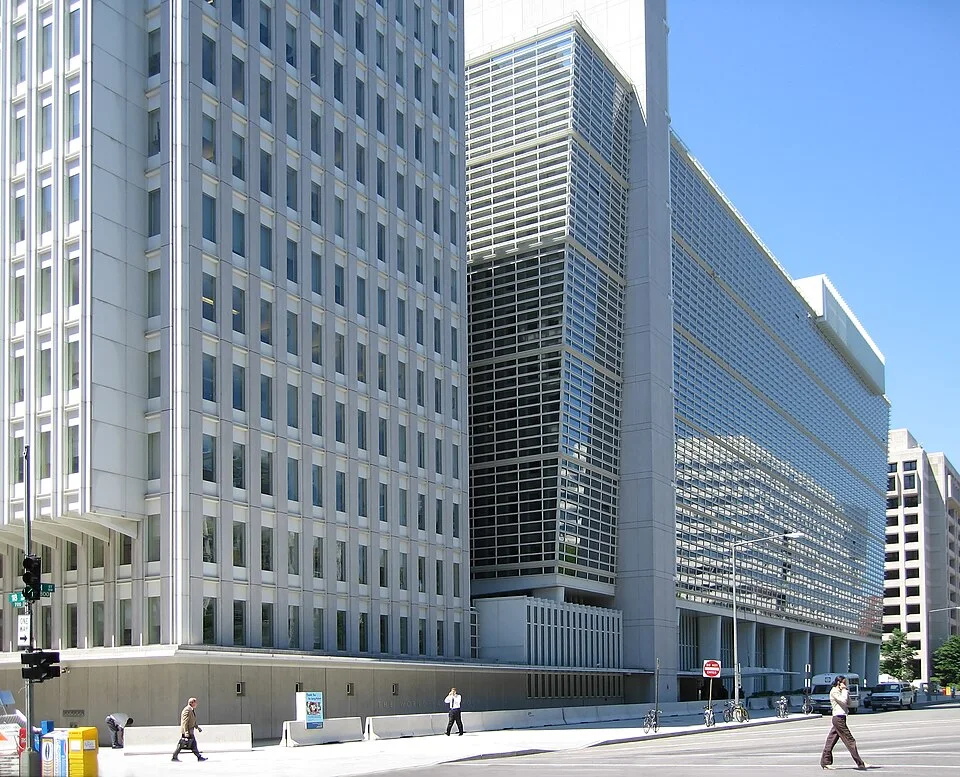
World Bank building in Washington, DC; institutional context for development lending.
Credit: Shiny Things · CC BY 2.0 · sourceResized and converted to WebP; uncropped.
1. Origins, mandate and governance
The International Bank for Reconstruction and Development emerged from the United Nations Monetary and Financial Conference held at Bretton Woods, New Hampshire, in July 1944. Its Articles of Agreement became effective on 27 December 1945, and operations began in 1946. Initially associated with post-war reconstruction, the institution progressively concentrated on development in poorer countries. Its first loan, approved in 1947, was to France. It is a specialised agency within the United Nations system, but has its own governance and financial structure.
The World Bank’s stated mission is to end extreme poverty and boost shared prosperity on a liveable planet. Its activities cover infrastructure, education, health, agriculture, public administration, social protection and environmental sustainability. Development finance is supplemented by analytical work, technical assistance and support for institutional reform. Unlike a commercial bank, it does not accept deposits from the general public or operate ordinary retail banking services.
The Board of Governors, normally comprising member countries’ finance ministers or equivalent officials, is the highest governing authority. Executive Directors oversee general operations and approve financing. Voting power is weighted, reflecting shareholding and basic votes, rather than being based on one country, one vote. The President chairs the Executive Directors and heads management. The longstanding practice of an American heading the Bank is a convention, not a treaty requirement.
Timeline
1944–1947
Bretton Woods Conference establishes the institutional framework; IBRD Articles become effective in 1945, operations begin in 1946, and the first loan is approved in 1947.
1956
IFC is established to support private-sector development.
1960
IDA is established to provide concessional development finance.
1966
The ICSID Convention enters into force.
1988
MIGA is established.
2021–2024
Doing Business is discontinued in 2021; the first Business Ready report appears in 2024.
2. World Bank and World Bank Group: institutional distinctions
The World Bank consists of two institutions: IBRD and IDA. IBRD lends mainly to middle-income countries and creditworthy low-income countries. It raises much of its lending resources by issuing bonds in international capital markets. Member-country capital subscriptions, reserves and financial strength support its borrowing capacity. IBRD loans are generally non-concessional relative to IDA credits, although their maturity, pricing and associated expertise can offer advantages over alternative borrowing.
The International Development Association, established in 1960, provides concessional credits and grants to eligible poorer countries. Eligibility depends principally on income and creditworthiness, not simply geographical location. Some countries qualify for both IDA and IBRD financing and are termed blend countries. IDA resources come from periodic replenishments by development partners, repayments, internal transfers and capital-market borrowing. Therefore, describing IDA as financed exclusively by rich-country donations is incorrect.
The wider World Bank Group also includes the International Finance Corporation, the Multilateral Investment Guarantee Agency and the International Centre for Settlement of Investment Disputes. IFC supports private-sector development through loans, equity and other instruments, usually without sovereign guarantees. MIGA principally provides political-risk insurance and credit enhancement to encourage cross-border investment. ICSID provides facilities for investment dispute conciliation and arbitration; it is neither a lending institution nor an automatic appellate court over domestic judgments. Membership of one Group institution does not automatically confer membership of all five.
Typical investment project cycle
- 1. Identify development needs and project objectives
- 2. Borrower prepares the project and supporting assessments
- 3. Bank appraises feasibility, risks and implementation arrangements
- 4. Negotiate financing and obtain Board approval
- 5. Implement, disburse and supervise
- 6. Complete the project and evaluate results
3. Financing instruments and the project cycle
Investment Project Financing supports specified activities such as transport systems, water supply, schools and institutional capacity. Development Policy Financing supplies budget support for policy and institutional reforms, subject to agreed prior actions and an adequate macroeconomic policy framework. Program-for-Results links disbursement to the achievement of agreed results and uses a country’s programme systems. These instruments should not be treated as interchangeable: they differ in their expenditure focus, disbursement conditions and implementation arrangements.
A typical project moves through identification, preparation, appraisal, approval, implementation and evaluation. The borrowing government normally prepares and implements the project, while the Bank assesses feasibility, fiduciary arrangements and environmental and social risks. Procurement is undertaken under applicable rules, not automatically awarded to companies from donor countries. Loans must generally be repaid; a World Bank-supported project is not necessarily grant-funded.
World Bank commitments, disbursements and outstanding debt are different concepts. A commitment is approved financing; disbursement is the actual release of funds; outstanding debt is the amount owed at a point in time. Borrowers must consider debt sustainability, exchange-rate exposure and the economic returns from projects. Environmental and social safeguards address issues including displacement, biodiversity and labour conditions. The Inspection Panel provides an avenue for eligible affected people to raise concerns about harm linked to non-compliance with Bank policies.
| Institution | Principal role | Key distinction |
|---|---|---|
| IBRD | Development loans, guarantees and advice | Middle-income and creditworthy low-income borrowers |
| IDA | Concessional credits and grants | Eligible poorer countries |
| IFC | Private-sector loans, equity and advisory services | Usually operates without sovereign guarantees |
| MIGA | Political-risk insurance and credit enhancement | Facilitates cross-border investment |
| ICSID | Investment dispute conciliation and arbitration | Does not provide development loans |
4. India’s engagement and development relevance
India is a founding member of IBRD and joined IDA at its establishment. Its first World Bank loan, approved in 1949, supported railway rehabilitation. India subsequently became a major recipient of development finance for irrigation, power, transport, livelihoods, health and education. India graduated from regular IDA eligibility at the end of the Bank’s 2014 fiscal year and received transitional support thereafter. It continues to engage substantially with IBRD, IFC and MIGA, but is not a contracting state to the ICSID Convention.
World Bank assistance can supplement domestic savings, provide long-maturity funding and introduce technical knowledge or stronger project-management practices. For India, these benefits must be balanced against repayment obligations, exchange-rate risk and the suitability of reform prescriptions to local conditions. State-level projects often involve the Union government in the external borrowing framework. World Bank finance is not foreign direct investment merely because it originates outside India.
Criticism of the institution centres on unequal voting influence, policy conditionality, displacement and environmental impacts, and the adequacy of accountability mechanisms. Supporters emphasise its ability to mobilise finance, generate comparable development data and support countries facing overlapping development and climate challenges. A balanced assessment distinguishes the institution’s mandate from the outcomes of individual projects.
5. Reports, IMF comparison and Prelims traps
The World Development Report examines a major development theme each year. Global Economic Prospects analyses the global outlook and implications for developing economies. World Development Indicators is an important development database. The World Bank also publishes the Logistics Performance Index. By contrast, World Economic Outlook and Global Financial Stability Report belong to the IMF, while the Human Development Report is published by UNDP.
The World Bank discontinued Doing Business in September 2021 after data irregularities raised concerns about its integrity. Business Ready, or B-READY, launched its first report in 2024, assessing the business environment through regulatory frameworks, public services and operational efficiency. Its methodology differs from Doing Business, so their rankings and scores should not be treated as a continuous comparable series.
The IMF primarily promotes international monetary cooperation and macroeconomic stability, conducts surveillance and provides balance-of-payments financing. The World Bank primarily finances long-term development and poverty reduction. This distinction is not absolute: both may support reforms and respond to crises. Special Drawing Rights are created and allocated by the IMF, not the World Bank. World Bank loans are not SDR allocations, and the Bank does not set national exchange rates.
World Bank: Institutional Structure and India’s Engagement
The building identified in the metadata provides an institutional reference for the World Bank, headquartered in Washington, D.C. The World Bank comprises two institutions: the International Bank for Reconstruction and Development (IBRD), which lends mainly to middle-income and creditworthy lower-income countries, and the International Development Association (IDA), which provides concessional credits and grants to eligible poorer countries. Their common development mandate should not obscure differences in eligibility, financing terms and funding arrangements.
The wider World Bank Group also includes the International Finance Corporation (IFC), the Multilateral Investment Guarantee Agency (MIGA) and the International Centre for Settlement of Investment Disputes (ICSID). These respectively support private-sector development, provide political-risk insurance and credit enhancement, and facilitate investment-dispute settlement. India’s engagement includes IBRD financing, technical assistance and analytical work across development sectors; India previously received IDA assistance. For Mains, assess such engagement through development outcomes, debt sustainability, safeguards and country ownership. A headquarters image establishes none of these outcomes; evaluation requires project documents and independent evidence.
- World Bank versus IMF: development finance is the Bank’s central mandate; the IMF focuses on monetary cooperation, surveillance and balance-of-payments support. Both can attach policy conditions to financing.
- Membership distinction: India belongs to IBRD, IDA, IFC and MIGA, but is not a contracting state to the ICSID Convention.
- Reports and instruments: the World Development Report is a World Bank publication. Project financing differs from development policy financing, which supports agreed policy and institutional reforms.
Real-world case studies
India: Swachh Bharat Mission Support Operation
In December 2015, the World Bank approved a US$1.5 billion operation supporting the rural Swachh Bharat Mission. It used Program-for-Results financing, linking disbursement to verified results concerning sanitation outcomes and institutional performance. It illustrates the difference between results-based financing and reimbursement solely for individual construction inputs.
India: Sardar Sarovar controversy
World Bank support for the Sardar Sarovar project became controversial over displacement, rehabilitation and environmental concerns. An independent review published in 1992 identified serious shortcomings. In 1993, India requested cancellation of the undisbursed balance. The episode illustrates why development projects require social safeguards, credible consultation and accountability.
Previous year questions
No source-linked PYQ is available here yet. Use the practice questions below.
Practice questions
Practice MCQ 1
Which of the following constitute the World Bank in the strict institutional sense?
- A. IBRD and IDA
- B. IBRD and IFC
- C. IDA and IMF
- D. All five World Bank Group institutions
Practice MCQ 2
Consider the following statements: 1. IFC can invest in private enterprises through equity. 2. MIGA provides political-risk insurance. 3. ICSID provides concessional loans to low-income countries. Which statements are correct?
- A. 1 only
- B. 1 and 2 only
- C. 2 and 3 only
- D. 1, 2 and 3
Practice MCQ 3
Consider the following statements: 1. World Development Report is published by the World Bank. 2. Special Drawing Rights are allocated by the World Bank. 3. Doing Business was discontinued in 2021. Which statements are correct?
- A. 1 and 2 only
- B. 2 only
- C. 1 and 3 only
- D. 1, 2 and 3
Mains practice · Explain the role of the World Bank in development financing. Assess the opportunities and concerns associated with its engagement with India. Answer in 250 words.
- Distinguish the World Bank from the wider World Bank Group.
- Explain investment finance, policy financing, results-based financing and knowledge assistance.
- Discuss infrastructure, human capital, institutional capacity and mobilisation of private investment.
- Use the Swachh Bharat operation and Sardar Sarovar experience as contrasting examples.
- Examine debt sustainability, exchange-rate exposure, conditionality and environmental and social risks.
- Conclude with country ownership, stronger safeguards and more representative governance.
Further reading
- NCERT, Introductory Macroeconomics: Open Economy Macroeconomics.
- World Bank official website: Who We Are; IBRD; IDA; Products and Services.
- World Bank Annual Report and World Development Report.
- World Bank official Business Ready website.
- IFC, MIGA and ICSID official websites.
- Department of Economic Affairs, Ministry of Finance, Government of India: Annual Report.
- https://commons.wikimedia.org/wiki/File:World_Bank_building_at_Washington.jpg
Preparing for UPSC Civil Services? Get classroom teaching, answer-writing evaluation and mentorship at Pragnya IAS Academy, Ashok Nagar — see why aspirants choose us for IAS coaching in Hyderabad.