
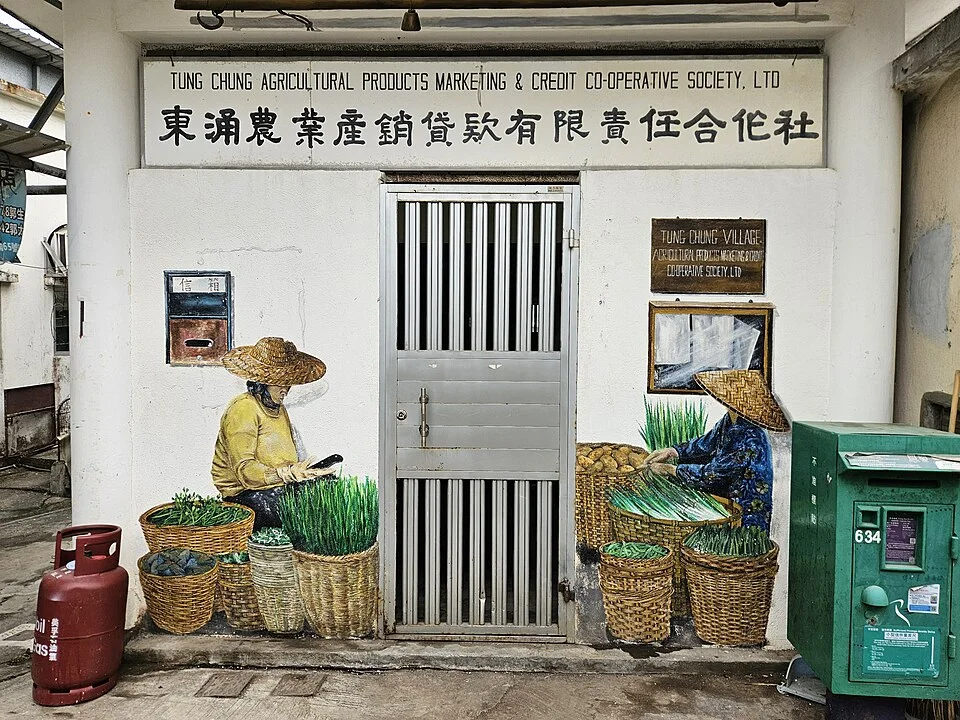
Tung Chung agricultural marketing and credit cooperative, Hong Kong: a comparative example, not Indian evidence.
Credit: 姒姓賢寧 · CC BY 4.0 · sourceResized and converted to WebP; uncropped.
1. Economic role and classification of agricultural credit
Agriculture has a pronounced time gap between expenditure and receipts. Farmers purchase seeds, fertilisers, feed and labour services before harvesting crops or selling livestock products. Credit bridges this seasonal gap and enables investment in irrigation, machinery, orchards and storage. Affordable borrowing can prevent distress sales immediately after harvest, when prices may be low. However, agricultural credit is a repayable liability, not a substitute for remunerative prices, irrigation or risk management.
Production credit generally finances recurring working-capital requirements, such as cultivation expenses and animal feed. Investment credit creates productive assets whose returns accrue over several years, including tractors, wells, dairy sheds and plantations. Short-term loans normally cover a crop or operating cycle, while medium- and long-term loans support investments with longer repayment periods. Exact maturity classifications vary across institutions and products; the central principle is matching repayment to the activity’s cash flow.
A farmer may also need funds for household consumption, health emergencies or social obligations. If formal finance covers only narrowly defined production needs, the household may still depend on moneylenders. Consequently, access to a bank account alone does not establish adequate financial inclusion. The amount, timing, repayment schedule and transaction costs of credit are equally important.
- Working capital: seeds, fertilisers, pesticides, hired labour and feed.
- Fixed capital: irrigation systems, farm machinery, livestock structures and storage facilities.
- Creditworthiness concerns repayment capacity; collateral is security available to the lender. The two are related but not identical.
Timeline
1969
Nationalisation of 14 major commercial banks accelerated the policy emphasis on rural banking and directed credit.
1975–1976
The first RRBs began operations in 1975; the Regional Rural Banks Act followed in 1976.
1982
NABARD was established on 12 July.
1992
NABARD launched the SHG–Bank Linkage Programme as a pilot.
1998
The Kisan Credit Card scheme was introduced.
1 January 2025
The enhanced ₹2 lakh collateral-free agricultural loan limit became effective.
2. Institutional architecture and sources
Institutional sources include commercial banks, Regional Rural Banks and cooperative credit institutions. Commercial banks provide both crop loans and investment finance and account for the largest share of formal agricultural credit disbursement. RRBs combine a rural development mandate with banking services; their ownership structure involves the Union government, the concerned State government and a sponsor bank. Non-institutional sources include moneylenders, traders, commission agents, landlords, relatives and friends.
The short-term cooperative credit structure commonly comprises State Cooperative Banks at the State level, District Central Cooperative Banks at the district level and Primary Agricultural Credit Societies at the village or local level. Some States have a two-tier structure. PACS are member-based cooperative societies, not equivalent to RBI-licensed commercial banks. Their legal position, governance arrangements and banking functions should not be confused with those of cooperative banks. Long-term cooperative credit institutions, where operational, support investment-oriented lending.
NABARD was established in 1982 under the NABARD Act, 1981. It provides refinance, development support and institutional strengthening rather than functioning as an ordinary retail crop-loan bank. Refinance supplies eligible lending institutions with funds against qualifying lending operations. NABARD also undertakes statutory inspection of RRBs and rural cooperative banks within the applicable regulatory framework. Its Rural Infrastructure Development Fund, operational since 1995–96, finances eligible rural infrastructure projects, principally through State governments and related entities.
Informal lenders remain important because they offer speed, proximity and flexible documentation. Their disadvantages can include high interest, opaque accounts and tied transactions requiring farmers to sell produce to the lender. Formalisation therefore requires convenient services, not merely additional branches.
- RBI: banking regulation, monetary policy and priority sector lending directions.
- NABARD: refinance, rural development, supervision-related functions and institutional capacity building.
- PACS: local cooperative credit access; performance varies considerably across States.
Typical crop-credit cycle
- 1. Assess cultivated area, cropping pattern and scale of finance
- 2. Verify eligibility and appraise repayment capacity
- 3. Sanction a crop loan or KCC limit
- 4. Disburse funds according to seasonal requirements
- 5. Use funds for eligible farm operations
- 6. Repay from farm receipts and review the limit
3. Priority sector lending and major credit instruments
Priority sector lending directs a prescribed share of bank lending towards specified sectors. For domestic commercial banks, the overall target is generally 40% of adjusted net bank credit or credit-equivalent off-balance-sheet exposure, whichever is higher. Agriculture has an 18% target, including a 10% sub-target for small and marginal farmers. Bank-category-specific rules matter: RRBs and small finance banks have different overall priority sector targets. Agricultural priority sector lending covers eligible farm credit, agricultural infrastructure and ancillary activities, not only crop loans.
The Kisan Credit Card scheme, introduced in 1998, provides a revolving credit facility rather than requiring a fresh loan application for every input purchase. Limits consider cropping patterns, area cultivated, the district-level scale of finance and eligible additional requirements. The scheme includes provision for post-harvest expenses, household consumption needs and maintenance of farm assets within its design. Eligibility extends beyond individual landowners to eligible tenant farmers, oral lessees, sharecroppers and farmer groups, although proving cultivation rights remains a practical obstacle. KCC coverage was extended to working-capital needs of animal husbandry and fisheries in 2019.
Interest subvention reduces the effective borrowing cost on eligible short-term agricultural loans. Under the Modified Interest Subvention Scheme terms for 2024–25, eligible short-term crop loans up to ₹3 lakh carried a 7% interest rate, with an additional 3% prompt repayment incentive reducing the effective rate to 4% for timely repayment. These figures are scheme-year-specific: aspirants should distinguish an announced Budget enhancement from the operational limit subsequently notified.
RBI increased the collateral-free agricultural loan limit to ₹2 lakh per borrower from 1 January 2025, including loans for allied activities. This means waiver of collateral and margin requirements within the prescribed limit; it does not make the loan interest-free or remove repayment obligations.
- Priority sector status does not automatically imply an interest subsidy.
- KCC is a credit facility, not a grant or crop insurance policy.
- A marginal farmer generally holds up to 1 hectare; a small farmer holds more than 1 hectare and up to 2 hectares.
| Instrument | Main function | Important distinction |
|---|---|---|
| Kisan Credit Card | Flexible access to eligible agricultural credit | Credit facility, not an income transfer |
| Interest subvention | Reduces eligible borrowers’ interest cost | Does not cancel principal repayment |
| Credit guarantee | Covers specified lender losses under scheme conditions | Does not automatically discharge the borrower |
| Loan restructuring | Changes repayment terms to address stress | Different from waiver of debt |
| NABARD refinance | Supports eligible lending institutions | Different from a farmer’s retail loan |
4. Inclusion gaps, indebtedness and credit risk
Agricultural lending faces correlated risks: drought, floods, pest attacks or a price collapse may affect many borrowers simultaneously. Seasonal income and limited financial records complicate appraisal. Small loans also involve relatively high servicing costs. Banks may therefore prefer established customers with clear land titles, potentially excluding tenants, women cultivators, tribal farmers and farmers with fragmented holdings.
The NSO Situation Assessment Survey of Agricultural Households for 2019, conducted in its 77th Round, estimated that 50.2% of agricultural households were indebted, with average outstanding debt of ₹74,121 per agricultural household. These figures cover agricultural households as defined by the survey and should not be interpreted as applying to every rural household. Aggregate agricultural credit growth can coexist with unequal access across regions, farm sizes and activities.
Loan waivers may provide immediate relief to eligible borrowers, but impose fiscal costs and can weaken repayment incentives if repeatedly anticipated. They often exclude borrowers dependent on informal lenders. Rescheduling or restructuring after notified natural calamities addresses repayment timing, whereas a waiver extinguishes specified eligible dues. Neither measure alone resolves low productivity, volatile prices or inadequate non-farm employment.
- Examine credit quality and distribution, not only total disbursement.
- Distinguish fresh lending from renewals and short-term production finance from investment finance.
- Crop insurance can support repayment capacity after covered losses, but does not guarantee settlement of every loan.
5. Reform priorities and examination approach
Joint Liability Groups enable small groups of borrowers to access loans through mutual guarantees and are particularly relevant to tenants and cultivators lacking conventional collateral. Self-Help Groups combine savings, internal lending and bank linkage. Farmer Producer Organisations can improve access to inputs, markets and institutional finance, although weak governance or uncertain cash flows can constrain their borrowing.
Digitised land records, reliable cultivation records, PACS computerisation and consent-based financial data can reduce processing delays and duplicate lending. However, digital systems must allow corrections, protect personal data and accommodate tenants whose names do not appear in ownership records. A sound reform strategy combines inclusive lending with extension services, irrigation, storage, insurance and stronger markets. For Prelims, identify the institution, eligible borrower, lending purpose and whether a provision concerns a target, subsidy, guarantee or collateral exemption.
- Match repayment schedules to crop and livestock cash flows.
- Expand viable investment finance alongside seasonal crop loans.
- Strengthen grievance redressal, transparent pricing and financial literacy.
Cooperative credit and agricultural marketing
The supplied metadata identifies an agricultural products marketing and credit cooperative in Tung Chung, Hong Kong. It offers a comparative reference for studying how cooperative institutions can connect farm finance with the sale of produce. Cultivators typically incur expenses before receiving harvest income; credit bridges this timing gap, while marketing arrangements can support collective bargaining and repayment through sale proceeds. However, the institution’s name alone does not establish its lending practices, membership, financial performance or benefits to farmers.
In India, cooperative institutions form one channel of agricultural credit alongside commercial banks and regional rural banks. The short-term cooperative credit structure generally comprises State Cooperative Banks, District Central Cooperative Banks and Primary Agricultural Credit Societies, although arrangements vary across states. PACS operate at the grassroots and are distinct from commercial bank branches. Connecting credit with input supply, storage and marketing can improve financing continuity, but does not automatically ensure affordable loans or remunerative prices. Tenant farmers and sharecroppers may face access barriers because cultivation rights and documentation do not always align with ownership records.
- Distinguish functions: marketing facilitates produce sales; credit finances expenditure. Combining them does not eliminate production or price risk.
- NABARD supports agricultural finance through refinance and development functions; it is not the routine retail crop-loan counter for individual farmers.
- For Mains, assess timeliness, effective borrowing cost and inclusion—not merely loan volumes. This overseas example cannot demonstrate outcomes within India’s cooperative credit system.
Real-world case studies
India: SHG–Bank Linkage Programme
Initiated by NABARD in 1992, the programme links savings-based groups, predominantly of women, with formal banks. Group records and collective discipline help overcome limited conventional collateral. It demonstrates how relationship-based finance can serve rural households, although SHG lending is not exclusively agricultural credit.
Andhra Pradesh: recognising tenant cultivators
The Andhra Pradesh Crop Cultivator Rights Act, 2019 provides for Crop Cultivator Rights Cards through agreements between landowners and cultivators while protecting ownership rights. The approach seeks to improve cultivators’ access to benefits, including crop loans. Its practical effectiveness depends on landowner participation, documentation and lender acceptance.
Previous year questions
No source-linked PYQ is available here yet. Use the practice questions below.
Practice questions
Practice MCQ 1
Consider the following statements: 1. A Kisan Credit Card is a grant that need not be repaid. 2. Eligible tenant farmers and sharecroppers can be covered under the KCC scheme. 3. KCC facilities can cover eligible working-capital requirements of animal husbandry and fisheries. Which statements are correct?
- A. 1 and 2 only
- B. 2 and 3 only
- C. 1 and 3 only
- D. 1, 2 and 3
Practice MCQ 2
For domestic commercial banks, the 10% priority sector sub-target for small and marginal farmers is calculated with reference to:
- A. Total agricultural lending alone
- B. Total deposits of rural branches
- C. Adjusted net bank credit or credit-equivalent off-balance-sheet exposure, whichever is higher
- D. The bank’s annual profit
Practice MCQ 3
Which of the following correctly distinguishes agricultural credit measures?
- A. Interest subvention cancels the principal amount of a loan.
- B. Collateral-free lending removes the borrower’s repayment obligation.
- C. Refinancing necessarily involves NABARD directly issuing crop loans to individual farmers.
- D. Restructuring can alter repayment terms without waiving the underlying debt.
Mains practice · Expansion of institutional agricultural credit does not necessarily ensure equitable access or sustainable farm incomes. Discuss and suggest reforms. (250 words)
- Explain the seasonal working-capital and long-term investment needs of agriculture.
- Outline commercial banks, RRBs, cooperatives, NABARD and KCC.
- Discuss regional disparities and exclusion of tenants, women and small cultivators.
- Differentiate credit availability from farm profitability and repayment capacity.
- Assess the limitations of repeated loan waivers.
- Recommend JLGs, cultivation records, better appraisal, investment finance and safeguards in digitisation.
- Integrate credit reform with insurance, irrigation, extension and market access.
Further reading
- NCERT, Indian Economic Development: Rural Development.
- RBI, Priority Sector Lending: Targets and Classification, applicable Master Directions.
- RBI, Kisan Credit Card Scheme guidelines.
- RBI, December 2024 circular on enhancement of the collateral-free agricultural loan limit.
- NABARD, Annual Report and Status of Microfinance in India.
- NSO, Situation Assessment of Agricultural Households and Land and Livestock Holdings of Households in Rural India, 2019.
- Union Budget and Department of Financial Services notifications on agricultural credit and interest subvention.
- https://commons.wikimedia.org/wiki/File:Tung_Chung_Agricultural_Products_Marketing_%26_Credit_Cooperative_Society.Ltd_in_February_2026.jpg
Preparing for UPSC Civil Services? Get classroom teaching, answer-writing evaluation and mentorship at Pragnya IAS Academy, Ashok Nagar — see why aspirants choose us for IAS coaching in Hyderabad.