
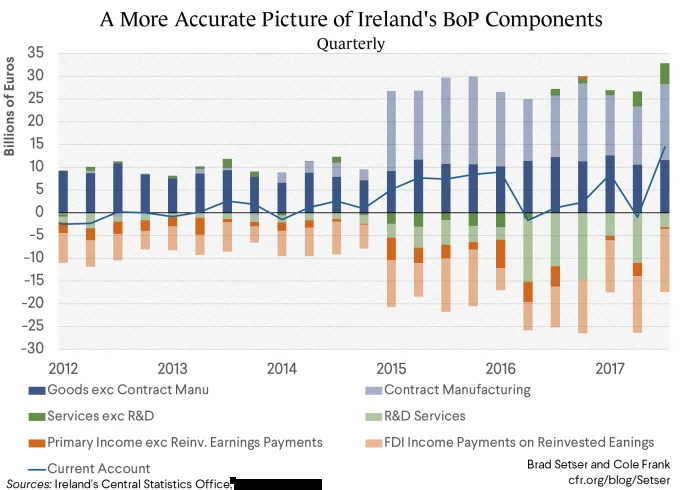
Ireland’s balance-of-payments components, 2012–2017: a comparative example of multinational restructuring effects.
Credit: Brad Setser and Cole Frank cc-by-sa 4.0 (see the bottom of the article, the author fixed this for Wikipedia) · CC BY-SA 4.0 · sourceResized and converted to WebP; uncropped.
1. Meaning, coverage and accounting principles
The Balance of Payments, or BoP, records economic transactions between residents and non-residents over a period, usually a quarter or year. The Reserve Bank of India compiles India’s BoP using internationally accepted statistical principles. A resident is an institutional unit whose centre of predominant economic interest lies within the economy. A presence of one year or more is a useful operational guideline, subject to exceptions. Nationality alone does not determine residence.
Coverage extends beyond exports and imports to investment income, remittances, borrowing, investment and reserve transactions. Most entries involve exchanges, but transfers without a direct economic return are also recorded. International transactions can occur in rupees as well as foreign currencies. Therefore, BoP should not be understood merely as a statement of foreign exchange receipts and payments.
Double-entry bookkeeping gives each transaction corresponding entries of equal value. For example, an export financed through trade credit creates an export receipt and a financial claim on a non-resident. The complete accounts balance conceptually; statistical discrepancies appear as net errors and omissions. An overall surplus or deficit refers to a selected analytical balance before its financing, not to a failure of the accounting identity.
- Exports and income receivable are current-account credits; imports and income payable are debits.
- BoP measures flows during a period, while the International Investment Position measures external financial assets and liabilities at a date.
2. Current account: trade, services, income and transfers
The current account has four principal components. Goods cover merchandise exports and imports, generally valued on a free-on-board basis in BoP statistics. Services include transport, travel, insurance, financial services, telecommunications and computer services. The merchandise trade balance is narrower than the current account balance. Consequently, a country with a goods trade deficit can still achieve a current account surplus through services and other receipts.
Primary income includes compensation of employees and investment income such as interest, dividends and reinvested earnings. Secondary income comprises current transfers, including personal transfers between resident and non-resident households. Transfers from Indians settled abroad to households in India generally enter secondary income; the precise classification of workers’ receipts depends on residence and employment arrangements. India’s invisibles conventionally encompass services, income and transfers.
A current account deficit, or CAD, means that current-account debits exceed credits. In macroeconomic terms, the current account balance equals national saving minus domestic investment. A deficit can therefore reflect productive investment exceeding domestic saving rather than merely excessive consumption. Its sustainability depends on its size, persistence, financing and contribution to future repayment capacity. Capital-goods imports may raise productivity, whereas persistent debt-financed consumption offers fewer future foreign exchange earnings.
- An imported machine enters the goods account, not the capital account merely because it is a capital good.
- Interest on an external loan enters primary income; repayment of its principal enters the financial account.
Possible transmission of an oil-price shock
- 1. Global crude oil prices rise
- 2. India’s import bill increases, other things unchanged
- 3. The trade deficit and potentially the CAD widen
- 4. Additional external financing or reserve use becomes necessary
- 5. The rupee may face depreciation pressure
- 6. Adjustment depends on policy, capital flows and export and import responses
3. Capital account, financial account and reserve assets
Under the IMF’s Balance of Payments and International Investment Position Manual, Sixth Edition, the capital account has a narrow meaning. It records capital transfers and transactions in non-produced, non-financial assets, such as certain transferable contracts and licences. Debt forgiveness is a capital transfer. Ordinary purchases of machinery or shares are not capital-account transactions under this classification.
The financial account records transactions in financial assets and liabilities. Its functional categories include direct investment, portfolio investment, financial derivatives, other investment and reserve assets. Direct investment generally involves ownership of at least 10 per cent of voting power, indicating significant influence. Portfolio investment includes equity and debt securities outside direct investment. Other investment covers items such as loans, currency and deposits, and trade credit.
Indian textbooks and policy discussions frequently use capital account broadly to include non-reserve financial flows such as FDI, foreign portfolio investment, external commercial borrowings and non-resident deposits. Aspirants should identify the convention used in a question. In a simplified analytical presentation, a CAD must be financed by net non-reserve capital inflows or a drawdown of reserve assets, allowing for errors and omissions.
Reserve assets are external assets readily available to and controlled by monetary authorities. They include monetary gold, Special Drawing Rights, the reserve position in the IMF and eligible foreign currency assets. A change in the published reserve stock is not identical to the BoP reserve transaction: exchange-rate and asset-price valuation changes also affect the stock.
| Transaction | BoP classification | Exam distinction |
|---|---|---|
| Import of industrial machinery | Current account: goods | A capital good is not a capital-account entry |
| Export of software services | Current account: services | Part of invisible receipts |
| Dividend paid to a foreign shareholder | Current account: primary income | Separate from the original investment |
| Personal transfer from a non-resident household | Current account: secondary income | Not an investment inflow |
| Foreign acquisition of a controlling equity stake | Financial account: direct investment | Creates an equity liability, not external debt |
| Repayment of an overseas loan principal | Financial account: other investment | Interest is recorded separately under primary income |
4. India’s external-sector pattern and vulnerabilities
India typically runs a merchandise trade deficit, partly because of imports of crude oil, gold, electronics and capital goods. Net services receipts, particularly from software and business services, and substantial inward remittances offset part of this gap. Net primary income is commonly negative because interest and investment income paid abroad exceed corresponding receipts.
RBI data show that India’s CAD narrowed to US$23.2 billion, or 0.7 per cent of GDP, in 2023–24 from US$67.0 billion, or 2.0 per cent, in 2022–23. These are annual figures and should not be confused with quarterly balances. Their significance lies not simply in a lower deficit but also in the composition of imports, export performance and financing.
External vulnerability depends on more than the CAD-to-GDP ratio. Relevant indicators include reserve adequacy, short-term external debt by residual maturity, debt-service obligations, currency mismatches and the composition of inflows. FDI is generally more stable than portfolio flows, although it also generates future income payments. External debt and external liabilities are not synonymous: foreign equity investment creates a liability without being debt.
5. Adjustment mechanisms and policy choices
A rise in global oil prices can increase India’s import bill, while slower global growth can weaken exports. Higher international interest rates may trigger portfolio outflows and raise borrowing costs. Together, these shocks can put pressure on the rupee and reserves. Exchange-rate depreciation can encourage exports and discourage imports, but the outcome depends on demand elasticities, imported inputs and supply capacity.
The Marshall–Lerner condition states, under standard simplifying assumptions, that depreciation improves the trade balance when the sum of the absolute export and import demand elasticities exceeds one. Adjustment may be delayed by existing contracts, producing a J-curve pattern: an initial deterioration followed by improvement. Depreciation also increases the domestic-currency cost of foreign-currency debt and essential imports.
Policy options include exchange-rate adjustment, temporary reserve use, credible macroeconomic management, export diversification and reducing structural import dependence. Demand compression may lower imports but also weaken investment and growth. India’s 1991 crisis illustrates why reserve loss and financing fragility can require comprehensive reform. FEMA, 1999, which replaced FERA in 2000, provides the legal framework for facilitating external trade and payments and managing foreign exchange.
Balance of Payments: Residency and Multinational Restructuring
The supplied metadata describes a chart of Ireland’s balance-of-payments components and links it to Apple’s 2015 restructuring. This is a comparative example, not evidence about India. It illustrates why external-sector statistics must be interpreted through economic residency and ownership rather than nationality or the physical movement of goods alone. Multinational restructuring can change where assets, production and income are recorded without a corresponding change in domestic employment or household welfare.
The balance of payments records transactions between residents and non-residents. Its current account covers goods, services, primary income and secondary income; its capital account records capital transfers and transactions in non-produced, non-financial assets; and its financial account records transactions in financial assets and liabilities, including reserve assets. Double-entry accounting means these accounts reconcile in principle, with net errors and omissions reflecting measurement discrepancies. For India, the framework helps explain how a current-account deficit relates to net external borrowing and financial flows. Ireland’s experience cautions against treating a headline external surplus or GDP increase as sufficient evidence of broad-based prosperity. The metadata alone does not establish component magnitudes, directions or the precise accounting entries behind the restructuring.
- Residency is not citizenship: a foreign-owned enterprise resident in India can contribute to India’s production, while income payable to its foreign owners enters primary income.
- A current-account deficit is not an accounting failure: assess financing composition, maturity and sustainability, distinguishing direct investment, portfolio flows, borrowing and reserve transactions.
- Terminology matters: discussions often call financial flows the ‘capital account’; formal international accounting separates the capital and financial accounts.
Real-world case studies
India’s 1991 Balance of Payments crisis
Large fiscal and external imbalances, the Gulf crisis and weakening external confidence severely constrained India’s foreign exchange availability. Usable reserves fell to levels covering only a few weeks of imports. Emergency financing, gold-backed borrowing, the July 1991 rupee adjustment and subsequent reforms addressed immediate and structural pressures. The lesson is that financing conditions and liquid reserves matter alongside the trade balance.
India’s current account surplus in 2020–21
India recorded a current account surplus of 0.9 per cent of GDP in 2020–21, compared with a deficit of 0.9 per cent in 2019–20. Pandemic-related import compression was a major factor. A surplus is therefore not automatically evidence of economic strength: it may also reflect weak domestic demand and investment.
Previous year questions
No source-linked PYQ is available here yet. Use the practice questions below.
Practice questions
Practice MCQ 1
Which of the following are recorded in the current account? 1. Import of a power-generation turbine. 2. Interest paid on an external commercial borrowing. 3. Repayment of the principal of that borrowing. Select the correct answer.
- A. 1 and 2 only
- B. 2 and 3 only
- C. 1 and 3 only
- D. 1, 2 and 3
Practice MCQ 2
A country has a current account deficit of US$40 billion and net non-reserve financial inflows of US$55 billion. Assuming no capital transfers or statistical discrepancies, which outcome is consistent with these figures?
- A. Reserve assets decline by US$15 billion
- B. Reserve assets increase by US$15 billion through transactions
- C. The current account becomes a surplus of US$15 billion
- D. External debt necessarily increases by US$55 billion
Practice MCQ 3
Consider the following statements: 1. BoP classification depends primarily on citizenship. 2. Exchange-rate valuation changes can alter the reserve stock without a BoP transaction. 3. Foreign equity investment is an external liability but not external debt. Which statements are correct?
- A. 1 and 2 only
- B. 2 and 3 only
- C. 1 and 3 only
- D. 1, 2 and 3
Mains practice · A current account deficit is not necessarily a sign of economic weakness. Discuss with reference to India’s external-sector structure and the quality of deficit financing. Answer in 250 words.
- Define CAD and relate it to the saving–investment gap.
- Distinguish investment-led imports from consumption-led external dependence.
- Explain India’s goods deficit and offsetting services and remittance receipts.
- Compare FDI, portfolio flows and debt financing.
- Examine reserves, debt maturity, currency mismatches and repayment capacity.
- Recommend productivity-enhancing investment, export diversification and prudent external liability management.
Further reading
- NCERT, Introductory Macroeconomics, chapter: Open Economy Macroeconomics.
- Reserve Bank of India, Developments in India’s Balance of Payments, quarterly releases.
- Reserve Bank of India, Annual Report 2023–24, discussion of the external sector.
- IMF, Balance of Payments and International Investment Position Manual, Sixth Edition.
- Government of India, Economic Survey, external-sector chapter.
- India Code, Foreign Exchange Management Act, 1999.
- https://commons.wikimedia.org/wiki/File:Ireland_Balance_of_Payment_Components_(2012-2017).png
Preparing for UPSC Civil Services? Get classroom teaching, answer-writing evaluation and mentorship at Pragnya IAS Academy, Ashok Nagar — see why aspirants choose us for IAS coaching in Hyderabad.