
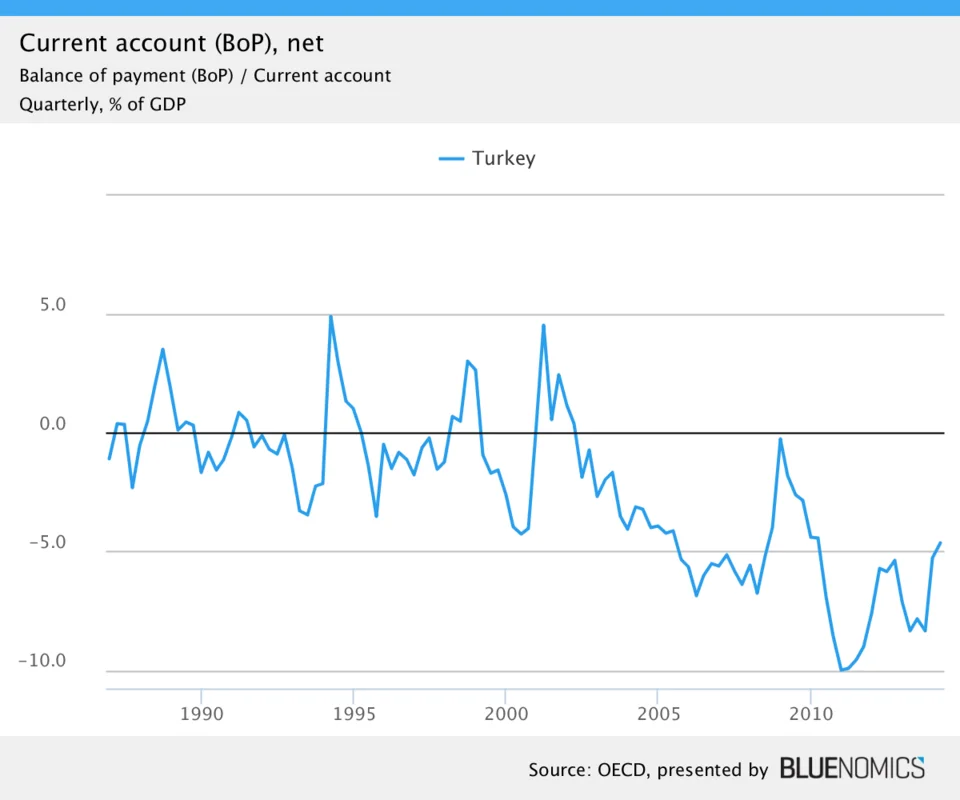
Turkey’s current account as a percentage of GDP: a comparative illustration, not evidence about India.
Credit: Abluher · CC BY-SA 4.0 · sourceResized and converted to WebP; uncropped.
1. Meaning, coverage and accounting principles
The balance of payments, or BoP, is a statistical statement of transactions between residents of an economy and non-residents during a specified period. Its current account covers goods, services, primary income and secondary income. Residence depends principally on the centre of predominant economic interest, not citizenship. Consequently, an Indian citizen established abroad can be a non-resident for BoP purposes, while a foreign-owned enterprise operating in India can be an Indian resident.
Exports, income receivable and current transfers receivable are current account credits; imports, income payable and current transfers payable are debits. The difference between credits and debits is the current account balance. A positive balance is a surplus and a negative balance is a deficit. The account measures flows over a period, unlike the international investment position, which measures stocks of external financial assets and liabilities at a particular date.
BoP accounting follows double-entry principles: each transaction has corresponding entries. An export paid for through an increase in a resident’s foreign bank deposit generates a goods credit and an acquisition of a foreign financial asset. The complete BoP therefore balances conceptually, although actual statistics contain net errors and omissions. A current account deficit does not mean that the overall accounting statement fails to balance.
2. The four components of the current account
Goods cover merchandise transactions such as petroleum, machinery, electronics, textiles and agricultural products. The goods balance is commonly called the merchandise trade balance. BoP goods statistics generally value exports and imports on a free-on-board basis. They can differ from customs trade statistics because of valuation, timing, coverage and change-of-ownership adjustments. Freight and insurance supplied across borders are generally recorded separately under services.
Services include telecommunications, computer and information services, business services, transport, travel, insurance and financial services. India’s software and business-service exports are important sources of foreign exchange. Spending by foreign tourists in India is a travel-services credit; expenditure by Indian residents travelling abroad is a debit. Tuition and living expenses of Indian students studying overseas are generally recorded under travel services.
Primary income arises from providing labour, financial assets or other productive resources. It includes compensation of employees, investment income such as interest and dividends, and reinvested earnings from direct investment. Secondary income consists of current transfers without a corresponding economic return, including personal transfers and certain forms of international assistance. Workers’ remittances generally fall here. However, compensation received by short-term cross-border workers belongs to primary income; not every payment loosely described as a remittance has identical statistical treatment.
Indian discussions often group services, income and transfers as invisibles. Net invisibles can offset a merchandise deficit. Distinguish these receipts from financial inflows: interest paid on an external loan is a primary-income debit, whereas receipt of the loan and repayment of principal are financial-account transactions. Grants for current expenditure and capital transfers also require different treatment.
How an oil-price shock can affect India
- 1. Global crude oil prices rise.
- 2. India’s oil import bill increases if quantities do not fall sufficiently.
- 3. The merchandise trade deficit widens, other things remaining equal.
- 4. The current account deficit increases unless services or income balances offset it.
- 5. Additional financing, reserve use or domestic adjustment becomes necessary.
3. Saving, investment and financing a deficit
In the standard national-accounting identity, the current account balance equals national saving minus domestic investment: CA = S − I. National saving incorporates disposable income, including net income and current transfers from abroad. A deficit therefore indicates that investment exceeds national saving; a surplus indicates the reverse. This is an accounting relationship, not proof that one specific variable caused the imbalance.
A deficit must be matched by financing from outside the current account, allowing for capital transfers and statistical discrepancies. In practical terms, this can involve inward investment, external borrowing, reduction of residents’ foreign assets or a drawdown of official reserves. A deficit does not automatically imply falling reserves: sufficiently large net financial inflows can coexist with both a current account deficit and reserve accumulation.
Under the IMF’s sixth-edition Balance of Payments Manual, the capital account narrowly covers capital transfers and transactions in non-produced, non-financial assets. FDI, portfolio flows, loans and reserve assets belong to the financial account. Indian policy discussions sometimes use capital account broadly for these financing flows, so aspirants must identify the terminology used in a question.
A fiscal deficit may widen the current account deficit by reducing government saving or stimulating import-intensive demand, producing the twin-deficits hypothesis. This outcome is not inevitable: private saving, private investment, exchange rates and economic conditions can offset the fiscal effect. Likewise, a current account surplus is not automatically evidence of strong welfare; it may reflect weak domestic consumption or investment.
| Transaction | Account | Treatment |
|---|---|---|
| Indian firm exports software services | Current account: services | Credit |
| Indian company pays interest to an overseas lender | Current account: primary income | Debit |
| Non-resident worker sends money to a resident household | Current account: secondary income | Generally a personal-transfer credit |
| Foreign company makes an equity investment in an Indian subsidiary | Financial account: direct investment | Increase in external equity liabilities |
| Indian firm repays principal on an external loan | Financial account: other investment | Reduction in external loan liabilities |
4. India’s current account and sustainability
India usually records a merchandise trade deficit, reflecting demand for crude oil, gold, electronics and capital goods. Services exports and transfers from the Indian diaspora provide substantial offsets, while net investment-income payments generally reduce the balance. RBI reported a current account deficit of US$23.2 billion, or 0.7% of GDP, in 2023–24, compared with US$67.0 billion, or 2.0%, in 2022–23. These figures are period-specific, not permanent structural ratios.
Deficit quality matters as much as its size. Imports of productive machinery may raise future output and export capacity, whereas consumption-led deficits may create fewer future foreign-exchange earnings. Financing through stable, long-term investment is generally less vulnerable to abrupt reversals than reliance on short-term foreign-currency debt. Nevertheless, FDI can generate future dividend and profit-remittance outflows.
Sustainability depends on export competitiveness, external debt-service obligations, reserve adequacy, financing maturity and investor confidence. There is no universally safe deficit-to-GDP threshold. A large deficit financed by volatile inflows can create vulnerability to a sudden stop, particularly when global interest rates rise. Oil-price shocks are important for India because they can simultaneously worsen the import bill, domestic inflation and production costs.
5. Adjustment mechanisms and current account convertibility
Currency depreciation makes foreign goods costlier in domestic currency and can make domestic exports cheaper to overseas buyers. However, an improvement in the trade balance is not automatic. It depends on demand responsiveness, production capacity, imported input costs and contract adjustment. Under standard assumptions, the Marshall–Lerner condition links eventual improvement to the sum of export and import demand elasticities exceeding one. A J-curve describes possible initial deterioration before quantities adjust.
Durable adjustment requires competitive exports, reliable infrastructure, diversified energy supplies and higher productivity. Monetary or fiscal tightening can restrain import demand, but may also reduce growth. Import compression during a recession can improve the current account without indicating economic strength. Restrictive trade measures can also raise input costs and invite retaliation.
Current account convertibility means access to foreign exchange for permitted current international transactions, such as trade, travel and income payments. India’s acceptance of IMF Article VIII obligations in 1994 was a key milestone. Under Section 5 of the Foreign Exchange Management Act, 1999, current account transactions are generally permitted, subject to prescribed restrictions. The Foreign Exchange Management (Current Account Transactions) Rules, 2000 specify prohibited transactions and approval requirements. Convertibility does not eliminate documentation, regulatory conditions or limits, and it is distinct from unrestricted capital account convertibility.
Understanding the Current Account–GDP Ratio
The metadata identifies a chart of Turkey’s current account balance as a percentage of GDP. This is directly relevant as a comparative illustration: the ratio expresses an economy’s external current balance relative to its economic size, allowing more meaningful comparisons than absolute currency amounts. A positive balance denotes a surplus and a negative balance a deficit. The current account includes goods, services, primary income such as investment earnings, and secondary income such as personal transfers; it is not synonymous with the merchandise trade balance.
In macroeconomic accounting, the current account balance equals national saving minus domestic investment. A deficit therefore reflects investment exceeding national saving, but does not by itself establish economic weakness. Sustainability depends on how the deficit is financed, the productivity of investment, external liabilities and vulnerability to financing reversals. For India, services receipts and remittances can partly offset a merchandise trade deficit, while net primary income payments can widen the current account gap. Turkey’s experience is comparative, not Indian evidence. The supplied metadata does not establish the chart’s period, underlying source or particular movements, so no trend or causal conclusion should be inferred.
- Component distinction: remittances generally enter secondary income; interest and dividends enter primary income; foreign equity investment enters the financial account.
- Financing distinction: a current account deficit requires counterpart financing or reserve use; it does not automatically mean reserves decline.
- Interpretation caution: a changing balance-to-GDP ratio may reflect changes in the current account balance, GDP, or both.
Real-world case studies
India’s external vulnerability in 2012–13
India’s current account deficit reached 4.8% of GDP in 2012–13. A large oil and gold import bill contributed to the imbalance. When expectations of reduced US monetary stimulus unsettled emerging markets in 2013, India faced capital-flow pressures and rupee depreciation. The episode illustrates why a large deficit becomes riskier when financing conditions change abruptly.
The pandemic-era surplus in 2020–21
India recorded a current account surplus of 0.9% of GDP in 2020–21, compared with a deficit of 0.9% in 2019–20. Pandemic-related import compression and a narrower merchandise deficit were major factors. The surplus demonstrates that an improving external balance can accompany depressed domestic demand rather than stronger underlying economic performance.
Previous year questions
No source-linked PYQ is available here yet. Use the practice questions below.
Practice questions
Practice MCQ 1
Which of the following are recorded in India’s current account? 1. Interest paid on an external commercial borrowing. 2. Principal repayment of that borrowing. 3. Personal transfers received by resident households from relatives settled abroad. Select the correct answer.
- A. 1 and 2 only
- B. 1 and 3 only
- C. 2 and 3 only
- D. 1, 2 and 3
Practice MCQ 2
An economy records a goods deficit of US$180 billion, a services surplus of US$100 billion, net primary-income payments of US$35 billion and net secondary-income receipts of US$90 billion. Its current account has:
- A. A deficit of US$25 billion
- B. A surplus of US$25 billion
- C. A deficit of US$45 billion
- D. A surplus of US$45 billion
Practice MCQ 3
Consider the following statements: 1. A current account deficit necessarily causes official foreign-exchange reserves to decline. 2. In the standard saving–investment identity, a current account deficit implies domestic investment exceeds national saving. 3. Currency depreciation always improves the trade balance immediately. Which statement is correct?
- A. 1 only
- B. 2 only
- C. 2 and 3 only
- D. 1 and 3 only
Mains practice · A current account deficit is not necessarily undesirable, but its composition and financing determine its sustainability. Discuss with reference to India. Answer in 250 words.
- Define the current account and explain CA = S − I.
- Distinguish productive investment-related imports from consumption-led deficits.
- Explain India’s goods deficit, services surplus, remittances and investment-income payments.
- Compare stable investment financing with short-term debt and volatile portfolio flows.
- Assess reserves, debt-service capacity, oil dependence and global financial conditions.
- Recommend productivity-led exports, energy diversification and prudent external liability management.
Further reading
- NCERT, Introductory Macroeconomics, chapter on Open Economy Macroeconomics.
- Reserve Bank of India: quarterly Developments in India’s Balance of Payments releases and Database on Indian Economy.
- International Monetary Fund: Balance of Payments and International Investment Position Manual, Sixth Edition.
- Economic Survey of India: External Sector chapter.
- India Code: Foreign Exchange Management Act, 1999, Section 5; Foreign Exchange Management (Current Account Transactions) Rules, 2000.
- https://commons.wikimedia.org/wiki/File:Turkey_current_account_per_GDP.png
Preparing for UPSC Civil Services? Get classroom teaching, answer-writing evaluation and mentorship at Pragnya IAS Academy, Ashok Nagar — see why aspirants choose us for IAS coaching in Hyderabad.