
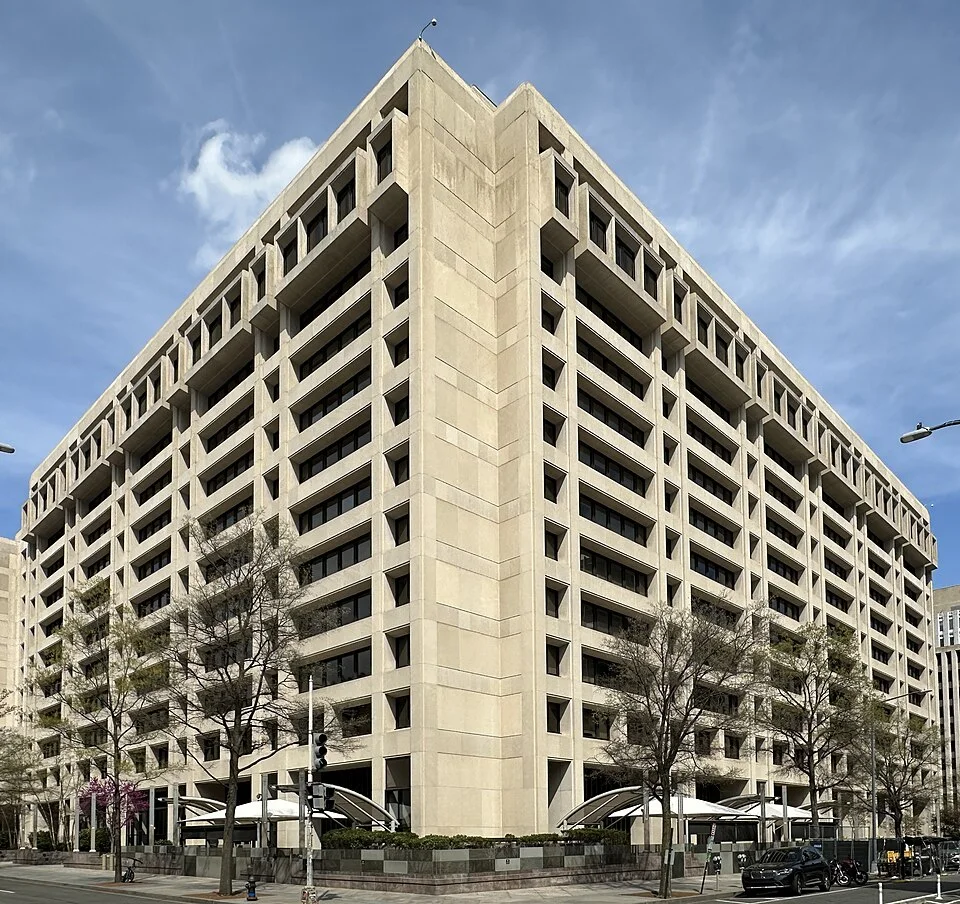
IMF headquarters in Washington, D.C., as identified in the supplied metadata.
Credit: APK · CC BY 4.0 · sourceResized and converted to WebP; uncropped.
1. Origins, objectives and institutional structure
The IMF emerged from the Bretton Woods Conference, held in New Hampshire, United States, in July 1944. Its Articles of Agreement entered into force on 27 December 1945, and financial operations began in March 1947. The institution originally supported a system of fixed but adjustable exchange rates, under which currencies were linked to the US dollar and the dollar was convertible into gold for official holders.
After the breakdown of dollar–gold convertibility in 1971 and the subsequent move towards floating exchange rates, the IMF’s role evolved. It now oversees the international monetary system, assesses members’ economic policies and provides financing for balance-of-payments problems. Its objectives include facilitating balanced international trade, promoting exchange stability and helping establish a multilateral system of payments.
The Board of Governors is the highest decision-making body; each member appoints a governor and an alternate, usually drawn from finance ministries or central banks. The Executive Board conducts day-to-day business, while the Managing Director heads the staff and chairs the Executive Board. Unlike the UN General Assembly, the IMF does not follow one-country-one-vote: voting power largely reflects financial quotas.
- The IMF is a specialised agency of the United Nations, but operates under its own Articles of Agreement and governance arrangements.
- It is not a world central bank and does not routinely finance individual infrastructure projects.
Timeline
July 1944
Bretton Woods Conference lays the foundations of the IMF and the World Bank.
27 December 1945
The IMF formally comes into existence.
1969
Special Drawing Rights are created.
1991
India obtains IMF support during its balance-of-payments crisis.
1 October 2016
The Chinese renminbi enters the SDR valuation basket.
23 August 2021
The historically largest general SDR allocation, equivalent to about US$650 billion, becomes effective.
2. Three core functions: surveillance, lending and capacity development
Surveillance means monitoring economic and financial developments and advising members on policies. Under Article IV consultations, IMF staff generally hold annual discussions with national authorities on fiscal, monetary, exchange-rate, financial-sector and external-sector conditions. These consultations apply to members whether or not they borrow from the IMF. Multilateral surveillance examines cross-border spillovers and risks to the global economy.
IMF lending helps countries facing actual or potential balance-of-payments difficulties. Such problems can arise from capital flight, an export collapse, an import-price shock or an inability to refinance external debt. Financing gives a country time to adjust without relying entirely on abrupt import compression, reserve depletion or disruptive policy changes. It is not primarily project finance or a grant programme.
Conditionality links programme financing to agreed policy measures and, frequently, periodic reviews. Measures may involve fiscal reform, monetary tightening, exchange-rate adjustment, financial-sector repair or improved governance. Their design depends on the country’s circumstances and the lending instrument. Supporters emphasise restoration of stability and repayment capacity; critics highlight recessionary effects, social costs and insufficient national ownership when adjustment is poorly designed.
Capacity development consists of technical assistance and training. It covers tax administration, public financial management, central banking, statistics and financial supervision. The IMF’s South Asia Regional Training and Technical Assistance Center, located in New Delhi and inaugurated in 2017, serves six South Asian countries, including India.
- World Economic Outlook: global growth projections and macroeconomic analysis.
- Global Financial Stability Report: vulnerabilities in financial markets and institutions.
- Fiscal Monitor: public-finance developments, debt and fiscal-policy challenges.
Typical programme-based IMF lending process
- 1. Member identifies an external financing need and requests assistance
- 2. IMF and authorities assess financing gaps and debt sustainability
- 3. Authorities and staff agree on a policy programme
- 4. Executive Board approves the arrangement
- 5. Financing is disbursed according to the arrangement
- 6. Programme reviews assess performance and enable subsequent disbursements
3. Quotas, voting power and financial resources
A member’s quota broadly reflects its relative position in the world economy. Quotas determine its maximum financial subscription, strongly influence voting power and normally guide access to IMF financing. They also determine a member’s share in general SDR allocations. The quota formula considers GDP, openness, economic variability and international reserves; GDP combines market-exchange-rate and purchasing-power-parity measures.
Voting power consists of basic votes distributed equally among members plus quota-based votes. Thus, quota share and voting share are related but not identical. Certain major decisions require an 85 per cent majority of total voting power. Because the United States holds more than 15 per cent, it can block those decisions; this does not mean that it can unilaterally decide every IMF matter.
Quotas are the IMF’s principal resource base, supplemented by borrowing arrangements such as the New Arrangements to Borrow. Under the quota structure resulting from the Fourteenth General Review, India’s quota share is approximately 2.75 per cent and its voting share approximately 2.63 per cent. The Sixteenth General Review, approved in December 2023, authorised a 50 per cent equiproportional quota increase. Approval must be distinguished from implementation, which requires specified consent and effectiveness conditions.
Governance reform remains contentious because emerging economies seek representation closer to their growing economic weight. An equiproportional quota increase enlarges resources without itself changing relative quota shares.
- Prelims distinction: economic size influences quotas, but quotas are not calculated solely from GDP.
- Quota subscriptions, IMF borrowing and SDR allocations are distinct arrangements.
| Instrument | Main purpose | Distinguishing feature |
|---|---|---|
| Stand-By Arrangement | Shorter-term balance-of-payments adjustment | Generally involves programme conditions and periodic reviews |
| Extended Fund Facility | External imbalances linked to structural weaknesses | Longer adjustment horizon than a typical Stand-By Arrangement |
| Rapid Financing Instrument | Urgent balance-of-payments needs | Rapid assistance without a full-fledged programme |
| Flexible Credit Line | Crisis prevention or mitigation | Strong prequalification; no ex post programme conditionality |
| Extended Credit Facility | Protracted external problems in eligible low-income countries | Concessional support under the Poverty Reduction and Growth Trust |
4. Special Drawing Rights and lending instruments
The IMF created Special Drawing Rights in 1969 to supplement members’ official reserve assets. An SDR is neither a currency nor a claim on the IMF itself; it represents a potential claim on the freely usable currencies of IMF members. Through arrangements between participating holders, SDRs can be exchanged for usable currency.
The SDR’s value is based on a basket comprising the US dollar, euro, Chinese renminbi, Japanese yen and pound sterling. The renminbi entered the basket on 1 October 2016. Basket weights are periodically reviewed and are not equal. General SDR allocations are distributed in proportion to quotas, not according to poverty or immediate financing needs. In August 2021, an allocation of about SDR 456.5 billion, equivalent to US$650 billion at the time, became effective.
An SDR allocation is not a conventional IMF programme loan and does not carry programme conditionality. However, SDR holdings earn interest and cumulative allocations attract charges at the SDR interest rate. A country holding fewer SDRs than its cumulative allocation therefore incurs a net interest cost. SDRs also serve as the IMF’s unit of account.
The Stand-By Arrangement commonly addresses shorter-term external financing problems, while the Extended Fund Facility supports adjustment associated with deeper structural weaknesses. The Poverty Reduction and Growth Trust supports concessional lending to eligible low-income countries. The Resilience and Sustainability Trust provides longer-term financing for eligible countries addressing challenges such as climate change and pandemic preparedness.
- The Rapid Financing Instrument provides rapid assistance for urgent balance-of-payments needs without a full-fledged programme.
- The Flexible Credit Line relies on strong prequalification and has no ex post programme conditionality.
5. India, policy debates and examination distinctions
India’s relationship with the IMF includes membership, surveillance, borrowing during earlier crises and participation in international monetary governance. During the 1991 balance-of-payments crisis, exceptionally low usable foreign-exchange reserves, external-payment pressures and weak confidence led India to seek international assistance, including IMF financing. Domestic stabilisation and structural reforms accompanied the response.
India accepted the obligations of Article VIII, Sections 2, 3 and 4, in August 1994. These concern restrictions on payments and transfers for current international transactions, discriminatory currency arrangements and multiple currency practices. This must not be confused with full capital-account convertibility. Current-account transactions largely concern trade, services and income payments; capital-account liberalisation involves a different set of risks and policy choices.
The IMF can assess debt sustainability and make financing conditional on adequate financing assurances or debt treatment, but it cannot simply cancel all sovereign debt or compel every creditor to accept restructuring. Its effectiveness depends on member cooperation, credible policies and sufficient financing. For examination purposes, distinguish external liquidity support from long-term development lending and distinguish surveillance recommendations from legally identical obligations for every member.
- IMF: macroeconomic stability, external-payment support and monetary cooperation.
- World Bank: development finance, poverty reduction and institutional or sectoral investment.
- WTO: trade rules, negotiations and dispute settlement; it is not a crisis lender.
IMF: External Stability, Lending and Quota-Based Governance
The headquarters identified in the metadata provides institutional context for the International Monetary Fund, rather than evidence of its operations. The IMF supports international monetary cooperation and external stability through surveillance, financial assistance and capacity development. Surveillance includes assessing members’ economic policies through Article IV consultations; it does not itself constitute lending. IMF financing primarily helps countries address balance-of-payments problems and restore external viability, unlike the World Bank’s principal focus on longer-term development and poverty reduction.
For India, the IMF is relevant both as a forum for global economic governance and as a source of external-sector analysis. India’s 1991 balance-of-payments crisis illustrates the relevance of IMF assistance, but domestic reform choices should not be reduced to IMF involvement alone. Quotas shape members’ financial contributions, voting power, access to financing and shares in general Special Drawing Rights allocations. Consequently, debates about quota reform concern representation and influence as well as the institution’s resources. A headquarters photograph cannot establish the effectiveness, fairness or economic consequences of IMF programmes.
- SDRs are international reserve assets, not a currency or an IMF loan. Their value is based on a basket of major currencies; members can exchange SDRs for usable currencies.
- IMF voting is not one-country-one-vote: voting power combines basic votes with quota-linked votes. Quota share and voting share are related but not identical.
- Lending conditions vary across IMF facilities. For Mains, distinguish the objectives of restoring external stability from debates over adjustment costs, policy autonomy and protection of vulnerable groups.
Real-world case studies
India’s 1991 external-payments crisis
The Gulf crisis, higher oil costs, fiscal imbalances and weakening external confidence intensified India’s foreign-exchange shortage. IMF support formed part of a broader response involving exchange-rate adjustment, gold-backed mobilisation of foreign exchange and economic reforms. The episode illustrates how external liquidity pressures can trigger wider stabilisation measures; it should not be reduced to the claim that every subsequent reform was dictated by the IMF.
Sri Lanka’s 2023 IMF programme
Following its 2022 economic crisis and external-debt default, Sri Lanka received approval in March 2023 for a 48-month Extended Fund Facility arrangement of about US$3 billion. The programme combined revenue reform, monetary and financial stabilisation, governance measures and social-protection commitments. Debt restructuring with creditors was central, demonstrating that IMF financing cannot substitute for restoring debt sustainability.
Previous year questions
No source-linked PYQ is available here yet. Use the practice questions below.
Practice questions
Practice MCQ 1
Consider the following statements about Special Drawing Rights: 1. They are a currency issued by the IMF for public circulation. 2. General allocations are distributed in proportion to members’ IMF quotas. 3. Their valuation basket includes the Chinese renminbi. Which statements are correct?
- A. 1 and 2 only
- B. 2 and 3 only
- C. 1 and 3 only
- D. 1, 2 and 3
Practice MCQ 2
Which statement correctly describes IMF governance?
- A. Every member has identical voting power.
- B. Voting power is determined exclusively by population.
- C. Voting power combines basic votes and quota-based votes.
- D. Only countries borrowing from the IMF may vote.
Practice MCQ 3
Consider the following statements: 1. Article IV consultations are confined to countries receiving IMF loans. 2. The IMF’s principal lending role is to finance individual infrastructure projects. 3. Acceptance of Article VIII obligations does not establish full capital-account convertibility. Which statements are correct?
- A. 1 only
- B. 2 and 3 only
- C. 3 only
- D. 1, 2 and 3
Mains practice · Explain the IMF’s role in maintaining international monetary stability. Why are reforms of its governance and lending practices necessary? Answer in 250 words.
- Introduce the IMF’s mandate and distinguish it from development banks.
- Discuss surveillance, balance-of-payments financing, SDRs and capacity development.
- Use India in 1991 or Sri Lanka in 2023 to illustrate crisis support.
- Examine unequal voting power, representation and quota-reform debates.
- Assess conditionality, social protection, debt sustainability and national ownership.
- Conclude with more representative governance and country-sensitive, adequately financed adjustment.
Further reading
- NCERT, Introductory Macroeconomics: Open Economy Macroeconomics.
- NCERT, Indian Economic Development: Liberalisation, Privatisation and Globalisation—An Appraisal.
- IMF official website: Articles of Agreement; IMF Quotas; Special Drawing Rights; IMF Lending factsheets.
- IMF: World Economic Outlook, Global Financial Stability Report and Fiscal Monitor.
- Reserve Bank of India: Annual Report and materials on India’s external sector.
- Government of India: Economic Survey, external-sector chapter.
- https://commons.wikimedia.org/wiki/File:International_Monetary_Fund_headquarters.jpg
Preparing for UPSC Civil Services? Get classroom teaching, answer-writing evaluation and mentorship at Pragnya IAS Academy, Ashok Nagar — see why aspirants choose us for IAS coaching in Hyderabad.