
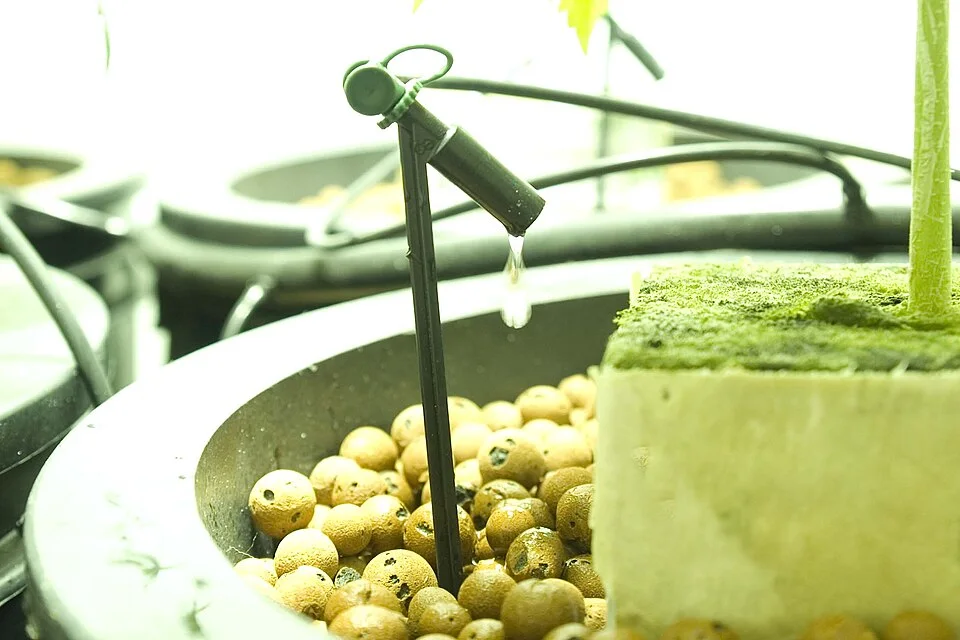
Drip emitter in a hydroponic setup using rockwool and expanded clay; an illustrative irrigation application.
Credit: Alan.ca · Public domain · sourceResized and converted to WebP; uncropped.
1. Irrigation and the agrarian economy
Indian agriculture depends heavily on the southwest monsoon, whose rainfall varies across regions and years. Irrigation reduces exposure to dry spells and allows cultivation during the rabi and summer seasons. Assured water encourages investment in improved seeds, fertilisers, machinery and high-value crops. It helped sustain the Green Revolution in northwestern India and supports intensive rice cultivation in several river deltas.
Irrigation can increase both yield per hectare and cropping intensity, which is gross cropped area divided by net sown area, multiplied by 100. Protective irrigation supplies limited water at critical growth stages to prevent crop failure. Intensive irrigation seeks higher output through more assured supplies. Its benefits depend on timing, reliability, drainage and soil conditions, not merely the volume delivered.
Distribution matters as much as aggregate coverage. Canal head-reach farmers may receive excessive water while tail-end farmers face shortages. Smallholders may lack money for borewells or pumps and depend on water purchases. Rainfed regions therefore need watershed treatment, soil-moisture conservation and supplementary irrigation alongside investment in larger infrastructure.
- Irrigation potential created: area expected to be irrigated by completed infrastructure.
- Irrigation potential utilised: the portion of that potential actually brought under irrigation.
- A utilisation gap can arise from incomplete field channels, unreliable supply, poor maintenance, inadequate drainage or weak coordination.
2. Sources, methods and project classification
Surface irrigation sources include rivers, reservoirs, canals and tanks. Perennial canals draw regulated or dependable supplies, whereas inundation canals depend on high river levels. Tanks store runoff and are particularly important in parts of peninsular India. Besides irrigation, functioning tanks can support groundwater recharge, fisheries and local ecosystems. Siltation, encroachment and disruption of feeder channels reduce their usefulness.
Groundwater irrigation through dug wells and tube wells offers farmers greater control over timing than many canal systems. Alluvial aquifers of the Indo-Gangetic plains generally store more groundwater than the fractured hard-rock aquifers widespread in peninsular India. However, local availability depends on recharge, geology and extraction. Lift irrigation raises water using pumps; gravity irrigation conveys it along a suitable slope.
Application methods are a separate classification. Surface methods include basin, border and furrow irrigation. Sprinklers distribute pressurised water through nozzles and suit many uneven or sandy fields, though wind and evaporation can reduce performance. Drip systems deliver frequent, small quantities near the root zone. Their emitters require filtration and maintenance, and their suitability depends on crops, spacing and water quality.
- Major irrigation project: culturable command area exceeding 10,000 hectares.
- Medium irrigation project: culturable command area exceeding 2,000 hectares and up to 10,000 hectares.
- Minor irrigation project: culturable command area up to 2,000 hectares; it can use either surface water or groundwater.
Planning sustainable irrigation
- 1. Assess rainfall, aquifer conditions and available surface water
- 2. Estimate crop demand and other water requirements
- 3. Select suitable sources, crops and application methods
- 4. Ensure distribution, drainage and maintenance arrangements
- 5. Monitor withdrawals, soil moisture and water productivity
- 6. Revise allocations and cropping plans using the water budget
3. Water productivity and environmental risks
Conveyance efficiency concerns water delivered from the source to the field; application efficiency concerns water stored usefully in the crop root zone relative to water applied. Water productivity measures output or economic value per unit of water. Canal lining, land levelling, irrigation scheduling, mulching and micro-irrigation can improve performance, but their results are location-specific.
Drip irrigation can reduce soil evaporation, unwanted weed growth and nutrient losses. Fertigation applies soluble fertilisers through irrigation water, allowing more precise delivery. Constraints include initial cost, clogged emitters, maintenance requirements, fragmented holdings and weak after-sales service. Sprinklers are not equally suitable for every crop or climate, and micro-irrigation does not eliminate the need for appropriate scheduling.
Excessive irrigation without drainage can raise the water table and cause waterlogging. Evaporation may concentrate salts near the soil surface, reducing crop growth. Salinity is associated with excess soluble salts, while sodicity involves excessive exchangeable sodium and often poor soil structure. Leaching requires suitable water and drainage; gypsum is commonly used to reclaim sodic soils, not as a universal remedy for all salt-affected land.
Water saved at field level is not necessarily saved at basin level. Some canal seepage and field percolation recharge aquifers or become downstream return flows. Moreover, farmers may use efficiency gains to expand irrigated area or cultivate thirstier crops. This rebound effect makes extraction limits, crop planning and groundwater monitoring important complements to improved equipment.
| Source | Main advantage | Important limitation |
|---|---|---|
| Canals | Can serve extensive command areas | Unequal distribution, maintenance gaps and waterlogging |
| Wells and tube wells | Farmer-controlled and timely supply | Aquifer depletion, pumping costs and unequal access |
| Tanks | Local runoff storage with multiple uses | Siltation, encroachment and rainfall dependence |
| Lift irrigation from rivers or reservoirs | Supplies land above the source level | Energy requirements and recurring operating costs |
4. Institutions, schemes and policy instruments
Water is primarily a State List subject under Entry 17, subject to Union powers concerning inter-State rivers and river valleys under Union List Entry 56. States manage most irrigation systems, while the Union supports financing, technical standards and inter-State coordination. Groundwater management is complicated by dispersed users and the practical connection between land access and well ownership.
Pradhan Mantri Krishi Sinchayee Yojana, launched in 2015, promotes irrigation access and efficient water use through the ideas of Har Khet Ko Pani and More Crop Per Drop. The Accelerated Irrigation Benefits Programme supports completion of eligible major and medium projects. Command Area Development and Water Management addresses field-level distribution and the gap between potential creation and utilisation. Watershed development supports rainfed landscapes through runoff management, soil conservation and water harvesting.
Per Drop More Crop operated as a PMKSY component from 2015–16 and has been implemented under Rashtriya Krishi Vikas Yojana from 2022–23. It promotes micro-irrigation. NABARD’s Micro Irrigation Fund supports states in expanding coverage. Atal Bhujal Yojana was designed for community-led groundwater management in water-stressed areas of seven states, using water-security planning and demand-side measures.
Participatory Irrigation Management involves Water Users’ Associations in allocation, maintenance and fee collection. Rational water charges can support maintenance, while reliable electricity and carefully designed pump incentives can discourage waste. Solar pumps under PM-KUSUM reduce dependence on diesel, but cheap pumping can increase groundwater extraction unless accompanied by safeguards or incentives to sell surplus electricity.
5. Regional priorities and an integrated approach
Northwestern India needs groundwater demand management and viable alternatives to water-intensive paddy in stressed locations. Parts of eastern India have scope for improved irrigation access, but flooding, drainage, energy access and local aquifer conditions must guide investment. Hard-rock regions of the Deccan need careful groundwater budgeting because storage is limited and borewell yields can be highly variable.
A sustainable approach combines maintenance of existing infrastructure, tank restoration, conjunctive use of surface water and groundwater, and crop choices suited to local agro-climatic conditions. Conjunctive use can reduce pressure on individual sources and help manage waterlogging. Procurement policies, agricultural extension and markets must support diversification; simply advising farmers to change crops is insufficient when income risks remain high.
For examination purposes, avoid treating large dams, groundwater recharge or drip irrigation as universal solutions. Irrigation policy must balance agricultural production with drinking-water needs, environmental flows, equitable access and long-term aquifer health.
Drip Irrigation: Precise Delivery and Its Limits
The metadata identifies a drip emitter used in a hydroponic setup with rockwool and expanded clay. This is directly relevant to irrigation as an example of controlled water delivery, but it is not evidence of an Indian farm or field-scale performance. Drip irrigation supplies water through emitters close to the root zone, generally in small, frequent doses. Hydroponics refers to cultivation without soil; it is not synonymous with drip irrigation. Drip systems can also serve soil-grown crops, while hydroponic systems may use other delivery methods.
In India, drip irrigation can help manage limited water supplies, particularly for horticultural crops and other suitable cropping systems. Its effectiveness depends on crop requirements, scheduling, filtration, pressure regulation and maintenance. Emitters may clog, and installation costs or inadequate technical support can limit adoption. Precise application can reduce certain evaporation, runoff and deep-percolation losses, but higher application efficiency does not automatically conserve water across an aquifer or river basin. Farmers may expand irrigated area or shift to more water-demanding crops; reduced percolation may also diminish groundwater recharge. Evaluation must therefore consider withdrawals, crop water consumption and return flows, not equipment alone.
- Source versus method: groundwater, canals and tanks supply water; drip and sprinkler systems describe how water is applied.
- Fertigation means applying nutrients through irrigation water; neither fertigation nor drip irrigation necessarily implies hydroponic cultivation.
- For Mains, connect micro-irrigation with groundwater governance, energy incentives and equitable access; the metadata cannot establish water savings or yield gains.
Real-world case studies
Punjab: irrigation and groundwater stress
Assured irrigation, procurement and subsidised power supported the rice–wheat system but also encouraged intensive groundwater extraction. The Punjab Preservation of Subsoil Water Act, 2009 regulates the timing of paddy nursery sowing and transplantation to reduce pre-monsoon groundwater use. It illustrates why seasonal regulation must be complemented by diversification and demand management.
Andhra Pradesh Farmer Managed Groundwater Systems
This programme used farmer training, rainfall and groundwater monitoring, and crop-water budgeting in hard-rock areas. Its importance lies in making aquifer constraints understandable to users and encouraging collective decisions. Information and participation remain most effective when supported by viable crop choices and appropriate incentives.
Previous year questions
UPSC Mains 2021 · GS-III
How and to what extent would micro-irrigation help in solving India’s water crisis?
- Explain drip, sprinkler irrigation and fertigation.
- Discuss higher application efficiency and water productivity.
- Examine affordability, maintenance and crop suitability.
- Distinguish field-level savings from basin-level conservation.
- Combine technology with groundwater governance and crop diversification.
Practice questions
Practice MCQ 1
Consider the following statements: 1. Gross irrigated area can exceed net irrigated area. 2. Minor irrigation projects necessarily use groundwater. 3. Irrigation project classification uses culturable command area. Which statements are correct?
- A. 1 and 2 only
- B. 1 and 3 only
- C. 2 and 3 only
- D. 1, 2 and 3
Practice MCQ 2
Which best explains why adoption of drip irrigation may not reduce groundwater extraction?
- A. Drip irrigation cannot use groundwater
- B. Drip irrigation necessarily increases crop water requirements
- C. Farmers may expand irrigated area using the water saved
- D. Drip irrigation prevents fertigation
Practice MCQ 3
Consider the following statements: 1. Excessive irrigation with inadequate drainage can cause waterlogging. 2. Gypsum is commonly used for reclaiming sodic soils. 3. Canal seepage is always an irrecoverable loss at basin level. Which statements are correct?
- A. 1 only
- B. 2 and 3 only
- C. 1 and 2 only
- D. 1, 2 and 3
Mains practice · Expanding irrigation coverage is necessary but insufficient for agricultural water security in India. Discuss. Suggest an integrated strategy. Answer in 250 words.
- Connect irrigation with productivity and resilience.
- Discuss regional disparities and potential-utilisation gaps.
- Examine depletion, waterlogging and unequal access.
- Integrate micro-irrigation, drainage, tank restoration and conjunctive use.
- Reform crop incentives and strengthen participatory water budgeting.
- Measure success through reliable access and sustainable water productivity.
Further reading
- NCERT, India: People and Economy, Class XII: Water Resources; Land Resources and Agriculture.
- Department of Agriculture and Farmers Welfare: Agricultural Statistics at a Glance and Per Drop More Crop guidelines.
- Ministry of Jal Shakti: PMKSY guidelines and Minor Irrigation Census reports.
- Central Ground Water Board: National Compilation on Dynamic Ground Water Resources of India.
- NABARD: Micro Irrigation Fund information.
- https://commons.wikimedia.org/wiki/File:Drip_emitter.jpg
Preparing for UPSC Civil Services? Get classroom teaching, answer-writing evaluation and mentorship at Pragnya IAS Academy, Ashok Nagar — see why aspirants choose us for IAS coaching in Hyderabad.