
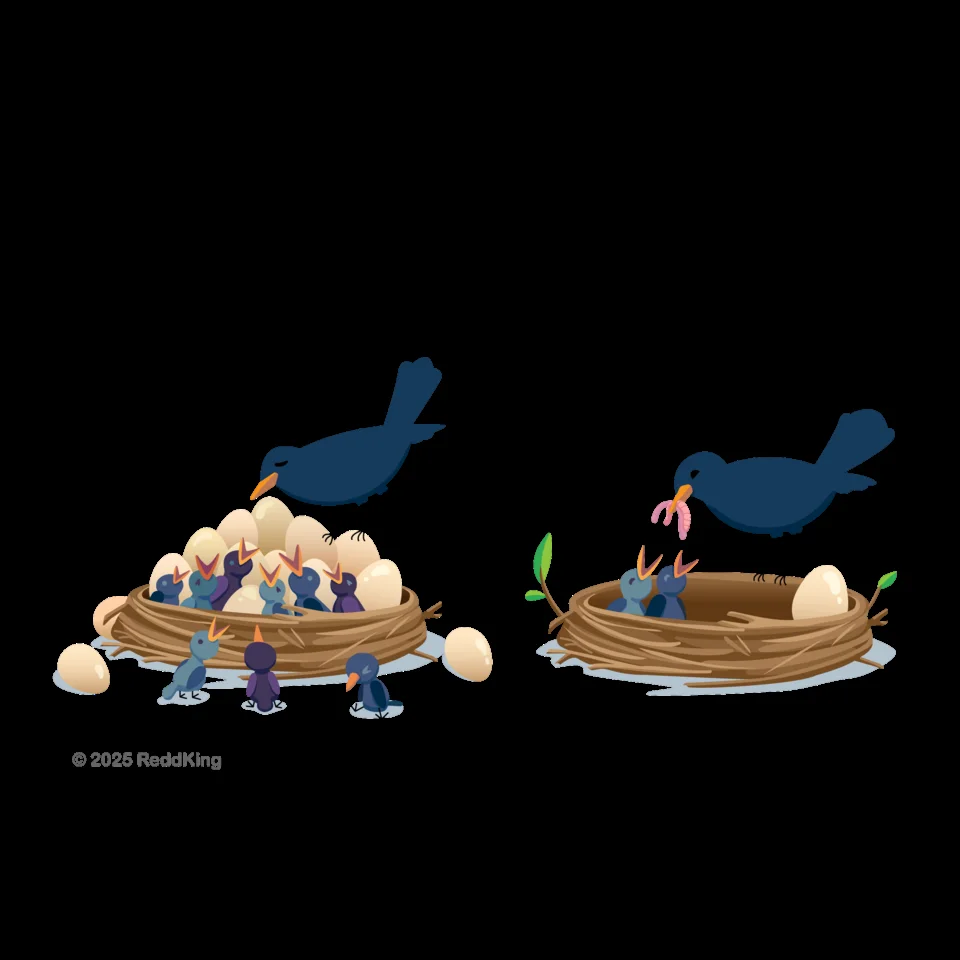
Illustration on carrying capacity, as identified by the supplied metadata.
Credit: ReddKing · CC BY 4.0 · sourceResized and converted to WebP; uncropped.
1. Meaning and ecological foundations
Carrying capacity describes the population of a particular species that a habitat can sustain over time under given conditions. Support depends not merely on the presence of resources but on their availability, accessibility, quality and rate of renewal. A grassland’s capacity to support herbivores, for example, depends on forage production, drinking water, seasonal variation and the condition of soils and vegetation.
The concept is species-specific. The same wetland can support different numbers of fish, waterbirds and aquatic plants because their needs and ecological roles differ. Carrying capacity must also be defined for an appropriate spatial scale and time period. A brief abundance of food during the monsoon does not necessarily indicate the population that can survive the dry season.
Biotic potential is a population’s reproductive capacity under favourable conditions, whereas environmental resistance comprises constraints that prevent this potential from being fully realised. Competition, predation, disease and resource shortages contribute to this resistance. Carrying capacity reflects the outcome of environmental support and constraints rather than simply an organism’s ability to reproduce.
- A limiting factor restricts population growth when it is scarce or otherwise unfavourable; it need not be food.
- Habitat area and habitat quality are distinct: a large but degraded habitat may support fewer individuals than a smaller, productive one.
2. Exponential and logistic population growth
Exponential growth assumes that resources do not impose effective limits during the period considered. Its continuous-time equation is dN/dt = rN, where N is population size, t is time and r is the intrinsic rate of natural increase. When r is positive and constant, population size follows a J-shaped curve. Such growth can occur temporarily after colonisation of a favourable habitat but cannot continue indefinitely in a finite environment.
The simple logistic model introduces carrying capacity: dN/dt = rN(1 − N/K). The term (1 − N/K) reduces population growth as density increases. When N is much smaller than K, growth approximates exponential growth. As N approaches K, the net growth rate approaches zero, producing an S-shaped, or sigmoid, curve.
An important distinction concerns total and per capita growth. In this model, the absolute population increase is greatest at N = K/2, while per capita growth decreases continuously with increasing N. At K, births and immigration, where relevant, can balance deaths and emigration; zero net growth does not mean that reproduction and mortality cease.
The basic model assumes a constant K and an immediate response to crowding, while ignoring age structure and many interactions among species. Real populations may fluctuate, migrate or respond with delays. Therefore, the logistic curve is a useful conceptual model, not a universal description of observed population behaviour.
- For positive r, the simple logistic equation predicts a decline when N exceeds K.
- K/2 is not automatically a safe harvesting target: the model’s assumptions and ecological uncertainty must be considered.
Assessing carrying capacity for management
- 1. Define the species or activity, area, time horizon and ecological objectives.
- 2. Identify limiting resources and seasonal bottlenecks.
- 3. Measure resource renewal, existing pressures and habitat condition.
- 4. Estimate support levels under different scenarios and uncertainties.
- 5. Set precautionary management limits and monitor indicators.
- 6. Revise limits as resources, climate or observed impacts change.
3. Regulation, changing capacity and overshoot
Density-dependent factors become more influential as population density rises. Competition for nesting sites, depletion of forage, and transmission of some infectious diseases are examples. These processes can reduce birth rates or increase death rates, contributing to population regulation. Predation may also be density-dependent, although predator–prey relationships are more complex than a single logistic equation.
Density-independent factors affect populations without their operation necessarily depending on population density. Droughts, cyclones, extreme temperatures and volcanic eruptions are standard examples. Their effects can nevertheless interact with crowding and habitat condition. A drought may both cause mortality and reduce the habitat’s carrying capacity by lowering water availability and primary production.
Carrying capacity changes through seasons and over longer periods. Habitat restoration, improved water retention and vegetation recovery may raise it; soil erosion, fragmentation, pollution and climate change may lower it. Supplementary feeding can raise the number of animals temporarily supported, but this should not be confused with recovery of the habitat’s unaided ecological capacity.
Overshoot occurs when a population exceeds the level that current resources can sustain. Delayed reproductive responses or unusually favourable preceding years can contribute to overshoot. If excessive grazing or extraction damages the resource base, subsequent carrying capacity may fall, causing a sharp decline or dieback. However, overshoot does not invariably produce a catastrophic collapse; adjustment depends on resource renewal, movement and management.
- Seasonal bottlenecks can determine long-term support more strongly than peak seasonal productivity.
- Population fluctuation is not, by itself, proof of overshoot; evidence of resource constraints and ecological change is necessary.
| Concept | Meaning | Exam distinction |
|---|---|---|
| Carrying capacity | Population supportable under specified environmental conditions | Represented by K; can change over time |
| Biotic potential | Reproductive capacity under favourable conditions | Does not account fully for environmental constraints |
| Environmental resistance | Combined constraints on population growth | Includes biotic and abiotic influences |
| Assimilative capacity | Capacity to accommodate pollutants without unacceptable damage | Concerns pollution loads rather than population numbers directly |
| Overshoot | Population or demand exceeds sustainable support | May deplete resources and reduce future capacity |
4. Human carrying capacity and related concepts
Human carrying capacity is harder to express as a single number because people alter resource availability through agriculture, irrigation, technology and institutions. Consumption also varies greatly: equal-sized populations can impose very different demands on energy, land and water. Any estimate therefore depends on assumptions about living standards, resource distribution, technology and acceptable environmental damage.
Trade allows a city or region to support more people than its local ecosystems alone could sustain. However, importing food, water-intensive goods or energy transfers part of its ecological demand elsewhere rather than eliminating that demand. Groundwater mining and soil depletion can likewise support current consumption while reducing future support capacity.
Ecological footprint measures demand in terms of biologically productive area, while biocapacity represents the regenerative capacity of such areas. These are related to, but not identical with, carrying capacity. Assimilative capacity instead concerns an environment’s ability to receive and process pollutants without unacceptable harm. Social or tourism carrying capacity also includes visitor experience, resident tolerance and service constraints alongside ecological limits.
- A population maintained by persistent depletion of natural capital is not necessarily sustainable.
- A tourism visitor limit is a management threshold based on selected objectives, not a universal biological constant.
5. Applications in conservation and Indian environmental planning
In wildlife management, carrying-capacity assessment helps evaluate prey availability, habitat restoration, livestock competition and the implications of reintroduction. Supporting more animals is not always equivalent to achieving conservation success: species diversity, vegetation recovery, genetic viability and ecosystem processes must also be protected. Monitoring should therefore combine population counts with habitat and resource indicators.
For Indian hill towns and pilgrimage centres, assessment should include dry-season drinking water, sewage treatment, solid-waste handling, road congestion, slope stability and emergency evacuation. Average annual visitor numbers can conceal short seasonal peaks that overload infrastructure. Similarly, coastal tourism requires attention to freshwater, dunes, beaches, waste disposal and sensitive habitats.
The EIA Notification, 2006, issued under the Environment (Protection) Act, 1986, provides for prior environmental clearance of specified project categories. Carrying-capacity and cumulative-impact studies can complement project-level appraisal by examining pressures from multiple activities across a region. The practical approach is adaptive management: establish locally justified limits, monitor environmental outcomes, and revise permissions or restoration measures as conditions change.
- For grazing systems, stocking decisions should reflect forage renewal and drought risk rather than only current livestock demand.
- For groundwater-dependent settlements, extraction should be assessed against replenishment while accounting for ecosystem needs and water quality.
Carrying capacity: a conditional ecological limit
Carrying capacity, commonly represented by K, is the population an environment can sustain over time under specified conditions without progressive resource depletion. The supplied title and description directly identify this concept, although metadata alone cannot establish the diagram’s axes or plotted relationships. In the standard logistic model, population growth slows as population size approaches K because per-capita resource availability declines and density-dependent constraints intensify. This differs from biotic potential: the capacity to reproduce under ideal conditions, rather than the population an actual habitat can support.
K is not a permanent ceiling. Drought, habitat fragmentation, restoration and changes in food supply can alter it; populations may also overshoot available resources and subsequently decline. In India, carrying-capacity reasoning informs grazing management, wildlife habitat assessment and planning for water-stressed settlements or tourism destinations. Human applications require particular caution: consumption patterns, technology, trade and waste-assimilation capacity influence environmental pressure. Imports can shift resource burdens elsewhere rather than remove ecological limits. A defensible assessment therefore specifies the population, spatial boundary, time horizon, resource constraints and acceptable environmental impacts instead of presenting one universal number.
- Logistic growth: dN/dt = rN(1 − N/K); net growth is zero at K in the idealised model, not because births necessarily cease.
- Density dependence is central to logistic regulation; density-independent disturbances can change habitat conditions and thereby alter K.
- Do not equate carrying capacity with maximum population observed or maximum sustainable yield; real populations fluctuate, and estimates require context-specific evidence.
Real-world case studies
Reindeer on St Matthew Island, Alaska
Twenty-nine reindeer introduced in 1944 increased to about 6,000 by 1963, followed by a collapse to 42 counted in 1966. Heavy grazing depleted slow-growing lichens, while severe winter conditions contributed to mortality. The case illustrates the interaction of resource depletion, overshoot and climatic stress rather than a single-factor explanation.
Char Dham pilgrimage planning, Uttarakhand
Kedarnath, Badrinath, Gangotri and Yamunotri experience concentrated seasonal visitor pressure. Their planning illustrates why road capacity alone is insufficient: water, waste treatment, fragile terrain, accommodation and disaster-response capability must be assessed together. Different sites and seasons require different management thresholds rather than one uniform carrying-capacity figure.
Previous year questions
No source-linked PYQ is available here yet. Use the practice questions below.
Practice questions
Practice MCQ 1
Under the simple continuous-time logistic growth model with positive r and constant K, consider the following statements: 1. Absolute population growth is greatest at N = K/2. 2. Per capita growth increases as N approaches K. 3. Net population growth is zero at N = K. Which statements are correct?
- A. 1 and 2 only
- B. 1 and 3 only
- C. 2 and 3 only
- D. 1, 2 and 3
Practice MCQ 2
Which situation most clearly indicates that current human resource use may exceed local long-term ecological support?
- A. Population remains constant while groundwater levels decline persistently because extraction exceeds replenishment.
- B. Population rises while treated wastewater reuse increases.
- C. A settlement imports food from another region.
- D. Annual rainfall varies between years.
Practice MCQ 3
Consider the following statements about carrying capacity: 1. It may decline following habitat degradation. 2. It is identical for all species occupying the same ecosystem. 3. Seasonal resource scarcity may constrain it. Which statements are correct?
- A. 1 only
- B. 2 and 3 only
- C. 1 and 3 only
- D. 1, 2 and 3
Mains practice · Explain the ecological concept of carrying capacity. How can it guide sustainable management of tourism in Himalayan towns? Answer in 150 words.
- Define carrying capacity as conditional and dynamic, not a permanently fixed number.
- Link visitor pressure to seasonal water availability, waste treatment and habitat disturbance.
- Include slope stability, congestion, resident needs and emergency response.
- Recommend cumulative assessment, seasonal visitor management and infrastructure matched to ecological limits.
- Conclude with monitoring, local participation and adaptive revision of thresholds.
Further reading
- NCERT, Biology, Class XII: Organisms and Populations.
- NCERT, Biology, Class XII: Ecosystem.
- Odum and Barrett, Fundamentals of Ecology.
- Ministry of Environment, Forest and Climate Change: EIA Notification, 2006, and subsequent amendments.
- Wildlife Institute of India: publications on habitat assessment and wildlife population monitoring.
- David R. Klein, The Introduction, Increase, and Crash of Reindeer on St. Matthew Island, Journal of Wildlife Management, 1968.
- https://commons.wikimedia.org/wiki/File:Climate-science-carrying-capacity.png
Preparing for UPSC Civil Services? Get classroom teaching, answer-writing evaluation and mentorship at Pragnya IAS Academy, Ashok Nagar — see why aspirants choose us for IAS coaching in Hyderabad.