
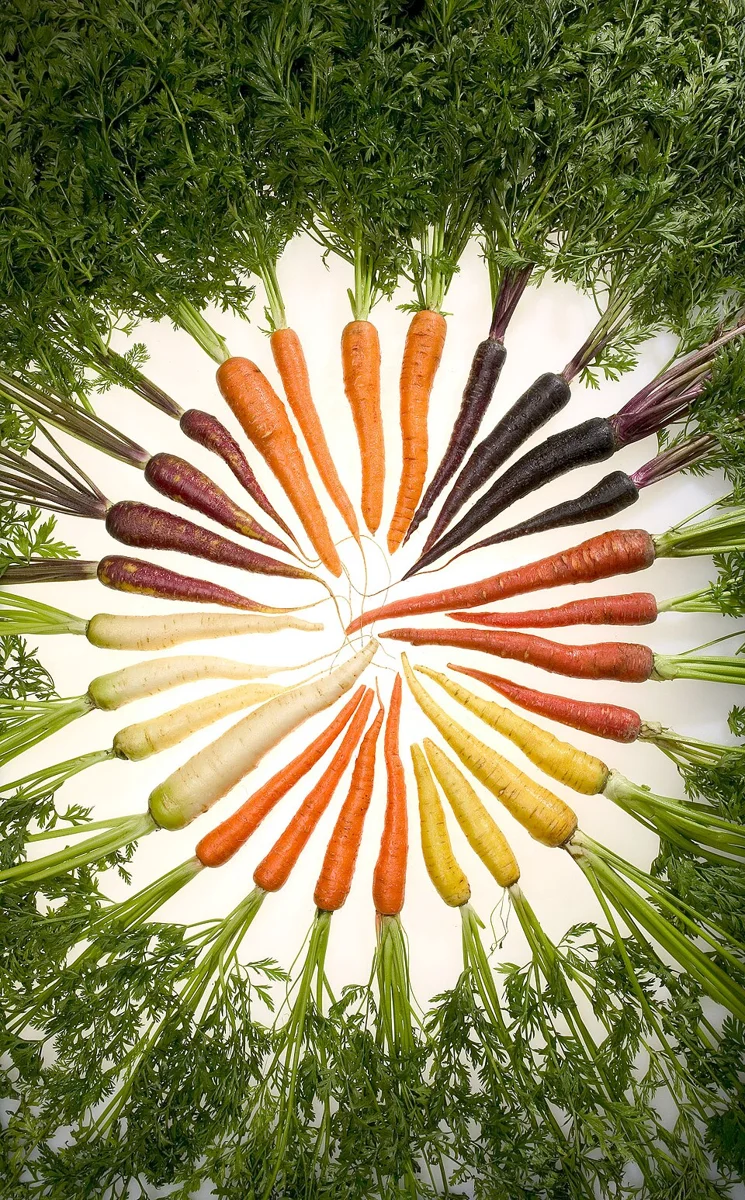
Selectively bred carrot colour varieties: an illustrative example of variation within a crop species.
Credit: Stephen Ausmus · Public domain · sourceResized and converted to WebP; uncropped.
1. Meaning, levels and measurement
Genetic diversity refers to differences in DNA sequences and hereditary characteristics among individuals and populations of the same species. An allele is an alternative form of a gene or genetic locus. Individuals may possess different alleles affecting characteristics such as disease resistance, flowering time, heat tolerance or coat colour. Genetic variation also occurs in DNA regions without an established effect on observable traits. It must not be confused with species diversity, which concerns the variety and relative abundance of species.
Variation exists both within populations and between geographically or ecologically separated populations. For example, populations of the same tree species on dry slopes and in moist valleys may differ in drought tolerance. Conserving only one population may therefore fail to represent the species’ full genetic resources. Conversely, visible differences do not always establish genetic differences: nutrition, temperature and other environmental conditions can alter an organism’s phenotype.
Common measures include allelic richness, or the number of alleles present; heterozygosity, the frequency of individuals carrying different alleles at a locus; and nucleotide diversity, which measures DNA sequence variation. Genetic differentiation describes differences between populations. No single measure captures all conservation value: neutral molecular markers help reconstruct population history, while adaptive variation is particularly relevant to environmental responses.
- Genotype means genetic constitution; phenotype means observable characteristics arising from genotype and environment.
- High genetic diversity can improve adaptive potential, but does not guarantee survival under habitat destruction or rapid environmental change.
2. Processes that generate and erode variation
Mutation is the ultimate source of new alleles. During sexual reproduction, recombination and independent assortment generate new combinations of existing alleles. Gene flow transfers alleles between populations when dispersing individuals reproduce, or through pollen and seed movement in plants. Natural selection changes allele frequencies through differences in survival and reproductive success. Depending on circumstances, selection may remove variation, maintain multiple variants or favour different variants in different habitats.
Genetic drift is random change in allele frequencies between generations. Its effects are strongest in small populations, where rare alleles can disappear even when they are not harmful. A population bottleneck occurs when numbers fall sharply because of hunting, disease, habitat loss or another disturbance. The founder effect arises when a few individuals establish a new population carrying only part of the source population’s variation. Subsequent numerical recovery does not automatically restore alleles already lost.
Inbreeding is mating between relatives. It increases homozygosity and can expose harmful recessive alleles, reducing fertility, survival or other components of fitness; this is inbreeding depression. Effective population size reflects the strength of genetic drift and inbreeding relative to an idealised population. Unequal sex ratios, large differences in reproductive success and population fluctuations commonly make it smaller than census size. Thus, counting animals alone cannot establish genetic security.
- Inbreeding primarily changes genotype frequencies; drift directly changes allele frequencies.
- A small population can enter an extinction vortex in which genetic deterioration and demographic decline reinforce one another.
Planning conservation of genetic diversity
- 1. Identify populations, landraces or breeds and their threats
- 2. Assess demographic status, genetic variation and local adaptation
- 3. Protect representative habitats and maintain viable breeding populations
- 4. Restore suitable connectivity or undertake carefully evaluated genetic rescue
- 5. Create representative ex situ backup collections where feasible
- 6. Monitor genetic diversity, reproductive success and population recovery
3. Ecological, agricultural and economic significance
Genetic variation provides the material on which selection acts when climates, pathogens or habitats change. A genetically variable population may contain individuals able to withstand a new stress and reproduce. However, demographic stability, suitable habitat and the speed of environmental change remain important. Conservation should therefore maintain evolutionary potential rather than assume that genetic diversity alone makes a population resilient.
Agriculture depends on genetic resources found in cultivated varieties, farmers’ landraces, traditional livestock breeds and crop wild relatives. A landrace is a locally adapted, often genetically heterogeneous crop population shaped by farmer selection and environmental conditions. Crop wild relatives may possess useful genes for pest resistance, salinity tolerance or drought tolerance. Replacement of many traditional varieties by a narrow set of uniform cultivars can cause genetic erosion, although modern breeding can also deliberately incorporate diverse genetic resources.
NCERT illustrates India’s genetic diversity through rice varieties and mango varieties. Traditional rice diversity in eastern and northeastern India and indigenous livestock breeds such as Gir cattle and Malpura sheep demonstrate its practical significance. Such resources support breeding, nutritional choices, cultural practices and livelihood security. Within a single crop species, many varieties represent genetic diversity; cultivating rice, wheat and millet together represents diversity among species. This distinction is frequently useful in objective examinations.
- Genetic erosion means the loss of genetic variation, including the disappearance of alleles, varieties or distinct populations.
- Traditional knowledge can guide identification and use of genetic resources, but knowledge and biological material are not identical concepts.
| Process | Defining feature | Conservation implication |
|---|---|---|
| Mutation | Produces new alleles | Supplies new variation, usually too slowly to reverse rapid genetic erosion |
| Gene flow | Transfers alleles between breeding populations | Can restore variation and reduce isolation |
| Genetic drift | Random changes in allele frequencies | Can eliminate variation rapidly in small populations |
| Inbreeding | Mating between relatives increases homozygosity | May expose harmful recessive alleles and reduce fitness |
| Natural selection | Non-random differences in reproductive success | Shapes adaptation and may increase or decrease particular forms of variation |
4. Conservation strategies and genetic management
In situ conservation maintains genetic resources in their natural surroundings and, for domesticated species, in settings where their distinctive properties developed. Protected areas, community-managed habitats and habitat restoration can retain wild populations. On-farm conservation keeps traditional crop varieties under cultivation, allowing farmer selection and environmental adaptation to continue. Protecting multiple populations across a species’ ecological range is generally more representative than protecting a single isolated population.
Connectivity can reduce isolation and enable gene flow, but corridors must be designed for the species and landscape concerned. Assisted movement of individuals may provide genetic rescue when suitable migrants improve the fitness of an inbred population. Such interventions require evidence: mixing highly divergent or differently adapted populations can sometimes cause outbreeding depression, disrupt local adaptation or introduce disease. Genetic rescue is therefore not a universal instruction to mix all populations.
Ex situ conservation includes seed banks, field gene banks, tissue culture, cryopreservation and managed captive breeding. Orthodox seeds tolerate drying and low-temperature storage; recalcitrant seeds do not tolerate conventional drying and freezing regimes well. Coconut and mango require approaches other than ordinary long-term seed banking. Collections should sample adequate individuals and populations, document provenance and monitor viability. Captive breeding programmes use pedigrees or genetic data to limit close-relative mating and avoid overrepresentation of a few founders.
- Ex situ storage cannot fully conserve species interactions or continuing adaptation in natural habitats.
- Recovery plans should monitor population trends, habitat quality and genetic indicators together.
5. Institutions, agreements and Indian policy
The Convention on Biological Diversity defines biological diversity to include diversity within species, between species and of ecosystems. Its three objectives are conservation, sustainable use and fair and equitable sharing of benefits arising from utilisation of genetic resources. The Nagoya Protocol elaborates access and benefit-sharing arrangements. These arrangements concern access, consent where applicable and agreed benefit-sharing; they should not be confused with a blanket prohibition on research.
India implements these objectives through the Biological Diversity Act, 2002, as amended in 2023, and associated rules. The institutional structure includes the National Biodiversity Authority, State Biodiversity Boards and local Biodiversity Management Committees. People’s Biodiversity Registers document local biological resources and associated knowledge, supporting awareness and management. Documentation, however, does not by itself ensure that threatened varieties or populations remain viable.
ICAR–National Bureau of Plant Genetic Resources in New Delhi manages the National Genebank and coordinates plant germplasm conservation. ICAR–National Bureau of Animal Genetic Resources at Karnal works on livestock genetic resources. The International Treaty on Plant Genetic Resources for Food and Agriculture provides a multilateral access and benefit-sharing system for specified food and forage crops. Under the Kunming–Montreal Global Biodiversity Framework, Target 4 explicitly addresses maintaining and restoring genetic diversity within and between populations of native, wild and domesticated species.
- For Prelims, distinguish conservation of germplasm from patent protection, plant variety protection and access-and-benefit-sharing regulation.
- Germplasm is living genetic material, such as seeds or tissues, maintained for conservation, breeding or research.
Genetic Diversity Within a Species
The supplied metadata describes carrots selectively bred for different pigments, making this a useful illustration of variation within a crop species rather than diversity among species. Heritable differences in pigment production can provide material for selection by breeders. However, colour is a phenotype, not a direct measure of overall genetic diversity: environmental conditions can influence trait expression, and visually similar plants may carry important genetic differences.
Conservation biology examines variation in alleles and genotypes within and among populations. Such variation can help populations respond to disease, climatic stress and changing habitats, although greater diversity does not guarantee survival. Small, isolated populations may lose alleles through genetic drift and experience inbreeding, which can reduce fitness. Conserving multiple viable populations therefore matters alongside maintaining species richness.
For India, crop landraces, indigenous livestock breeds and crop wild relatives are important reservoirs of hereditary variation. On-farm conservation maintains farmer selection and adaptation, while seed banks conserve sampled genetic material outside its original habitat. These approaches are complementary, not interchangeable. The carrot example is illustrative rather than evidence about Indian germplasm, and its metadata alone cannot establish genetic distances, nutritional superiority or resilience.
- Prelims distinction: genetic diversity occurs within species; species diversity concerns the variety and relative abundance of species.
- Evidence limit: visible colour differences cannot substitute for genetic markers, pedigree information or population-level sampling.
- Mains linkage: combine habitat connectivity, viable population management and germplasm conservation to protect evolutionary potential and agricultural options.
Real-world case studies
Florida panther: evidence-based genetic rescue
By the early 1990s, the isolated Florida panther population showed low genetic variation and traits associated with inbreeding. In 1995, eight female pumas from Texas were introduced into southern Florida. Subsequent research documented increased genetic variation and improvements in several fitness measures. The intervention illustrates genetic rescue, while continuing habitat loss and road mortality show why genetic management cannot replace habitat protection.
India’s National Genebank
The National Genebank at ICAR–NBPGR, New Delhi, stores crop germplasm under controlled conditions and supports access for research and breeding. Stored accessions provide a safeguard against the loss of agricultural diversity from farms. Their long-term usefulness depends on reliable identification, viability testing, regeneration and documentation, alongside complementary on-farm conservation.
Previous year questions
No source-linked PYQ is available here yet. Use the practice questions below.
Practice questions
Practice MCQ 1
With reference to genetic diversity, consider the following statements: 1. Mutation can produce new alleles. 2. Genetic drift operates only on harmful alleles. 3. A population recovering numerically after a bottleneck may still have reduced genetic diversity. Which of the statements given above are correct?
- A. 1 and 2 only
- B. 1 and 3 only
- C. 2 and 3 only
- D. 1, 2 and 3
Practice MCQ 2
Which one of the following best illustrates conservation of genetic diversity within a species?
- A. Protecting one representative species from each major plant family
- B. Maintaining several locally adapted rice landraces
- C. Increasing the number of ecosystem types within a reserve
- D. Replacing different indigenous cattle breeds with a single high-yielding breed
Practice MCQ 3
Consider the following statements about conservation methods: 1. All seeds can be conserved through conventional drying and freezing. 2. On-farm conservation allows continued selection under local conditions. 3. Introducing individuals from another population always improves the fitness of the recipient population. Which of the statements given above is/are correct?
- A. 1 only
- B. 2 only
- C. 2 and 3 only
- D. 1 and 3 only
Mains practice · Conserving a species requires more than preventing the disappearance of its last individuals. Explain with reference to genetic diversity, and suggest measures relevant to India. (150 words)
- Explain genetic variation as the basis of adaptive potential.
- Link small populations with drift, inbreeding and reduced effective population size.
- Protect multiple representative populations and restore appropriate connectivity.
- Conserve landraces and indigenous livestock breeds through community participation.
- Complement in situ measures with representative gene banks and managed breeding.
- Use genetic monitoring and evidence-based translocations; integrate benefit-sharing and traditional knowledge.
Further reading
- NCERT, Biology, Class XII: Biodiversity and Conservation; Evolution.
- Convention on Biological Diversity: Convention text and Kunming–Montreal Global Biodiversity Framework, Target 4; cbd.int.
- National Biodiversity Authority: Biological Diversity Act, amendments and access-and-benefit-sharing resources; nbaindia.org.
- ICAR–National Bureau of Plant Genetic Resources: National Genebank and plant genetic resource conservation; nbpgr.icar.gov.in.
- FAO: Genebank Standards for Plant Genetic Resources for Food and Agriculture.
- FAO: International Treaty on Plant Genetic Resources for Food and Agriculture.
- https://commons.wikimedia.org/wiki/File:Carrots_of_many_colors.jpg
Preparing for UPSC Civil Services? Get classroom teaching, answer-writing evaluation and mentorship at Pragnya IAS Academy, Ashok Nagar — see why aspirants choose us for IAS coaching in Hyderabad.