
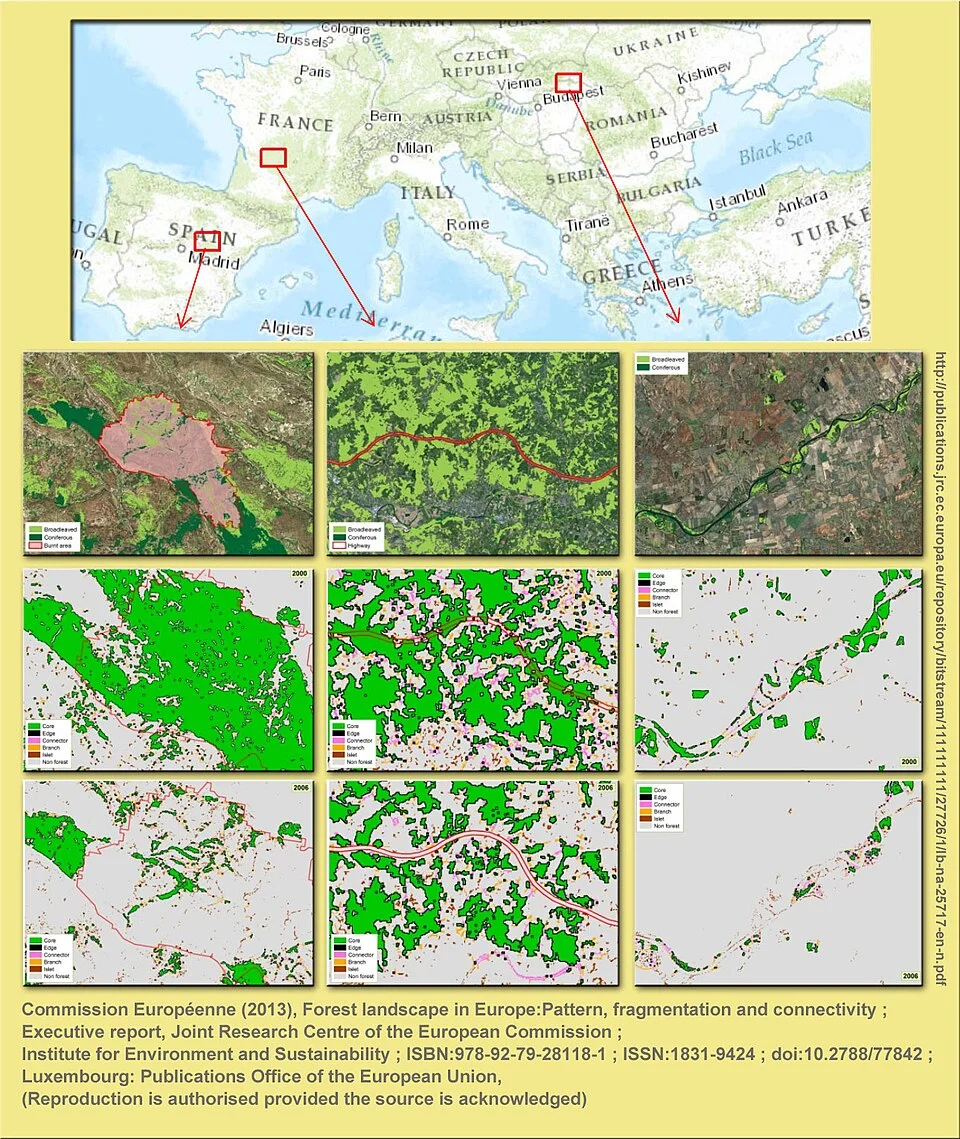
European forest-fragmentation examples involving fire, a highway and riparian clearance; source: Estreguil et al., European Commission JRC (2013).
Credit: Lamiot · CC BY-SA 3.0 · sourceResized and converted to WebP; uncropped.
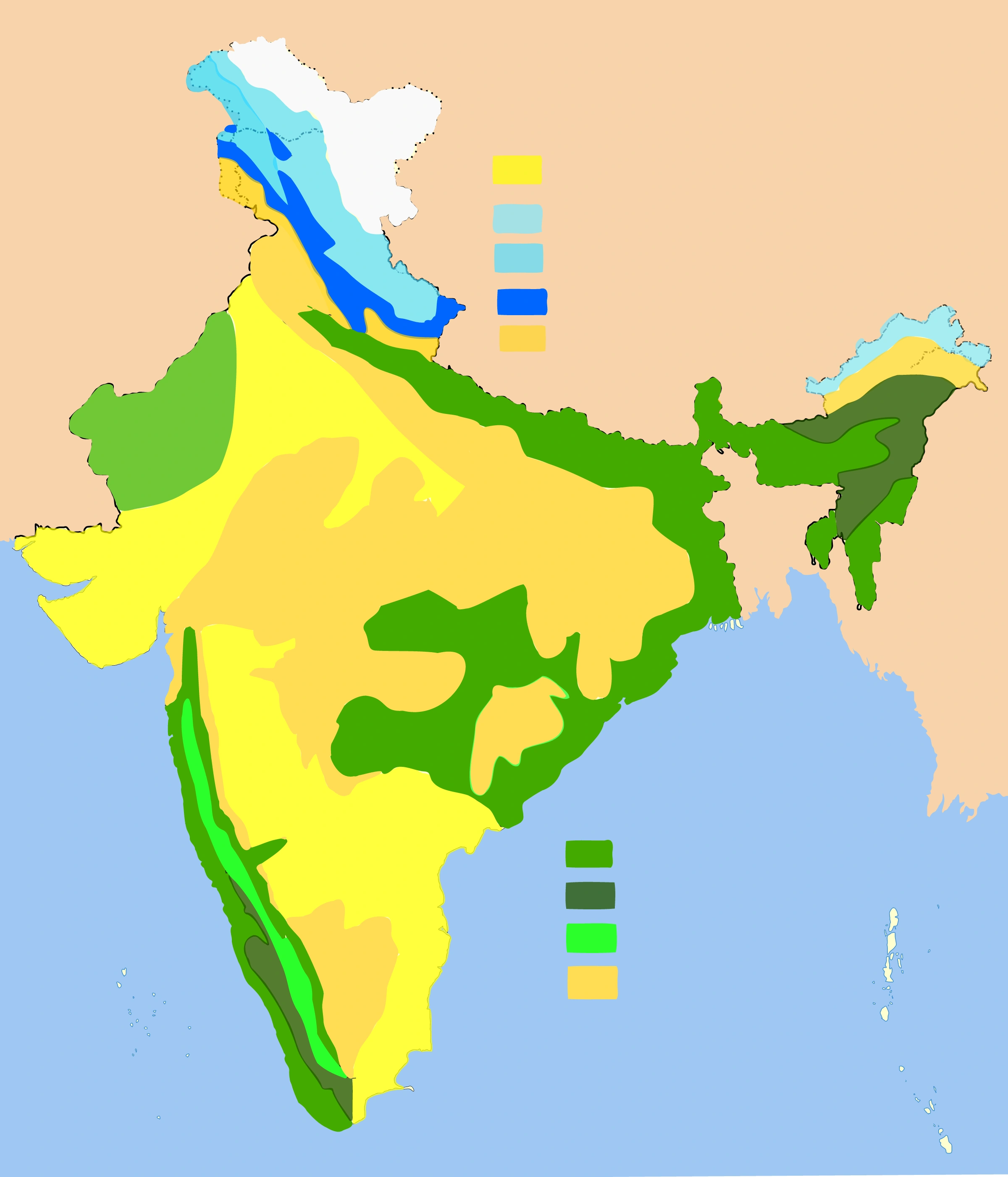
Map study
Natural vegetation zones: relate patterns to rainfall, relief and temperature. Potential natural vegetation differs from measured current forest cover.
- Read the source legend, scale and reference period before comparing regions.
- Connect spatial patterns to the processes discussed in this topic; this map is a study reference, not live operational data.
Credit: Amog · CC BY-SA 3.0 · sourceConverted to WebP on an opaque white background; proportionally resized without cropping. Original cartography and legend retained.
1. Meaning, drivers and landscape structure
Habitat fragmentation occurs when a relatively continuous habitat becomes divided into spatially separated patches. Habitat loss refers to a reduction in total habitat area, while fragmentation describes changes in patch size, number, arrangement and isolation. They frequently occur together, but are not interchangeable. A forest can lose area along one boundary without being split; conversely, a narrow road may divide animal populations while removing relatively little vegetation. Fragmentation must therefore be assessed at an appropriate spatial scale and for particular species.
Major human drivers include agricultural expansion, urbanisation, mining, dams, roads, railway lines, transmission infrastructure and fencing. River fragmentation occurs when dams and barrages interrupt longitudinal connectivity, while embankments can disconnect rivers from their floodplains. Natural disturbances also create patchy habitats, but naturally patchy ecosystems should not automatically be classified as degraded. Conservation must consider the ecosystem’s historical structure and disturbance regime.
Landscape ecology describes a patch as a habitat unit, a corridor as a connecting strip or route, and the matrix as the surrounding land cover. Matrix quality strongly influences isolation. A shaded plantation may permit movement by some forest animals, whereas a densely built settlement may be a strong barrier. A patch suitable for feeding may still lack the conditions necessary for breeding.
- Typical progression: perforation by clearings, subdivision, shrinkage of remaining patches and eventual disappearance of some patches.
- Fragmentation is not confined to forests; grasslands, wetlands, coral reefs and freshwater systems can also become disconnected.
2. Ecological consequences: edges, isolation and population decline
Fragmentation often increases the proportion of habitat near an edge relative to protected interior habitat. Forest edges may experience greater light, wind exposure and temperature fluctuations, together with lower humidity. These conditions can increase tree mortality, facilitate invasive species or raise fire vulnerability, depending on the ecosystem. Some generalist species benefit, but interior specialists may decline. Patch shape matters: a compact patch generally retains more core habitat than a long, narrow patch of equal area.
Isolation can restrict dispersal, seasonal migration and access to mates, food or breeding sites. Roads impose both direct mortality through collisions and indirect barrier effects through traffic, noise, lighting and avoidance behaviour. Fences may obstruct terrestrial mammals, while dams block migratory fish. Habitat requirements change across seasons and life stages, so protecting a breeding site alone may not safeguard the species using it.
Small populations are more vulnerable to random variation in births and deaths, environmental shocks, inbreeding and genetic drift. Reduced gene flow may weaken adaptive potential. Fragmentation can also disrupt pollination, seed dispersal and predator–prey relationships. Nevertheless, responses are not uniform: habitat amount, patch quality, matrix permeability and species traits all influence outcomes. The independent effects of fragmentation should not be assumed to be identical to those of habitat loss.
- Extinction debt: species may persist temporarily after fragmentation but disappear later as populations fail to remain viable.
- An ecological trap arises when animals are attracted to apparently suitable habitat that actually lowers their survival or reproductive success.
Planning a connectivity intervention
- 1. Identify focal species and their seasonal habitat requirements
- 2. Map habitat blocks, barriers, tenure and movement bottlenecks
- 3. Validate routes using field observations, movement data and community knowledge
- 4. Avoid damaging alignments and protect priority linkages
- 5. Restore habitat and install species-appropriate crossing measures
- 6. Monitor survival, dispersal and gene flow; revise management
3. Core theories and tools used in conservation biology
MacArthur and Wilson’s theory of island biogeography explains species richness through the balance between immigration and extinction. Larger islands generally support more species, while isolated islands tend to receive fewer colonists. Habitat patches can function as ecological islands, although terrestrial matrices are often more permeable than an ocean. The species–area relationship is commonly expressed as S = cA^z, where S is species richness, A is area, and c and z are fitted constants; it is not an exact universal extinction calculator.
Metapopulation theory examines groups of local populations linked by dispersal. Individual patches may undergo local extinction and subsequent recolonisation. Immigration can reduce local extinction risk through the rescue effect. In source–sink dynamics, source habitats produce a demographic surplus, whereas sink populations depend on immigration for persistence. A patch containing animals is therefore not necessarily a self-sustaining population.
Structural connectivity can be estimated using maps, patch distances and land-cover patterns. Functional connectivity requires information on actual movement, dispersal or gene flow, obtained through telemetry, camera traps, field observations and genetic analysis. Least-cost paths and circuit-theory models help identify potential routes and bottlenecks, but need ground validation. The SLOSS debate, single large or several small reserves, has no universal answer: large blocks favour many area-sensitive species, while several sites may capture distinct habitats and spread catastrophe risk.
- Useful indicators include core habitat area, edge density, patch isolation, road density and continuity of riparian vegetation.
- A corridor mapped from vegetation alone may not be functionally usable by the target species.
| Concept | Meaning | Example |
|---|---|---|
| Habitat loss | Reduction in available habitat area | Forest converted into cropland |
| Fragmentation | Subdivision and changed spatial arrangement of habitat | A transport corridor divides a forest |
| Degradation | Decline in habitat quality | Selective removal of nesting trees |
| Edge effect | Ecological changes near habitat boundaries | Greater wind exposure at a forest margin |
| Functional connectivity | Capacity of organisms to move between habitat units | Successful dispersal between breeding populations |
4. Indian conservation relevance and governance
Fragmentation is important in the Western Ghats, Himalayan foothills, central Indian tiger landscapes and northeastern elephant ranges. Protected areas may conserve breeding populations, but animals frequently move through reserve forests, farms, plantations and community-managed lands outside their boundaries. Narrow movement bottlenecks are especially vulnerable to construction and land-use change. In floodplain landscapes such as Kaziranga–Karbi Anglong, access to higher ground becomes critical during major floods.
The Wild Life (Protection) Act, 1972 provides for national parks, wildlife sanctuaries, conservation reserves and community reserves. Conservation reserves can help protect government-owned areas, particularly those adjacent to protected areas or linking them. Community reserves provide a framework for voluntary conservation of eligible private or community land. However, describing land as a wildlife corridor does not by itself create a new protected-area category or automatically prohibit every competing use.
Project Tiger, the National Tiger Conservation Authority and Project Elephant support landscape-level conservation. The Wildlife Institute of India provides research and guidance on wildlife-friendly infrastructure. Environmental appraisal under the Environment (Protection) Act, 1986 and EIA Notification, 2006, where applicable, should examine fragmentation alongside direct habitat loss. Eco-sensitive zones can regulate specified activities around protected areas, but their restrictions depend on notifications; they are neither blanket no-development belts nor substitutes for safeguarding distant movement corridors.
- Landscape planning must involve local communities and recognise applicable forest rights, tenure and livelihood dependence.
- Cumulative impacts matter: several individually small projects can collectively sever a major movement route.
5. Prevention, restoration and limitations of connectivity measures
The mitigation hierarchy begins with avoiding damage, followed by minimisation, restoration and, for residual impacts, carefully assessed offsets. Avoiding critical habitats and bottlenecks is preferable to promising compensation after they are severed. Afforestation elsewhere does not immediately replace an old-growth forest’s structure, species composition or ecological relationships. Regional infrastructure planning should therefore compare alternative routes before project alignment becomes fixed.
Connectivity measures include protecting broad habitat linkages, restoring native vegetation, retaining riparian buffers and conserving stepping-stone patches. Roads and railways may require species-appropriate underpasses, overpasses, canopy bridges, fencing that guides animals towards crossings, and controls on traffic or speed. Structures must match animal behaviour and local hydrology; poorly placed crossings or indiscriminate fencing can worsen barriers.
Corridors are not universally beneficial or sufficient. They may facilitate disease, invasive species or fire spread, and narrow strips may provide little interior habitat. Large, high-quality habitat blocks remain essential. Monitoring should assess successful dispersal, survival, reproduction and gene flow rather than merely recording occasional passage. Adaptive management adjusts interventions using evidence. Maintaining elevational and climatic gradients can also enable range shifts under climate change, provided destination habitats remain suitable.
- Combine ecological restoration with conflict prevention, timely compensation and locally appropriate livelihood measures.
- Conserve both connectivity and habitat quality; movement routes cannot compensate for the disappearance of breeding habitat.
Fragmentation: spatial patterns and ecological connectivity
The supplied metadata identifies three European examples of forest fragmentation associated with fire, a trans-European highway and clearance along a riparian area. These are comparative illustrations, not evidence of fragmentation in India. Their conceptual value lies in showing that different disturbances can interrupt habitat continuity. Habitat loss concerns how much habitat remains; fragmentation concerns its configuration, including patch size, isolation and connections. The two often occur together, but equal remaining forest areas can have different conservation outcomes depending on their arrangement.
Ecological consequences depend on the organism and the surrounding landscape, or matrix. A road may impede movement and increase mortality for some mammals while remaining traversable for certain birds. Newly created edges can alter light, temperature, moisture and exposure to disturbance, reducing effective interior habitat. In India, these mechanisms help explain why infrastructure planning near forests and protection of elephant and tiger movement routes matter alongside protected-area coverage. However, mapped forest continuity is not proof of functional connectivity: species-specific movement, survival and breeding evidence are needed. Fire-related breaks also require interpretation because their persistence and ecological effects depend on the fire regime and subsequent regeneration.
- Distinguish structural connectivity, measured from landscape patterns, from functional connectivity, demonstrated by organisms’ actual movement through that landscape.
- Corridors and wildlife crossings can reduce isolation, but cannot substitute for adequate habitat area, quality and protection from disturbance.
- The cited maps concern European forests in 2000 and 2006; they cannot establish present Indian conditions or quantify population and genetic effects.
Real-world case studies
Wildlife crossings on NH-44 in the Pench landscape
Widening of NH-44 through the Pench landscape raised concerns about disruption of wildlife movement. Dedicated crossing structures were incorporated, and Wildlife Institute of India monitoring documented their use by multiple species, including tigers. The example demonstrates that mitigation can improve road permeability, but crossing records alone do not establish complete restoration of population connectivity.
Long-term forest fragmentation research in the Brazilian Amazon
The Biological Dynamics of Forest Fragments Project near Manaus has studied experimental forest fragments since the late 1970s. Research documented strong edge effects and differing responses among species groups. Regeneration in the surrounding matrix subsequently altered isolation, showing that fragment outcomes depend on both patch characteristics and changes in the wider landscape.
Previous year questions
No source-linked PYQ is available here yet. Use the practice questions below.
Practice questions
Practice MCQ 1
With reference to habitat fragmentation, consider the following statements: 1. Habitat loss and habitat fragmentation are identical processes. 2. Matrix quality can influence movement between habitat patches. 3. A compact patch generally retains more core habitat than an elongated patch of equal area. Which of the statements given above are correct?
- A. 1 and 2 only
- B. 2 and 3 only
- C. 1 and 3 only
- D. 1, 2 and 3
Practice MCQ 2
A forest bird continues to occur in isolated patches for several decades after forest clearance, but subsequently disappears because recruitment cannot sustain its populations. This best illustrates:
- A. Ecological succession
- B. Competitive release
- C. Extinction debt
- D. Biomagnification
Practice MCQ 3
Which of the following provides the strongest evidence that a restored corridor has improved functional connectivity between two mammal populations?
- A. Increased vegetation cover visible in satellite images
- B. A continuous strip of land marked on a planning map
- C. Installation of signboards identifying a wildlife corridor
- D. Documented dispersal followed by breeding between the populations
Mains practice · Habitat conservation cannot be confined to protected-area boundaries. Explain with reference to fragmentation and suggest measures for maintaining ecological connectivity in India. Answer in 250 words.
- Distinguish habitat loss, fragmentation and degradation.
- Explain edge effects, isolation, reduced gene flow and extinction debt.
- Discuss seasonal movement and dispersal through human-used landscapes.
- Use Pench wildlife crossings and Kaziranga–Karbi Anglong linkages as examples.
- Prioritise avoidance, landscape planning, corridor protection and native habitat restoration.
- Include community participation, applicable rights, conflict mitigation and outcome-based monitoring.
Further reading
- NCERT, Biology, Class XII: Biodiversity and Conservation.
- Wildlife Institute of India: Eco-friendly Measures to Mitigate Impacts of Linear Infrastructure on Wildlife.
- India Code: Wild Life (Protection) Act, 1972.
- Ministry of Environment, Forest and Climate Change: Elephant Corridors of India, 2023.
- National Tiger Conservation Authority: reports and guidance on tiger landscapes and corridors.
- Convention on Biological Diversity: Kunming–Montreal Global Biodiversity Framework, especially Targets 1–3.
- https://commons.wikimedia.org/wiki/File:Fragmentation_foresti%C3%A8reRapportUE2013.jpg
Preparing for UPSC Civil Services? Get classroom teaching, answer-writing evaluation and mentorship at Pragnya IAS Academy, Ashok Nagar — see why aspirants choose us for IAS coaching in Hyderabad.