
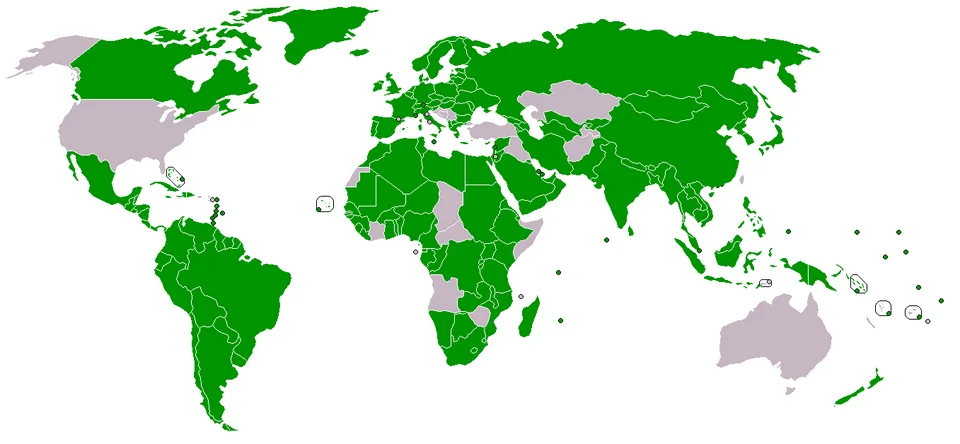
Kyoto Protocol ratification map identified as depicting 2005; a historical illustration of treaty participation.
Credit: Wikimedia Commons · CC BY-SA 3.0 · sourceResized and converted to WebP; uncropped.
1. Origins, legal character and differentiated responsibility
The UNFCCC, adopted in 1992, established the framework for stabilising greenhouse-gas concentrations at a level that would prevent dangerous human interference with the climate system. However, its initial framework did not impose Kyoto-style quantified emission limits. The 1995 Berlin Mandate initiated negotiations to strengthen developed-country commitments, culminating in the Kyoto Protocol at COP3 in 1997.
Kyoto operationalised the principle of common but differentiated responsibilities and respective capabilities. All countries share responsibility for climate protection, but developed countries were expected to lead because of their historical emissions and greater financial and technological capacity. Binding quantified commitments were assigned to participating developed countries and economies in transition, rather than to all Parties.
The Protocol entered into force after ratification by at least 55 UNFCCC Parties, including Annex I Parties accounting for at least 55% of that group’s total carbon dioxide emissions in 1990. Russia’s ratification helped satisfy the emissions threshold. These two entry-into-force conditions should not be confused with emission-reduction targets.
- UNFCCC Annex I identifies developed countries and economies in transition; Kyoto Annex B records quantified emission limitation or reduction commitments.
- The Protocol’s governing body is the Conference of the Parties serving as the meeting of the Parties to the Kyoto Protocol, abbreviated CMP.
Timeline
1992
UNFCCC adopted.
1997
Kyoto Protocol adopted at COP3.
2002
India accedes to the Protocol.
2005
Protocol enters into force on 16 February.
2008–2012
First commitment period.
2012
Doha Amendment adopted, establishing the 2013–2020 second commitment period.
2020
Doha Amendment enters into force on 31 December.
2. Commitment periods, gases and emission accounting
During the first commitment period, 2008–2012, participating developed countries undertook differentiated national or joint targets that collectively amounted to an average reduction of about 5% below 1990 levels. This was not a requirement that every country cut emissions by exactly 5%. Some targets allowed stabilisation or limited increases, while others required larger reductions.
The original greenhouse-gas basket comprised carbon dioxide, methane, nitrous oxide, hydrofluorocarbons, perfluorocarbons and sulphur hexafluoride. Emissions of different gases were aggregated using carbon dioxide equivalent, based on agreed global warming potentials. Nitrogen trifluoride was added for the second commitment period through the Doha Amendment.
Adopted at CMP8 in Doha in December 2012, the amendment established a second commitment period for 2013–2020. Participating Parties committed collectively to reductions of at least 18% below 1990 levels. Participation was narrower than in the first period, and the amendment entered into force only on 31 December 2020.
Assigned amounts defined permitted emissions over a commitment period. National inventories, registries, expert review and accounting for eligible land use, land-use change and forestry activities supported implementation. Forest sinks could contribute to compliance, but their treatment followed specific accounting rules rather than unrestricted credit for every plantation.
Simplified CDM project cycle
- 1. Prepare project design, baseline and additionality assessment
- 2. Obtain host-country approval and independent validation
- 3. Secure registration by the CDM Executive Board
- 4. Implement the project and monitor emission reductions
- 5. Obtain independent verification and certification
- 6. Receive CERs issued through the CDM system
3. The three Kyoto flexibility mechanisms
Kyoto introduced market-based flexibility mechanisms to lower the cost of meeting commitments. Their economic rationale was that a tonne of greenhouse-gas reduction can deliver a comparable atmospheric benefit regardless of where it occurs, provided the reduction is real and correctly accounted for. Nevertheless, using these mechanisms was intended to supplement domestic action.
International Emissions Trading under Article 17 enabled eligible Parties with commitments to trade emission units. Joint Implementation under Article 6 allowed an eligible Party to obtain emission reduction units from a reduction or removal project in another Party with a Kyoto commitment. Such projects generally involved developed countries or economies in transition.
The Clean Development Mechanism under Article 12 allowed projects in developing-country Parties without Kyoto emission caps to generate certified emission reductions. These CERs could be used by eligible developed-country Parties towards compliance. The CDM had a dual purpose: supporting sustainable development in host countries and assisting compliance by countries with commitments.
A CER represents one tonne of carbon dioxide equivalent. Additionality is central: credited reductions must be additional to those that would occur without the registered project activity. Baseline selection, monitoring and independent verification are therefore crucial. Weak additionality can create credits without equivalent climate benefits, undermining environmental integrity.
- CDM: project activity in a developing-country host; principal unit is the CER.
- Joint Implementation: project activity between Parties with Kyoto commitments; principal unit is the ERU.
- Emissions trading: exchange of eligible Kyoto units, including assigned amount units, or AAUs.
| Mechanism | Article | Participation or location | Principal unit |
|---|---|---|---|
| International Emissions Trading | 17 | Eligible Parties with Kyoto commitments | AAUs and other eligible Kyoto units |
| Joint Implementation | 6 | Projects in another Party with a Kyoto commitment | Emission reduction unit: ERU |
| Clean Development Mechanism | 12 | Projects hosted by developing-country Parties without Kyoto caps | Certified emission reduction: CER |
4. India’s position, opportunities and adaptation finance
India acceded to the Kyoto Protocol in August 2002 as a non-Annex I Party. It therefore had no binding Kyoto emission-reduction target. This did not mean India lacked climate responsibilities: it remained part of the UNFCCC framework and could undertake mitigation, reporting and sustainable-development measures without accepting the same quantified obligations as developed countries.
India became a major host of CDM projects across renewable energy, energy efficiency, industrial processes and waste management. Its national CDM approval arrangements assessed projects’ contribution to sustainable development. Host-country approval, however, did not itself create CERs; projects also had to satisfy international registration, monitoring and verification requirements.
Kyoto also linked mitigation markets with adaptation finance. A 2% share of CERs issued for most CDM projects supported the Adaptation Fund, with an exemption for projects in least developed countries. The Fund finances concrete adaptation projects and programmes in vulnerable developing countries. For India, Kyoto illustrates the interaction between climate equity, international finance, technology deployment and development needs.
5. Compliance, achievements and criticisms
Kyoto created a comparatively detailed international architecture for monitoring, reporting, review and compliance. Its Compliance Committee has facilitative and enforcement branches. Consequences for exceeding assigned emissions included deduction of the excess multiplied by 1.3 from the next commitment period’s assigned amount, a compliance action plan and suspension of eligibility to transfer units under emissions trading.
The treaty established practical experience with carbon pricing, project verification, emissions registries and international accounting. However, its coverage was constrained by the United States’ non-ratification, Canada’s withdrawal and the absence of binding caps for developing countries, whose share of global emissions was increasing.
Criticisms also included uncertain project additionality, uneven geographical distribution of CDM investment, volatile credit prices and surplus assigned units associated with economic contraction in some economies in transition. Such surplus units were often described as hot air. Meeting formal targets did not necessarily demonstrate an equivalent amount of new climate policy effort. Kyoto’s institutional achievements must therefore be distinguished from its limited ability to reverse rising global emissions.
6. Kyoto and the Paris climate architecture
The Paris Agreement, adopted in 2015, shifted climate governance towards nationally determined contributions from all Parties. Unlike Kyoto’s internationally negotiated quantified commitments for a specified group, Paris requires successive national contributions within a common framework, while retaining equity and differentiated responsibilities in the light of different national circumstances.
It is inaccurate to describe Kyoto as legally binding and Paris as entirely voluntary. Paris is a legally binding treaty with procedural obligations, including preparing, communicating and maintaining successive NDCs. However, achieving each nationally chosen mitigation outcome is not imposed in the same manner as Kyoto’s quantified commitments.
Paris did not simply abolish Kyoto in 2015. Kyoto’s second commitment period continued through 2020, and subsequent decisions addressed accounting and aspects of the transition from the CDM. Paris Article 6 provides a separate framework for international cooperation and carbon markets; it should not be treated as another name for the three Kyoto mechanisms.
Ratification, differentiated commitments and India’s position
A ratification map helps explain the Kyoto Protocol’s geographical participation, but participation must not be confused with uniform obligations. Under the UNFCCC principle of common but differentiated responsibilities and respective capabilities, Kyoto assigned quantified emission limitation or reduction commitments to developed-country Parties listed in Annex B. Developing-country Parties, including India, did not receive these binding targets. The supplied title identifies this as a 2005 map: it is therefore a historical reference, not evidence of present treaty status. Without a description or verified legend, individual countries’ classifications cannot be established from the metadata alone.
Kyoto linked binding commitments with emissions accounting, reporting, review and compliance procedures. Its three flexible mechanisms were international emissions trading, Joint Implementation and the Clean Development Mechanism (CDM). India’s principal connection to these mechanisms was as a developing-country host for CDM projects, which could generate certified emission reductions for use towards eligible Parties’ commitments. Such credits required more than a claim of environmental benefit: reductions had to be assessed against a baseline and demonstrate additionality. For governance analysis, distinguish formal treaty participation from the stringency of commitments, actual implementation and environmental effectiveness.
- Ratification is not a reduction target: Annex I under the UNFCCC and Annex B under Kyoto serve related but distinct legal functions.
- CDM involved projects in developing countries; Joint Implementation involved projects in countries with Kyoto commitments. Neither mechanism meant that India acquired a national Kyoto emissions cap.
- Kyoto’s differentiated target structure contrasts with the Paris Agreement’s nationally determined contributions from all Parties; differentiation did not disappear under Paris.
Real-world case studies
Delhi Metro: regenerative braking
Delhi Metro’s regenerative-braking CDM project recovered electrical energy during braking, reducing electricity consumption and associated emissions. It illustrates how urban transport efficiency can generate measurable mitigation benefits. The credited benefit was energy recovery, not an automatic credit for every passenger journey.
Industrial-gas credits and perverse incentives
CDM projects destroying HFC-23, a potent greenhouse gas produced as a by-product of HCFC-22 manufacture, generated substantial credits. Concerns arose that credit revenues could incentivise increased production or manipulation of baselines. The controversy prompted tighter rules and restrictions in major credit markets, illustrating why additionality and incentive design matter.
Previous year questions
No source-linked PYQ is available here yet. Use the practice questions below.
Practice questions
Practice MCQ 1
With reference to the Kyoto Protocol, consider the following statements: 1. India had a binding quantified emission-reduction target during the first commitment period. 2. The United States signed but did not ratify the Protocol. 3. Nitrogen trifluoride was added to the greenhouse-gas basket for the second commitment period. Which statements are correct?
- A. 1 and 2 only
- B. 2 and 3 only
- C. 1 and 3 only
- D. 1, 2 and 3
Practice MCQ 2
Which Kyoto mechanism primarily enabled emission-reduction projects hosted in developing countries without Kyoto emission caps to generate certified emission reductions?
- A. Joint Implementation
- B. International Emissions Trading
- C. Clean Development Mechanism
- D. Global Stocktake
Practice MCQ 3
In the context of Kyoto carbon credits, additionality refers to which of the following?
- A. Reductions beyond those that would occur without the project activity
- B. An automatic increase in a country’s assigned emission allowance
- C. Counting the same reduction towards two countries’ targets
- D. Adding all existing forest carbon stocks to tradable credits
Mains practice · The Kyoto Protocol established durable institutions for climate governance but achieved limited global emissions coverage. Discuss, highlighting lessons for the Paris Agreement. Answer in 250 words.
- Introduce Kyoto’s differentiated, quantified commitments and two commitment periods.
- Explain contributions to carbon markets, inventories, registries, verification and compliance.
- Discuss non-participation, withdrawal, narrower second-period coverage and rising emissions outside capped countries.
- Examine additionality, surplus units, market instability and unequal access to project finance.
- Relate lessons to wider participation under Paris, stronger ambition, transparent accounting and environmental integrity.
- Conclude with the need to combine equity, finance and credible domestic mitigation.
Further reading
- UNFCCC: Kyoto Protocol treaty text, especially Articles 3, 6, 12 and 17 and Annex B.
- UNFCCC: Doha Amendment and Kyoto Protocol compliance mechanism.
- UNFCCC CDM website: project cycle, methodologies and project database.
- Adaptation Fund official website: history, financing and project portfolio.
- Ministry of Environment, Forest and Climate Change: India’s climate-change reports and CDM information.
- https://commons.wikimedia.org/wiki/File:Kyoto_Protocol_ratification_map_2005.png
Preparing for UPSC Civil Services? Get classroom teaching, answer-writing evaluation and mentorship at Pragnya IAS Academy, Ashok Nagar — see why aspirants choose us for IAS coaching in Hyderabad.