

Indian rhinoceros (Rhinoceros unicornis, Rhinocerotidae, Perissodactyla) in Kaziranga National Park, Assam, India.
Credit: Tisha Mukherjee · CC BY-SA 4.0 · source

A Blue-crested lizard (Calotes mystaceus) in Keibul Lamjao National Park, Bishnupur district, Manipur, India.
Credit: ianaré sévi · CC BY-SA 3.0 · source
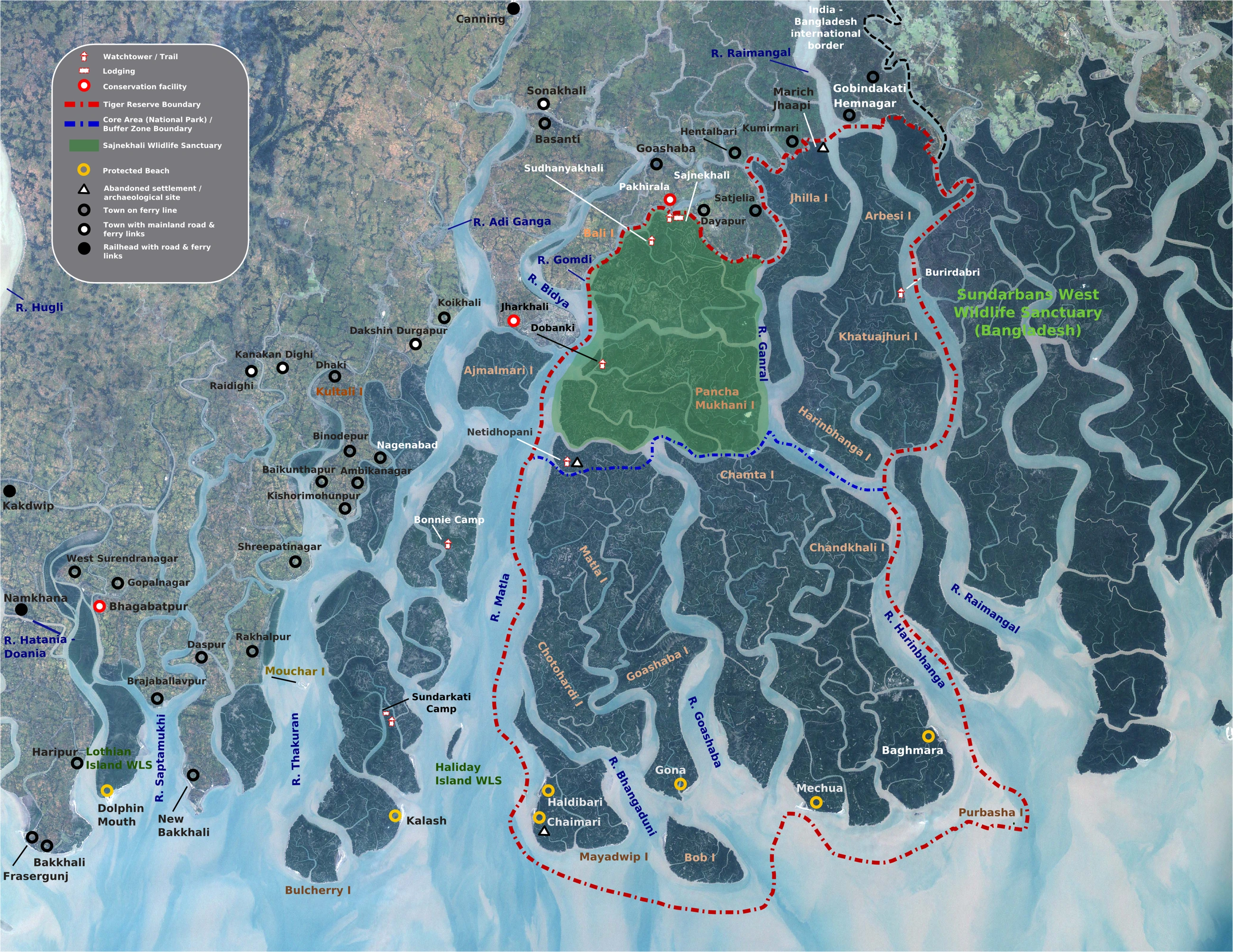
Map study
Sundarbans delta: relate distributaries and the Bay of Bengal coast to mangrove habitats. This geographic view is not a complete current protected-area boundary inventory.
- Read the source legend and reference date before interpreting the map.
- Use spatial patterns to support topic revision; verify current official boundaries, designations and warnings separately.
Credit: Pradiptaray · Public domain · sourceConverted to WebP on an opaque white background; proportionally resized without cropping. Original cartography and legend retained.
1. Meaning, purpose and ecological significance
A national park is an area protected for its ecological, faunal, floral, geomorphological or zoological importance. Its objective is not merely to preserve a flagship animal, but to conserve the larger ecosystem: native species, breeding grounds, food webs, water regimes and natural ecological processes. National parks are therefore examples of in situ conservation, in which organisms are protected within their natural habitats.
India’s national parks represent considerable ecological diversity. Hemis protects cold-desert and high-altitude habitats in Ladakh; Desert National Park protects parts of the Thar ecosystem in Rajasthan; Kaziranga conserves the Brahmaputra floodplain in Assam; and Gulf of Kachchh Marine National Park protects intertidal and marine habitats in Gujarat. Thus, neither dense tree cover nor the presence of large mammals is a necessary condition for national park status.
Protected ecosystems also provide services beyond their boundaries, including watershed protection, carbon storage, erosion control, pollination and opportunities for education and regulated tourism. However, a park is not an ecologically self-sufficient island. Migratory animals, river flows, seasonal grazing grounds of wild herbivores and genetic exchange often depend on adjoining landscapes and wildlife corridors.
- In situ conservation contrasts with ex situ conservation in zoos, botanical gardens, seed banks and captive-breeding facilities.
- The IUCN Category II management category is called National Park, but a domestic legal label does not automatically establish its IUCN classification.
- Marine national parks show that protected-area conservation extends beyond terrestrial forests.
Timeline
1936
Hailey National Park, now Jim Corbett National Park, becomes India’s first national park.
1972
The Wild Life (Protection) Act establishes the principal national statutory framework for wildlife protection and national parks.
1973
Project Tiger is launched; several national parks become central to tiger-conservation landscapes.
2006
Wildlife-law amendments provide the statutory framework for the National Tiger Conservation Authority and tiger reserves; the Forest Rights Act is also enacted.
September 2022
Cheetahs from Namibia are introduced into Kuno National Park.
2. Legal framework and declaration
The principal law is the Wild Life (Protection) Act, 1972. Under Section 35, a State Government may issue a notification declaring its intention to constitute an area as a national park. The proposed area may lie within a wildlife sanctuary or outside one. Its limits must be specified, followed by investigation and settlement of existing rights through the statutory process.
A final national park notification follows the required settlement of claims and vesting of relevant rights in the State Government. Unlike the sanctuary framework, which can permit the continuation of certain rights, the national park framework does not provide the same route for retaining such rights. These provisions must nevertheless be read alongside the Forest Rights Act, 2006, applicable rights-recognition procedures and judicial directions. Notification does not justify disregarding lawful claims or due process.
Alteration of a national park’s boundaries requires a recommendation of the National Board for Wild Life. Destruction, exploitation or removal of wildlife, damage or diversion of habitat, and diversion, stoppage or enhancement of water flow are restricted by the Act. The exceptional statutory permission route requires a conservation-related determination by the State Government in consultation with the National Board and a permit from the Chief Wild Life Warden; it is not an ordinary resource-extraction licence.
Livestock grazing is prohibited. Livestock entry is also prohibited except where an animal is used as a vehicle by a person authorised to enter. Hunting is prohibited subject to narrowly defined statutory exceptions. Entry and tourism are regulated rather than universally banned. Section 38 additionally enables the Central Government to declare national parks over qualifying areas leased or otherwise transferred to it.
- A State Government notification, rather than a UNESCO decision, creates the domestic national park designation.
- The National Board for Wild Life is chaired by the Prime Minister; it is distinct from the National Tiger Conservation Authority.
- For Prelims, distinguish regulated visitor access from prohibited grazing and extractive uses.
Simplified national park declaration process
- 1. Identify an ecologically significant area and proposed boundaries
- 2. State Government issues notification of intention under Section 35
- 3. Investigate and settle claims and rights through applicable legal procedures
- 4. Complete statutory requirements concerning rights and vesting
- 5. Issue final notification specifying boundaries and commencement date
- 6. Implement protection, habitat management and regulated access
3. National parks and overlapping conservation designations
National parks and wildlife sanctuaries are both statutory protected areas under the 1972 Act. National parks impose stricter controls concerning grazing and the continuation of rights. This does not mean that sanctuaries permit unrestricted hunting, construction or commercial exploitation: they also operate under substantial legal protection.
A tiger reserve is notified under the tiger-conservation provisions of the same Act and includes a core or critical tiger habitat and a buffer or peripheral area. A national park may form part of its core, but national parks and tiger reserves are not interchangeable categories. Similarly, a biosphere reserve is a broader conservation and sustainable-development framework with core, buffer and transition zones; it is not a separate protected-area category created by the 1972 Act.
Conservation reserves generally concern government-owned land, especially areas adjoining protected areas or linking them, and are declared after consultation with local communities. Community reserves concern voluntarily conserved private or community land under the statutory conditions. Neither designation should be confused with a national park.
Ramsar recognition concerns wetlands of international importance, while UNESCO World Heritage inscription recognises outstanding universal value. A national park may carry either designation without losing its domestic legal identity. Eco-sensitive zones around protected areas are separately notified under the Environment (Protection) Act, 1986 framework. They are not themselves national parks, and applicable boundaries and restrictions must be checked against notifications and court directions.
- Critical tiger habitat under wildlife law and critical wildlife habitat under the Forest Rights Act are different legal concepts.
- International recognition does not substitute for national or state-level legal protection.
- A protected area’s boundary, a tiger reserve’s boundary and a World Heritage property’s boundary need not coincide.
| Designation | Legal or institutional basis | Key distinction |
|---|---|---|
| National park | Wild Life (Protection) Act, Section 35 | Strict habitat protection; livestock grazing prohibited |
| Wildlife sanctuary | Wild Life (Protection) Act, Sections 18–26A | Certain rights may continue; grazing may be regulated, controlled or prohibited |
| Conservation reserve | Wild Life (Protection) Act, Section 36A | Government-owned land; consultation with local communities |
| Community reserve | Wild Life (Protection) Act, Section 36C | Voluntarily conserved private or community land |
| Tiger reserve | Wild Life (Protection) Act, Section 38V | Tiger-focused core-and-buffer landscape |
| Biosphere reserve | National programme and UNESCO MAB framework | Core, buffer and transition zones; not a separate category under the wildlife Act |
4. Geography and species associations for Prelims
Prepare national parks through map-based clusters rather than isolated lists. In the Himalaya, connect Hemis with Ladakh and snow leopard habitat, Great Himalayan National Park with Himachal Pradesh, and Nanda Devi and Valley of Flowers with Uttarakhand. In the Northeast, associate Kaziranga with Assam’s floodplain grasslands, Namdapha with Arunachal Pradesh and Keibul Lamjao with Manipur.
Across western and central India, connect Gir with Gujarat and the Asiatic lion; Desert National Park with Rajasthan and the Great Indian Bustard; and Kanha, Bandhavgarh and Kuno with Madhya Pradesh. Kuno received the first batch of cheetahs from Namibia in September 2022 under India’s cheetah introduction programme. This makes it important for questions connecting species conservation with habitat management.
In southern India, link Silent Valley with Kerala’s tropical evergreen forests, Eravikulam with the Nilgiri tahr, and Bandipur with Karnataka’s Western Ghats landscape. Sundarbans National Park in West Bengal represents a tidal mangrove ecosystem. Such associations are useful, but a species recorded in a park should not automatically be treated as endemic to that park.
- Keibul Lamjao is associated with Loktak Lake, floating phumdis and the sangai deer.
- Dachigam in Jammu and Kashmir is especially associated with the hangul.
- Kaziranga, Manas, Keoladeo and Sundarbans are examples of national parks with UNESCO World Heritage recognition.
5. Management challenges and conservation priorities
Legal notification is only the beginning of conservation. Parks face habitat fragmentation, invasive alien species, poaching, pollution, altered river flows, unregulated tourism and climate-related changes. Roads and railways can obstruct migration and cause animal mortality, while activities outside a park may damage its ecological functioning.
Effective management requires habitat-specific decisions. Grasslands should not be treated as degraded forests awaiting tree planting; floodplain parks require attention to natural inundation and access to high-ground refuges; marine parks depend on coastal water quality. Scientific monitoring must assess habitats and ecological processes, not only charismatic-animal numbers.
A durable approach combines enforcement with rights-sensitive governance, local participation, timely conflict compensation, responsible tourism and protection of corridors. Relocation, wherever legally considered, requires applicable safeguards and cannot be assumed to follow automatically from national park status.
- Priorities include invasive-species control, appropriate fire management and maintenance of environmental flows.
- Wildlife crossings and careful infrastructure siting can reduce landscape fragmentation.
- Assess conservation outcomes alongside livelihood impacts and procedural fairness.
Real-world case studies
Kaziranga: conserving a flood-dependent ecosystem
Annual Brahmaputra floods sustain Kaziranga’s floodplain ecology but can temporarily submerge extensive habitat. Wildlife moves towards higher ground, including the adjoining Karbi Anglong landscape. Protection of movement routes and traffic management during floods illustrate why conservation must extend beyond park boundaries.
Keibul Lamjao: hydrology and a specialised habitat
Keibul Lamjao National Park protects floating phumdi habitat in Loktak Lake and the sangai, a brow-antlered deer. Altered water-level regimes associated with the Ithai barrage affect the ecological cycle of phumdis. Species conservation therefore requires wetland and hydrological management alongside protection from hunting.
Previous year questions
UPSC Prelims 2015
Which national park is distinctive for being a swamp with floating vegetation that supports rich biodiversity?
- A. Bhitarkanika National Park
- B. Keibul Lamjao National Park
- C. Keoladeo Ghana National Park
- D. Sultanpur National Park
Practice questions
Practice MCQ 1
Consider the following statements about national parks in India: 1. A national park may be declared outside an existing wildlife sanctuary. 2. Livestock grazing may routinely be permitted by the Chief Wild Life Warden. 3. Alteration of national park boundaries requires a recommendation of the National Board for Wild Life. Which statements are correct?
- A. 1 and 2 only
- B. 2 and 3 only
- C. 1 and 3 only
- D. 1, 2 and 3
Practice MCQ 2
Which pair is incorrectly matched?
- A. Hemis National Park — Ladakh
- B. Namdapha National Park — Arunachal Pradesh
- C. Eravikulam National Park — Karnataka
- D. Desert National Park — Rajasthan
Practice MCQ 3
Consider the following statements: 1. Every national park is necessarily a tiger reserve. 2. National park and Ramsar site designations may overlap. 3. Biosphere reserve is a separate protected-area category created by the Wild Life (Protection) Act, 1972. Which statements are correct?
- A. 1 only
- B. 2 only
- C. 2 and 3 only
- D. 1 and 3 only
Mains practice · National parks are essential but insufficient for long-term biodiversity conservation. Discuss with reference to India. (150 words)
- Explain in situ protection, habitat conservation and ecosystem services.
- Identify limitations arising from isolation, disrupted water regimes and external pressures.
- Use Kaziranga’s movement corridors or Keibul Lamjao’s hydrology as an example.
- Recommend landscape connectivity, scientific management and infrastructure mitigation.
- Integrate community participation, lawful rights safeguards and conflict reduction.
Further reading
- India Code: Wild Life (Protection) Act, 1972, particularly Sections 35, 36A, 36C, 38 and 38V.
- Wildlife Institute of India: National Wildlife Database, protected-area lists and profiles.
- Ministry of Environment, Forest and Climate Change: National Wildlife Action Plan 2017–2031.
- Ministry of Tribal Affairs: Forest Rights Act, 2006 and associated rules.
- NCERT Biology, Class XII: Biodiversity and Conservation.
- UNESCO World Heritage Centre: Official profiles of Indian natural World Heritage properties.
Preparing for UPSC Civil Services? Get classroom teaching, answer-writing evaluation and mentorship at Pragnya IAS Academy, Ashok Nagar — see why aspirants choose us for IAS coaching in Hyderabad.