
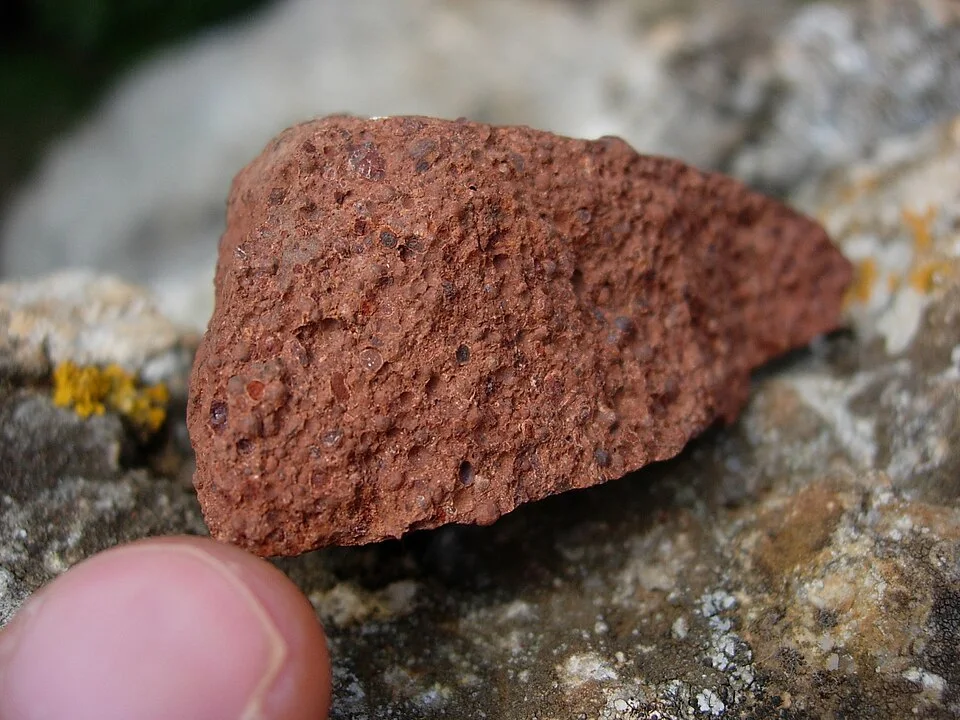
Bauxite identified in the metadata as from Hérault, France; a comparative example, not Indian geological evidence.
Credit: saphon · CC BY-SA 1.0 · sourceResized and converted to WebP; uncropped.
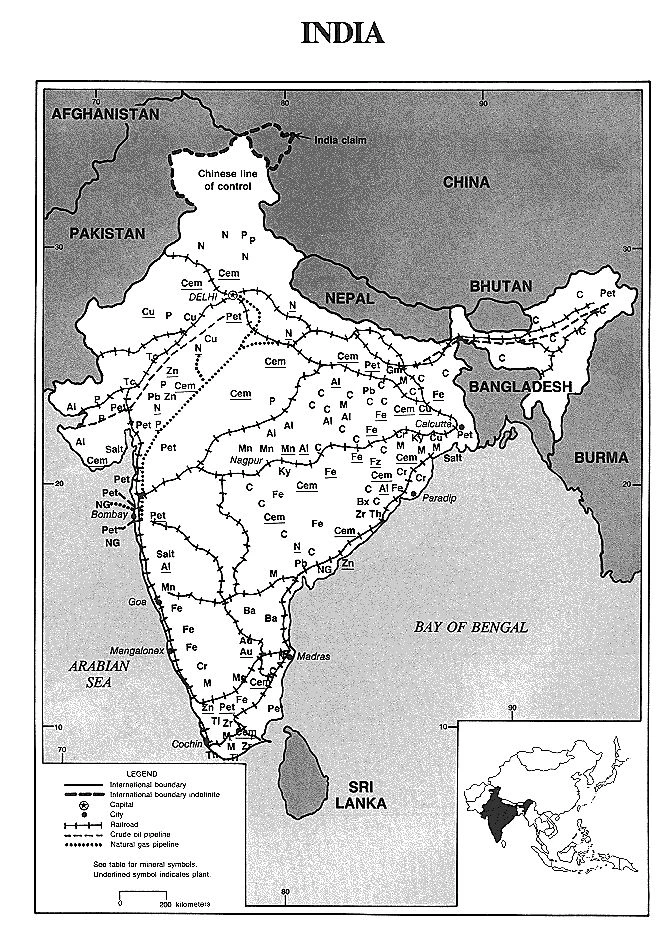
Map study
USGS reference map of mineral deposits and mineral industries in India. Historical place names and boundary depiction are retained from the source; not a current official political map, mine inventory or production dataset.
- Locate Fe (iron), Mn (manganese), Al (aluminium/bauxite-related) and C (coal) symbols; underlined symbols denote industrial plants, not deposits.
- Compare the eastern and peninsular mineral belts. The source legend does not establish present reserves, output or operating status.
- For current official boundary depiction and mineral statistics, consult Survey of India and Indian Bureau of Mines publications.
Credit: United States Geological Survey · Public domain (US federal government work) · sourceConverted to WebP without cropping or changing cartography; original legend retained.
1. Nature, composition and economic significance
Bauxite is a heterogeneous rock containing hydrated aluminium oxides and oxyhydroxides, together with varying amounts of iron oxides, silica and titanium-bearing minerals. The principal aluminium minerals are gibbsite, boehmite and diaspore. Iron compounds commonly give bauxite a reddish or brownish colour, although pale, yellow and grey varieties also occur. Unlike an individual mineral, bauxite has no fixed chemical composition.
Its suitability for industry depends on available alumina, reactive silica, mineralogy and processing conditions. High reactive silica is undesirable in Bayer refining because it consumes caustic soda and causes alumina losses. Consequently, a large geological occurrence is not automatically an economically workable deposit. Ore quality, deposit thickness, overburden, transport, water availability, environmental permissions and energy costs determine commercial viability.
Most bauxite is used to manufacture alumina, which is subsequently smelted into aluminium. Selected grades also serve refractory, abrasive, cement and chemical industries. Aluminium combines low density, corrosion resistance, electrical conductivity and recyclability. These properties explain its use in aircraft, vehicles, transmission conductors, buildings and packaging. Distinguish the three stages carefully: bauxite is the ore, alumina is aluminium oxide, and aluminium is the metal.
- Resource denotes a geological concentration with potential economic interest; reserve denotes the economically mineable portion established through appropriate assessment.
- Deposits rich in readily digestible gibbsite generally require less severe Bayer-process conditions than deposits dominated by boehmite or diaspore.
2. Formation and association with laterite
Many important bauxite deposits form through prolonged chemical weathering of aluminium-bearing rocks under warm, humid conditions. Percolating water removes relatively mobile constituents, including alkalis and much of the silica, while aluminium and iron become residually concentrated. This enrichment is commonly associated with lateritisation. Aluminium need not be completely immobile: dissolution and reprecipitation can also contribute to the development of a bauxitic profile.
High rainfall, warmth, effective drainage and long periods of landscape stability favour this process. Well-drained plateau surfaces allow repeated leaching, while limited erosion helps preserve the weathered mantle. Bauxite therefore frequently occurs as caps or discontinuous layers on uplands, above weathered parent rock. Where uplift and dissection subsequently reshape the landscape, remnants can survive on isolated flat-topped hills.
Two broad settings are lateritic bauxite and karst bauxite. Lateritic deposits develop over varied silicate rocks, including basalt and crystalline rocks; karst deposits occur in depressions and cavities associated with carbonate terrains. Indian deposits are predominantly lateritic. However, laterite and bauxite are not synonyms: laterite may be strongly iron-rich and contain too little recoverable alumina to qualify as ore. Present vegetation or climate alone cannot explain a deposit, because many profiles preserve evidence of older weathering conditions.
- Map linkage: connect bauxite with plateau caps in the Eastern Ghats, central Indian uplands and parts of the western peninsular region.
- Exam distinction: lateritisation is a weathering process; economic bauxitisation requires sufficient aluminium enrichment and acceptable ore quality.
From bauxite deposit to aluminium product
- 1. Assess ore quality, feasibility, environmental impacts and legal requirements
- 2. Mine bauxite and prepare the ore
- 3. Digest ore in caustic soda through the Bayer process
- 4. Separate residue, precipitate aluminium hydroxide and calcine to alumina
- 5. Smelt alumina electrolytically through the Hall–Héroult process
- 6. Cast and fabricate aluminium; collect scrap for recycling
3. Distribution in India and the world
Odisha is India’s leading bauxite state in both resource importance and production. Major occurrences lie in the Eastern Ghats, especially in the southern and southwestern plateau belt. Panchpatmali in Koraput district supplies National Aluminium Company Limited’s refinery at Damanjodi. The Baphlimali deposit is associated with the Utkal Alumina project in Rayagada district. These examples connect plateau geology with large-scale, integrated mineral development.
Gujarat, Jharkhand, Chhattisgarh, Maharashtra and Madhya Pradesh are other important bauxite-bearing states. Gujarat has deposits in Kachchh and the Saurashtra region. Jharkhand’s Lohardaga–Gumla belt is well known, while the Mainpat plateau is a significant occurrence in Chhattisgarh. Maharashtra has lateritic deposits in the Kolhapur region and adjoining western uplands. Madhya Pradesh includes occurrences around Amarkantak and the Maikal uplands. Andhra Pradesh also has substantial Eastern Ghats resources, but resource availability must not be equated with active large-scale mining.
Globally, Australia, Guinea, China and Brazil are major bauxite-producing countries. Guinea is especially important for high-quality resources and exports, while Australia has extensive deposits and major mining operations. Jamaica is a classic Caribbean bauxite locality. Production rankings and trade shares change over time; they should be checked against the latest Indian Bureau of Mines and international mineral statistics rather than memorised without a reference year.
- For map practice, locate Koraput, Rayagada, Lohardaga, Mainpat, Kolhapur and Amarkantak.
- Do not confuse bauxite-producing countries with aluminium-producing countries: smelting depends heavily on electricity availability and price.
| State | Location or belt | Association |
|---|---|---|
| Odisha | Panchpatmali, Koraput | Eastern Ghats plateau deposit; NALCO mine |
| Jharkhand | Lohardaga–Gumla | Lateritic deposits of the Chota Nagpur uplands |
| Chhattisgarh | Mainpat | Plateau-cap bauxite |
| Gujarat | Kachchh and Saurashtra | Western Indian bauxite-bearing regions |
| Maharashtra | Kolhapur region | Lateritic deposits in western peninsular uplands |
| Madhya Pradesh | Amarkantak–Maikal region | Central Indian upland occurrences |
4. Processing, industrial location and strategic value
Mining commonly uses opencast methods where bauxite occurs near the surface. After removing overburden, the ore is extracted, crushed and sometimes washed or otherwise beneficiated. In the Bayer process, hot caustic soda dissolves the aluminium-bearing component. Insoluble material is separated, aluminium hydroxide is precipitated from the solution, and calcination converts it into alumina.
The Hall–Héroult process then reduces alumina electrolytically in molten cryolite-based electrolyte. Carbon anodes are consumed during conventional smelting, generating carbon dioxide. As a rough industrial rule, about four to five tonnes of bauxite yield approximately two tonnes of alumina and one tonne of aluminium; actual requirements vary with ore grade and recovery efficiency. Refining requires substantial heat, water and chemicals, whereas smelting is particularly electricity-intensive.
These differences shape industrial location. Refineries often benefit from proximity to mines, water and transport infrastructure; smelters require dependable, competitively priced electricity and may be distant from the ore source. NALCO illustrates this separation through its Panchpatmali mine and Damanjodi refinery in Koraput, and its smelter and captive power complex at Angul. Aluminium’s role in electrification, lightweight transport and renewable-energy infrastructure increases its economic significance. Recycling aluminium requires only a small fraction of the energy needed for primary production, although collection, sorting and alloy quality constrain circularity.
- Location sequence: geological availability governs mining; ore logistics influence refining; electricity strongly influences smelting.
- Aluminium is abundant in Earth’s crust, but abundance does not make extraction cheap because its compounds are chemically stable.
5. Environmental impacts and governance
Bauxite-bearing plateaus may overlap forests, biodiversity-rich habitats, tribal settlements and culturally important landscapes. Opencast mining can remove vegetation and soil, fragment habitats, generate dust and alter drainage. Plateau weathering profiles can influence infiltration, groundwater storage and spring flows, but the effects of mining depend on local geology and must be assessed rather than assumed to be identical everywhere.
Alumina refining generates alkaline bauxite residue, or red mud, containing iron-rich solids and other constituents. Poorly managed storage can cause seepage, dust pollution or containment failure. Safer management includes engineered containment, water recovery, appropriate residue thickening or dry stacking, monitoring and progressive rehabilitation. Smelting creates a different set of concerns, including electricity-related emissions and hazardous spent pot lining. Thus, mining, refining and smelting should not be treated as environmentally interchangeable activities.
India’s governance framework includes the Mines and Minerals (Development and Regulation) Act, 1957, environmental clearance requirements under the EIA Notification, 2006, applicable forest-clearance law and the Forest Rights Act, 2006. PESA, 1996, is relevant in Scheduled Areas. Gram Sabha roles arise from specific legal provisions and recognised rights, not from a blanket rule applying identically to every mine. District Mineral Foundations support mining-affected areas. Effective governance requires credible assessments, rights recognition, transparent consultation, benefit sharing and funded mine-closure plans.
- A balanced answer should connect mineral security and employment with water security, biodiversity, community rights and intergenerational equity.
- Mitigation priorities include preserving topsoil, controlling runoff, restoring native vegetation and independently monitoring rehabilitation.
Bauxite: From Lateritic Weathering to Aluminium
Bauxite is the principal commercial ore of aluminium, but it is not a single mineral. It is a rock composed chiefly of aluminium-bearing hydroxides, commonly accompanied by iron oxides, silica and other constituents. Many economically important Indian deposits formed through prolonged chemical weathering and leaching under warm, humid conditions. Removal of more soluble materials can leave an aluminium-rich residue associated with lateritic surfaces. However, not every laterite is bauxite: ore quality depends on aluminium content, impurities and economic recoverability.
The supplied metadata identifies a bauxite example from Hérault, France. It illustrates the resource category comparatively; it does not establish the appearance, grade or formation history of an Indian deposit. In India, important bauxite-bearing regions include Odisha’s plateau belt and parts of Gujarat, Jharkhand, Chhattisgarh, Maharashtra and Madhya Pradesh. Aluminium production links distinct stages: mining bauxite, refining it into alumina, and electrolytically reducing alumina to aluminium. Since smelting requires substantial electricity, industrial location cannot be explained by ore proximity alone. Plateau mining also raises questions concerning forest clearance, water systems, rehabilitation and the rights of affected communities, including Scheduled Tribes.
- Formation distinction: lateritisation can concentrate aluminium, but laterite and commercially workable bauxite are not synonymous.
- Processing distinction: the Bayer process produces alumina; the Hall–Héroult process produces aluminium. Refinery red mud is distinct from smelting emissions.
- Evidence limit: a specimen’s locality label cannot establish Indian reserves, production rankings or mine-level impacts; these require separate geological and official evidence.
Real-world case studies
Niyamgiri: mineral development and community rights
In Orissa Mining Corporation v. Ministry of Environment and Forests, 2013, the Supreme Court directed Gram Sabhas to determine relevant community, cultural and religious rights under the Forest Rights Act in relation to proposed bauxite mining in Niyamgiri. All 12 Gram Sabhas subsequently consulted rejected the proposal. The case highlights the relationship between tribal rights, sacred landscapes and forest diversion.
Ajka, Hungary: bauxite-residue containment failure
In October 2010, a residue-storage failure at an alumina plant near Ajka released alkaline red mud into nearby settlements and waterways. The disaster demonstrated that risks extend beyond the mine itself and underlined the importance of engineered storage, inspection, emergency preparedness and long-term residue management.
Previous year questions
No source-linked PYQ is available here yet. Use the practice questions below.
Practice questions
Practice MCQ 1
With reference to bauxite formation, consider the following statements: 1. Prolonged chemical weathering can concentrate aluminium through removal of more mobile constituents. 2. Every lateritic soil constitutes commercially workable bauxite ore. 3. Stable, well-drained plateau surfaces can favour preservation of bauxitic profiles. Which statements are correct?
- A. 1 and 2 only
- B. 1 and 3 only
- C. 2 and 3 only
- D. 1, 2 and 3
Practice MCQ 2
Which of the following pairs is correctly matched?
- A. Panchpatmali — Odisha
- B. Lohardaga — Gujarat
- C. Mainpat — Maharashtra
- D. Kolhapur — Jharkhand
Practice MCQ 3
Consider the following statements: 1. The Bayer process converts bauxite into alumina. 2. Aluminium smelting is strongly influenced by electricity costs. 3. Red mud is principally generated during the electrolytic reduction of alumina. Which statements are correct?
- A. 1 only
- B. 2 and 3 only
- C. 1 and 2 only
- D. 1, 2 and 3
Mains practice · Explain the geographical conditions associated with India’s bauxite deposits. Why do bauxite mining, alumina refining and aluminium smelting exhibit different locational requirements? Discuss the principal sustainability challenges. Answer in 250 words.
- Explain tropical chemical weathering, leaching, residual enrichment and plateau preservation.
- Locate major deposits, emphasising Odisha and selected central and western Indian belts.
- Distinguish ore-linked mining, logistics- and water-dependent refining, and electricity-intensive smelting.
- Use NALCO’s Koraput–Angul production chain as an example.
- Discuss forest loss, drainage changes, community rights, red mud and emissions.
- Conclude with rights-based planning, safer residue storage, rehabilitation and recycling.
Further reading
- NCERT, Contemporary India–II, chapter on Minerals and Energy Resources.
- NCERT, India: People and Economy, chapter on Mineral and Energy Resources.
- Indian Bureau of Mines, Indian Minerals Yearbook, Bauxite chapter: ibm.gov.in.
- Ministry of Mines, Government of India, Annual Report: mines.gov.in.
- NALCO, official information on mines, refinery and smelter: nalcoindia.com.
- US Geological Survey, Mineral Commodity Summaries, Bauxite and Alumina.
- Supreme Court of India, Orissa Mining Corporation Ltd. v. Ministry of Environment and Forests, judgment dated 18 April 2013.
- https://commons.wikimedia.org/wiki/File:Bauxite_h%C3%A9rault.JPG
Preparing for UPSC Civil Services? Get classroom teaching, answer-writing evaluation and mentorship at Pragnya IAS Academy, Ashok Nagar — see why aspirants choose us for IAS coaching in Hyderabad.