
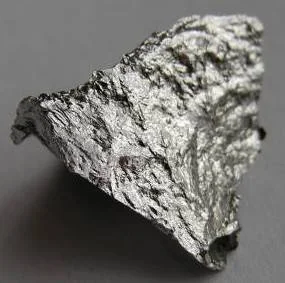
Manganese sample from Tomihahndorf’s element collection; illustrative of the metal, not an Indian ore deposit.
Credit: Tomihahndorf at German Wikipedia · CC BY-SA 3.0 · sourceResized and converted to WebP; uncropped.
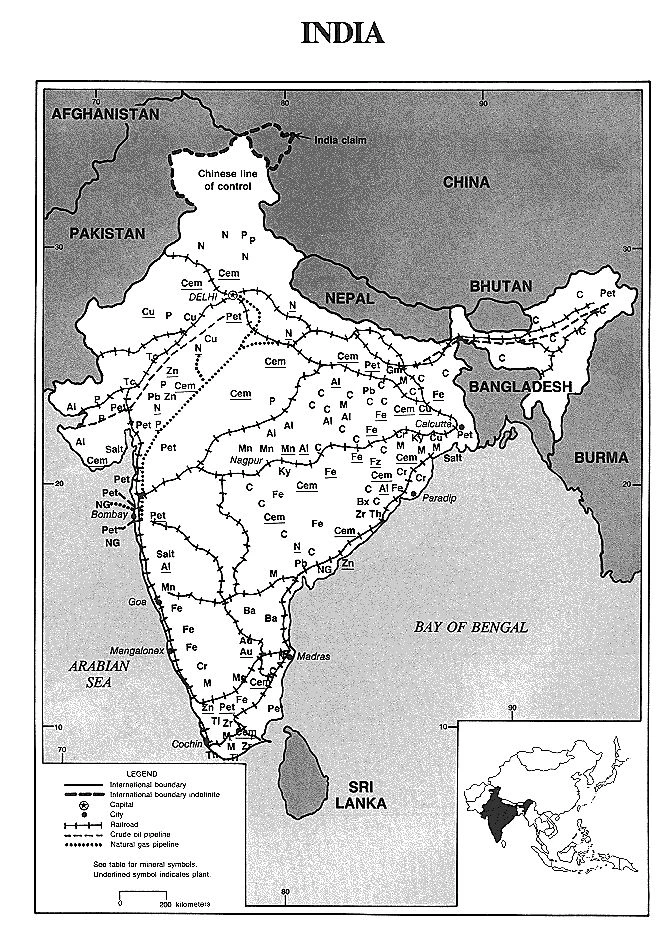
Map study
USGS reference map of mineral deposits and mineral industries in India. Historical place names and boundary depiction are retained from the source; not a current official political map, mine inventory or production dataset.
- Locate Fe (iron), Mn (manganese), Al (aluminium/bauxite-related) and C (coal) symbols; underlined symbols denote industrial plants, not deposits.
- Compare the eastern and peninsular mineral belts. The source legend does not establish present reserves, output or operating status.
- For current official boundary depiction and mineral statistics, consult Survey of India and Indian Bureau of Mines publications.
Credit: United States Geological Survey · Public domain (US federal government work) · sourceConverted to WebP without cropping or changing cartography; original legend retained.
1. Nature, occurrence and economic significance
Manganese is a transition metal that occurs naturally in several mineral compounds rather than commonly as native metal. Important ore minerals include pyrolusite, braunite and manganite. Psilomelane is a traditional field term used for certain hard, dark manganese oxide materials rather than a single precisely defined mineral. Commercial ore generally contains mixtures of manganese minerals, iron minerals and gangue. Its usefulness depends not only on manganese content but also on the manganese-to-iron ratio and impurities such as phosphorus and silica.
Manganese deposits can originate through sedimentary accumulation, subsequent metamorphism, hydrothermal activity and weathering-related enrichment. In central India, many deposits are associated with metamorphosed manganese-bearing sedimentary rocks, including gondite, a manganese-rich rock commonly containing spessartine garnet and quartz. Weathering can mobilise and reconcentrate manganese near the surface. Consequently, a map of manganese resources reflects both ancient geological environments and later landscape evolution.
Manganese is often grouped with ferrous minerals in economic geography because of its close association with the iron and steel industry. This does not mean manganese itself is iron. It is indispensable in conventional steelmaking as a deoxidising and desulphurising agent and as an alloying element. Distinguishing the metal, its ore minerals and its industrial classification is useful for statement-based Prelims questions.
- Ore grade describes the concentration of valuable material; it does not by itself establish whether a deposit can be mined profitably.
- Resources include geological concentrations with varying degrees of certainty and economic potential; reserves are the economically mineable portion established through appropriate assessment.
2. Distribution in India and major mining belts
Indian manganese deposits are concentrated mainly in the Peninsular Plateau. The Balaghat–Bhandara–Nagpur belt is particularly important, extending across southeastern Madhya Pradesh and northeastern Maharashtra. Balaghat district contains major deposits associated with the Sausar geological belt. In Maharashtra, the Nagpur and Bhandara areas contain several established mines. This cross-state geological continuity illustrates why mineral belts should not be understood only through administrative boundaries.
Odisha has important manganese occurrences in the Keonjhar, Sundargarh and Koraput regions. Parts of its manganese-bearing terrain occur within or near the broader iron-ore-bearing geological province. Karnataka has deposits in areas such as Ballari, Chitradurga, Shivamogga and Uttara Kannada. Andhra Pradesh has deposits in the Srikakulam–Vizianagaram region. Manganese also occurs in Goa, Jharkhand and other states, although occurrence does not necessarily imply substantial current production.
Madhya Pradesh has led manganese ore production in recent Indian Bureau of Mines reporting, while Maharashtra and Odisha are other major producers. Odisha holds the largest share of India's total manganese ore resources in commonly cited IBM inventories. These are different indicators: a state with the largest resources need not produce the most ore annually. Output changes with mine capacity, ore quality, approvals, costs and demand.
- Map priority: locate Balaghat in Madhya Pradesh and Nagpur–Bhandara in Maharashtra before studying other deposits.
- Check the reference year and whether a ranking concerns resources, reserves or production; avoid treating textbook rankings as timeless facts.
Typical manganese-to-steel value chain
- 1. Exploration and assessment of ore quantity, grade and impurities
- 2. Mine development and opencast or underground extraction
- 3. Sorting, crushing, screening and beneficiation where appropriate
- 4. Blending and transport to ferroalloy plants
- 5. Reduction to produce ferromanganese or silicomanganese
- 6. Addition during steelmaking to control chemistry and properties
3. Uses, processing and industrial linkages
The principal market for manganese is iron and steel production. Ferromanganese and silicomanganese are manganese-bearing ferroalloys used during steelmaking. Manganese helps control oxygen and sulphur and contributes to desired mechanical properties. High-manganese steels have specialised applications where resistance to wear and impact is important, such as crushing equipment and railway components. However, different steel grades require different additions; there is no single universal manganese requirement per tonne of steel.
Mining may be opencast or underground depending on deposit depth, shape and other conditions. Extracted ore is sorted, crushed and screened. Where suitable, beneficiation methods such as washing and gravity separation upgrade the ore by removing unwanted material. Beneficiation improves quality but does not create additional manganese. Some finely intergrown ores remain difficult or costly to upgrade. Ferroalloy production generally requires reduction in high-temperature furnaces and substantial electricity.
Beyond metallurgy, manganese compounds are used in dry-cell batteries, chemicals, pigments and glassmaking. Manganese dioxide is used in conventional zinc–carbon and alkaline batteries. Manganese is also present in some lithium-ion battery cathodes, including nickel–manganese–cobalt chemistries, but not in every lithium-ion battery type. Battery manufacturing often requires high-purity processed manganese products, which are distinct from ordinary metallurgical ore.
- Ferroalloy location depends on ore supply, reliable electricity, reductants, transport and access to steel markets.
- Battery demand adds a processing and purity dimension to mineral security; geological availability alone does not establish supply-chain self-sufficiency.
| State | Important areas | Examination significance |
|---|---|---|
| Madhya Pradesh | Balaghat | Major producing region associated with the Sausar manganese belt |
| Maharashtra | Nagpur and Bhandara | Continuation of the central Indian belt; important MOIL operations |
| Odisha | Keonjhar, Sundargarh and Koraput regions | Large resource base and an important producing state |
| Karnataka | Ballari, Chitradurga, Shivamogga and Uttara Kannada | Substantial resources across several Peninsular geological settings |
| Andhra Pradesh | Srikakulam–Vizianagaram region | Important eastern coastal hinterland occurrences |
4. Trade, strategic importance and regulation
India both produces and imports manganese ore. Imports supplement domestic availability and help industries obtain suitable grades and blending characteristics. South Africa, Gabon and Australia are important global suppliers, although India's supplier shares vary by year. Domestic deposits therefore do not automatically eliminate import dependence. The relevant questions are whether adequate quantities of appropriate grades can be mined, transported and processed at competitive cost.
Manganese supply links mining regions with ferroalloy plants, steel-producing centres and ports. South Africa's Kalahari manganese field is a globally significant concentration of manganese resources. Gabon is an important exporter, while Australia has major deposits, including Groote Eylandt. For geographical comparison, manganese differs from minerals whose world supply is concentrated in only one or two dominant producers, but transport interruptions and grade-specific shortages can still affect consumers.
In India, manganese mining falls within the framework of the Mines and Minerals (Development and Regulation) Act, 1957, as amended. Mineral concessions operate through the applicable statutory and auction framework. Mining projects must also comply with relevant environmental requirements and, where forest land is involved, forest-clearance provisions. District Mineral Foundations support people and areas affected by mining. Mine planning, conservation and closure obligations are important because mineral deposits are finite and extraction can impose long-lasting local costs.
- Do not assume that every economically important mineral appears on every official critical-mineral list; classifications are jurisdiction-specific and may change.
- A robust supply strategy combines domestic exploration, efficient extraction, beneficiation, diversified imports and recovery through metal recycling.
5. Environmental concerns and the agriculture connection
Manganese mining can cause land degradation, habitat fragmentation, dust generation, waste accumulation and changes in local drainage. Washing and beneficiation require careful water management. Depending on local geology and mine conditions, runoff and seepage may affect water quality. Appropriate safeguards include topsoil conservation, controlled waste-dump design, dust suppression, water recycling and progressive rehabilitation rather than postponing all restoration until mining ends.
Manganese is an essential micronutrient for plants and participates in photosynthesis, including the water-splitting system of photosystem II. Agricultural deficiency may develop where manganese becomes poorly available, including some high-pH or calcareous soils. Conversely, strongly acidic or waterlogged conditions can increase the availability of reduced manganese and create toxicity risks. Total manganese content in soil is therefore not the same as plant-available manganese.
Soil testing and locally appropriate agronomic advice should guide correction of deficiency or toxicity. Manganese sulphate may be used to address diagnosed deficiency, while drainage improvement and correction of excessive acidity can help in suitable toxicity-prone situations. For people, manganese is an essential trace nutrient, but excessive exposure, particularly occupational inhalation of manganese-containing dust or fumes, can damage the nervous system. Mine and processing-plant safety therefore requires exposure control and health monitoring.
- Agricultural availability depends strongly on soil pH, aeration and oxidation–reduction conditions.
- Exam linkage: the same element can be an industrial resource, an essential nutrient and a pollutant at excessive exposure levels.
Manganese: Linking the Metal to India’s Mineral Geography
The metadata identifies this specimen as manganese from an element collection. It is therefore a relevant illustration of the metal, but does not establish an Indian origin, an ore type or a mining locality. Distinguish manganese as a chemical element from manganese ore: an ore is naturally occurring material from which a valuable constituent can be extracted economically. Pyrolusite, a manganese dioxide mineral, is an important manganese ore mineral; an elemental sample should not be labelled pyrolusite.
Manganese’s principal industrial importance lies in iron and steel production, especially through ferroalloys such as ferromanganese and silicomanganese. It helps deoxidise steel and control sulphur-related defects, while alloying can improve strength and wear resistance. In India, manganese mineralisation occurs in several geological settings, with important producing regions in Odisha, Madhya Pradesh, Maharashtra and Karnataka. The Balaghat–Nagpur–Bhandara belt is a useful regional reference. Industrial location depends not simply on ore proximity but also on electricity, transport, other raw materials and market access. Domestic deposits do not eliminate imports: ore grade, suitability for particular processes and supply economics also matter.
- Distribution is not production: distinguish mineral occurrences, resources, economically recoverable reserves and actual output; state rankings require a dated source.
- Manganese is classified as a ferrous mineral because of its association with iron and steel industries, not because elemental manganese contains iron.
- For Mains, connect mining with land disturbance, dust, water management and rehabilitation; this specimen alone establishes neither extraction methods nor environmental impacts.
Real-world case studies
Balaghat: geology and underground mining
MOIL's Balaghat mine in Madhya Pradesh is a prominent underground manganese operation. It demonstrates that manganese extraction is not exclusively opencast. The central Indian belt also shows how metamorphosed mineral-bearing formations extend across state boundaries, linking Balaghat with the Nagpur–Bhandara region.
Central Indian Ocean Basin: a prospective source
India holds an International Seabed Authority exploration contract for polymetallic nodules in the Central Indian Ocean Basin. These nodules contain manganese, nickel, copper and cobalt. Exploration rights do not amount to commercial exploitation: technological feasibility, environmental impacts and the international regulatory framework remain central considerations.
Previous year questions
No source-linked PYQ is available here yet. Use the practice questions below.
Practice questions
Practice MCQ 1
Consider the following statements: 1. Pyrolusite is a manganese oxide mineral. 2. Manganese is used as a deoxidising agent in steelmaking. 3. Every lithium-ion battery uses a manganese-containing cathode. Which of the statements given above are correct?
- A. 1 and 2 only
- B. 2 and 3 only
- C. 1 and 3 only
- D. 1, 2 and 3
Practice MCQ 2
Which of the following pairs is incorrectly matched?
- A. Balaghat — Madhya Pradesh
- B. Bhandara — Maharashtra
- C. Keonjhar — Odisha
- D. Chitradurga — Andhra Pradesh
Practice MCQ 3
With reference to manganese in soils, consider the following statements: 1. It is an essential plant micronutrient. 2. High soil pH can reduce its availability to plants. 3. Total soil manganese always accurately indicates plant-available manganese. Which of the statements given above are correct?
- A. 1 only
- B. 1 and 2 only
- C. 2 and 3 only
- D. 1, 2 and 3
Mains practice · Explain the distribution of manganese resources in India. Why does domestic mineral availability not necessarily ensure industrial self-sufficiency? Discuss with reference to manganese. Answer in 250 words.
- Locate the Balaghat–Bhandara–Nagpur belt, Odisha, Karnataka and northeastern Andhra Pradesh.
- Connect distribution with geological formations and weathering-related enrichment.
- Distinguish resources, economically mineable reserves and annual production.
- Explain ore grade, impurities, blending requirements and beneficiation limitations.
- Discuss steel demand, ferroalloy capacity, electricity, transport and high-purity processing.
- Conclude with exploration, efficient resource use, diversified sourcing and environmental safeguards.
Further reading
- NCERT, Contemporary India–II: Minerals and Energy Resources.
- NCERT, India: People and Economy: Mineral and Energy Resources.
- Indian Bureau of Mines, Indian Minerals Yearbook: Manganese Ore chapter; check the reporting year for statistics.
- MOIL Limited: official annual reports and mine information.
- Ministry of Mines: annual reports and the MMDR Act framework.
- International Seabed Authority: India's polymetallic-nodule exploration contract information.
- https://commons.wikimedia.org/wiki/File:Mangan_1-crop.jpg
Preparing for UPSC Civil Services? Get classroom teaching, answer-writing evaluation and mentorship at Pragnya IAS Academy, Ashok Nagar — see why aspirants choose us for IAS coaching in Hyderabad.