

A diagram of the geological time scale
Credit: United States Geological Survey · Public domain · source

Kola Superdeep Borehole
Credit: Andre Belozeroff · CC BY-SA 3.0 · source
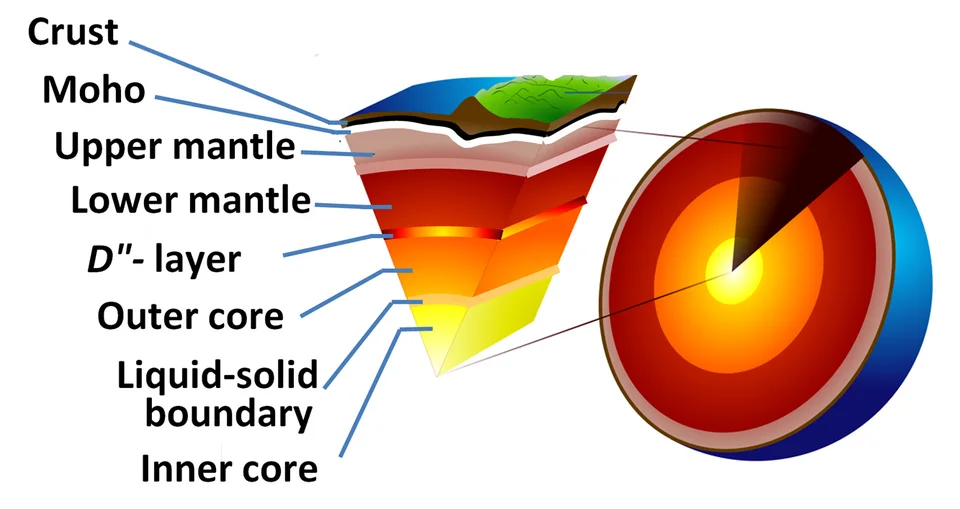
English-labelled Earth cutaway showing the crust, mantle, outer core and inner core; schematic, not to scale.
Credit: Earth-crust-cutaway-japanese.svg: Washiucho derivative work: Brews ohare (talk) · Public domain · sourceResized and converted to WebP; uncropped.
1. How the inaccessible interior is studied
Earth cannot be investigated deeply by direct observation. Even the Kola Superdeep Borehole in Russia, which reached approximately 12.26 km, penetrated only a small fraction of the continental crust. Mining, boreholes and exposed rocks provide direct information about shallow levels. Volcanic eruptions bring magma and fragments of deeper rocks, called xenoliths, to the surface, but these samples do not represent every layer of Earth.
Indirect evidence therefore dominates. Seismic waves reveal changes in density, elasticity and physical state. Gravity measurements identify variations in mass distribution, while magnetic observations constrain the operation of the core. Surface heat flow provides evidence about internal thermal processes. Meteorites offer clues to the materials from which Earth formed, but they are analogues rather than actual samples of Earth’s interior.
Earth’s average density exceeds that of common surface rocks, indicating a denser interior. Its moment of inertia also demonstrates that mass is concentrated towards the centre. Scientists combine these observations with high-pressure laboratory experiments and mathematical models rather than relying on any single source.
- Direct evidence is geographically limited and overwhelmingly shallow.
- Indirect evidence supplies the principal basis for global models of Earth’s internal structure.
2. Seismic waves and shadow zones
Earthquakes release energy at the focus or hypocentre. Body waves travel through Earth, while surface waves propagate along its surface. Primary or P-waves involve compression and expansion parallel to the direction of travel; they are faster and pass through solids and fluids. Secondary or S-waves involve transverse particle motion and require rigidity, so they cannot propagate through liquids.
Wave speeds depend on elastic properties and density. At internal boundaries, waves may be reflected, refracted or converted between wave types. Abrupt changes in their arrival times and paths reveal discontinuities. Velocity does not simply increase with density: material stiffness and physical state are also decisive.
The liquid outer core prevents direct S-waves from reaching stations beyond about 103° angular distance from an earthquake’s epicentre. Strong refraction of P-waves at the core–mantle boundary creates a conventional direct P-wave shadow zone between approximately 103° and 142°. P-waves are detected again beyond this zone after travelling through the core.
These angles describe simplified global patterns; reflected, converted and diffracted phases make actual records more complex. A shadow zone does not mean that absolutely no seismic signal can be recorded there. Inge Lehmann’s interpretation of seismic observations in 1936 established the existence of an inner core.
- Prelims distinction: absence of direct S-waves supports a liquid outer core, not a wholly liquid core.
- Surface waves are important for earthquake damage but are not the principal evidence for the deep core.
Inferring internal structure from an earthquake
- 1. An earthquake generates P-waves and S-waves.
- 2. Seismographs record arrival times and wave characteristics at different distances.
- 3. Reflection, refraction and missing direct arrivals reveal internal contrasts.
- 4. Scientists infer discontinuities, layer depths and physical states.
- 5. Gravity, mineral-physics and heat-flow evidence refine the seismic model.
3. Compositional layers: crust, mantle and core
The crust is Earth’s outermost compositional layer. Oceanic crust is generally about 5–10 km thick, relatively dense and predominantly basaltic and gabbroic. Continental crust averages roughly 35–40 km in thickness, becoming much thicker beneath major mountain belts. Its composition is diverse, although its upper part is commonly described as granitic. Oceanic crust is generally younger because it is continuously produced and recycled through plate tectonics.
The mantle extends from the Moho to roughly 2,900 km depth and accounts for about 84% of Earth’s volume. It consists mainly of magnesium- and iron-rich silicate rocks, especially peridotitic compositions in the upper mantle. It is not a global ocean of magma: most mantle material is solid but can undergo slow ductile flow.
The core extends from approximately 2,900 km depth to Earth’s centre. The liquid outer core ends at about 5,150 km depth, below which lies the solid inner core. Iron dominates both, accompanied by nickel and lighter elements. The inner core remains solid because extreme pressure raises the melting temperature, despite its very high temperature.
Traditional labels such as sial, sima and nife are useful historical shorthand, but they oversimplify modern knowledge. Continental crust is not uniformly granite, and the mantle should not be equated with a continuous basaltic layer.
| Layer | Extent or thickness | Composition and state | Key examination point |
|---|---|---|---|
| Continental crust | Average thickness about 35–40 km; thicker beneath mountains | Diverse silicate rocks; solid | Generally thicker, older and less dense than oceanic crust |
| Oceanic crust | Usually about 5–10 km thick | Predominantly basalt and gabbro; solid | Forms at spreading ridges and is recycled at subduction zones |
| Mantle | Moho to about 2,900 km depth | Magnesium- and iron-rich silicates; predominantly solid | Slow flow does not imply a fully molten state |
| Outer core | About 2,900–5,150 km depth | Iron-rich alloy; liquid | Blocks S-waves and hosts the geodynamo |
| Inner core | About 5,150–6,371 km depth | Iron-rich alloy; solid | Extreme pressure favours solidity |
4. Mechanical layers and important discontinuities
Mechanical classification describes how materials respond to stress. The lithosphere comprises the crust and rigid uppermost mantle and forms tectonic plates. Its thickness varies widely: it is thin near spreading ridges and can exceed 200 km beneath old continental interiors. The weaker asthenosphere lies beneath it within the upper mantle.
The asthenosphere is predominantly solid, yet weak enough to deform over long periods. Small fractions of partial melt may occur, but complete melting is not required for weakness. It commonly overlaps a seismic low-velocity zone. Below it, the deeper mantle is stronger but still capable of convection; in mechanical schemes this region is often called the mesosphere.
The Moho separates crust from mantle. The Gutenberg discontinuity marks the core–mantle boundary, while the inner-core boundary separates liquid outer core from solid inner core. Discontinuities near 410 km and 660 km largely reflect pressure-induced mineral transformations. The intervening mantle transition zone should not be mistaken for the liquid outer core.
- The Conrad discontinuity is recognised within parts of continental crust; it is not a universal global boundary.
- Compositional and mechanical boundaries need not coincide: the Moho lies within the lithosphere.
5. Internal heat and its geographical consequences
Earth’s internal heat comes mainly from residual heat of formation and differentiation, radioactive decay, and processes associated with core cooling and crystallisation. Temperature generally increases downwards, but the geothermal gradient is not constant. Typical shallow continental gradients of around 25–30°C per kilometre cannot be extrapolated to the centre.
Heat is transferred mainly by conduction through the rigid lithosphere and by convection within the mantle and liquid outer core. Mantle circulation is coupled to plate motion; slab pull and ridge-related gravitational forces are important components of plate dynamics. Partial melting occurs through decompression, addition of volatiles or heat transfer, explaining why magma generation is concentrated in particular tectonic settings.
Convection of electrically conducting fluid in the outer core, organised partly by Earth’s rotation, sustains the geodynamo. The magnetic field is therefore not produced by a permanent bar magnet inside Earth. Internal structure also explains isostasy: thick, relatively buoyant continental crust can possess deep roots beneath mountain ranges such as the Himalaya.
- Isostatic adjustment follows loading or unloading, including erosion, sediment accumulation and ice-sheet melting.
- For examination questions, distinguish a material’s present physical state from its ability to flow over geological time.
Earth’s Interior: Layers and Seismic Evidence
A cutaway illustration provides a conceptual starting point, not direct evidence of conditions at depth. Earth’s compositional layers are the crust, mantle and core. Its mechanical divisions describe how material behaves: the rigid lithosphere includes both crust and uppermost mantle, while the underlying asthenosphere is relatively weak and deforms over geological time. The mantle is predominantly solid; describing it as a global ocean of magma is incorrect.
Seismic waves provide the strongest constraints on internal structure. P waves travel through solids and liquids, whereas S waves cannot propagate through liquids. Their travel times, refraction and shadow zones support a liquid outer core and, alongside other seismic observations, a solid inner core. The Mohorovičić discontinuity marks the crust–mantle boundary, not the lithosphere–asthenosphere boundary. Layer boundaries inferred from changes in seismic velocity need not coincide with every chemical or mechanical transition.
For India, these distinctions clarify why continental collision produces Himalayan crustal thickening and earthquakes without requiring a molten mantle beneath the entire region. Seismic observations beneath India help constrain crustal thickness and deeper structure, but a general cutaway cannot establish local depths or geological conditions.
- Prelims distinction: crust is compositional; lithosphere is mechanical and includes mantle material.
- Evidence limit: seismic velocities depend on composition, temperature, pressure and physical state.
- Mains linkage: connect mantle convection, plate motion and crustal deformation without equating solid-state flow with melting.
Real-world case studies
Kola Superdeep Borehole: limits of direct exploration
The Soviet drilling project on Russia’s Kola Peninsula reached approximately 12,262 metres in 1989. It remained within continental crust and did not reach the mantle. The project illustrates why even exceptional engineering achievements cannot replace indirect evidence for understanding Earth’s deep interior.
Deccan volcanism: evidence from surface rocks
The Deccan Traps of western and central India record extensive basaltic volcanism around 66 million years ago. Their rocks preserve evidence of mantle-derived magmas and interactions with the crust. They illustrate how surface samples constrain deep processes, while the precise roles of plume activity, lithospheric conditions and magma evolution require multiple lines of evidence.
Previous year questions
No source-linked PYQ is available here yet. Use the practice questions below.
Practice questions
Practice MCQ 1
With reference to Earth’s internal layers, consider the following statements: 1. The lithosphere includes both crust and uppermost mantle. 2. The asthenosphere is an entirely molten layer. 3. The Moho is a compositional boundary. Which of the statements given above are correct?
- A. 1 and 2 only
- B. 2 and 3 only
- C. 1 and 3 only
- D. 1, 2 and 3
Practice MCQ 2
Which one of the following best explains the conventional direct P-wave shadow zone between approximately 103° and 142° from an earthquake’s epicentre?
- A. P-waves cannot travel through any liquid.
- B. P-waves undergo strong refraction at the core–mantle boundary.
- C. The mantle completely absorbs all seismic energy.
- D. The solid inner core prevents all P-wave transmission.
Practice MCQ 3
Consider the following statements: 1. Oceanic crust is generally denser than continental crust. 2. The inner core is solid primarily because its temperature is lower than that of the mantle. 3. The mantle transition zone includes major pressure-induced mineral transformations. Which of the statements given above are correct?
- A. 1 only
- B. 2 only
- C. 1 and 3 only
- D. 1, 2 and 3
Mains practice · How do seismic observations reveal Earth’s internal structure? Distinguish between compositional and mechanical classifications of its interior. Answer in 150 words.
- Introduce the limitations of direct exploration.
- Explain P-wave and S-wave behaviour, refraction and shadow zones.
- Identify crust, mantle and core as compositional divisions.
- Identify lithosphere, asthenosphere, deeper mantle and the two core layers by mechanical behaviour.
- Clarify that lithosphere includes mantle and that the asthenosphere is predominantly solid.
- Conclude with links to plate tectonics and the geodynamo.
Further reading
- NCERT, Fundamentals of Physical Geography, Class XI, chapter: Interior of the Earth.
- United States Geological Survey, This Dynamic Earth: The Story of Plate Tectonics.
- National Centre for Seismology, Ministry of Earth Sciences, Government of India: seismology resources at seismo.gov.in.
- British Geological Survey: educational resources on Earth’s structure and seismic waves.
- https://commons.wikimedia.org/wiki/File:Earth-crust-cutaway-English-Large_label.PNG
Preparing for UPSC Civil Services? Get classroom teaching, answer-writing evaluation and mentorship at Pragnya IAS Academy, Ashok Nagar — see why aspirants choose us for IAS coaching in Hyderabad.