
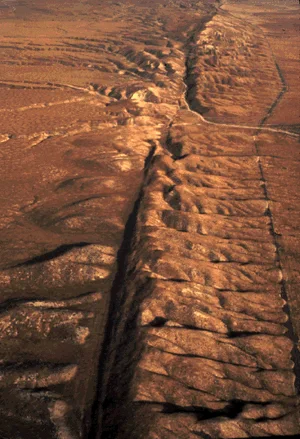
Aerial view of the San Andreas Fault, Carrizo Plain, California—a comparative example of strike-slip faulting.
Credit: USGS · Public domain · sourceResized and converted to WebP; uncropped.
Map study
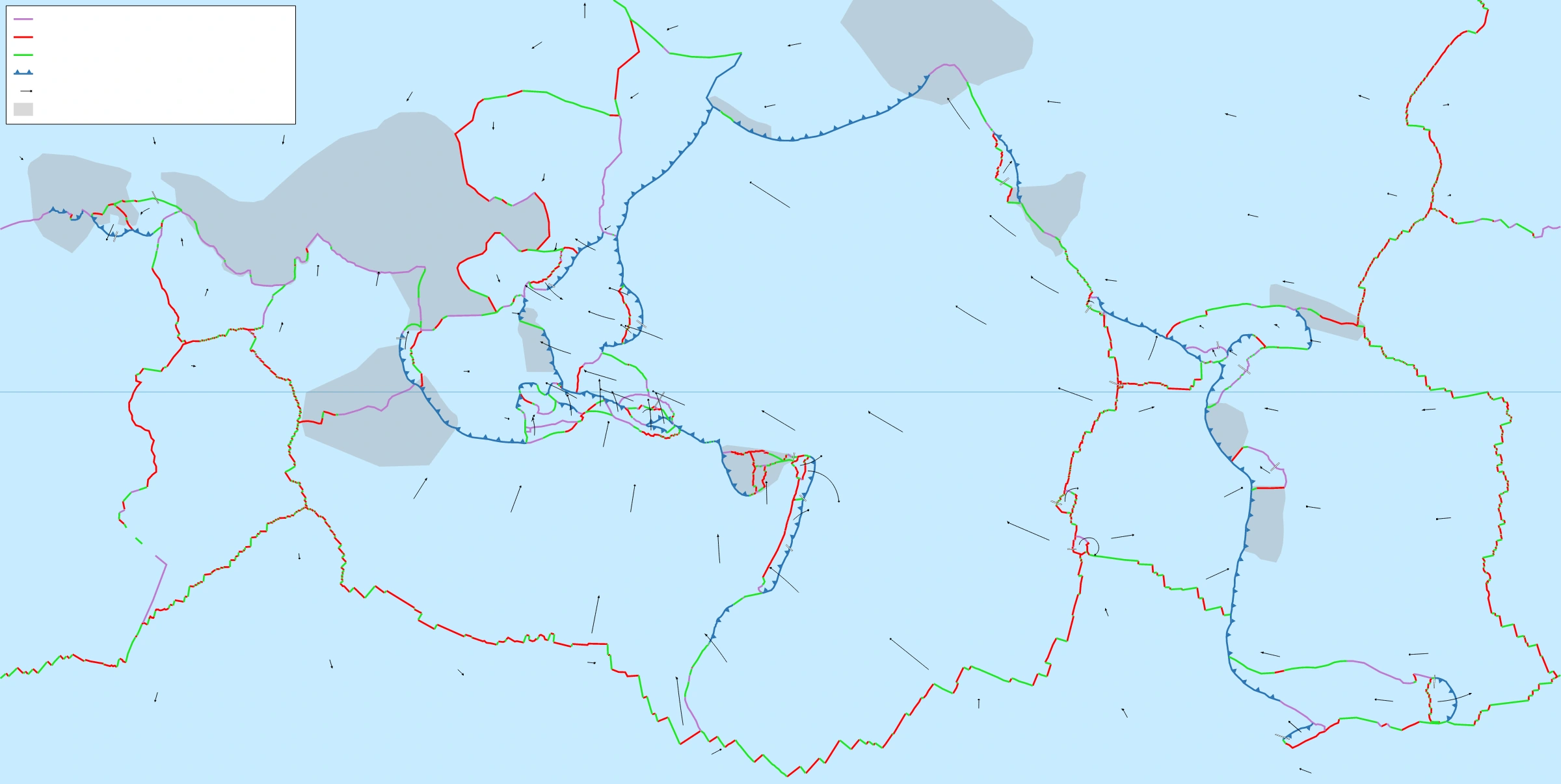
World tectonic plates: locate the Indian and Eurasian plates and distinguish convergent, divergent and transform boundaries through the legend.
- Read the source legend, scale and reference period before comparing regions.
- Connect spatial patterns to the processes discussed in this topic; this map is a study reference, not live operational data.
Credit: Eric Gaba (Sting) · CC BY-SA 2.5 · sourceConverted to WebP on an opaque white background; proportionally resized without cropping. Original cartography and legend retained.
1. Meaning, origin and structural terminology
Faulting occurs when rocks fracture and undergo relative movement along the fracture. Stress represents force per unit area, whereas strain is the resulting deformation. At shallow crustal depths, relatively low confining pressure and temperature favour brittle behaviour. At greater depths, higher temperatures and pressures generally favour ductile deformation. Rock composition, fluids and deformation rate also influence whether a rock fractures or flows; depth alone does not determine its behaviour.
Tectonic forces build stress through plate divergence, convergence and lateral motion. Faults may form as new fractures or develop through renewed movement along older weaknesses. Fluid pressure can reduce effective normal stress across a fault and make sliding easier. Many faults therefore have long, complex histories, with different episodes of movement separated by extended periods of inactivity.
The fault plane is the surface along which displacement occurs; its intersection with the ground surface is the fault trace. Strike is the direction of a horizontal line on an inclined plane, while dip is the angle at which that plane slopes downward from the horizontal. The hanging wall lies above an inclined fault plane and the footwall lies below it. These terms do not usefully distinguish the sides of an exactly vertical fault.
Slip describes relative displacement along a fault. Its vertical component is called throw and its horizontal component perpendicular to strike is called heave. Slickensides are polished or striated surfaces produced by movement. Fault breccia consists of broken angular rock fragments, while fault gouge is finely crushed material. A fault zone contains multiple fractures and deformed rocks rather than one perfectly continuous plane.
- Fault versus joint: both are fractures, but only a fault has appreciable shear displacement.
- Fault versus fold: faulting involves displacement along fractures; folding bends rock layers, although both can coexist.
2. Major fault types and associated stresses
A normal fault forms when the hanging wall moves downward relative to the footwall. It commonly accommodates crustal extension and thinning. Normal faults are widespread in continental rifts and divergent settings, but also occur where elevated crust spreads gravitationally. The word normal describes the movement geometry, not the frequency or harmlessness of the fault.
A reverse fault has upward movement of the hanging wall relative to the footwall, usually under compression. It contributes to crustal shortening and thickening. A thrust fault is a low-angle reverse fault, commonly defined as dipping less than about 45 degrees. Thrusting can place older rocks over younger rocks and repeat a stratigraphic sequence. Major thrust systems are characteristic of fold-and-thrust mountain belts such as the Himalayas.
A strike-slip fault has predominantly horizontal displacement parallel to strike. Viewed from either side, if the opposite block moves to the right, movement is right-lateral or dextral; if it moves to the left, it is left-lateral or sinistral. Oblique-slip faults combine strike-slip and dip-slip components. Natural faults frequently display such mixed movement rather than an idealised textbook geometry.
A transform fault is a particular type of strike-slip plate boundary that accommodates relative motion between plates. Not every strike-slip fault is a transform boundary. Similarly, faults are not restricted to plate margins: ancient weaknesses within plates can be reactivated. Classification should therefore begin with observed relative movement rather than assuming fault type solely from geographic location.
- Extension: hanging wall down, normal fault.
- Compression: hanging wall up, reverse or thrust fault.
- Shearing: predominantly lateral displacement, strike-slip fault.
Typical earthquake cycle on a locked fault
- 1. Tectonic motion loads the fault
- 2. Friction resists sliding and surrounding rocks deform elastically
- 3. Stress exceeds fault resistance locally
- 4. Rupture propagates and rapid slip occurs
- 5. Seismic waves radiate and rocks undergo elastic rebound
- 6. Stress is redistributed, with possible aftershocks and renewed loading
3. Landforms produced or controlled by faulting
A fault scarp is a steep slope created directly by displacement of the ground surface. A fault-line scarp, by contrast, results from differential erosion along an exposed fault contact, often because rocks on opposite sides have different resistance. Thus, a prominent scarp along a fault may be erosional and need not represent recent surface rupture.
A graben is an elongated, relatively down-dropped block bounded by faults, typically normal faults. A horst is a relatively elevated block between faults. These are relative positions: a horst need not have risen in an absolute sense if neighbouring blocks subsided. A half-graben is an asymmetric basin controlled mainly by a major normal fault along one side. Tilted fault blocks can also produce mountain-and-basin landscapes.
Rift valleys develop through regional extension involving faulting, crustal thinning and subsidence. They are not simply cracks pulled open at the surface. Their floors commonly accumulate river, lake and volcanic deposits. Magmatism frequently accompanies continental rifting, but its extent varies. Long, narrow lakes may occupy subsiding rift basins, as seen in parts of East Africa.
Faults also influence drainage by guiding river courses along fractured rock and creating sharp bends, offset channels or local barriers. Along strike-slip faults, releasing bends can produce pull-apart basins, whereas restraining bends can generate local uplift. Erosion and deposition subsequently modify these tectonic forms, so present relief reflects both crustal movement and surface processes.
- Classic association: the Upper Rhine Graben lies between the Vosges and Black Forest uplands.
- Avoid the absolute rule that every straight valley, steep slope or block-shaped mountain was produced by faulting.
| Type | Relative movement | Typical stress | Common expression |
|---|---|---|---|
| Normal | Hanging wall moves down | Extension | Grabens, half-grabens and tilted blocks |
| Reverse | Hanging wall moves up | Compression | Shortened and uplifted crust |
| Thrust | Hanging wall moves up on a low-angle plane | Compression | Overlapping rock sheets and repeated strata |
| Strike-slip | Predominantly horizontal movement along strike | Shearing | Offset channels and linear valleys |
| Oblique-slip | Combined lateral and dip-slip movement | Combined stress conditions | Mixed vertical and horizontal displacement |
4. Global and Indian distribution
The East African Rift illustrates active continental extension, normal faulting, subsiding basins and uplifted rift shoulders. The Basin and Range Province of the western United States displays alternating fault-block mountains and basins. California's San Andreas Fault system illustrates predominantly right-lateral motion along the boundary between the Pacific and North American plates.
In India, the Himalayan belt reflects convergence between the Indian and Eurasian plates. Major structures include the Main Central Thrust, Main Boundary Thrust and Main Frontal Thrust. They form part of a wider shortening system associated with the Main Himalayan Thrust at depth. The Himalayas are therefore not simply block mountains: folding, thrusting, uplift, erosion and sedimentation operate together.
The Narmada and Tapi valleys are commonly discussed in school geography as fault-controlled or rift-related valleys. Their modern landscapes reflect inherited structures, tectonic reactivation and prolonged erosion. They should not be assumed to represent active divergent plate boundaries like the East African Rift. The Kachchh region of Gujarat likewise shows how old rift structures can be reactivated under a later compressional stress regime.
- Location cue: East African Rift, eastern Africa; Upper Rhine Graben, western Europe; San Andreas Fault, California.
- Indian cue: Himalayan thrusting contrasts with the reactivation of older structures in peninsular and western India.
5. Earthquakes, resources and examination relevance
In the elastic rebound model, rocks on either side of a locked fault deform as stress accumulates. When resistance is overcome, rapid slip releases stored elastic energy, some of which travels as seismic waves. The focus or hypocentre is where rupture begins, while the epicentre is the point vertically above it at the surface. Rupture can propagate across a much larger fault area.
Not all fault movement produces a damaging earthquake: some faults undergo slow or aseismic slip. Conversely, a damaging earthquake need not create an obvious surface break. Blind faults terminate below the surface. Earthquake risk depends on shaking, local ground conditions, exposure and building vulnerability, not simply distance from a visible fault trace.
Faults can act as groundwater conduits where fracturing improves permeability, or as barriers where clay-rich gouge restricts flow. They can influence mineral deposition, geothermal circulation and hydrocarbon traps. Infrastructure planning must therefore consider both seismic hazards and subsurface conditions. In India, seismic monitoring by the National Centre for Seismology, Geological Survey of India investigations and earthquake-resistant design guidance are relevant to risk reduction.
- Prelims trap: movement of the hanging wall is always stated relative to the footwall.
- Prelims trap: an ancient fault is not necessarily active, and a large earthquake does not require visible surface rupture.
- Geomorphological evidence identifies possible faulting; establishing activity requires geological, geodetic or seismological investigation.
Strike-slip faulting: movement without major vertical displacement
The supplied metadata identifies an aerial view of the San Andreas Fault in California. This is a comparative, non-Indian example of a major right-lateral strike-slip fault system associated with the boundary between the Pacific and North American plates. Strike-slip displacement is predominantly horizontal: an observer on either side sees the opposite block move to the right in a right-lateral fault. This differs from normal and reverse faulting, where displacement is predominantly along the dip of the fault plane.
Fault movement can offset streams, roads and other markers, while bends and stepovers may create local zones of compression or extension. Thus, a strike-slip system can produce uplifted areas or depressions despite its predominantly horizontal movement. However, the metadata alone cannot establish which features this particular image depicts, measure displacement or date fault activity. For India, use this example to understand fault mechanics, not as evidence of Indian tectonic conditions. Himalayan thrusting chiefly illustrates crustal shortening, whereas the Kachchh region demonstrates that damaging fault-related earthquakes can also occur within a plate.
- Stress–movement link: extension commonly produces normal faults; compression produces reverse faults and thrusts; shear favours strike-slip faults.
- Terminology trap: a fault requires relative displacement; a joint does not. A thrust is a low-angle reverse fault, not a separate stress regime.
- Boundary distinction: transform describes a plate-boundary relationship; strike-slip describes movement. Not every strike-slip fault is a transform boundary, and earthquakes do not require a visible surface rupture.
Real-world case studies
Kachchh earthquake, Gujarat, 2001
The 26 January 2001 Bhuj earthquake, approximately moment magnitude 7.7, occurred within the Indian plate. It involved reverse faulting in the ancient Kachchh rift region. The event demonstrates tectonic inversion: structures inherited from an extensional setting can later accommodate compression. It also shows that intraplate regions can experience destructive earthquakes.
San Francisco earthquake, 1906
The 18 April 1906 earthquake ruptured a long segment of California's San Andreas Fault, producing conspicuous right-lateral offsets. Investigations of deformation associated with the earthquake helped Harry Fielding Reid formulate elastic rebound theory. The case links strike-slip movement, displaced surface features and the release of accumulated elastic strain.
Previous year questions
No source-linked PYQ is available here yet. Use the practice questions below.
Practice questions
Practice MCQ 1
Consider the following statements: 1. The hanging wall moves downward relative to the footwall in a normal fault. 2. A thrust fault is a low-angle reverse fault. 3. Every strike-slip fault is a transform plate boundary. Which statements are correct?
- A. 1 and 2 only
- B. 2 and 3 only
- C. 1 and 3 only
- D. 1, 2 and 3
Practice MCQ 2
An elongated block has subsided relative to blocks on both sides and is bounded by normal faults. It is best described as a:
- A. Horst
- B. Graben
- C. Anticline
- D. Thrust sheet
Practice MCQ 3
Which statement best distinguishes a fault scarp from a fault-line scarp?
- A. A fault scarp is depositional, whereas a fault-line scarp is volcanic.
- B. A fault scarp forms only along strike-slip faults.
- C. A fault scarp results directly from surface displacement, whereas a fault-line scarp develops through differential erosion along a fault contact.
- D. Both necessarily indicate a recent earthquake.
Mains practice · Explain how faulting produces different landforms and influences earthquake hazards. Illustrate with Indian and global examples. Answer in 250 words.
- Define faulting and distinguish it from jointing and folding.
- Relate normal, reverse, thrust and strike-slip faults to stress and relative block movement.
- Explain grabens, horsts, half-grabens, scarps and offset drainage.
- Use East African Rift, San Andreas, Himalayan thrusts and Kachchh as examples.
- Explain elastic rebound, blind faults and intraplate reactivation.
- Conclude with fault mapping, land-use planning and earthquake-resistant construction.
Further reading
- NCERT, Fundamentals of Physical Geography, Class XI: Interior of the Earth; Distribution of Oceans and Continents; Geomorphic Processes.
- NCERT, Contemporary India I, Class IX: Physical Features of India.
- US Geological Survey: Earthquake Hazards Program resources on faults and elastic rebound.
- Geological Survey of India: publications and maps on Indian tectonics and seismotectonics.
- National Centre for Seismology, Ministry of Earth Sciences: earthquake monitoring and earthquake information.
- https://commons.wikimedia.org/wiki/File:San_Andreas_Fault_Aerial_View.gif
Preparing for UPSC Civil Services? Get classroom teaching, answer-writing evaluation and mentorship at Pragnya IAS Academy, Ashok Nagar — see why aspirants choose us for IAS coaching in Hyderabad.