

Photo Taken From Saffron Fields From Kashmir.Kashmir is Known For Its Saffron Fields.
Credit: Umarsami · CC BY-SA 4.0 · source

Grapes at vineyard in Nasik
Credit: Savitr1915 · CC BY-SA 4.0 · source
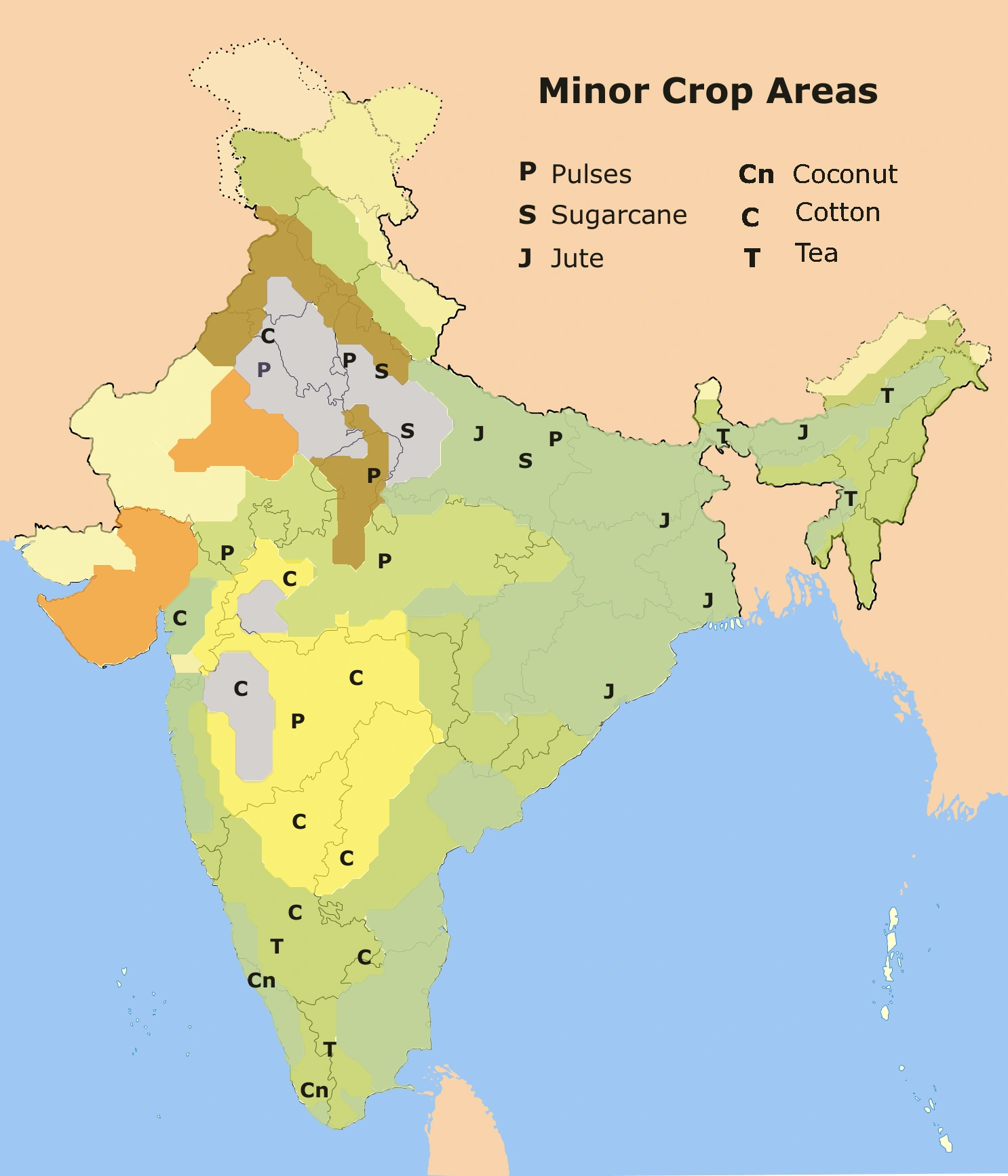
Map study
Selected crop regions of India: identify the legend symbols before comparing patterns. Symbols do not imply exclusive growing areas or current production totals.
- Read the source legend, scale and reference period before comparing regions.
- Connect spatial patterns to the processes discussed in this topic; this map is a study reference, not live operational data.
Credit: Amog · CC BY-SA 2.5 · sourceConverted to WebP on an opaque white background; proportionally resized without cropping. Original cartography and legend retained.
1. Scope and significance of horticulture
Horticulture combines specialised crop cultivation with nursery management, propagation, harvesting, grading, storage and marketing. Pomology deals with fruits, olericulture with vegetables, and floriculture with flowers and ornamental plants. Plantation crops such as coconut, arecanut and cashew are generally included in Indian horticultural statistics. Tea, coffee and rubber are often studied alongside them in agricultural geography, although their administrative and statistical treatment differs.
Horticulture can generate higher returns per hectare than many cereals, particularly where irrigation, quality planting material and reliable markets are available. Nursery raising, pruning, harvesting, sorting, processing and retailing create substantial employment. Fruits and vegetables supply vitamins, minerals and dietary fibre, linking horticulture with nutritional security rather than merely foodgrain availability.
High value does not mean low risk. Many crops require significant initial investment, skilled management and frequent operations. Orchards have a gestation period before commercial bearing, while vegetables and flowers can lose value rapidly after harvest. Smallholders therefore need affordable credit, extension, aggregation and market information. Production by tonnage should also be interpreted cautiously because fresh horticultural produce contains considerable water.
- Major groups: fruits, vegetables, flowers, spices, plantation crops, and medicinal and aromatic plants.
- Important linkages: food processing, pharmaceuticals, perfumery, hospitality and agricultural exports.
2. Agroclimatic controls and regional distribution
Temperature is a major control on horticultural geography. Tropical fruits such as banana, pineapple and papaya generally require warm conditions and are vulnerable to frost. Mango is tropical to subtropical; relatively dry weather during flowering is favourable, whereas rain and high humidity can encourage diseases and impair fruit set. Citrus species differ in climatic requirements, making simple tropical–temperate classifications insufficient.
Temperate fruits such as apple, pear, peach and cherry generally require winter chilling for normal dormancy release and flowering, although requirements differ between species and cultivars. Apple cultivation is concentrated in Jammu and Kashmir, Himachal Pradesh and parts of Uttarakhand. Elevation influences temperature, but altitude alone does not determine suitability: slope, aspect, chilling accumulation and spring frost exposure also matter.
Water availability, drainage and soils shape other crop belts. Coconut thrives in warm, humid coastal environments, with important production in Kerala, Karnataka, Tamil Nadu and Andhra Pradesh. Cashew tolerates relatively poor, well-drained soils and is associated with peninsular coastal belts. Black pepper favours humid tropical conditions and is commonly grown on support trees. Large cardamom is associated with the cool, humid eastern Himalaya, especially Sikkim, whereas small cardamom is characteristic of the Western Ghats.
Market access can modify climatic advantages. Peri-urban zones supply leafy vegetables and flowers because transport time is critical. Grapes and pomegranates are prominent in parts of Maharashtra, where relatively dry conditions, irrigation and specialised management support commercial production. Potato is widely grown as a cool-season crop in northern plains, notably Uttar Pradesh and West Bengal, as well as in hill areas.
- Useful associations: Nagpur–mandarin; Nashik–grapes and onions; Kashmir Valley–apple and saffron; Muzaffarpur–litchi.
- A famous crop region need not be the largest producer; state rankings vary by crop and year.
A market-oriented horticultural value chain
- 1. Assess climate, soil, water availability and market demand
- 2. Select suitable cultivars and quality planting material
- 3. Manage irrigation, nutrition, canopy, pests and pollination
- 4. Harvest at commodity-appropriate maturity
- 5. Grade, pack and apply suitable pre-cooling or curing
- 6. Transport, store, process and market with quality assurance
3. Cultivation techniques and scientific concepts
Vegetative propagation is widely used because seedlings may not retain desirable parental characteristics. Grafting, budding, layering and cuttings help multiply selected varieties. In grafting, the scion forms the upper portion of the plant, while the rootstock provides the root system and can influence vigour, stress tolerance and disease resistance. Tissue culture enables rapid multiplication under controlled conditions; pathogen-free material requires appropriate testing and nursery quality assurance.
High-density planting accommodates more plants per unit area through suitable cultivars or rootstocks, spacing, pruning and canopy management. It can improve early productivity but requires precise nutrient and water management. Protected cultivation uses structures such as greenhouses, polyhouses and shade nets to modify the growing environment. It helps produce high-value vegetables and flowers, but investment costs, heat management, pests and market fluctuations remain important constraints.
Drip irrigation delivers water near the root zone, while fertigation supplies soluble nutrients through irrigation. Mulching reduces evaporation and weed growth, though plastic mulch creates disposal concerns. Integrated pest management combines monitoring, cultural practices, biological control and judicious pesticide use. Pollination is equally significant: bees improve fruit set in many crops, and some apple orchards require compatible polliniser varieties.
- Protected cultivation modifies the crop environment; it does not automatically imply hydroponics or organic farming.
- Vegetative propagation preserves selected traits but can also transmit pathogens through infected planting material.
| Crop | Key requirement or feature | Important Indian regions |
|---|---|---|
| Apple | Temperate fruit; cultivar-specific winter chilling | Jammu and Kashmir, Himachal Pradesh, Uttarakhand |
| Banana | Warm conditions; frost-sensitive; vegetative propagation | Andhra Pradesh, Maharashtra, Tamil Nadu, Gujarat |
| Potato | Cool-season crop; edible underground stem tuber | Uttar Pradesh, West Bengal, Bihar |
| Small cardamom | Humid, shaded hill environments | Western Ghats, especially Kerala |
| Large cardamom | Cool, humid Himalayan hill environments | Sikkim and adjoining eastern Himalayan areas |
| Saffron | Dried stigmas of Crocus sativus | Kashmir Valley, especially Pampore |
4. Post-harvest management and agricultural markets
Horticultural produce remains biologically active after harvest. Respiration, moisture loss, mechanical damage and microbial decay shorten shelf life. Climacteric fruits, including mango, banana and apple, show a characteristic rise in respiration associated with ripening and can ripen after harvest when picked at suitable maturity. Grapes, citrus and pineapple are non-climacteric and should be harvested at appropriate eating maturity.
A cold chain is an integrated system of pre-cooling, temperature-controlled storage, transport and handling, not merely a cold-storage building. Commodity-specific conditions are essential: excessively low temperatures can cause chilling injury in tropical produce. Onions require curing and well-ventilated storage, illustrating why all horticultural products should not be managed using the same refrigeration model.
Processing into pulp, dried products, pickles, frozen foods and juices can extend shelf life and widen markets. Farmer Producer Organisations can aggregate produce, arrange grading and negotiate with buyers. Export competitiveness depends on traceability, pesticide-residue compliance, phytosanitary certification and reliable logistics. Domestic gluts and shortages frequently reflect weak coordination between production, storage and markets rather than inadequate national production alone.
- Ethylene can be used for controlled fruit ripening under prescribed conditions; calcium carbide is prohibited for artificial ripening under Indian food-safety rules.
- Controlled-atmosphere storage manages oxygen and carbon dioxide as well as temperature to slow deterioration.
5. Policies, institutions and sustainability
The Mission for Integrated Development of Horticulture is a centrally sponsored framework supporting the horticultural value chain. Its interventions include nurseries, area expansion, rejuvenation of old orchards, protected cultivation, training and post-harvest infrastructure. Its architecture includes the National Horticulture Mission and the Horticulture Mission for North East and Himalayan States. Assistance conditions vary by component and applicable guidelines.
The National Horticulture Board supports commercial horticulture and related infrastructure. The Coconut Development Board focuses on coconut development. ICAR institutes undertake crop research, while state agricultural universities and Krishi Vigyan Kendras provide regional technology and extension support. APEDA, under the Ministry of Commerce and Industry, promotes exports of scheduled agricultural and processed food products. The Spices Board has a specialised role in spice-sector development and exports.
Sustainability requires matching crops to local water budgets and climatic risks. Rising temperatures can alter winter chilling, flowering and pest incidence; extreme rainfall and hail can damage high-value crops within hours. Priorities include climate-suitable cultivars, water-efficient irrigation, soil-health management, crop diversification, better weather advisories and stronger post-harvest systems. Expanding orchards without secure water, suitable planting material or market assessment can create long-term liabilities.
- Operation Greens, administered by the Ministry of Food Processing Industries, initially focused on tomato, onion and potato and was subsequently expanded.
- Geographical Indication registration protects products linked to geographical origin; it does not itself certify organic production or guarantee exports.
Real-world case studies
Maharashtra grapes and export traceability
The Nashik grape belt illustrates how favourable growing conditions must be combined with irrigation, skilled management and market infrastructure. APEDA’s GrapeNet system supports traceability and certification processes for fresh grape exports. Farm records, residue testing and packhouse controls demonstrate that horticultural competitiveness depends on food safety and logistics as much as yield.
Saffron cultivation in Kashmir
Saffron cultivation around Pampore depends on suitable soils, seasonal moisture and intensive manual harvesting. The spice consists of dried flower stigmas, making it highly valuable relative to its weight. The National Saffron Mission, launched in 2010–11, sought to improve productivity and associated infrastructure. Kashmir Saffron received GI registration in 2020, highlighting the link between distinctive geography, product identity and farmer livelihoods.
Previous year questions
No source-linked PYQ is available here yet. Use the practice questions below.
Practice questions
Practice MCQ 1
Consider the following pairs: 1. Potato — Stem tuber 2. Sweet potato — Tuberous root 3. Ginger — Rhizome. How many of the pairs are correctly matched?
- A. Only one
- B. Only two
- C. All three
- D. None
Practice MCQ 2
With reference to post-harvest management, consider the following statements: 1. Mango and banana are climacteric fruits. 2. All tropical fruits can safely be stored at temperatures close to 0°C. 3. Curing and ventilation are important for onion storage. Which of the statements given above are correct?
- A. 1 and 2 only
- B. 2 and 3 only
- C. 1 and 3 only
- D. 1, 2 and 3
Practice MCQ 3
Which one of the following correctly distinguishes small cardamom from large cardamom in India?
- A. Small cardamom is mainly associated with the Western Ghats, while large cardamom is associated with the eastern Himalaya.
- B. Small cardamom is a temperate orchard fruit, while large cardamom is a plantation tree.
- C. Small cardamom requires arid conditions, while large cardamom requires saline soils.
- D. Small cardamom is mainly cultivated in Punjab, while large cardamom is mainly cultivated in Rajasthan.
Mains practice · Horticultural diversification can improve farm incomes and nutritional security, but production expansion alone is insufficient. Discuss with reference to India. Answer in 250 words.
- Introduce horticulture as high-value, agroclimatically diverse agriculture.
- Explain income, employment, nutrition, processing and export opportunities.
- Discuss perishability, orchard gestation periods, price volatility, water constraints and planting-material quality.
- Link regional examples such as Maharashtra grapes and Himalayan apples to specific infrastructure needs.
- Assess MIDH, producer organisations, research, extension and traceability.
- Conclude with market-led, climate-resilient diversification and commodity-specific post-harvest investment.
Further reading
- NCERT, India: People and Economy, Class XII: Land Resources and Agriculture.
- Department of Agriculture and Farmers Welfare: horticultural area and production estimates.
- Mission for Integrated Development of Horticulture: official operational guidelines.
- National Horticulture Board: crop information and horticulture statistics.
- ICAR, Handbook of Horticulture.
- APEDA: fresh fruit and vegetable exports and GrapeNet documentation.
- FSSAI: guidance on artificial ripening of fruits.
Preparing for UPSC Civil Services? Get classroom teaching, answer-writing evaluation and mentorship at Pragnya IAS Academy, Ashok Nagar — see why aspirants choose us for IAS coaching in Hyderabad.