

A number of tea plantations in Assam would soon be converted into wildlife havens to protect its fauna and reduce cases of man-animal conflict in collaboration with the WWF.
Credit: Drashokk · CC BY-SA 4.0 · source

Rubber tapping cut and tree lace
Credit: Vis M · CC BY-SA 4.0 · source
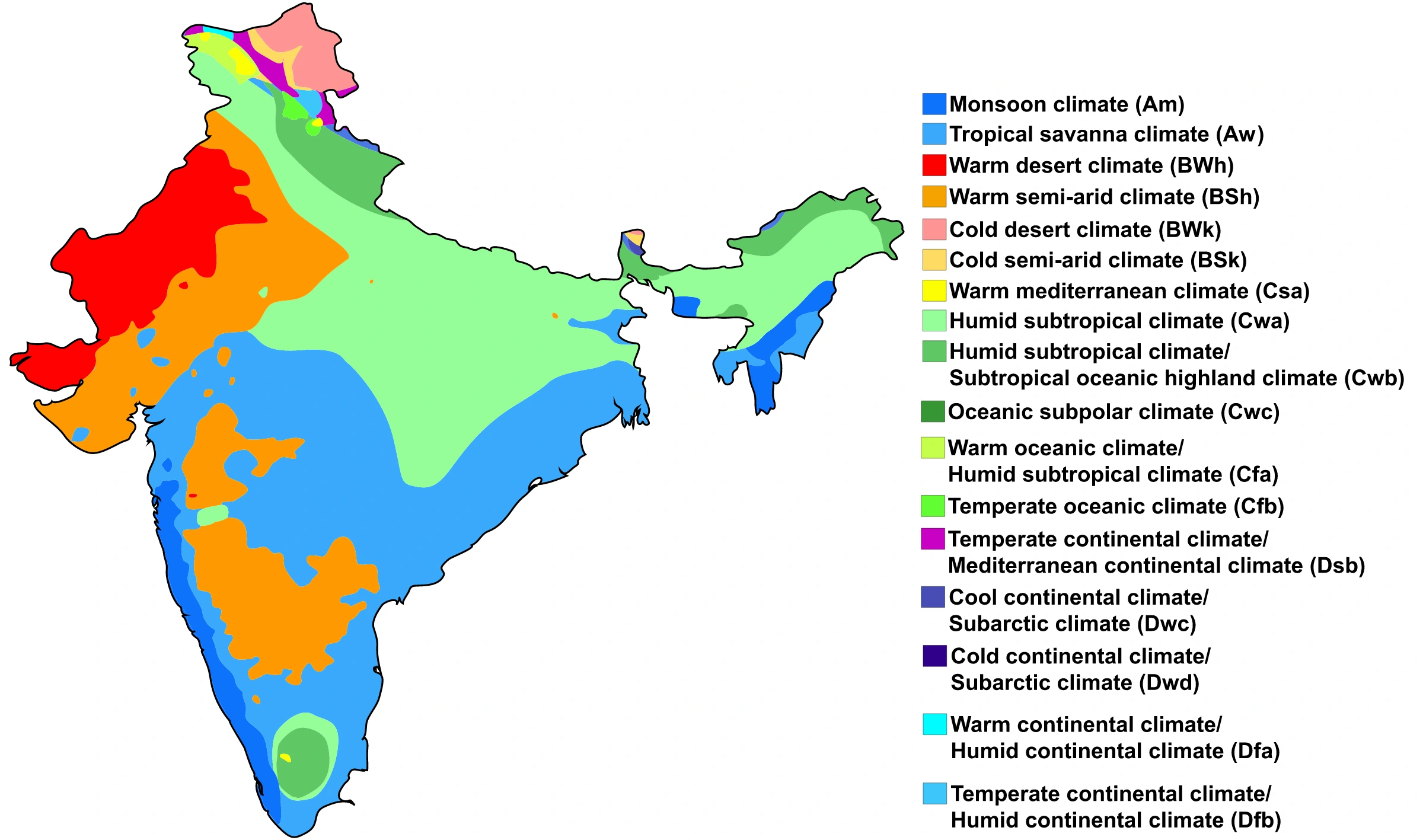
Map study
Köppen climate zones of India: compare arid, tropical and mountain classes. Long-term climate classes are not daily weather.
- Read the source legend, scale and reference period before comparing regions.
- Connect spatial patterns to the processes discussed in this topic; this map is a study reference, not live operational data.
Credit: Ali Zifan · CC BY-SA 4.0 · sourceConverted to WebP on an opaque white background; proportionally resized without cropping. Original cartography and legend retained.
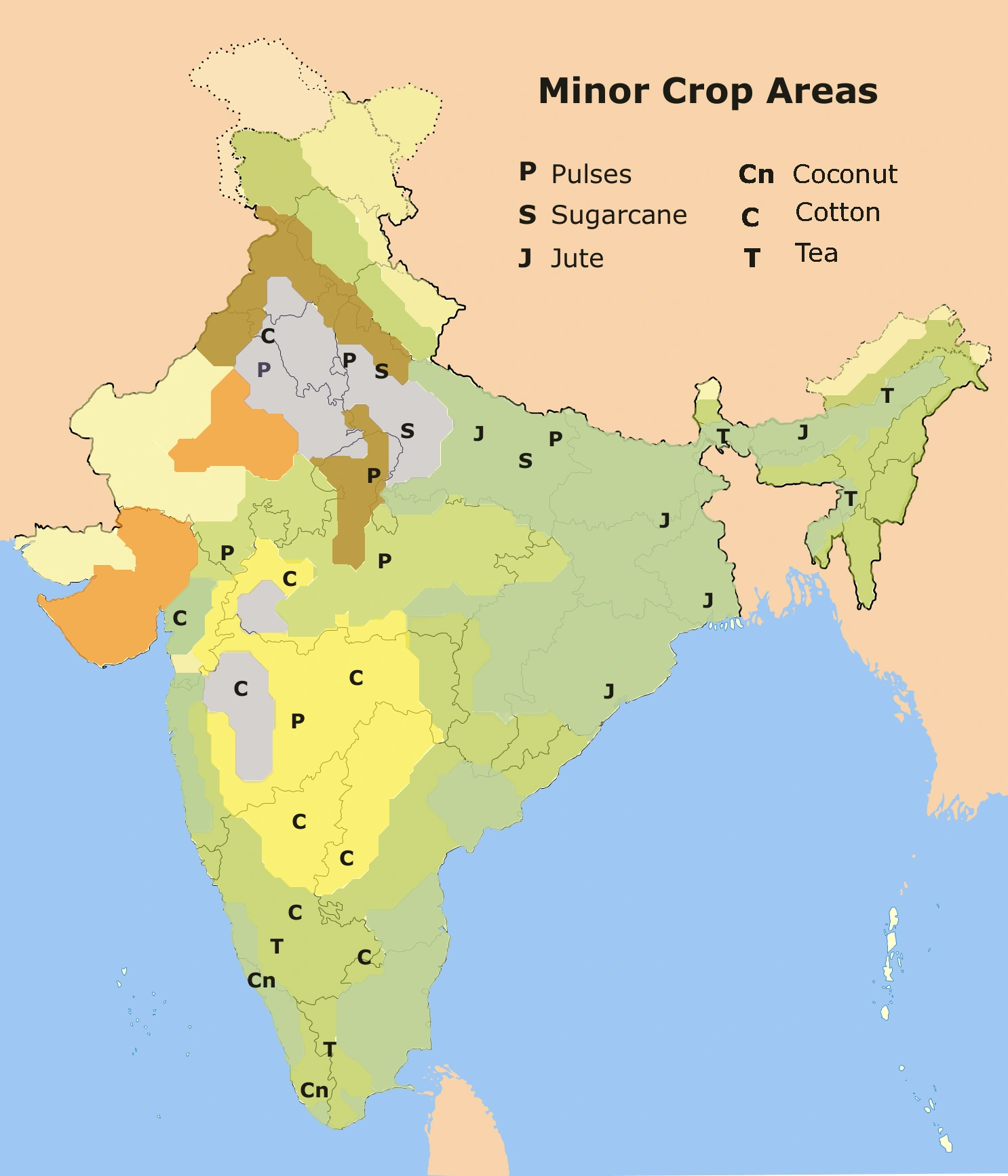
Map study
Selected crop regions of India: identify the legend symbols before comparing patterns. Symbols do not imply exclusive growing areas or current production totals.
- Read the source legend, scale and reference period before comparing regions.
- Connect spatial patterns to the processes discussed in this topic; this map is a study reference, not live operational data.
Credit: Amog · CC BY-SA 2.5 · sourceConverted to WebP on an opaque white background; proportionally resized without cropping. Original cartography and legend retained.
1. Meaning, characteristics and geographical significance
Plantation agriculture is a specialised form of commercial farming in which a perennial crop is grown for a market, usually with organised labour, capital investment and close links to processing. Its classic features include large estates, monoculture, hired workers, scientific management and export orientation. However, these are tendencies rather than universal conditions: small growers supply substantial quantities of Indian tea, coffee, rubber and coconut.
Tea, coffee, rubber and coconut are the main plantation crops relevant to Indian geography. Arecanut, cocoa and cashew also appear within plantation-crop or related horticultural classifications, depending on the institution and statistical series. Horticultural statistics may report tea, coffee and rubber separately from other plantation crops. Consequently, examination answers should distinguish a broad geographical category from a particular administrative classification.
Plantations expanded under colonial rule through the integration of land, labour, transport and overseas markets. Tea estates in Assam and northern Bengal and coffee estates in southern hill regions illustrate this history. Their present economic importance includes rural employment, export earnings, industrial raw materials and regional development. Most have a gestation period before commercial yields begin, making investment sensitive to credit costs and long-term price expectations.
- Perennial crop does not automatically mean plantation crop; commercial organisation and processing linkages also matter.
- Plantation agriculture contrasts with subsistence farming, but estate cultivation and smallholder production can coexist.
2. Tea: humid environments, intensive labour and rapid processing
Tea, obtained from Camellia sinensis, grows best in a warm, humid environment with well-distributed rainfall, commonly around 150–300 cm annually. Conditions vary by variety and elevation, but temperatures around 20–30°C generally favour active growth. Prolonged drought, waterlogging and severe frost are harmful. Deep, acidic, well-drained soils rich in organic matter are desirable. Slopes assist drainage, although erosion control is essential.
Assam's Brahmaputra and Barak valleys and West Bengal's Darjeeling hills, Terai and Dooars form the major northern tea regions. Southern production is concentrated in Tamil Nadu and Kerala, especially the Nilgiris, Anamalai and adjoining highlands. Smaller producing areas include Karnataka, Tripura, Himachal Pradesh and Uttarakhand. Assam is noted for strong, full-bodied tea, while Darjeeling's highland environment contributes to a distinctive aroma and quality.
Tea bushes are pruned to maintain a convenient plucking surface. Selective harvesting commonly takes the terminal bud and two young leaves. Repeated plucking makes tea highly labour-intensive. Fresh leaves deteriorate quickly, so factories must be accessible from gardens. Black tea undergoes withering, rolling or crushing, enzymatic oxidation and drying; green tea is heated early to limit oxidation. CTC means crush, tear and curl, not a separate plant species.
- Tea occurs in both plains and hills; the Assam valleys disprove the assumption that it is exclusively a mountain crop.
- Altitude can influence flavour and harvest timing, while lower, warmer areas often support higher output.
Typical black-tea processing sequence
- 1. Pluck suitable young leaves and buds
- 2. Wither leaves to reduce moisture
- 3. Roll leaves or use CTC processing
- 4. Allow controlled enzymatic oxidation
- 5. Dry or fire to arrest oxidation
- 6. Grade, pack and market
3. Coffee: shaded hills and species-specific requirements
Coffee is grown mainly on well-drained hill slopes in frost-free tropical environments. Indian coffee is predominantly shade-grown, often beneath mixed trees alongside pepper, cardamom or other crops. Rainfall is commonly around 150–250 cm, although requirements differ with species and site. A relatively dry period supports flowering preparation and harvesting; timely blossom showers and subsequent backing showers help fruit establishment.
Arabica generally favours cooler, higher elevations and is valued for flavour, but is more susceptible to important pests and diseases. Robusta tolerates warmer conditions and is generally cultivated at lower elevations than Arabica; its beans typically contain more caffeine. Neither species tolerates prolonged waterlogging. Shade, soil organic matter, drainage and careful moisture management are therefore central to plantation management.
Karnataka leads Indian coffee production, particularly in Kodagu, Chikkamagaluru and Hassan. Kerala, especially Wayanad, and Tamil Nadu's hill regions are the other traditional centres. Coffee has also expanded in Andhra Pradesh, Odisha and parts of the Northeast. The Baba Budan tradition links early coffee introduction to the Chikkamagaluru hills, but should not be confused with the later expansion of commercial estates.
- Coffee fruits are called cherries; the traded beans are seeds extracted through processing.
- Wet processing and dry processing differ in how the fruit layers are removed and the beans prepared.
| Crop | Key ecological requirement | Major Indian regions | Harvested material |
|---|---|---|---|
| Tea | Humid conditions; acidic, well-drained soils | Assam, West Bengal, Tamil Nadu, Kerala | Young leaves and buds |
| Coffee | Frost-free hills; drainage and managed shade | Karnataka, Kerala, Tamil Nadu | Seeds within cherries |
| Natural rubber | Hot, humid climate; no prolonged waterlogging | Kerala, Tripura, Tamil Nadu | Latex tapped from bark |
| Coconut | Warm climate; adequate moisture and drainage | Karnataka, Tamil Nadu, Kerala, Andhra Pradesh | Nuts supplying kernel, water and husk |
| Arecanut | Warm, humid conditions with reliable moisture | Karnataka, Kerala, Assam | Seed of the fruit |
4. Rubber, coconut and associated plantation crops
Natural rubber is obtained chiefly from the latex of Hevea brasiliensis, a tree native to tropical South America. It requires a warm, humid, frost-free climate, generally with temperatures around 25–35°C and rainfall near or above 200 cm. Deep, well-drained soils are important. After an immature period of several years, bark is tapped carefully to collect latex without seriously damaging the tree.
Kerala is India's main rubber-producing state, supported by favourable humidity and established processing and marketing networks. The adjoining Kanyakumari region of Tamil Nadu is another traditional area. Tripura and other suitable northeastern areas have become important expansion zones. Latex can be concentrated or coagulated and processed into products such as sheet rubber and technically specified rubber. Tyre manufacturing is a major source of demand.
Coconut, Cocos nucifera, needs a warm, frost-free climate and adequate moisture. It tolerates coastal conditions better than many crops but also grows inland on suitable, well-drained soils, including under irrigation. Kerala, Karnataka, Tamil Nadu and Andhra Pradesh are major producers; islands such as Lakshadweep also have significant coconut-based livelihoods. Products include edible nuts, copra, oil, coir and tender-coconut water.
Arecanut favours warm, humid conditions and is important in Karnataka, Kerala and Assam. Cocoa can be grown as an intercrop under coconut or arecanut where moisture and shade are suitable. Cashew is associated with tropical peninsular regions and tolerates relatively poor, well-drained soils, though commercial yields respond to improved management.
- Natural rubber is a biological agricultural product; synthetic rubber is industrially manufactured.
- Coir comes from the coconut husk, while copra is the dried kernel.
5. Economic challenges, institutions and sustainable management
Plantation economies face fluctuating commodity prices, rising labour costs, ageing plants and delayed returns from replanting. Small growers may depend on intermediaries or external factories, weakening their bargaining position. Climate risks include erratic rainfall, heat stress, drought, intense storms and changing pest incidence. Excessive chemical use, forest conversion and poorly managed slopes can damage biodiversity, soil and water.
Policy priorities include climate-resilient planting material, staggered replanting, water conservation, integrated pest management and stronger grower organisations. Contour planting, mulching, cover crops and suitable shade trees reduce erosion and moisture stress. Processing improvements, traceability, geographical indications and diversified products can raise value realisation. Shade-grown systems can retain considerable biodiversity, but they should not be treated as substitutes for natural forests.
The Tea Act, 1953, Coffee Act, 1942, and Rubber Act, 1947, underpin the respective commodity boards. The Coconut Development Board was established in 1981 under the Coconut Development Board Act, 1979. Plantation labour welfare has historically been addressed through the Plantations Labour Act, 1951. For examination preparation, distinguish commodity promotion, agricultural development and labour regulation rather than assuming that one institution manages every aspect.
- Assess plantation sustainability through three dimensions: ecological protection, worker welfare and grower profitability.
- Use current official data for rankings: production, cultivated area, productivity and exports are different indicators.
Real-world case studies
Darjeeling tea: geographical identity and value addition
Darjeeling tea became India's first registered geographical indication in 2004. Its reputation is linked to a defined hill environment and established cultivation and processing practices. The Tea Board administers origin-related protection and certification. The example illustrates how geographical identity can differentiate a commodity, while also creating a need to prevent mislabelling.
Tripura: rubber beyond the traditional belt
Tripura's rubber sector demonstrates the expansion of a plantation crop outside southern India. Suitable climatic conditions, planting support and institutional interventions helped establish production. Rubber offers long-term cash income, but its immature phase requires livelihood support. Landscape planning must also account for biodiversity, food-crop needs and exposure to rubber-price fluctuations.
Previous year questions
No source-linked PYQ is available here yet. Use the practice questions below.
Practice questions
Practice MCQ 1
With reference to tea cultivation and processing, consider the following statements: 1. Commercial tea cultivation in India is confined to hill slopes. 2. Tea generally favours acidic, well-drained soils. 3. Green-tea processing limits enzymatic oxidation through early heating. Which statements are correct?
- A. 1 and 2 only
- B. 2 and 3 only
- C. 1 and 3 only
- D. 1, 2 and 3
Practice MCQ 2
Which one of the following pairs is correctly matched?
- A. Coir — Dried coconut kernel
- B. Natural rubber — Latex of Hevea brasiliensis
- C. Coffee bean — Dried outer fruit wall
- D. CTC tea — A separate species of tea plant
Practice MCQ 3
Consider the following statements about coffee in India: 1. Karnataka is the leading producing state. 2. Indian coffee is predominantly cultivated under shade. 3. Arabica generally favours warmer, lower elevations than Robusta. Which statements are correct?
- A. 1 only
- B. 2 and 3 only
- C. 1 and 2 only
- D. 1, 2 and 3
Mains practice · Explain the geographical factors governing the distribution of major plantation crops in India. Discuss measures to improve their economic and ecological sustainability. Answer in 250 words.
- Define plantation agriculture while acknowledging the importance of smallholders.
- Relate tea to humid conditions and acidic soils, coffee to shaded hills, rubber to humid tropical conditions and coconut to warm environments.
- Locate Assam–West Bengal tea, Karnataka coffee, Kerala–Tripura rubber and the southern coconut belt.
- Explain labour, processing, transport, historical investment and market linkages.
- Discuss price volatility, ageing plants, climate stress, worker welfare and ecological degradation.
- Recommend replanting, diversification, soil-water conservation, grower organisations, quality certification and value addition.
Further reading
- NCERT, Contemporary India–II, chapter on Agriculture.
- NCERT, India: People and Economy, chapter on Land Resources and Agriculture.
- Tea Board India: annual reports and tea statistics, teaboard.gov.in.
- Coffee Board of India: cultivation guidance and production statistics, coffeeboard.gov.in.
- Rubber Board: natural-rubber statistics and cultivation guidance, rubberboard.gov.in.
- Coconut Development Board: cultivation guidance and area-production-productivity statistics, coconutboard.gov.in.
Preparing for UPSC Civil Services? Get classroom teaching, answer-writing evaluation and mentorship at Pragnya IAS Academy, Ashok Nagar — see why aspirants choose us for IAS coaching in Hyderabad.