
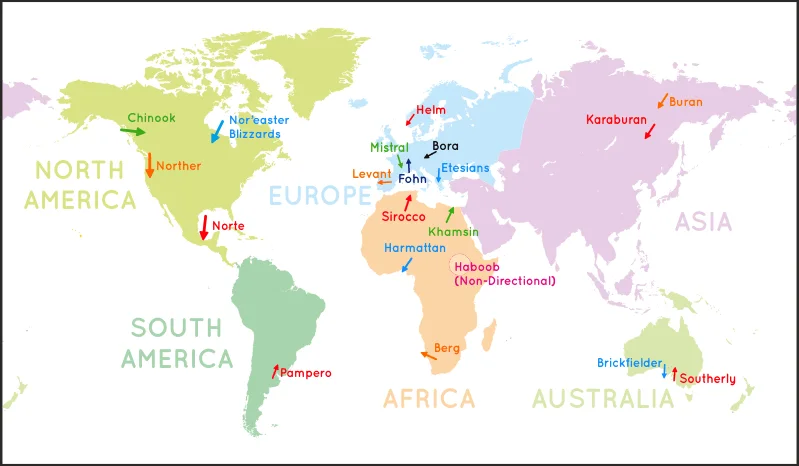
World distribution of local winds: an illustrative geographical reference.
Credit: Bharat Choudhary · CC BY-SA 4.0 · sourceResized and converted to WebP; uncropped.
1. Meaning, scale and physical controls
Local winds operate over limited areas and periods, often ranging from a few kilometres to several hundred kilometres and from hours to several days. Textbooks also discuss named regional winds under this category, although some depend primarily on synoptic-scale pressure systems. Unlike planetary winds such as the trade winds, they do not form permanent, continuous belts around the Earth.
The pressure-gradient force initiates air movement, while friction, the Coriolis effect and topography influence its speed and direction. On small spatial scales and over short periods, heating contrasts and terrain may dominate. Coastlines, valley orientation, mountain gaps, surface roughness and snow cover therefore produce distinctive wind patterns.
Three mechanisms help organise the topic: differential heating creates thermal circulations; mountains force air to rise, descend or pass through gaps; and radiative cooling creates dense air that drains downhill. A strong background wind can overwhelm a local circulation, so textbook daily reversals are clearest under relatively calm, fair-weather conditions.
- Temperature and humidity must be considered separately: a cold wind can be dry, while a wind originating over a desert may acquire moisture over a sea.
- Regional wind names identify typical conditions, not an unchanging temperature or wind speed.
2. Coastal breezes: land–sea thermal contrast
During a sunny day, land generally heats faster than the adjoining sea. Water has a higher heat capacity, mixes vertically and uses substantial energy in evaporation. Heating over land promotes rising air and creates a near-surface pressure contrast that draws cooler marine air inland. This onshore flow is the sea breeze, with a compensating return circulation aloft.
Sea breezes commonly strengthen from late morning into the afternoon. Their leading boundary, the sea-breeze front, can lift warm inland air and promote clouds or thunderstorms if moisture and atmospheric instability are sufficient. Along Indian coasts, including Chennai, sea breezes influence afternoon temperature, humidity and local air-pollution dispersion. The cooling benefit can be partly offset by increased humidity.
At night, land usually cools faster than the sea. Relatively cooler, denser air over land then flows offshore as a land breeze. It is often shallower and weaker than the daytime sea breeze because the nighttime thermal contrast is commonly smaller and stable air limits vertical mixing. Neither breeze has a universal starting time or fixed inland reach.
The monsoon also involves land–ocean heating contrasts, but it is not simply a large sea breeze. Seasonal migration of circulation systems, the intertropical convergence zone, moisture transport and continental-scale pressure patterns are essential to monsoon development.
Classical moist-air explanation of a warm foehn
- 1. A pressure pattern drives air towards a mountain barrier.
- 2. Air rises on the windward slope and cools through expansion.
- 3. After saturation, condensation releases latent heat; precipitation may remove moisture.
- 4. Air crosses the crest and descends the leeward slope.
- 5. Unsaturated descending air warms by compression at about 9.8°C per kilometre.
- 6. A warm, low-relative-humidity downslope wind reaches the leeward foothills.
3. Mountain breezes and warm downslope winds
On sunny days, mountain slopes heat the air touching them. This relatively buoyant air moves upslope as an anabatic wind. At night, slopes lose heat through radiation, cooling adjacent air, which becomes denser and drains downslope as a katabatic wind. Mountain–valley systems also develop along-valley circulations: daytime up-valley and nighttime down-valley flow are common, although slope winds and valley-axis winds are not identical.
Cold air can accumulate in valley bottoms and enclosed basins at night, creating a temperature inversion in which temperature increases with height through a layer. Such inversions encourage frost pockets and trap pollutants near the surface. Strong katabatic winds also occur over the ice sheets of Antarctica and Greenland, where persistent cooling and sloping terrain sustain drainage.
Foehn and Chinook belong to a different category: they are warm, dry downslope winds. In the classical explanation, moist air ascends a mountain, cools, condenses and may lose precipitation on the windward side. After crossing the crest, descending unsaturated air is compressed and warms at approximately the dry adiabatic lapse rate of 9.8°C per kilometre. Its relative humidity falls as it warms.
Foehn is associated with the Alps, while Chinook affects the eastern, leeward side of the Rocky Mountains. Chinook is popularly called a snow eater because warm, dry, windy conditions can rapidly reduce snow cover through melting and sublimation. Windward precipitation is not essential in every event: descent of potentially warmer air from aloft and turbulent mixing can also contribute to foehn warming.
- Exam distinction: cold katabatic drainage is driven by dense cooled air, whereas a warm foehn involves dynamically forced descent and adiabatic warming.
- The environmental lapse rate describes the surrounding atmosphere; the adiabatic lapse rate describes temperature change in a moving air parcel.
| Wind | Principal region | Typical character | Key association |
|---|---|---|---|
| Loo | Northern India and adjoining Pakistan | Very hot and dry | Pre-monsoon summer afternoons |
| Chinook / Foehn | Eastern Rockies / European Alps | Warm and dry | Leeward descent and compression |
| Mistral | Rhône valley, southern France | Cold and generally dry | Flow towards the Mediterranean |
| Bora | Eastern Adriatic coast | Cold and gusty | Descent across coastal mountain terrain |
| Sirocco | North Africa to the Mediterranean | Hot, dusty; may become humid | Moisture acquisition over the sea |
| Harmattan | Sahara to West Africa | Dry and dust-laden | Northeasterly flow in the dry season |
4. Important named regional winds
Loo is a very hot, dry wind affecting northern and northwestern India and adjoining Pakistan during the pre-monsoon summer, especially May and June. It is commonly strongest during the afternoon and increases dehydration and heat-stress risks. It should not be confused with a dust storm, although dust may accompany hot, gusty weather.
Mistral is a cold, generally dry northerly or northwesterly wind channelled through the Rhône valley towards the Mediterranean coast of southern France. Bora is a cold, gusty downslope wind, commonly northeasterly, affecting the eastern Adriatic coast, especially around the Dinaric mountain barrier. Both demonstrate how pressure gradients and terrain can accelerate regional airflow.
Sirocco originates over North Africa and carries warm or hot air towards the Mediterranean. It is initially dry and often dusty but can become moisture-laden after crossing the sea, producing humid conditions or dust-bearing rain in southern Europe. Harmattan is a dry northeasterly wind carrying Saharan dust towards West Africa and the Gulf of Guinea, especially during the boreal winter dry season.
Khamsin denotes hot, dry, dusty episodes affecting Egypt and nearby areas, particularly in spring. Santa Ana winds are dry, often warm offshore winds of southern California, associated with inland high pressure and descent towards the coast. Their low humidity and gustiness can sharply increase wildfire spread.
- Buran refers to cold, often snow-bearing winds or blizzard conditions in parts of Russia and Central Asia.
- Nor’westers or Kalbaisakhi of eastern India are pre-monsoon thunderstorms with squalls, rather than a steady local wind comparable to Loo.
5. Applications, hazards and examination approach
Local winds influence agriculture, transport, settlements and disaster management. Cold-air drainage explains why valley floors can suffer frost while nearby slopes remain warmer. Warm downslope winds can accelerate snowmelt and affect water availability. Dust-bearing winds reduce visibility and worsen respiratory exposure, while dry, gusty winds increase the rate of fire spread.
Coastal and valley circulations influence pollutant transport but do not always cleanse the air. Sea breezes can carry coastal emissions inland or recirculate pollution, while nighttime inversions suppress dispersion. Urban expansion modifies heating contrasts and surface roughness, making observations and local forecasts more useful than fixed rules about wind timing.
For Prelims, identify four attributes before matching a wind: region, direction or pathway, thermal character and moisture character. Then connect these attributes to the mechanism. Particularly important traps are treating every downslope wind as cold, assuming every desert-origin wind remains dry, and confusing daily local breezes with seasonal monsoon circulation.
Local Winds: Connect Location with Mechanism
The metadata identifies a world map of local winds, directly relevant to locating named winds and comparing their regional settings. Use such a map to connect each wind with its source region, terrain and thermal character, rather than treating names as isolated facts. Local winds arise from differential heating or are strongly modified by relief; some named regional winds also depend on larger-scale pressure systems. Their mapped locations alone do not explain their formation.
Distinguish thermally driven circulations from terrain-modified flows. Sea and land breezes reflect contrasting heating and cooling of land and water, while valley and mountain breezes involve slope heating and nocturnal cooling. Foehn and Chinook illustrate warming during descent as air compresses; they are comparative examples outside India. In India, the Loo is a hot, dry pre-monsoon wind associated with the northern plains, relevant to heat exposure and agricultural moisture stress. The metadata does not establish which winds are labelled, so individual locations and classifications require verification.
- Coastal breezes usually reverse between day and night; prevailing winds, cloud cover and local terrain can weaken or disrupt this pattern.
- Do not equate every downslope wind with a warm wind: cold, dense air can drain downslope as a katabatic flow.
- For Prelims, pair names with regions and properties; for Mains, explain pressure gradients, relief and consequences rather than merely listing examples.
Real-world case studies
Chennai: sea breeze and coastal weather
Chennai’s Bay of Bengal coastline supports a pronounced sea-breeze circulation when the background weather is favourable. Marine air can moderate afternoon temperature while increasing humidity. Convergence along the advancing sea-breeze front can help initiate convection. The example connects differential heating with urban thermal comfort and short-range thunderstorm forecasting.
Southern California: Santa Ana winds and wildfire
Santa Ana episodes carry dry inland air through mountain passes and towards the southern California coast. Descent lowers relative humidity, while strong gusts accelerate fire spread and transport embers. Santa Ana winds contributed to the rapid spread of the October 2007 southern California wildfires. Wind is an amplifier of fire behaviour, not necessarily the ignition source.
Previous year questions
No source-linked PYQ is available here yet. Use the practice questions below.
Practice questions
Practice MCQ 1
With reference to land and sea breezes, consider the following statements: 1. A daytime sea breeze generally blows from the sea towards land near the surface. 2. A nighttime land breeze results primarily from land remaining warmer than the adjoining sea. 3. Strong background winds can suppress or substantially modify these circulations. Which of the statements given above are correct?
- A. 1 and 2 only
- B. 1 and 3 only
- C. 2 and 3 only
- D. 1, 2 and 3
Practice MCQ 2
Which one of the following pairs is incorrectly matched?
- A. Chinook — Eastern slopes of the Rocky Mountains
- B. Mistral — Rhône valley and southern France
- C. Harmattan — Dry northeasterly wind affecting West Africa
- D. Bora — Hot desert wind flowing from North Africa towards Europe
Practice MCQ 3
Consider the following statements: 1. Unsaturated air generally warms as it descends and is compressed. 2. Every downslope wind is a cold katabatic wind. 3. Sirocco can acquire moisture while crossing the Mediterranean Sea. Which of the statements given above are correct?
- A. 1 only
- B. 2 and 3 only
- C. 1 and 3 only
- D. 1, 2 and 3
Mains practice · Explain how differential heating and topography generate local winds. Examine their significance for human comfort, agriculture and disaster risk, using suitable examples. Answer in 250 words.
- Define local winds and distinguish thermal circulations from terrain-modified regional winds.
- Explain sea–land breeze reversal through differential heating and cooling.
- Describe daytime upslope flow, nighttime cold-air drainage and valley inversions.
- Explain warm downslope winds through adiabatic compression, using Chinook or Foehn.
- Discuss coastal cooling, humidity, frost pockets, snowmelt and pollutant trapping.
- Use Loo for heat stress, Harmattan for dust exposure and Santa Ana for wildfire spread.
- Conclude with locally tailored forecasting, heat-health precautions and land-use planning.
Further reading
- NCERT, Class XI, Fundamentals of Physical Geography: Atmospheric Circulation and Weather Systems.
- India Meteorological Department, official weather glossary, heat-wave guidance and regional forecasts: mausam.imd.gov.in.
- World Meteorological Organization, International Cloud Atlas and meteorological terminology resources: wmo.int.
- American Meteorological Society, Glossary of Meteorology: entries on sea breeze, katabatic wind, foehn and Chinook.
- US National Weather Service, educational resources on Santa Ana winds and fire weather: weather.gov.
- https://commons.wikimedia.org/wiki/File:Distribution_of_Local_Winds_over_the_world.gif
Preparing for UPSC Civil Services? Get classroom teaching, answer-writing evaluation and mentorship at Pragnya IAS Academy, Ashok Nagar — see why aspirants choose us for IAS coaching in Hyderabad.