
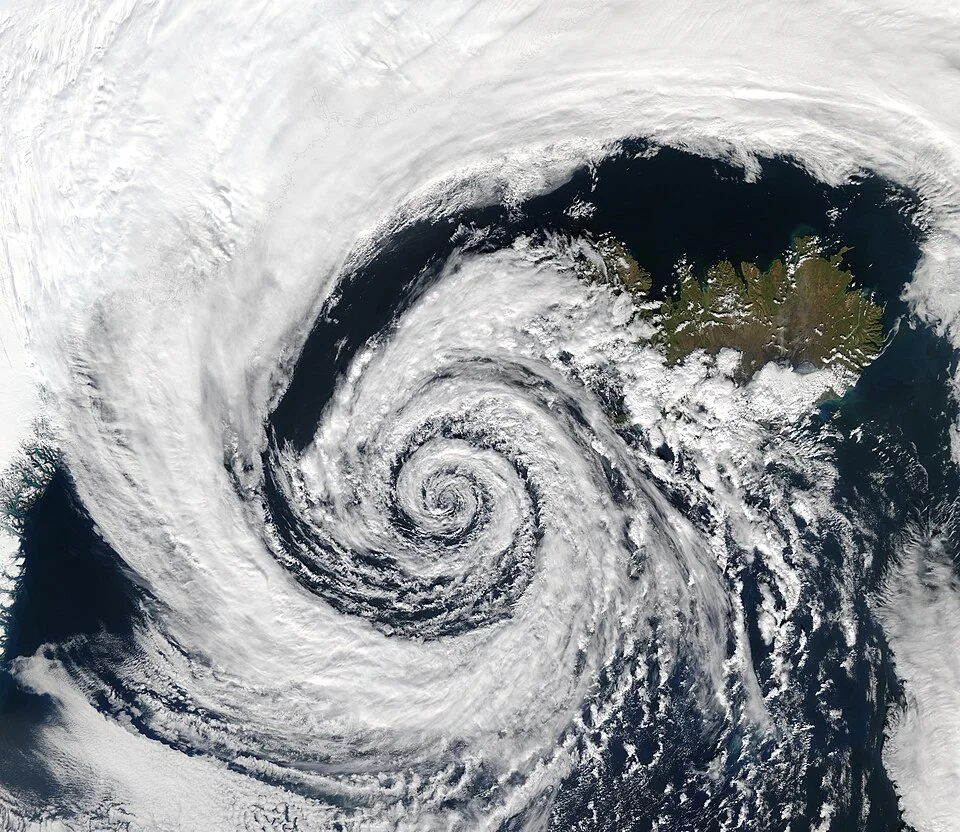
Low-pressure system near Iceland, recorded by Aqua MODIS; a Northern Hemisphere example of cyclonic circulation.
Credit: NASA/GSFC, MODIS Rapid Response Team, Jacques Descloitres · Public domain · sourceResized and converted to WebP; uncropped.
1. Meaning and physical basis
The Coriolis force is an apparent or inertial force used to describe motion in a rotating reference frame. An observer fixed to Earth's surface is in such a frame. A moving air parcel appears to turn relative to the rotating ground even though no corresponding sideways interaction is required in a non-rotating description. This is not an illusion: the deflection relative to Earth's surface is measurable and essential to weather prediction.
The effect is named after French mathematician Gaspard-Gustave de Coriolis, who described the relevant mechanics in 1835. For atmospheric circulation, it must be distinguished from the pressure-gradient force, which pushes air from higher towards lower pressure, and friction, which opposes motion relative to the surface. Coriolis force does not initiate wind in still air; it acts once air is moving relative to Earth.
A common explanation uses conservation of angular momentum. Air moving poleward tends to retain more eastward momentum than its new surroundings, while equatorward-moving air tends to lag behind the ground. This illustrates deflection during north–south motion. The rotating-frame formulation is more general and also explains deflection of eastward and westward motion.
2. Direction, magnitude and latitude
For the horizontal component used in large-scale meteorology, Coriolis acceleration is perpendicular to horizontal velocity. Its magnitude is |2Ω sin φ|V. Earth's angular velocity, Ω, is approximately 7.292 × 10⁻⁵ radians per second. The quantity f = 2Ω sin φ is the Coriolis parameter: positive in the Northern Hemisphere and negative in the Southern Hemisphere. Acceleration is independent of mass, although the corresponding force equals mass multiplied by acceleration.
At a fixed latitude, faster motion produces greater Coriolis acceleration. At a fixed speed, its magnitude increases from zero at the equator to a maximum at the poles. The cause of this latitude variation is the changing component of Earth's rotation vector perpendicular to the local horizontal surface. It is incorrect to explain the maximum polar effect by claiming that the ground moves fastest there; Earth's surface has its greatest linear rotational speed at the equator.
Right and left must always be judged while facing the direction of movement. In the Northern Hemisphere, northward motion is deflected eastward, southward motion westward, eastward motion southward and westward motion northward. All these directions reverse in the Southern Hemisphere. Thus, rightward deflection does not universally mean eastward deflection.
The textbook statement that Coriolis force is absent at the equator refers to the horizontal deflection of horizontal motion. The complete three-dimensional Coriolis acceleration can have other components there. For ordinary UPSC questions on winds and ocean currents, the horizontal formulation is normally intended unless the question specifies otherwise.
Development of idealised geostrophic wind
- 1. A horizontal pressure gradient exists.
- 2. Air begins accelerating towards lower pressure.
- 3. Moving air experiences Coriolis deflection.
- 4. As wind speed increases, Coriolis acceleration strengthens.
- 5. In the steady, straight-flow, frictionless approximation, the two forces balance.
- 6. Wind flows parallel to isobars.
3. Force balance and atmospheric circulation
Pressure differences initially accelerate air across isobars from high towards low pressure. As the wind strengthens, Coriolis deflection becomes stronger. Above the friction-dominated surface layer, straight, steady flow can approach geostrophic balance: the pressure-gradient force and Coriolis force are equal and opposite. Geostrophic wind consequently blows parallel to straight isobars rather than directly from high to low pressure.
In the Northern Hemisphere, low pressure lies to the left of the geostrophic wind; in the Southern Hemisphere, it lies to the right. Closely spaced isobars generally indicate a stronger pressure gradient and, under comparable conditions, stronger winds. Where isobars curve, the required centripetal acceleration must also be considered. The corresponding curved-flow approximation is called gradient-wind balance.
Near Earth's surface, friction generally slows wind and reduces the Coriolis force associated with it. The pressure-gradient force is then not fully balanced by Coriolis force, so winds cross isobars towards lower pressure. Surface winds spiral inward around lows and outward around highs. Northern Hemisphere lows rotate anticlockwise and highs clockwise; Southern Hemisphere lows rotate clockwise and highs anticlockwise.
Coriolis deflection contributes to the easterly character of trade winds moving equatorward and the westerly character of mid-latitude winds moving poleward. However, the three-cell circulation model is an idealisation. Unequal heating, continents, seasonal shifts, mountains and atmospheric eddies also determine actual wind patterns. Earth's rotation alone cannot explain the entire general circulation.
| Feature | Northern Hemisphere | Southern Hemisphere |
|---|---|---|
| Deflection relative to motion | Right | Left |
| Surface circulation around low pressure | Anticlockwise and inward | Clockwise and inward |
| Surface circulation around high pressure | Clockwise and outward | Anticlockwise and outward |
| Low pressure relative to geostrophic wind | Left | Right |
| Idealised net Ekman transport | 90° right of wind | 90° left of wind |
4. Cyclones, monsoons and ocean circulation
Tropical cyclones generally require sufficient planetary rotation to organise a persistent rotating circulation. Their formation is therefore uncommon within about 5° latitude of the equator, where the horizontal Coriolis parameter is small. This is a broad climatological condition, not an absolute geographical prohibition. Warm ocean water, adequate moisture, atmospheric instability, a pre-existing disturbance and relatively weak vertical wind shear are also important.
During the Indian summer monsoon, cross-equatorial flow develops in response to the seasonal pressure distribution. Winds approaching from the Southern Hemisphere experience leftward deflection there and rightward deflection after entering the Northern Hemisphere, contributing to southwesterly flow towards India. The Somali low-level jet over the western Indian Ocean is a prominent component. Its strength and location also reflect pressure gradients, East African topography and boundary-layer processes.
In oceans, wind stress, rotation and friction interact to produce Ekman transport. In the idealised model, net transport across the Ekman layer is 90° to the right of the wind in the Northern Hemisphere and 90° to the left in the Southern Hemisphere. This describes depth-integrated transport, not the direction of every water parcel or necessarily the surface current.
When Ekman transport moves surface water away from a coastline, deeper water rises to replace it, producing coastal upwelling. This supports productive fisheries along regions such as Peru–Chile and California. Coriolis force also contributes to oceanic geostrophic balance, in which currents flow approximately along sea-surface height contours under a balance between the horizontal pressure-gradient force and Coriolis force.
5. Scale dependence and examination pitfalls
The importance of rotation can be assessed using the Rossby number, Ro = U/(|f|L), where U is a characteristic speed and L a characteristic horizontal length. A small Rossby number indicates that Coriolis effects are important relative to inertial acceleration. Large-scale weather systems and ocean currents often satisfy this condition, whereas small, rapidly evolving flows may not. Near the equator, this simple diagnostic requires care because f approaches zero.
Coriolis force acts perpendicular to instantaneous velocity and does no work. Acting alone, it changes direction without changing speed. Real winds nevertheless accelerate or decelerate because pressure gradients, friction and other processes act simultaneously. Similarly, the rotation of tornadoes cannot be inferred from hemisphere alone: local storm dynamics and wind shear are crucial.
Household sinks and toilets are not reliable demonstrations of hemispheric Coriolis deflection. Basin shape, inlet jets, initial water motion and friction usually overwhelm the tiny rotational influence at that scale. Finally, distinguish Coriolis force from centrifugal force. Both occur in rotating-frame descriptions, but the former depends on velocity relative to the frame, while the latter does not.
Coriolis Force and Circulation Around Low Pressure
The metadata identifies a low-pressure system near Iceland, making this a relevant example of how Earth’s rotation influences atmospheric circulation. A low-pressure centre is not a vacuum: the horizontal pressure-gradient force accelerates air from higher towards lower pressure. In the rotating Earth reference frame, Coriolis acceleration deflects moving air to its right in the Northern Hemisphere. Together, these influences help produce counter-clockwise circulation around a northern low; southern lows generally circulate clockwise.
Away from the surface, where friction is weak, pressure-gradient and Coriolis forces can approximately balance, producing geostrophic wind parallel to straight isobars. Curved circulation requires a gradient-wind description that includes centripetal acceleration. Near the surface, friction reduces wind speed and therefore Coriolis acceleration, allowing air to cross isobars towards lower pressure. This Icelandic system is a comparative illustration, not evidence about a particular Indian cyclone. The same dynamics help explain counter-clockwise circulation around Bay of Bengal and Arabian Sea lows. Cloud imagery alone cannot establish wind speeds, pressure gradients or the precise force balance.
- For horizontal motion, Coriolis acceleration has magnitude |f|V, where f = 2Ω sin φ. It increases with speed and absolute latitude, vanishing at the equator and reaching its latitudinal maximum at the poles.
- Coriolis acceleration acts perpendicular to velocity: it redirects motion rather than directly increasing speed. The pressure-gradient force initiates motion; Coriolis force does not.
- Do not identify every spiral cloud system as a tropical cyclone. Extratropical lows also rotate cyclonically, while tropical cyclone formation is inhibited close to the equator by weak planetary rotation effects.
Real-world case studies
Cyclone Fani, Bay of Bengal, 2019
Extremely Severe Cyclonic Storm Fani crossed the Odisha coast near Puri on 3 May 2019. Its anticlockwise circulation was consistent with a Northern Hemisphere low-pressure system. Its development nevertheless required favourable oceanic and atmospheric conditions; Coriolis force organised rotation but did not supply the cyclone's energy.
Near-equatorial Typhoon Vamei, 2001
Vamei formed in December 2001 near 1.5°N in the South China Sea. This unusually low-latitude tropical cyclone demonstrates why the approximately 5° formation threshold should not be treated as an absolute rule. A strong monsoon surge and a pre-existing Borneo-region circulation helped provide substantial relative vorticity despite weak planetary vorticity.
Previous year questions
UPSC Prelims 2024
With reference to Coriolis force, consider the following statements: 1. It increases with an increase in wind velocity. 2. It is maximum at the poles and absent at the equator. Which of the statements given above is/are correct?
- A. 1 only
- B. 2 only
- C. Both 1 and 2
- D. Neither 1 nor 2
Practice questions
Practice MCQ 1
An air parcel moves due west in the Northern Hemisphere. In which direction does its horizontal Coriolis acceleration act?
- A. North
- B. South
- C. East
- D. Vertically upward
Practice MCQ 2
Consider the following statements: 1. Coriolis force can initiate motion in stationary air. 2. Coriolis force does no work on a moving air parcel. 3. Geostrophic wind flows parallel to straight isobars. Which statements are correct?
- A. 1 and 2 only
- B. 2 and 3 only
- C. 1 and 3 only
- D. 1, 2 and 3
Practice MCQ 3
Two air parcels have identical horizontal speeds at 30°N and 90°N. What is the ratio of their horizontal Coriolis acceleration magnitudes, respectively?
- A. 1:1
- B. 1:2
- C. 2:1
- D. 1:4
Mains practice · Explain how Coriolis force influences atmospheric and oceanic circulation. Why does its importance vary with latitude and the scale of motion? Answer in 250 words.
- Define the apparent force and state hemispheric deflection rules.
- Use f = 2Ω sin φ to explain latitude dependence.
- Discuss geostrophic balance, frictional cross-isobar flow and cyclone rotation.
- Illustrate with trade winds and Indian cross-equatorial monsoon flow.
- Explain idealised Ekman transport and coastal upwelling.
- Use the Rossby number to distinguish large-scale circulation from household drainage.
- Clarify that Coriolis force neither supplies energy nor independently determines circulation.
Further reading
- NCERT, Class XI, Fundamentals of Physical Geography: Atmospheric Circulation and Weather Systems.
- India Meteorological Department: Frequently Asked Questions on Tropical Cyclones, rsmcnewdelhi.imd.gov.in.
- NOAA Ocean Service: What is the Coriolis effect? oceanservice.noaa.gov.
- UCAR Center for Science Education: Coriolis Effect, scied.ucar.edu.
- UPSC Civil Services Preliminary Examination 2024, General Studies Paper I, upsc.gov.in.
- https://commons.wikimedia.org/wiki/File:Low_pressure_system_over_Iceland.jpg
Preparing for UPSC Civil Services? Get classroom teaching, answer-writing evaluation and mentorship at Pragnya IAS Academy, Ashok Nagar — see why aspirants choose us for IAS coaching in Hyderabad.