

View from Cannon Hill on Elephanta Island, Maharashtra, India.
Credit: A.Savin · FAL · source

Entrance of Visakhapatnam Harbour in Vizag city, Andhra Pradesh
Credit: Pinakpani · CC BY 4.0 · source
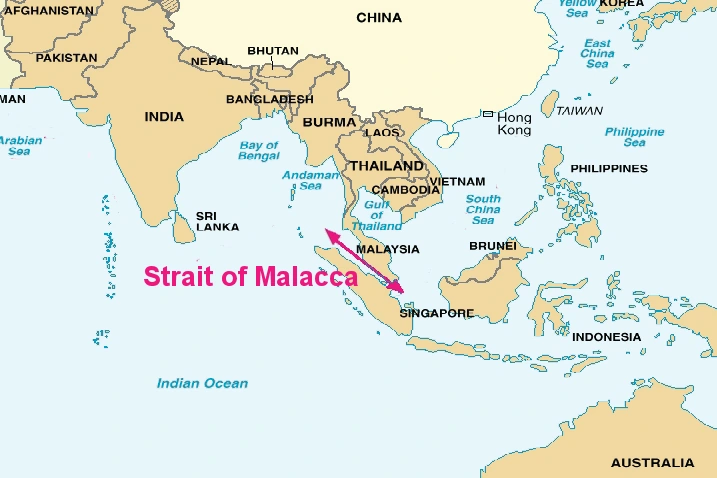
Map study
Strait of Malacca between the Malay Peninsula and Sumatra: trace the Indian Ocean–South China Sea shipping connection and its trade significance.
- Read the source legend and reference date before interpreting the map.
- Use spatial patterns to support topic revision; verify current official boundaries, designations and warnings separately.
Credit: US Department of Defense · Public domain · sourceConverted to WebP on an opaque white background; proportionally resized without cropping. Original cartography and legend retained.
1. Meaning, functions and locational geography
A port is a coastal or river-side facility where vessels load and unload cargo or passengers and obtain services such as pilotage, repairs and storage. A harbour is a sheltered water area where vessels can anchor safely; it need not possess extensive cargo-handling facilities. A terminal is a specialised operating facility within a port, handling containers, petroleum, coal, automobiles or other traffic. Several terminals may operate within one port.
Port location depends on shelter from waves, adequate water depth, an accessible approach channel, stable coastal conditions and sufficient land for docks, warehouses and transport links. Draught is the vertical distance between a vessel’s waterline and its lowest point; deeper channels allow vessels with greater draught to enter. Sedimentation can reduce navigable depth and require recurring maintenance dredging. Tides, cyclones, currents and coastal erosion also influence construction and operations.
Economic geography is equally important. A hinterland is the inland region served by a port, while its foreland comprises overseas markets and maritime connections. Ports prosper where railways, highways, pipelines and waterways connect them efficiently to industrial and agricultural centres. Proximity to international shipping routes encourages transshipment, in which cargo is transferred between vessels rather than moving directly into the port’s domestic hinterland.
- Natural harbours use existing coastal shelter; artificial harbours rely substantially on engineered protection such as breakwaters.
- Riverine ports operate along rivers or estuaries and may face channel-depth and sedimentation constraints.
- Landlord ports generally provide land and basic infrastructure while private operators manage terminals under concessions.
2. Western coast: gateways to industrial hinterlands
The western coast provides gateways to the Arabian Sea, the Persian Gulf and Europe through the Suez Canal. Gujarat and Maharashtra benefit from industrial concentration, petroleum refining, manufacturing and connections with northern India. However, physical advantages vary locally: the Gulfs of Kachchh and Khambhat have strong tidal influences, while some estuarine locations require substantial channel management.
Deendayal Port at Kandla in Gujarat developed as an important alternative gateway after Partition placed Karachi in Pakistan. It serves a broad north-western hinterland and handles diverse bulk and liquid cargo. Mundra, also in Gujarat, is a major commercial gateway under the non-major-port category, with container, bulk and energy-related facilities. Their contrast illustrates why statutory status should not be confused with cargo volume or economic importance.
Mumbai has a natural harbour and historically supported cotton textiles, commerce and industry. Urban congestion and limited expansion space constrained its development. Jawaharlal Nehru Port at Nhava Sheva emerged as a specialised container gateway serving Maharashtra and a wider inland hinterland. The Western Dedicated Freight Corridor strengthens the region’s rail-based freight connections. Vadhavan, approved in 2024 in Palghar district, is planned as a deep-draught port, not an already established operational gateway.
Mormugao in Goa has historically been associated with iron-ore exports. New Mangalore in Karnataka serves petroleum refining, fertiliser and agricultural trade. Cochin in Kerala occupies a strategic position near major east–west shipping routes; its Vallarpadam terminal handles container transshipment. Vizhinjam, near Thiruvananthapuram, combines naturally deep water with proximity to these routes and is designed primarily as an international container transshipment gateway.
Typical containerised export movement
- 1. Production and packing in the hinterland
- 2. Road or rail movement, sometimes through an inland container depot
- 3. Customs clearance and terminal gate processing
- 4. Container-yard handling and vessel loading
- 5. Direct overseas shipment or transfer at a transshipment hub
- 6. Destination-port clearance and inland delivery
3. Eastern coast and riverine port systems
India’s eastern ports face the Bay of Bengal and connect mineral-rich eastern India and southern manufacturing centres with Asian and global markets. Large river deltas, sediment movement and cyclone exposure create important engineering challenges. Nevertheless, the coast is not uniformly unsuitable for harbours: Visakhapatnam demonstrates the importance of local relief and shelter. Avoid the simplistic assumption that every western port is natural and every eastern port is artificial.
V.O. Chidambaranar Port at Thoothukudi serves southern Tamil Nadu, including industrial clusters and agricultural exporters. Chennai is an artificial harbour with strong automobile, engineering and container connections. Kamarajar Port at Ennore, north of Chennai, was developed partly to accommodate bulk traffic and relieve pressure on Chennai. It operates as a company and should not be confused with a port authority constituted under the Major Port Authorities Act.
Visakhapatnam in Andhra Pradesh is linked with mineral exports, petroleum and heavy industry. Nearby Gangavaram is a separate non-major port. Paradip in Odisha is associated with coal, iron ore, petroleum and the mineral-industrial belt. Dhamra is another Odisha port but belongs to the non-major category. Such adjacent ports frequently compete for overlapping hinterlands while specialising in different cargoes or services.
Syama Prasad Mookerjee Port, Kolkata, is a riverine major-port system comprising the Kolkata Dock System and Haldia Dock Complex. Its Hooghly approach requires careful navigation and maintenance dredging. Haldia, farther downstream, helps serve vessels and cargo flows constrained by the upstream approach. This system provides access to eastern and north-eastern India and supports transit trade involving neighbouring landlocked countries.
| Port | Location | Examination significance |
|---|---|---|
| Deendayal | Gujarat; Gulf of Kachchh | Formerly Kandla; serves north-western hinterland |
| Jawaharlal Nehru | Nhava Sheva, Maharashtra | Major container gateway; distinct from Mumbai Port |
| Vizhinjam | Near Thiruvananthapuram, Kerala | Deep-water transshipment port; non-major category |
| Kamarajar | Ennore, Tamil Nadu | Major port organised as a company |
| Paradip | Odisha | Gateway for the eastern mineral-industrial belt |
| Syama Prasad Mookerjee | West Bengal; Hooghly system | Includes Kolkata and Haldia dock systems |
4. Governance, connectivity and development programmes
Under the Constitution, Union List Entry 27 covers ports declared major ports by law, while Concurrent List Entry 31 covers other ports. Major-port development is overseen by the Ministry of Ports, Shipping and Waterways. State governments and maritime boards principally administer non-major ports. Ownership and operation are separate questions: a publicly administered port may have privately operated terminals, while a privately developed port can remain legally non-major.
The Major Port Authorities Act, 2021 replaced the Major Port Trusts Act, 1963 for the ports covered by it, establishing boards with greater operational and financial autonomy. Kamarajar remains a company-form exception. Public–private partnerships are widely used for terminal construction, equipment and operations, but their performance depends on transparent concessions, reliable connectivity, competition and effective oversight.
Sagarmala, approved in 2015, promotes port-led development through port modernisation, connectivity, industrialisation and coastal-community development. PM Gati Shakti supports integrated infrastructure planning, while the National Logistics Policy, 2022 addresses logistics efficiency. Freight corridors, multimodal logistics parks, inland container depots and dedicated road links help extend port hinterlands. Inland container depots are inland customs and cargo-handling facilities, not maritime ports.
Maritime India Vision 2030 and Maritime Amrit Kaal Vision 2047 provide broader development frameworks. Evaluate projects through vessel turnaround time, berth productivity, cargo dwell time and end-to-end logistics costs rather than installed capacity alone. Transshipment competitiveness also depends on shipping-line networks, frequency of services, customs procedures and pricing; deep water by itself does not guarantee a successful hub.
5. Environmental concerns and examination approach
Port expansion can alter littoral sediment movement, causing erosion in some stretches and deposition in others. Dredging and disposal may affect benthic habitats, while reclamation can damage mangroves, mudflats and fishing grounds. Oil spills, coal dust, wastewater and invasive organisms transported through ballast water create additional risks. Cyclones, storm surges and sea-level rise make climate-resilient design essential.
Environmental appraisal must consider coastal regulation requirements, habitat protection, cumulative impacts and fishing-community access. Mitigation includes sediment-management plans, cleaner cargo handling, waste-reception facilities, shore power where feasible, electrified equipment and ecological monitoring. The Harit Sagar Green Port Guidelines, released in 2023, promote greener port operations. Development should combine logistics efficiency with livelihood safeguards and measurable environmental performance.
For Prelims, practise locating ports from Gujarat to West Bengal and distinguishing nearby facilities. Link each port with its state, sea or gulf, river where relevant, hinterland and prominent cargo. Treat rankings cautiously because total cargo, container throughput, installed capacity and annual performance are different measures. Any ranking should specify its year and metric.
Real-world case studies
Jawaharlal Nehru Port: containerisation and hinterland access
Commissioned in 1989, Jawaharlal Nehru Port developed across Mumbai Harbour to address changing cargo requirements and constraints at Mumbai. Specialised container terminals and inland transport connections made it a leading container gateway. Its experience shows that terminal capacity must be matched by rail evacuation, efficient gates and customs facilitation.
Vizhinjam: opportunity and coastal safeguards
Vizhinjam received its first mothership in July 2024 during trial operations. Deep water and proximity to international routes support its transshipment role, potentially reducing dependence on overseas hubs. However, attracting shipping services requires competitive operations, while local concerns over coastal change and fishing livelihoods require sustained scientific monitoring and consultation.
Previous year questions
No source-linked PYQ is available here yet. Use the practice questions below.
Practice questions
Practice MCQ 1
Consider the following statements: 1. Every privately operated Indian port is a non-major port. 2. A non-major port may handle more cargo than a major port. 3. Major-port status is a legal classification rather than simply a measure of cargo throughput. Which statements are correct?
- A. 1 and 2 only
- B. 2 and 3 only
- C. 1 and 3 only
- D. 1, 2 and 3
Practice MCQ 2
Which sequence correctly arranges the following ports from north to south?
- A. Paradip – Visakhapatnam – Chennai – V.O. Chidambaranar
- B. Visakhapatnam – Paradip – Chennai – V.O. Chidambaranar
- C. Paradip – Chennai – Visakhapatnam – V.O. Chidambaranar
- D. Paradip – Visakhapatnam – V.O. Chidambaranar – Chennai
Practice MCQ 3
In maritime transport, transshipment most appropriately refers to:
- A. Moving cargo from a factory to an inland container depot
- B. Transferring cargo between vessels at an intermediate port
- C. Removing sediment from an approach channel
- D. Transporting passengers exclusively between domestic ports
Mains practice · Port-led development requires more than the construction of deep-water terminals. Discuss with reference to hinterland connectivity, governance and coastal sustainability in India. Answer in 250 words.
- Introduce ports as nodes linking domestic production with global trade.
- Explain natural advantages: depth, shelter and proximity to shipping routes.
- Discuss rail, road, pipeline and inland-waterway links and last-mile bottlenecks.
- Examine customs efficiency, terminal productivity and transparent public–private partnerships.
- Use Jawaharlal Nehru Port and Vizhinjam as contrasting gateway and transshipment examples.
- Address dredging, erosion, climate hazards and fishing-community livelihoods.
- Conclude with integrated planning under Sagarmala and PM Gati Shakti.
Further reading
- NCERT, India: People and Economy, Class XII: Transport and Communication; International Trade.
- Ministry of Ports, Shipping and Waterways: Basic Port Statistics of India and annual reports.
- India Code: Constitution of India, Seventh Schedule; Major Port Authorities Act, 2021.
- Sagarmala Programme: official portal and project documents.
- Ministry of Ports, Shipping and Waterways: Maritime India Vision 2030; Harit Sagar Green Port Guidelines, 2023.
Preparing for UPSC Civil Services? Get classroom teaching, answer-writing evaluation and mentorship at Pragnya IAS Academy, Ashok Nagar — see why aspirants choose us for IAS coaching in Hyderabad.