

A view of landscape with pre harvest wheat crop in Punjab
Credit: Harvinder Chandigarh · CC BY-SA 4.0 · source

Mustard Fields in Rajasthan in november (mostly used to make mustard oil)
Credit: Trees ForTheFuture · CC BY 2.0 · source
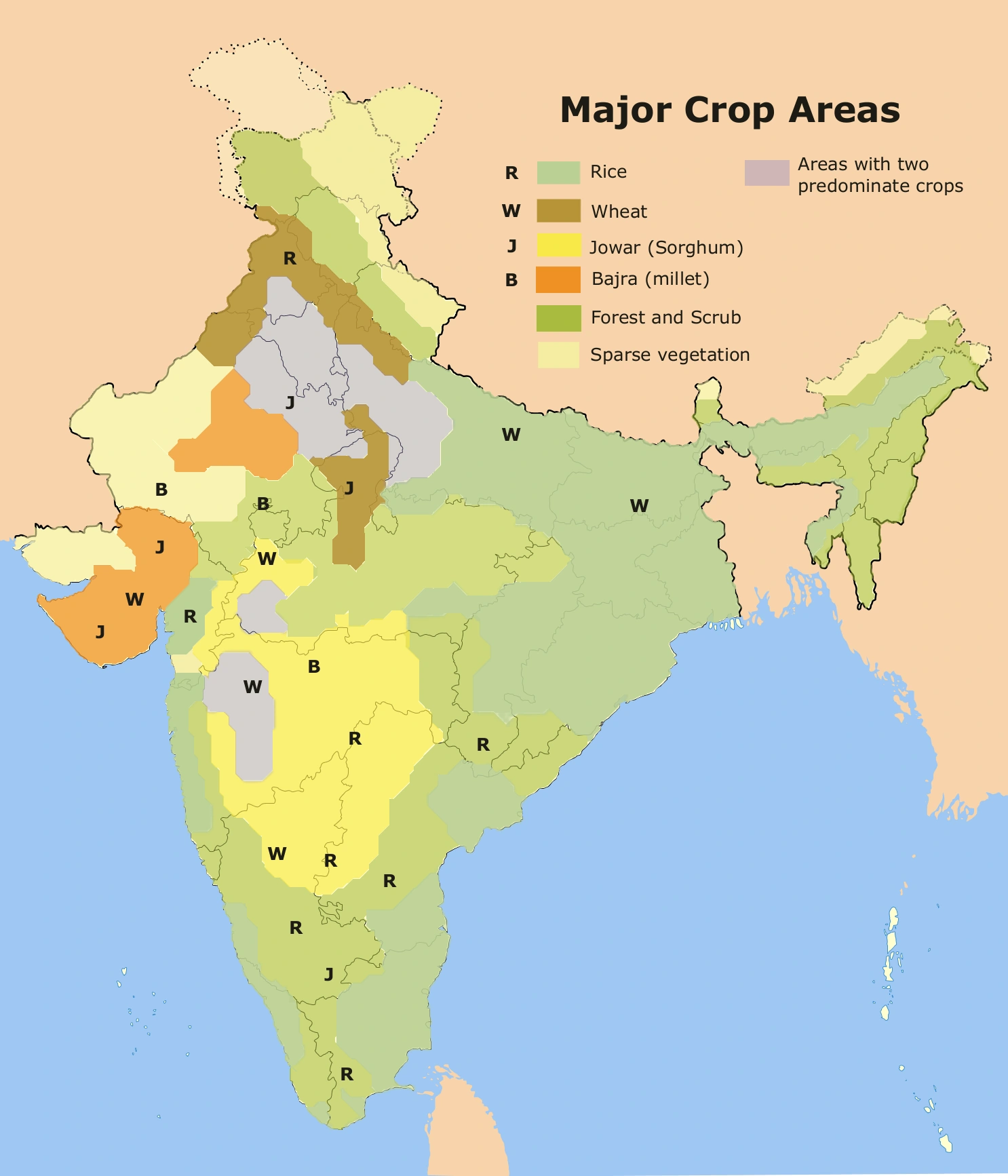
Map study
Major crop regions of India: relate crop belts to rainfall, soils, temperature and irrigation. Schematic historical reference, not current production rankings.
- Read the source legend, scale and reference period before comparing regions.
- Connect spatial patterns to the processes discussed in this topic; this map is a study reference, not live operational data.
Credit: Amog · CC BY-SA 2.5 · sourceConverted to WebP on an opaque white background; proportionally resized without cropping. Original cartography and legend retained.
1. Meaning, calendar and seasonal setting
Rabi, a term derived from the Arabic word for spring, refers in India to crops normally sown after the southwest monsoon and harvested in spring. Sowing generally takes place between October and December. Harvesting commonly occurs from March to April, extending into May in cooler wheat-growing areas. These months are indicative, not rigid national boundaries: latitude, altitude, irrigation availability and crop duration modify the calendar.
The season contrasts with kharif cultivation, which broadly coincides with the southwest monsoon, and zaid cultivation, the short summer season between rabi harvest and the next kharif crop. Many rabi crops favour cool conditions during early growth and warmer, dry weather at maturity. Nevertheless, their individual temperature and moisture requirements differ, so rabi is a seasonal category rather than a uniform ecological group.
Rabi agriculture is closely linked to the preceding monsoon. Monsoon rainfall recharges aquifers, fills reservoirs and leaves moisture in the soil. A weak monsoon can therefore reduce winter cropping even where rabi rainfall is normally low. Conversely, a delayed monsoon withdrawal or late kharif harvest may postpone sowing and expose the subsequent crop to greater heat during grain filling.
- Typical sequence: monsoon recharge, kharif harvest, winter sowing, spring harvest.
- Crop identity does not determine season everywhere: maize, rice and several pulses have regionally distinct calendars.
- The northeast monsoon supplies important October–December rainfall to Tamil Nadu and adjoining areas, creating a different seasonal context from northwestern India.
2. Major crops and their geographical distribution
Wheat grows best with a cool growing period and relatively warm, dry ripening conditions. Fertile, well-drained loamy and clayey soils are suitable, although irrigation and management permit cultivation across varied soils. Its major production belt includes Uttar Pradesh, Madhya Pradesh, Punjab, Haryana and Rajasthan. The northwestern plains combine favourable winters, irrigation, mechanisation and strong procurement infrastructure; central India is also a major wheat-producing region.
Barley generally tolerates drought and salinity better than wheat, though performance depends on the variety and degree of stress. Rajasthan, Uttar Pradesh and Haryana are important growing areas. It is used for food, feed and malt. Gram or chickpea occupies a different ecological niche: it can utilise stored soil moisture and generally requires less irrigation than wheat. Madhya Pradesh, Maharashtra and Rajasthan are important gram-producing states.
Lentil and field pea are additional winter pulses, particularly in northern and central India. Lentil is grown in states including Madhya Pradesh, Uttar Pradesh, Bihar and West Bengal. Rapeseed–mustard is prominent in Rajasthan, Uttar Pradesh, Haryana and Madhya Pradesh; cool growth conditions and adequate moisture support yields, while frost and high temperatures at sensitive stages can cause damage. Safflower is a rabi oilseed in parts of the Deccan, notably Maharashtra and Karnataka.
Potato, onion and several vegetables are also cultivated during winter. Irrigated rabi maize is important in parts of Bihar, Andhra Pradesh and Telangana. Southern and eastern India support irrigated winter rice under regional crop calendars. For examination purposes, distinguish conventional textbook examples from the broader range of crops actually grown during the season.
- Rabi cereals: wheat and barley; maize and rice in suitable regional systems.
- Rabi pulses: gram, lentil and field pea.
- Rabi oilseeds: rapeseed–mustard, safflower and linseed.
How the monsoon influences the rabi harvest
- 1. Monsoon rainfall replenishes soil moisture, reservoirs and groundwater.
- 2. Kharif harvest timing determines field availability.
- 3. Farmers select rabi crops according to temperature, moisture and market conditions.
- 4. Timely sowing establishes crops under favourable winter conditions.
- 5. Irrigation and winter rainfall support growth.
- 6. Spring temperature and harvest weather influence final yield and quality.
3. Water, weather and soil controls
Winter rainfall is limited across much of India, making irrigation especially important for high-yielding wheat. Canals, tube wells and reservoirs provide water beyond the monsoon season. However, rabi is not synonymous with irrigated farming. Gram, safflower and other crops can grow on conserved moisture in suitable soils. Deep black soils have substantial water-storage capacity, while alluvial plains offer extensive cultivable land with irrigation access.
Western disturbances are eastward-moving extratropical weather systems associated with the subtropical westerly circulation. They bring winter rain to northwestern plains and snowfall to the western Himalaya. Moderate, well-timed rain can supplement irrigation for wheat and other winter crops. Their effects are not uniformly beneficial: intense rain, hail or strong winds can cause waterlogging, lodging, flower loss and damage to mature grain.
Temperature is equally decisive. Late-sown wheat may encounter terminal heat during flowering and grain filling, shortening the grain-filling period and reducing grain weight. Frost can injure sensitive crop stages, including mustard flowering and pod development. Rain around harvest can delay field operations and impair grain quality. Weather must therefore be assessed by its timing and intensity, not simply by seasonal totals.
- Wheat’s crown-root initiation stage is particularly sensitive to moisture stress.
- Pulses require good drainage; prolonged waterlogging restricts root function and biological nitrogen fixation.
- Winter rainfall from western disturbances must not be confused with southwest monsoon rainfall.
| Crop | Category | Important growing states | Key consideration |
|---|---|---|---|
| Wheat | Cereal | Uttar Pradesh, Madhya Pradesh, Punjab, Haryana | Cool growth period; irrigation and timely sowing are important |
| Barley | Cereal | Rajasthan, Uttar Pradesh, Haryana | Relatively tolerant of drought and salinity |
| Gram | Pulse | Madhya Pradesh, Maharashtra, Rajasthan | Can exploit residual moisture; avoid waterlogging |
| Lentil | Pulse | Madhya Pradesh, Uttar Pradesh, Bihar, West Bengal | Suitable for cool-season cultivation and selected rice fallows |
| Rapeseed–mustard | Oilseed group | Rajasthan, Uttar Pradesh, Haryana, Madhya Pradesh | Sensitive to frost and heat at critical stages |
| Safflower | Oilseed | Maharashtra, Karnataka | Deep-rooted crop suited to stored-moisture cultivation |
4. Economic significance, institutions and policy
Rabi crops contribute cereals, pulses, edible oils, fodder and industrial raw materials. Wheat is central to public foodgrain stocks and distribution under the National Food Security Act, 2013. Rabi pulses help meet protein demand, while mustard and other winter oilseeds contribute to domestic edible-oil supply. Winter cultivation also increases cropping intensity, defined as gross cropped area divided by net sown area, multiplied by 100.
The Union government announces Minimum Support Prices for six principal rabi crops on the recommendations of the Commission for Agricultural Costs and Prices. An announced MSP is not a guarantee that every farmer’s entire output will be purchased. Actual procurement depends on the crop, location, quality standards and operational arrangements. Wheat procurement by the Food Corporation of India and state agencies is more extensive than procurement for many pulses and oilseeds.
Policy support includes irrigation development and water-use efficiency under Pradhan Mantri Krishi Sinchayee Yojana, crop insurance under Pradhan Mantri Fasal Bima Yojana for notified crops and areas, and research by Indian Council of Agricultural Research institutions. PM-AASHA supports mechanisms intended to improve price realisation for pulses, oilseeds and copra. Effective rabi policy must integrate irrigation, seed quality, extension, storage and remunerative markets rather than focus exclusively on expanding acreage.
- Procurement and marketing may occur in a different calendar year from sowing; distinguish crop season from marketing season.
- Leguminous rabi crops can improve rotations through symbiotic nitrogen fixation, though benefits depend on residue and nutrient management.
- Reliable markets and processing capacity are essential for sustained diversification towards pulses and oilseeds.
5. Sustainability, adaptation and examination approach
The rice–wheat system illustrates both the productivity gains and environmental costs of intensive agriculture. In northwestern India, groundwater depletion, energy use and the short interval between rice harvest and wheat sowing create management pressures. The water problem concerns the whole rotation, particularly water-intensive paddy; it should not be attributed to wheat alone. Residue burning during the transition is another major challenge.
Adaptation includes timely sowing, locally appropriate heat-tolerant varieties, irrigation scheduling and conservation agriculture. Zero-tillage seed drills and Happy Seeder technology can establish wheat without conventional intensive tillage, while the Happy Seeder also permits sowing into retained rice residues. These practices can save time and help manage residues, but adoption depends on machinery access, local conditions and technical support.
For Prelims, avoid absolute statements: all rabi crops do not need irrigation, all rice is not kharif, and all winter rainfall is not beneficial. Link each crop to its season, resource requirements and regional setting. Also distinguish weather shocks from long-term climate trends: an individual heatwave directly affects a harvest, while sustained warming changes the probability of heat stress and the suitability of cultivation calendars.
- Diversification must match local soil, water availability, consumption needs and market opportunities.
- Expanding pulses in suitable rice fallows can use residual moisture, but delayed sowing and rapid soil drying are constraints.
- Yield stability requires attention to both water scarcity and excess moisture at sensitive growth stages.
Real-world case studies
India’s wheat crop and the March 2022 heatwave
Unusually high temperatures in March 2022 exposed wheat in parts of northern and central India to terminal heat during grain filling. Production estimates were revised downward. The episode highlighted the importance of timely sowing, heat-tolerant varieties and weather advisories rather than relying on acreage alone to predict output.
Chickpea in the post-monsoon Deccan
In parts of Maharashtra and Karnataka, chickpea is cultivated after the monsoon using moisture stored in deep black soils, sometimes supplemented by irrigation. This system demonstrates why rabi should not be equated exclusively with canal- or tube-well-irrigated farming. Its success depends on soil depth, monsoon recharge and timely crop establishment.
Previous year questions
No source-linked PYQ is available here yet. Use the practice questions below.
Practice questions
Practice MCQ 1
Consider the following statements: 1. Rabi cultivation may depend on moisture stored during the preceding monsoon. 2. Every rabi crop requires assured irrigation. 3. Some crops can be cultivated in different seasons in different parts of India. Which statements are correct?
- A. 1 and 2 only
- B. 1 and 3 only
- C. 2 and 3 only
- D. 1, 2 and 3
Practice MCQ 2
Which one of the following groups consists entirely of crops covered by the Union government’s rabi MSP announcements?
- A. Wheat, gram, rapeseed–mustard and safflower
- B. Wheat, arhar, groundnut and barley
- C. Lentil, soybean, gram and wheat
- D. Barley, cotton, safflower and rapeseed–mustard
Practice MCQ 3
With reference to wheat cultivation in northwestern India, consider the following statements: 1. Moderate winter rainfall from western disturbances can supplement irrigation. 2. Late sowing can increase exposure to terminal heat. 3. Heavy rainfall at maturity invariably improves grain quality. Which statements are correct?
- A. 1 only
- B. 2 and 3 only
- C. 1 and 2 only
- D. 1, 2 and 3
Mains practice · Rabi agriculture is a product of both winter climatic conditions and the legacy of the preceding monsoon. Explain, and suggest measures to improve its climate resilience. Answer in 250 words.
- Define rabi and explain regional variations in crop calendars.
- Connect monsoon rainfall with soil moisture, groundwater recharge and reservoir storage.
- Discuss cool-season requirements, western disturbances and irrigation.
- Use wheat, gram and mustard to illustrate differing resource needs.
- Analyse terminal heat, frost, untimely rainfall and groundwater stress.
- Suggest timely sowing, improved varieties, irrigation scheduling, residue management and suitable diversification.
- Conclude with location-specific planning supported by extension, insurance and markets.
Further reading
- NCERT, Contemporary India–II, Class X: Agriculture.
- NCERT, India: People and Economy, Class XII: Land Resources and Agriculture.
- Department of Agriculture and Farmers Welfare: Agricultural Statistics at a Glance.
- Commission for Agricultural Costs and Prices: Price Policy for Rabi Crops reports.
- India Meteorological Department: agrometeorological advisories and western disturbance information.
- ICAR–Indian Institute of Wheat and Barley Research: crop production and advisory publications.
Preparing for UPSC Civil Services? Get classroom teaching, answer-writing evaluation and mentorship at Pragnya IAS Academy, Ashok Nagar — see why aspirants choose us for IAS coaching in Hyderabad.