

Rice Transplanter in Tamil Nadu - India
Credit: Nikhil.irri · CC BY-SA 3.0 · source

Kids in the cotton fields - Aurangabad (Maharastra, India)
Credit: François Zeller from Montreal, Canada · CC BY-SA 2.0 · source
Map study
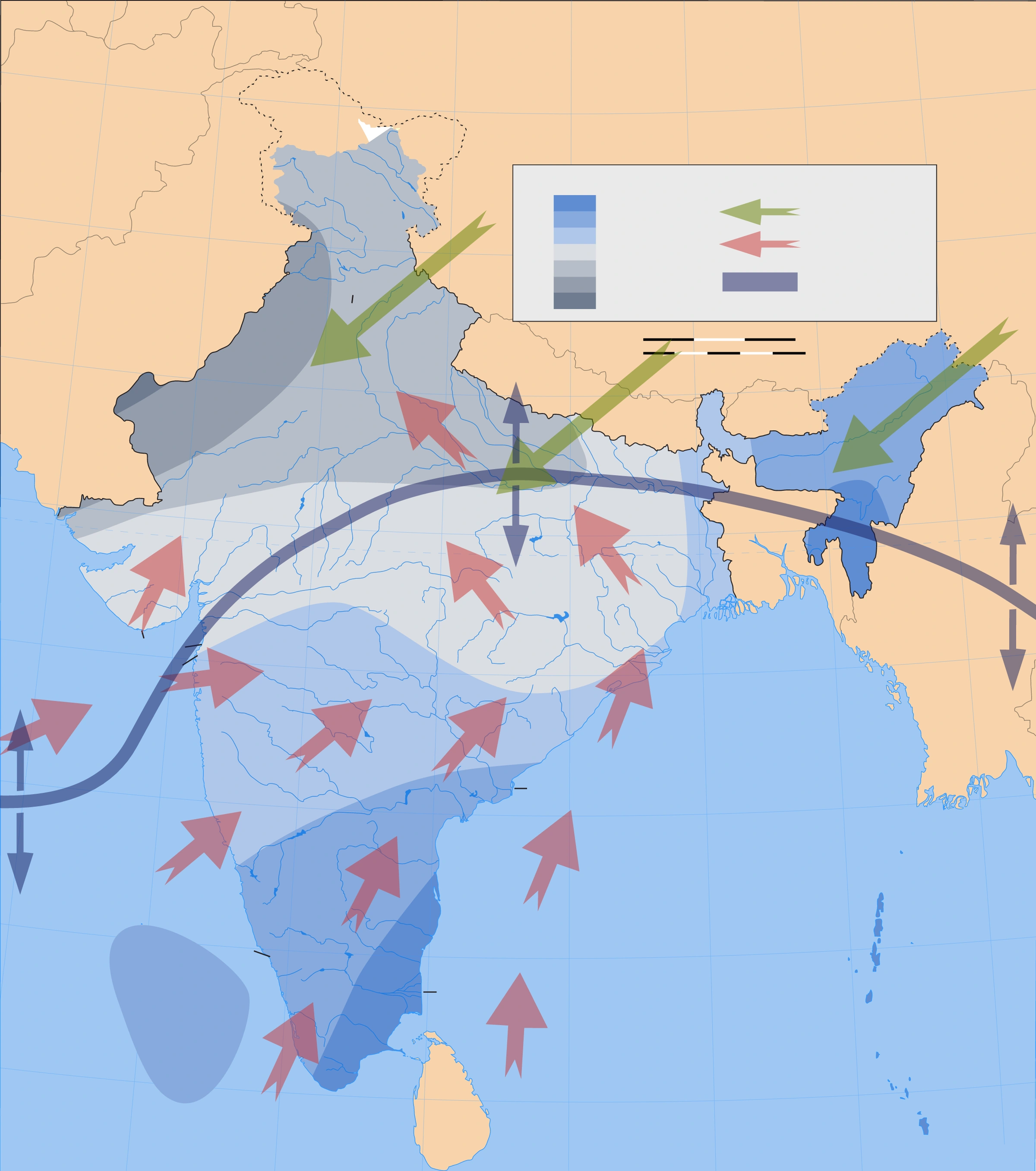
Southwest monsoon onset progression in the source reference map. Actual dates vary each year; consult IMD for current onset information.
- Read the source legend, scale and reference period before comparing regions.
- Connect spatial patterns to the processes discussed in this topic; this map is a study reference, not live operational data.
Credit: Saravask; Planemad; Nichalp · CC BY-SA 3.0 · sourceConverted to WebP on an opaque white background; proportionally resized without cropping. Original cartography and legend retained.
Map study
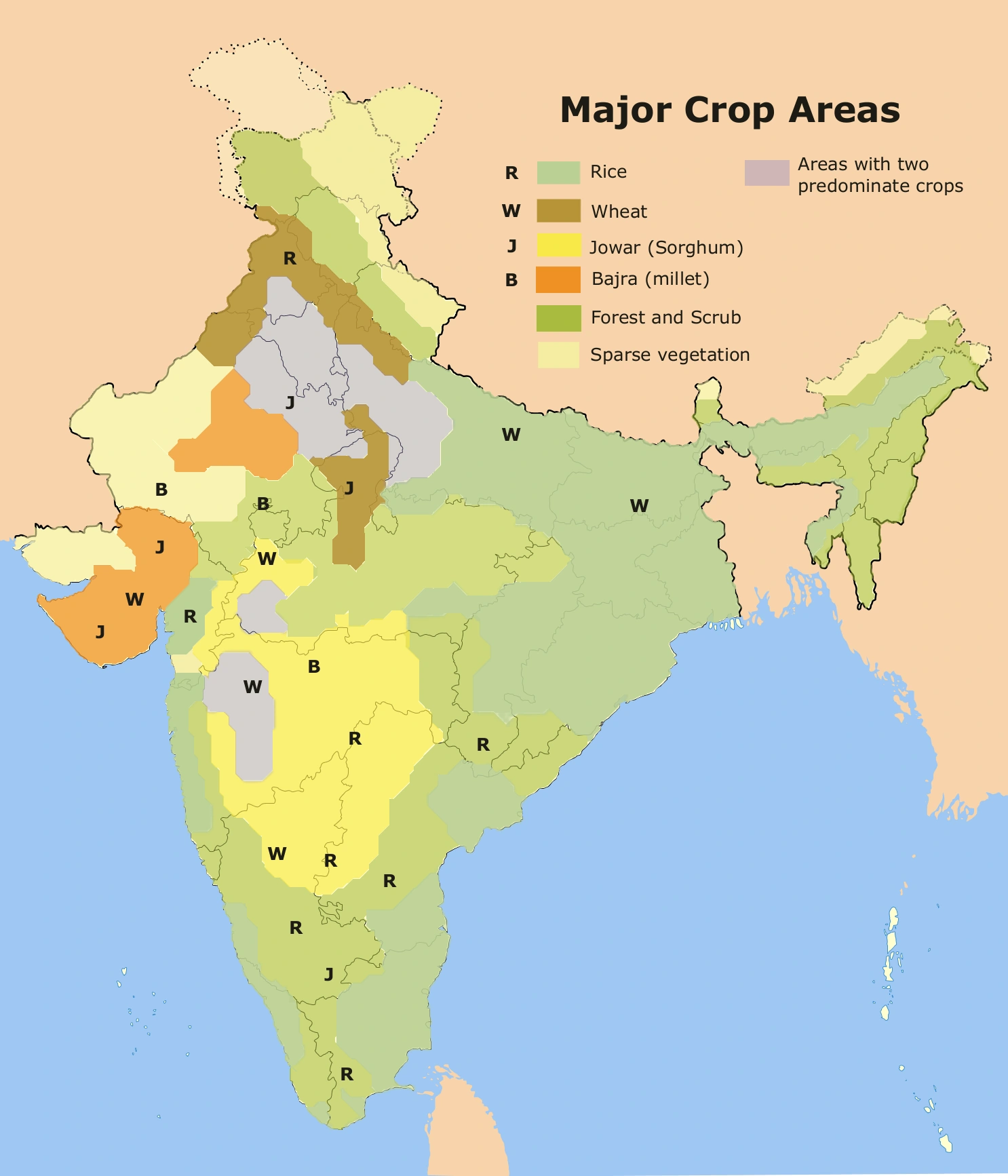
Major crop regions of India: relate crop belts to rainfall, soils, temperature and irrigation. Schematic historical reference, not current production rankings.
- Read the source legend, scale and reference period before comparing regions.
- Connect spatial patterns to the processes discussed in this topic; this map is a study reference, not live operational data.
Credit: Amog · CC BY-SA 2.5 · sourceConverted to WebP on an opaque white background; proportionally resized without cropping. Original cartography and legend retained.
1. Meaning, crop calendar and monsoon relationship
India’s agricultural calendar is commonly divided into kharif, rabi and zaid seasons. Kharif cultivation broadly coincides with the warm, rainy part of the year. Land preparation begins before or around monsoon onset; sowing usually occurs in June–July, followed by harvesting from September to November. These are broad windows rather than fixed dates. In northeastern India and parts of the south, sowing may begin earlier, while delayed rains can postpone planting elsewhere.
The southwest monsoon normally reaches Kerala around 1 June and advances across the country thereafter. Farmers depend not only on total seasonal rainfall but also on its onset, distribution and intervening dry spells. Adequate early rain establishes seedlings, whereas a prolonged break after sowing may require resowing. Heavy rainfall can cause waterlogging, soil erosion and nutrient losses. Rain near maturity can damage grain quality, delay harvesting and increase post-harvest losses.
Crop duration must be separated from the seasonal label. Cotton and pigeonpea sown during the monsoon may remain in the field well beyond the main kharif harvesting period. Conversely, short-duration pulses may mature quickly. Sugarcane is a long-duration crop with region-specific planting seasons and should not be treated simply as a standard short-duration kharif crop.
- Rabi crops are generally sown in October–December and harvested in spring; wheat, gram and mustard are standard examples.
- Zaid denotes the short summer cropping period between rabi and kharif; irrigated watermelon, cucumber and fodder crops are common examples.
2. Major kharif cereals and millets
Rice requires warmth and substantial moisture during growth. Rainfall around 100 cm or more is generally favourable, but irrigation permits cultivation in much drier regions. Fertile alluvial and clayey soils that retain water are useful for lowland paddy. However, upland rice can grow without continuous flooding, so standing water is not a universal biological requirement. West Bengal, Uttar Pradesh, Punjab, Odisha, Chhattisgarh, Andhra Pradesh, Telangana and Tamil Nadu are important rice-growing states.
Rice cultivation illustrates the difference between natural suitability and human modification. Eastern plains and coastal deltas benefit from abundant monsoon moisture, whereas Punjab and Haryana support large irrigated rice systems despite relatively low rainfall. In southern and eastern India, multiple rice crops may be grown annually. Tamil Nadu’s rice calendar is particularly influenced by irrigation and the October–December northeast monsoon, making a single all-India sowing calendar misleading.
Maize favours warm conditions, moderate rainfall and fertile, well-drained soils; prolonged waterlogging is harmful. Karnataka, Madhya Pradesh and Maharashtra are important producers, while Bihar has substantial winter maize cultivation. Kharif millets include bajra, jowar and ragi. Bajra is well adapted to hot, relatively dry conditions and light soils, especially in Rajasthan. Ragi is important in Karnataka. Jowar has both kharif and rabi crops, particularly across the Deccan, and must not be classified as exclusively monsoon-grown.
- Millets generally tolerate moisture stress better than rice, but drought tolerance does not mean that yields are unaffected by drought.
- Rice and maize are cereals; pigeonpea and green gram are pulses; groundnut and soybean are oilseeds.
Typical kharif production cycle
- 1. Assess rainfall outlook, soil moisture and irrigation availability
- 2. Select suitable crop and variety; prepare land and drainage
- 3. Sow or transplant with adequate moisture
- 4. Manage nutrients, weeds, pests and dry spells
- 5. Harvest at maturity during a suitable weather window
- 6. Dry, grade, store and market the produce
3. Pulses, oilseeds and fibre crops
Major kharif pulses include pigeonpea or arhar, green gram or moong, and black gram or urad. They provide dietary protein and are commonly cultivated in rainfed systems. Symbiotic bacteria in root nodules fix atmospheric nitrogen, supporting soil fertility when crop residues and rotations are managed appropriately. Most pulses require good drainage and suffer under prolonged waterlogging. Maharashtra, Karnataka and Madhya Pradesh are important pulse-growing states, although the dominant pulse varies by region.
Groundnut, soybean, sesamum and niger are important kharif oilseeds. Groundnut favours warm conditions and friable, well-drained soils that allow underground pods to develop. Gujarat and southern peninsular states are important producers. Soybean is prominent in Madhya Pradesh and Maharashtra and is often cultivated on black soils. Such soils retain moisture but may require drainage during heavy rain. Sesamum tolerates relatively dry conditions, yet is vulnerable to waterlogging.
Cotton requires a long frost-free period, warmth and adequate moisture during vegetative growth. Dry weather is desirable during boll opening and picking. Black soils are favourable because of their moisture-retaining capacity, but cotton is also cultivated on alluvial and other soils. Gujarat, Maharashtra, Telangana and Madhya Pradesh are important cotton-growing states. Jute requires a warm, humid climate and is strongly associated with the alluvial plains of the lower Ganga, particularly West Bengal. After harvesting, stems undergo retting, a microbial process that loosens fibres; water availability and quality influence fibre quality.
- Soybean and groundnut are legumes botanically but are grouped primarily as oilseeds in agricultural statistics.
- Jute is mainly a kharif crop, though sowing may begin during the pre-monsoon months.
| Crop | Favourable conditions | Illustrative region | Important qualification |
|---|---|---|---|
| Rice | Warmth and abundant moisture; water-retentive soils | Eastern plains and coastal deltas | Also grown in irrigated dry regions and non-kharif seasons |
| Bajra | Hot, relatively dry climate; light soils | Rajasthan | Drought-tolerant, not drought-proof |
| Soybean | Warm monsoon season; well-drained soils | Madhya Pradesh and Maharashtra | A legume classified primarily as an oilseed |
| Groundnut | Warm climate; friable, well-drained soil | Gujarat and peninsular India | Also cultivated in rabi or summer under suitable conditions |
| Cotton | Long frost-free season; dry weather at picking | Gujarat, Maharashtra and Telangana | Not confined to black soils |
| Jute | Warm, humid climate; alluvial soils | Lower Gangetic plain | Retting conditions affect fibre quality |
4. Regional patterns, irrigation and environmental concerns
Kharif agriculture broadly follows India’s moisture gradient. Humid eastern plains, northeastern valleys and coastal lowlands favour rice. Drier northwestern areas support bajra and pulses, while the Deccan combines cotton, soybean, jowar, maize and pulses according to soil depth, rainfall and irrigation. These are broad associations, not exclusive crop belts. Prices, procurement, processing industries, transport and access to technology can alter patterns substantially.
Irrigation buffers rainfall uncertainty but can create environmental costs when water-intensive crops expand into water-stressed regions. Groundwater-fed paddy cultivation in northwestern India is a major example. Flooded rice fields can emit methane, while excessive fertiliser use contributes to nutrient pollution and nitrous oxide emissions. Cotton, maize and pulses face different risks, including drought, pest outbreaks and waterlogging.
Adaptation requires crop and location-specific measures. Short-duration varieties, timely sowing, drainage, farm ponds, intercropping and weather advisories can reduce losses. Direct-seeded rice may save labour and water under suitable conditions, but weed management and establishment are critical. Alternate wetting and drying can reduce irrigation demand in appropriate paddy systems. Diversification towards pulses, oilseeds or millets works best when accompanied by reliable markets, processing and locally suitable agronomy.
5. Policy support and Prelims distinctions
The Commission for Agricultural Costs and Prices recommends minimum support prices, and the Union government announces them. The 14 mandated kharif crops are paddy, jowar, bajra, maize, ragi, arhar, moong, urad, groundnut, sunflower seed, soybean, sesamum, nigerseed and cotton. Jute is covered separately. MSP announcement does not mean that every farmer can sell an unlimited quantity at that price: procurement arrangements, quality standards and practical access differ across crops and states.
Pradhan Mantri Fasal Bima Yojana addresses specified production risks subject to notified crops, areas and scheme conditions. The maximum farmer premium is generally 2 per cent of the sum insured for kharif food and oilseed crops; annual commercial and horticultural crops have a 5 per cent rate. Irrigation programmes, soil testing and agrometeorological advisories complement insurance. For examination purposes, link each crop with season, moisture needs, soil, region and end use rather than memorising isolated lists.
- Do not confuse kharif with rainfed: many kharif crops receive irrigation.
- Do not confuse black soil with cotton exclusivity: both the soil and the crop occur in other agricultural combinations.
- Distinguish crop-year production estimates from final estimates when using current agricultural data.
Real-world case studies
Punjab: regulating paddy establishment to conserve groundwater
The Punjab Preservation of Subsoil Water Act, 2009 regulates the timing of paddy nursery sowing and transplantation through prescribed or notified dates. Aligning establishment more closely with monsoon rainfall seeks to reduce groundwater pumping during the hot pre-monsoon period. It illustrates how a kharif crop can depend heavily on irrigation and require conservation-oriented regulation.
Odisha: strengthening millet-based farming
Launched in 2017, the Odisha Millets Mission supported millet cultivation, processing and consumption, particularly in tribal areas. Ragi promotion demonstrates the importance of linking climate-suitable crops with procurement, local processing and nutrition programmes rather than relying on production incentives alone.
Previous year questions
No source-linked PYQ is available here yet. Use the practice questions below.
Practice questions
Practice MCQ 1
Consider the following statements: 1. Kharif crops are necessarily cultivated without irrigation. 2. Maize can be cultivated in both kharif and rabi seasons in India. 3. Jowar is exclusively a kharif crop. Which of the statements given above is/are correct?
- A. 1 and 2 only
- B. 2 only
- C. 2 and 3 only
- D. 1, 2 and 3
Practice MCQ 2
Which one of the following crop–condition pairs is incorrectly matched?
- A. Bajra — Relative tolerance of low-rainfall conditions
- B. Groundnut — Friable, well-drained soil
- C. Cotton — Persistent rainfall during boll opening is desirable
- D. Jute — Warm and humid growing conditions
Practice MCQ 3
Consider the following crops: 1. Soybean 2. Groundnut 3. Pigeonpea. Which of the above are legumes?
- A. 1 and 2 only
- B. 2 and 3 only
- C. 3 only
- D. 1, 2 and 3
Mains practice · Explain how monsoon variability shapes kharif agriculture in India. Suggest measures to improve resilience without intensifying pressure on water resources. Answer in 250 words.
- Distinguish rainfall onset, seasonal total, distribution, dry spells and extreme rainfall.
- Explain effects on sowing, establishment, flowering, harvesting and crop quality.
- Use examples from eastern rice regions, northwestern irrigated paddy and rainfed Deccan agriculture.
- Discuss suitable varieties, intercropping, drainage, soil-moisture conservation and supplemental irrigation.
- Evaluate location-specific rice water management and diversification towards suitable pulses, oilseeds and millets.
- Link agronomic measures with advisories, insurance, procurement and processing infrastructure.
Further reading
- NCERT, Contemporary India–II, Class X: Agriculture.
- NCERT, India: People and Economy, Class XII: Land Resources and Agriculture.
- Department of Agriculture and Farmers Welfare: Agricultural Statistics at a Glance.
- Commission for Agricultural Costs and Prices: Price Policy for Kharif Crops reports.
- India Meteorological Department: Monsoon information and agrometeorological advisories.
- Pradhan Mantri Fasal Bima Yojana official portal: Operational guidelines and farmer information.
Preparing for UPSC Civil Services? Get classroom teaching, answer-writing evaluation and mentorship at Pragnya IAS Academy, Ashok Nagar — see why aspirants choose us for IAS coaching in Hyderabad.