
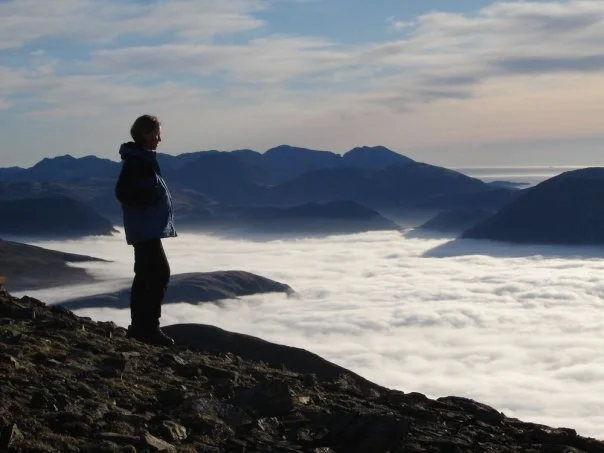
Temperature inversion in the Lake District, viewed from Grasmoor; a comparative example from Britain.
Credit: Penny Johnson · CC BY-SA 4.0 · sourceResized and converted to WebP; uncropped.
1. Meaning, lapse rate and atmospheric stability
The troposphere is heated substantially from below: the Earth's surface absorbs solar radiation and transfers energy to the atmosphere through longwave radiation, sensible heat and latent heat. Consequently, temperature generally decreases with altitude. Temperature inversion is the opposite arrangement within a particular layer, with relatively cold air below warmer air. It is different from an isothermal layer, in which temperature remains nearly constant with height.
The environmental lapse rate describes the actual temperature change with height at a particular place and time. Its commonly quoted average of 6.5°C per kilometre is not a universal daily value. The dry adiabatic lapse rate, approximately 9.8°C per kilometre, describes the cooling of an unsaturated air parcel rising without exchanging heat with its surroundings. These two rates must not be confused.
An inversion is strongly stable. An unsaturated parcel lifted from below expands and cools, while the surrounding air within the inversion becomes warmer upward. The parcel therefore becomes colder and denser than its surroundings and tends to sink back. This suppresses convection and limits vertical exchange. However, atmospheric stability does not require an inversion: a layer in which temperature decreases slowly with height can also be stable.
- Surface-based inversion: the inverted temperature profile begins at or very near the ground.
- Elevated inversion: the inversion base lies above the surface and may cap a mixed layer.
- Inversion strength is measured by the temperature increase across the layer; inversion depth is its vertical thickness.
2. Radiation inversions and cold-air pooling
A radiation inversion forms when the ground loses heat through outgoing longwave radiation and cools the air immediately above it. Higher air remains relatively warmer. This commonly develops after sunset and becomes strongest near sunrise. Long winter nights allow prolonged cooling, while clear skies reduce downward longwave radiation from clouds. Light winds permit a cold surface layer to persist; strong winds usually weaken it through turbulent mixing.
Dry air and clear skies favour strong radiative cooling, but moisture determines whether fog or dew develops. If the near-surface air reaches saturation, radiation fog may form. An inversion therefore does not automatically produce fog. Snow-covered ground can help maintain cold near-surface conditions because of high reflectivity, limited daytime heating and insulation from warmer soil beneath. In polar winters, weak or absent sunlight can sustain inversions for long periods.
In mountainous terrain, air cooled on slopes becomes dense and drains downslope under gravity. This katabatic drainage collects cold air in valleys and enclosed basins, producing a cold-air pool. Valley floors can consequently be colder than nearby slopes. A relatively warm belt on the slopes, sometimes called a thermal belt, may experience less frost. Such contrasts matter for orchard location, settlements and frost-sensitive crops.
- Best conditions: clear skies, long nights, light winds and effective surface heat loss.
- After sunrise, surface heating often breaks a shallow inversion from below; cloud, snow or weak winter sunshine can delay this.
- Cold-air pooling is strengthened where terrain restricts drainage and ventilation.
How a nocturnal inversion can worsen air quality
- 1. Clear skies permit strong nighttime surface heat loss
- 2. Air touching the ground cools below the temperature of air above
- 3. A stable surface inversion develops
- 4. Vertical mixing and effective dilution diminish
- 5. Continuing emissions accumulate if horizontal ventilation is also weak
3. Advection, subsidence and frontal inversions
Advection-related inversions develop when air moves horizontally across a surface with a different temperature. Warm air passing over cold land, snow or cold ocean water is cooled from below, creating a stable layer and sometimes an inversion. If sufficient moisture is present and saturation occurs, advection fog may accompany it. Unlike a typical radiation inversion, this process need not be confined to clear, calm nights.
A subsidence inversion develops when air descends over a broad region, commonly within a high-pressure system. Descending air compresses and warms adiabatically. When this produces warm, dry air above a cooler lower layer, an elevated inversion forms. Such inversions can persist and cap the atmospheric boundary layer. They are important over subtropical oceans, where they restrict deep convection and help confine marine clouds to lower levels.
Along some subtropical western continental margins, cold ocean currents cool the lowest air while subsiding air remains warm above it. This combination favours strong stability, coastal fog and limited rainfall, as seen along parts of the Namib and Atacama coasts. A frontal inversion, by contrast, occurs where warmer air overlies denser cold air along a sloping frontal zone. It reflects the arrangement of contrasting air masses rather than surface cooling alone.
- Radiation and subsidence describe different mechanisms, although they can operate together.
- Subsidence inversions are often elevated rather than rooted at the ground.
- High pressure favours stable conditions, but not every anticyclone produces the same inversion depth or intensity.
| Type | Main mechanism | Typical setting | Common association |
|---|---|---|---|
| Radiation | Ground cools air from below | Clear nights with light winds | Surface frost and radiation fog |
| Valley inversion | Cold-air drainage and pooling | Valleys and enclosed basins | Cold valley floors |
| Advection-related | Warm air moves over a cold surface | Cold seas or snow-covered land | Stable air and possible fog |
| Subsidence | Descending air warms above cooler lower air | Anticyclones and subtropical highs | Elevated cap and restricted convection |
| Frontal | Warm air overlies denser cold air | Sloping frontal zones | Stable frontal layer |
4. Effects on weather, agriculture and air quality
By suppressing upward motion, inversions can inhibit deep convection and convective cloud growth. Moisture may remain confined below the inversion, producing fog or low stratus if saturation occurs. Above the inversion, the air can be comparatively dry and visibility much better. A sufficiently strong lifting mechanism can nevertheless overcome a cap, so inversion should not be treated as an absolute prohibition on clouds or precipitation.
Near the ground, restricted mixing reduces the volume of air available to dilute emissions. Particulate matter and other pollutants from traffic, industry, domestic fuel use and burning can accumulate, especially when horizontal winds are also weak. A persistent elevated inversion may act as a lid above a shallow mixed layer. Air-quality deterioration therefore reflects the interaction of emissions, mixing height, wind, chemistry, humidity and terrain, not temperature inversion alone.
Agricultural effects include frost damage to crops in valley bottoms and low-lying fields. Under suitable shallow radiation-inversion conditions, orchard wind machines can mix warmer air downward; their effectiveness is limited during windy freezes associated with an incoming cold air mass. Fog and haze also disrupt road, rail and air transport. For urban planning, reducing emissions remains essential because favourable meteorology cannot be relied upon to disperse pollution.
- Fog consists of suspended water droplets or ice crystals near the surface; an inversion is a temperature structure.
- Smog is polluted air and may occur with or without fog.
- Strong daytime heating or mechanical turbulence may erode an inversion, while persistent subsidence can maintain an elevated cap.
5. Observation and examination approach
Radiosondes carried by weather balloons measure temperature, humidity and wind at different heights. An inversion is identified where the measured temperature rises with altitude. Surface measurements alone cannot establish its depth or whether an elevated inversion exists. Meteorologists also use remote-sensing instruments and numerical weather models to assess boundary-layer structure and pollutant dispersion.
For Prelims, connect each mechanism to its setting: nocturnal cooling to radiation inversion, enclosed relief to cold-air pooling, descending anticyclonic air to subsidence inversion, and warm air crossing a cold surface to advection-related inversion. Avoid statements claiming that inversions occur only in winter, only at night or only in valleys. They can occur in different seasons, at different heights and over both land and sea.
- A surface inversion often weakens after sunrise, whereas an elevated subsidence inversion may persist.
- Normal lapse rate, isothermal conditions and inversion are three distinct temperature profiles.
- Separate the cause of an inversion from its consequences: stability is direct; fog and pollution accumulation require additional conditions.
Temperature inversion: stability, terrain and trapped air
The image metadata identifies a temperature inversion in Britain’s Lake District, viewed from Grasmoor. It provides a comparative geographical example, not evidence of an Indian inversion event. An inversion occurs when temperature increases with height through a layer, reversing the usual tropospheric pattern. This arrangement resists vertical displacement: an air parcel lifted from below can become colder and denser than its surroundings and tend to sink back, limiting convection and turbulent mixing.
In hilly terrain, clear skies and light winds favour nocturnal radiative cooling of the ground and adjacent air. Dense, cold air can drain downslope and accumulate in valleys beneath warmer air. However, the metadata alone cannot establish the mechanism, inversion depth or temperature gradient; confirming these requires vertical temperature observations. In India, comparable processes contribute to Himalayan valley cold pools, while wintertime near-surface inversions over the Indo-Gangetic Plain can restrict pollutant dispersion. Fog additionally requires sufficient moisture and cooling to saturation; an inversion does not automatically produce it.
- Distinguish radiation inversions, commonly developing near the surface overnight, from subsidence inversions formed as sinking air warms aloft; inversions need not touch the ground.
- For Prelims, atmospheric stability is not identical to inversion: temperature may decrease with height yet still produce stable conditions, depending on the parcel’s cooling rate.
- For Mains, explain pollution through emissions plus meteorology. An inversion restricts dilution rather than creating pollutants; daytime heating or stronger mixing may weaken it.
Real-world case studies
Delhi and the Indo-Gangetic Plain
During winter, weak winds, low mixing heights and frequent stable layers favour pollution accumulation across the Indo-Gangetic Plain. Delhi's emissions arise from multiple local and regional sources. Inversions aggravate exposure by restricting dispersion, while high humidity can support fog and particle growth. Not every pollution episode has an identical meteorological or source profile.
London's Great Smog, December 1952
From 5–9 December 1952, stagnant conditions and a temperature inversion trapped coal-smoke pollution over London, where it mixed with fog. The episode caused a major public-health disaster and helped drive the United Kingdom's Clean Air Act, 1956. It illustrates how emissions become especially dangerous when atmospheric ventilation collapses.
Previous year questions
UPSC Mains 2013 · GS-I
What is temperature inversion in meteorology? How does it affect the weather and the inhabitants of a place?
- Define the reversal of the normal vertical temperature gradient.
- Explain surface cooling, cold-air drainage and subsidence.
- Discuss stability, fog, frost and restricted pollutant dispersion.
- Connect impacts to health, transport, agriculture and valley settlements.
Practice questions
Practice MCQ 1
Which combination most favours a strong nocturnal radiation inversion?
- A. Cloudy sky, strong winds and a short night
- B. Clear sky, light winds and a long night
- C. Clear sky, strong winds and intense daytime heating
- D. Overcast sky, vigorous convection and a long night
Practice MCQ 2
Consider the following statements: 1. Every stable atmospheric layer is a temperature inversion. 2. Subsidence inversions can occur above the ground. 3. A temperature inversion necessarily produces fog. Which of the statements is/are correct?
- A. 1 and 2 only
- B. 2 only
- C. 2 and 3 only
- D. 1, 2 and 3
Practice MCQ 3
During a clear winter night, a valley floor becomes colder than the adjoining middle slopes. Which explanation is most appropriate?
- A. Cold air drains downslope and accumulates in the valley
- B. Descending air always cools through expansion
- C. The normal lapse rate requires valleys to be colder
- D. Valley floors receive less terrestrial radiation from space
Mains practice · Explain the formation of temperature inversions and assess their role in winter air pollution over northern India. Why is inversion alone insufficient to explain severe pollution? Answer in 150 words.
- Define inversion and distinguish surface-based and elevated forms.
- Explain nocturnal radiation cooling and anticyclonic subsidence.
- Link stability to shallow mixing and reduced pollutant dilution.
- Include emissions, weak winds, regional transport and humidity.
- Conclude with emission reduction and meteorology-based forecasting.
Further reading
- NCERT, Fundamentals of Physical Geography, Class XI: Solar Radiation, Heat Balance and Temperature.
- India Meteorological Department: meteorological glossary, fog information and weather bulletins, mausam.imd.gov.in.
- Central Pollution Control Board: National Air Quality Index and air-quality monitoring information, cpcb.nic.in.
- World Meteorological Organization: International Cloud Atlas, entries on fog and atmospheric stability.
- https://commons.wikimedia.org/wiki/File:Temperature_inversion_in_the_Lake_District.jpg
Preparing for UPSC Civil Services? Get classroom teaching, answer-writing evaluation and mentorship at Pragnya IAS Academy, Ashok Nagar — see why aspirants choose us for IAS coaching in Hyderabad.