
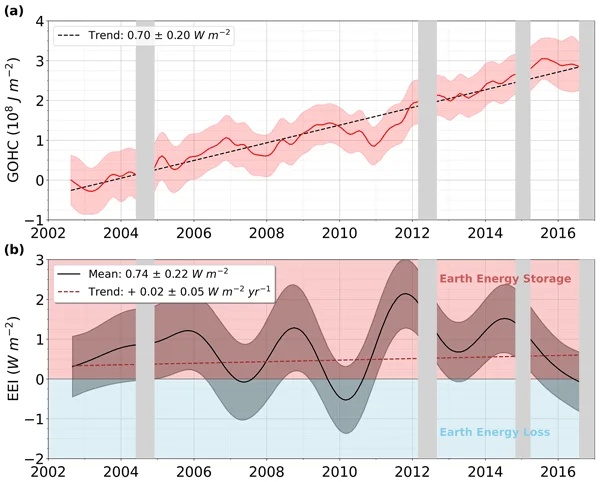
Global ocean heat content and Earth’s energy imbalance for 2002–2016, estimated using satellite altimetry and gravimetry.
Credit: Florence Marti, Alejandro Blazquez, Benoit Meyssignac, et al. · CC BY 4.0 · sourceResized and converted to WebP; uncropped.
1. Meaning and framework of the heat budget
The heat budget, also called the Earth’s energy budget, describes exchanges of energy between the Sun, Earth’s surface, the atmosphere and space. Its central principle is conservation of energy: absorbed energy must either be transferred, emitted or stored. In an approximately steady climate, globally averaged absorbed solar radiation nearly equals outgoing terrestrial radiation over sufficiently long periods. A persistent difference changes the heat stored in the climate system.
The Sun supplies almost all the energy driving weather and climate. Geothermal energy is important locally but very small compared with solar energy in the global surface budget. Solar irradiance is about 1,361 W/m² at the top of the atmosphere on a surface perpendicular to the rays. The planetary average is one-quarter of this, about 340 W/m², because Earth intercepts sunlight over a disc but distributes energy over a sphere with four times that area.
Three budgets must be distinguished: the top-of-atmosphere budget, the surface budget and the atmospheric budget. Exchanges within the system, such as downward infrared radiation from the atmosphere, affect surface temperature but are not additional energy entering from outside Earth.
- Insolation means incoming solar radiation.
- Energy balance is an accounting framework; temperature also depends on heat capacity, mixing and the rate of energy transfer.
2. Incoming solar radiation, albedo and absorption
The hot Sun emits mainly shortwave radiation, including visible light, ultraviolet radiation and near-infrared radiation. Before sunlight reaches the ground, clouds, gases, aerosols and air molecules reflect, scatter or absorb part of it. Ozone absorbs much ultraviolet radiation; water vapour, clouds and other atmospheric constituents absorb portions of the solar spectrum. The atmosphere is therefore selectively transparent rather than completely transparent.
Albedo is the fraction of incident solar radiation reflected by a surface or by the whole planet. Fresh snow generally has high albedo, while forests and oceans usually have lower albedo. Ocean reflectivity increases when the Sun is low on the horizon. Planetary albedo includes reflection by clouds and the atmosphere as well as the surface, so it should not be confused with surface albedo.
In the NCERT schematic, 100 units arrive at the top of the atmosphere. About 35 are reflected to space: 27 by clouds, 6 by atmospheric backscattering and 2 by snow- and ice-covered areas. Of the remaining 65 units, 14 are absorbed by the atmosphere and 51 by the surface. Modern observational summaries place reflected radiation nearer 30%; these are different approximations and should not be mixed within one numerical calculation.
- Clouds affect both shortwave reflection and longwave emission; their net effect depends on cloud properties.
- Melting snow and ice can lower albedo, increasing solar absorption and reinforcing warming.
From sunlight to planetary energy balance
- 1. Solar shortwave radiation reaches Earth.
- 2. Clouds, atmosphere and surface reflect a fraction to space.
- 3. Atmosphere and surface absorb the remainder.
- 4. Radiation, sensible heat and latent heat exchange energy internally.
- 5. Atmosphere and surface emit longwave radiation to space.
- 6. Any persistent absorption–emission difference changes stored heat.
3. Terrestrial radiation and surface–atmosphere exchange
Earth is much cooler than the Sun and emits predominantly longwave infrared radiation. According to the Stefan–Boltzmann law, radiation emitted by an ideal blackbody increases with the fourth power of absolute temperature. Wien’s displacement law explains why hotter bodies emit most strongly at shorter wavelengths. Together, these laws help distinguish solar radiation from terrestrial radiation.
The surface loses energy through infrared emission, sensible heat transfer and latent heat transfer. Conduction transfers heat across the immediate surface–air boundary; turbulence and convection carry it upward. Evaporation consumes energy at the surface, while condensation releases latent heat into the atmosphere. Horizontal transport of energy by moving air is called advection. These non-radiative transfers redistribute energy internally; radiation is the main means by which Earth loses energy to space.
Water vapour, carbon dioxide, methane and clouds absorb and emit infrared radiation. Their downward emission helps keep the surface warmer than it would be without an infrared-absorbing atmosphere. Earth’s effective radiating temperature is approximately −18°C, compared with a mean surface temperature near +15°C. Some surface radiation escapes through the atmospheric window, approximately 8–13 micrometres, although absorption bands and clouds interrupt this window.
- The atmosphere is heated substantially from below, but it also directly absorbs some incoming sunlight.
- The greenhouse effect does not stop heat escaping; it changes the relationship between surface temperature and radiation escaping to space.
| Component | Units | Interpretation |
|---|---|---|
| Reflected solar radiation | 35 | Returns to space without heating the system through absorption |
| Solar absorption by atmosphere | 14 | Direct atmospheric gain |
| Solar absorption by surface | 51 | Surface energy gain |
| Surface radiation escaping directly to space | 17 | Part of outgoing terrestrial radiation |
| Atmospheric radiation escaping to space | 48 | Together with 17 units, balances 65 absorbed units |
4. Latitudinal heat imbalance and redistribution
A near-balanced global budget can coexist with major regional imbalances. Low latitudes generally absorb more solar energy annually than they emit to space, whereas high latitudes emit more than they absorb. The NCERT schematic places the transition near 40° north and south. This boundary is approximate and varies with season, hemisphere, cloud cover and the dataset used.
The latitudinal contrast arises primarily from solar angle, day length and surface–atmosphere reflectivity. Oblique sunlight spreads energy over a larger area and travels through a longer atmospheric path. Snow and ice further reduce absorption at high latitudes. Polar summer has very long daylight, but low solar elevation and the long winter strongly influence the annual balance.
Atmospheric circulation and ocean currents transport energy from surplus to deficit regions. Hadley circulation, mid-latitude weather systems and associated moisture transport contribute to atmospheric redistribution. Ocean circulation carries heat through wind-driven currents and overturning circulation. The Gulf Stream and the wider North Atlantic circulation illustrate oceanic poleward heat transport. Without these transfers, the equator-to-pole temperature contrast would be substantially greater.
- Maritime climates have smaller temperature ranges partly because water stores heat efficiently and mixes vertically.
- Monsoons involve seasonal land–sea heating contrasts, moisture transport and latent heat release, not merely local surface temperature differences.
5. Energy imbalance, climate change and examination applications
Radiative forcing is a change in Earth’s radiative energy balance caused by a driver such as increased greenhouse gases, altered solar output or aerosols. Increasing carbon dioxide initially reduces outgoing infrared radiation for an otherwise unchanged climate state. The system warms, increasing emission towards a new balance. Feedbacks, including changes in water vapour, snow and ice, and clouds, modify the eventual response.
The IPCC Sixth Assessment Report assessed Earth’s energy imbalance at about 0.79 W/m² for 2006–2018, with an uncertainty range of 0.52–1.06 W/m². Though small relative to incoming solar energy, a sustained imbalance over the entire planet represents substantial heat accumulation. The ocean accounted for about 91% of the climate system’s heating during 1971–2018, making ocean heat content a crucial indicator.
For Prelims, distinguish reflected sunlight from emitted terrestrial radiation, and energy redistribution from energy creation. High albedo reduces absorbed sunlight, but surface temperature also depends on moisture, circulation and greenhouse conditions. Urban heat islands similarly cannot be explained by albedo alone: reduced evapotranspiration, heat storage, urban geometry and anthropogenic heat contribute. Finally, a balanced annual budget does not imply equal daytime and nighttime temperatures or identical seasonal conditions.
- Water vapour is an important greenhouse gas and acts mainly as a feedback in present global warming.
- Aerosol effects depend on composition: many scatter sunlight, while black carbon absorbs it.
Ocean Heat Storage and Earth’s Energy Imbalance
Earth’s heat budget links incoming solar radiation with reflected sunlight and outgoing thermal radiation. A positive Earth energy imbalance means the planet absorbs more energy than it emits to space; a negative imbalance implies net energy loss. The supplied metadata describes graphs of global ocean heat content and energy imbalance estimated for the GRACE mission period. These quantities are directly relevant but distinct: heat content measures stored energy, whereas energy imbalance expresses the rate of net energy gain or loss per unit area.
The ocean stores most of the excess energy accumulating in the climate system, making ocean heat content a valuable indicator beyond surface air temperature. Satellite altimetry measures sea-surface height, while gravimetry helps estimate changes in ocean mass. Combining these observations helps separate mass-related sea-level change from thermal expansion and infer ocean heat uptake. Such estimates depend on assumptions, corrections and uncertainty; they are not direct readings of every component of the heat budget. For India, Indian Ocean heat storage matters for marine heatwaves, sea-level rise and ocean–atmosphere interactions influencing monsoon variability. Global graphs alone, however, cannot establish regional trends or attribute individual monsoon events.
- Distinguish stocks from flows: ocean heat content is energy; energy imbalance is power per unit area.
- Do not equate sea-level rise solely with warming: added ocean mass also raises sea level.
- Separate redistribution from imbalance: poleward heat transport moves energy within Earth’s system; a planetary imbalance changes its total stored energy.
Real-world case studies
Mount Pinatubo eruption, Philippines, 1991
Sulphur dioxide injected into the stratosphere formed sulphate aerosols that increased sunlight scattering. Global surface temperatures temporarily declined by roughly 0.5°C at peak. This demonstrates how changes in atmospheric reflectivity can alter the planetary budget without a comparable change in solar output.
Arctic sea-ice feedback
Retreating Arctic sea ice exposes darker ocean during the sunlit season, increasing absorbed solar energy. Some stored heat is released later, influencing autumn and winter warming. This ice–albedo feedback contributes to Arctic amplification, alongside other atmospheric and oceanic processes.
Previous year questions
- 2024 · Prelims GS I — Consider the following statements: Statement-I: The atmosphere is heated more by incoming solar radiation than by terrestrial radiation. Statement-II: Carbon dioxide and other greenhouse gases in the atmosphere are good absorbers of long-wave radiation. Which one of the following is correct in respect of the above statements?
- 2024 · Prelims GS I — Consider the following statements: Statement-I: Thickness of the troposphere at the equator is much greater as compared to poles. Statement-II: At the equator, heat is transported to great heights by strong convectional currents. Which one of the following is correct in respect of the above statements?
Source-linked detailed analyses are available above.
Practice questions
Practice MCQ 1
Consider the following statements: 1. Planetary albedo includes reflection by clouds. 2. Latent heat transfer directly carries energy from the surface into outer space. 3. Earth emits predominantly longwave radiation. Which statements are correct?
- A. 1 and 2 only
- B. 1 and 3 only
- C. 2 and 3 only
- D. 1, 2 and 3
Practice MCQ 2
If incoming solar radiation remains unchanged while planetary albedo increases, what is the immediate effect, other conditions remaining unchanged?
- A. Absorbed solar energy increases
- B. Absorbed solar energy decreases
- C. Solar irradiance outside the atmosphere decreases
- D. Earth's geothermal heat production increases
Practice MCQ 3
Why can the polar regions emit more energy to space than they absorb annually without cooling indefinitely?
- A. Polar geothermal heating balances the entire deficit
- B. Snow absorbs nearly all incident sunlight
- C. Atmospheric and oceanic circulation import energy
- D. Longwave radiation cannot escape from polar regions
Mains practice · Explain Earth's heat budget and examine how latitudinal energy imbalances sustain atmospheric and oceanic circulation. How does anthropogenic warming modify this balance? Answer in 250 words.
- Define incoming shortwave, reflected solar and outgoing longwave radiation.
- Distinguish planetary, surface and atmospheric budgets.
- Explain tropical surplus, polar deficit and poleward energy transport.
- Discuss greenhouse forcing, feedbacks and ocean heat storage.
- Conclude that global balance does not imply regional or seasonal equality.
Further reading
- NCERT, Class XI, Fundamentals of Physical Geography: Solar Radiation, Heat Balance and Temperature.
- NASA Earth Observatory: Earth's Energy Budget.
- IPCC, Sixth Assessment Report, Working Group I, Chapter 7: The Earth's Energy Budget, Climate Feedbacks, and Climate Sensitivity.
- NOAA Global Monitoring Laboratory: Global Radiation and Aerosols.
- https://commons.wikimedia.org/wiki/File:Earth_heating_from_space_geodesy_2002-2016.png
Preparing for UPSC Civil Services? Get classroom teaching, answer-writing evaluation and mentorship at Pragnya IAS Academy, Ashok Nagar — see why aspirants choose us for IAS coaching in Hyderabad.