

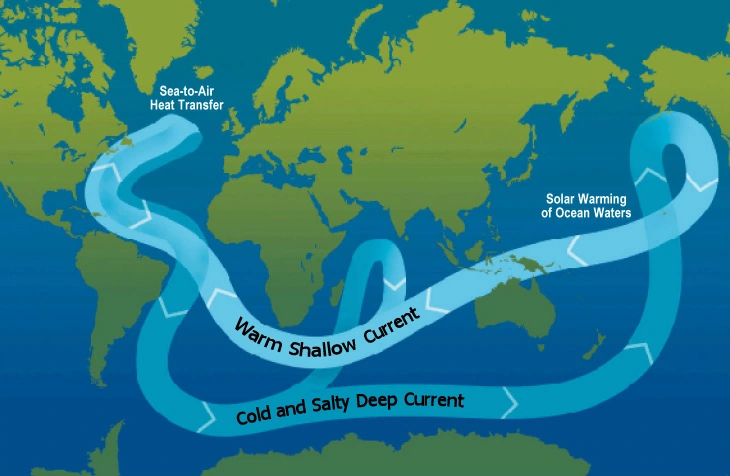
This map shows the pattern of thermohaline circulation also known as "meridional overturning circulation". This collection of currents is responsible for the large-scale exchange of water masses in th
Credit: Robert Simmon, NASA. Minor modifications by Robert A. Rohde also released to the public domain · Public domain · source

As autumn brings shortening daylight and falling temperatures to the Antarctic, sea ice has begun to grow along the eastern Weddell Sea ice edge. On April 4, 2018, the Moderate Resolution Imaging Spec
Credit: Jeff Schmaltz, MODIS Land Rapid Response Team, NASA GSFC · Public domain · source
Map study
Global overturning circulation: distinguish surface and deep return flow. This conveyor pathway is a simplified model, not an exact current-speed map.
- Read the source legend, scale and reference period before comparing regions.
- Connect spatial patterns to the processes discussed in this topic; this map is a study reference, not live operational data.
Credit: Thomas Splettstoesser · Public domain · sourceConverted to WebP on an opaque white background; proportionally resized without cropping. Original cartography and legend retained.
1. Meaning and physical controls
Thermohaline circulation refers to ocean movement associated with density differences created by temperature and salinity variations. It is commonly illustrated as a global conveyor belt linking the Atlantic, Southern, Indian and Pacific oceans. This is a useful introductory model, but the real ocean contains branching pathways, eddies, regional overturning cells and extensive mixing rather than a single continuous belt.
Seawater density depends on temperature, salinity and pressure. At comparable pressure, cooling generally increases density, while increasing salinity also increases density. Consequently, cold and salty surface water can sink if it becomes denser than the water beneath it. Oceanographers use measures such as potential density to compare water masses without confusing compression at depth with density differences that produce buoyancy.
Evaporation removes water but leaves most dissolved salts behind, increasing surface salinity. Precipitation, river discharge and melting ice usually freshen surface water and reduce its density. During sea-ice formation, much of the salt is excluded from the ice and enters the surrounding water through brine rejection. Together with intense winter cooling, this can generate very dense seawater.
- High salinity alone does not guarantee sinking: temperature and the density of surrounding water also matter.
- A strong density gradient, or pycnocline, inhibits vertical exchange and separates relatively light surface water from denser deep water.
- Sea-ice formation increases nearby water salinity; sea-ice melting has the opposite local effect.
2. Formation and movement of deep water
In the North Atlantic, relatively warm, saline water travels northward through the upper ocean. Heat loss to the atmosphere makes some of this water denser. Transformation in the Nordic Seas and subpolar North Atlantic, including the Labrador and Irminger seas, contributes to the production of North Atlantic Deep Water. Dense overflows across the Greenland–Scotland Ridge mix with surrounding water and feed deep currents moving southward through the Atlantic.
Around Antarctica, strong cooling and brine rejection over continental shelves help form dense shelf water. As this water descends the continental slope and mixes with surrounding water, it contributes to Antarctic Bottom Water. Important source regions include the Weddell and Ross seas. Antarctic Bottom Water occupies the deepest layers of much of the global ocean, commonly beneath North Atlantic Deep Water in the Atlantic.
Deep waters spread between ocean basins and eventually return towards the surface. Much of this return involves the Southern Ocean, where winds and the geometry of density surfaces enable deep water to rise. Interior mixing, partly powered by tides and winds, also supports the circulation. Surface buoyancy changes alone therefore do not explain the complete overturning system.
The northern Indian and Pacific oceans do not produce deep water on a scale comparable to the North Atlantic. Surface stratification and regional freshwater conditions limit deep convection. However, these basins contain extensive deep waters arriving from southern sources and play essential roles in mixing, storage and return pathways.
- Deep convection is geographically concentrated; it does not occur uniformly across polar oceans.
- The Southern Ocean connects the major ocean basins and is central to both deep-water transformation and upwelling.
Simplified deep-water formation and return pathway
- 1. Surface water reaches a high-latitude formation region
- 2. Heat loss and, in some regions, brine rejection increase its density
- 3. Dense water sinks or descends continental slopes and mixes
- 4. Deep and bottom waters spread through connected ocean basins
- 5. Winds and mixing support the return of deep water towards the surface
- 6. Surface pathways and air–sea exchanges complete interconnected overturning loops
3. Thermohaline circulation, AMOC and surface currents
The Atlantic Meridional Overturning Circulation describes the basin-scale north–south overturning of Atlantic waters: an upper branch carries relatively warm water northward, while a deeper branch carries colder water southward. AMOC is defined by the movement of water, whereas thermohaline circulation emphasises temperature- and salinity-related density forcing. Winds and mixing also influence AMOC, so the terms should not be treated as interchangeable.
Surface gyres, including the North Atlantic subtropical gyre, are driven mainly by winds and shaped by the Coriolis effect and ocean-basin boundaries. The Gulf Stream is a western boundary current within this system, although it also carries water contributing to northward Atlantic heat transport. An AMOC weakening would not necessarily eliminate the Gulf Stream because wind-driven circulation would continue.
Oceanic heat transport helps moderate the climate of the North Atlantic region. Nevertheless, western Europe's relatively mild winters cannot be attributed solely to the conveyor belt: prevailing westerlies, atmospheric heat transport and the maritime setting are also important.
- Exam distinction: thermohaline circulation concerns density forcing; AMOC concerns Atlantic overturning; the Gulf Stream is a named current.
- Actual ocean circulation combines wind forcing, buoyancy changes, rotation, topography and mixing.
| Feature | Principal region or control | Distinguishing point |
|---|---|---|
| North Atlantic Deep Water | Nordic Seas and subpolar North Atlantic | Spreads southward at depth in the Atlantic |
| Antarctic Bottom Water | Dense-water production around Antarctica | Occupies the deepest layers of many ocean basins |
| AMOC | Atlantic overturning influenced by buoyancy, winds and mixing | Upper northward and deep southward transport |
| Subtropical surface gyres | Trade winds, westerlies, rotation and basin boundaries | Mainly horizontal, wind-driven circulation |
| Southern Ocean upwelling | Winds, eddies and density structure | Major return route for deep water towards the surface |
4. Climatic and ecological significance
Overturning transfers heat between latitudes and between the surface and deep ocean. Changes in its strength can modify regional sea-surface temperatures, atmospheric circulation, rainfall belts and coastal sea level. A substantial AMOC weakening could influence tropical rainfall and monsoon systems, but regional outcomes depend on interactions with other climate processes.
Newly formed deep waters carry dissolved oxygen into the ocean interior, ventilating habitats far below the sunlit layer. They also transport dissolved inorganic carbon. Cold waters can absorb substantial carbon dioxide, while biological production and the sinking and decomposition of organic matter redistribute carbon and nutrients. Ocean circulation interacts with both the solubility pump and the biological pump; these are connected but distinct mechanisms.
Deep waters accumulate nutrients released through decomposition. Their eventual upwelling helps return these nutrients to surface ecosystems. However, productive coastal upwelling, such as along Peru or during the southwest monsoon off Somalia, is primarily wind-driven and should not automatically be labelled thermohaline circulation.
- Deep-ocean ventilation affects oxygen availability and the duration of carbon storage.
- Ocean overturning operates over much longer timescales than daily weather, although its strength also varies seasonally and between years.
5. Climate change, observations and examination cautions
Surface warming makes seawater more buoyant and can strengthen stratification. Freshwater from increased precipitation, runoff and Greenland ice-sheet melting can further reduce surface density in parts of the North Atlantic. These changes can inhibit deep-water formation. Around Antarctica, meltwater can similarly alter shelf-water density and bottom-water production.
The IPCC Sixth Assessment Report states that AMOC is very likely to weaken during the twenty-first century under all assessed emissions scenarios. It expresses medium confidence that an abrupt collapse will not occur before 2100. The magnitude of future weakening and the location of any critical threshold remain uncertain; scientific studies proposing collapse dates should not be presented as settled predictions.
The RAPID observing array has monitored AMOC across the Atlantic near 26.5°N since 2004. Other systems, including OSNAP in the subpolar North Atlantic, measure water transport and transformation. Direct records reveal strong variability but are relatively short for identifying century-scale change. Scientists therefore combine measurements with climate models and palaeoclimate evidence.
For prelims, avoid absolute statements such as all cold water sinks, the conveyor is driven only by salinity, or global warming must stop all Atlantic currents. The most reliable reasoning links temperature and salinity to density, density to stratification and sinking, and overturning to heat and material transport.
- A weakening is a reduction in circulation strength; a collapse is a much larger reorganisation into a different circulation state.
- The approximate thousand-year conveyor timescale is an educational simplification, not a fixed age for every parcel of deep water.
Real-world case studies
Younger Dryas: a palaeoclimate example
The Younger Dryas, approximately 12,900–11,700 years ago, was a pronounced cooling interval around the North Atlantic during the last deglaciation. Evidence links it to major ocean–atmosphere changes, including weakened Atlantic overturning, with freshwater forcing a leading explanation. The precise freshwater sources, routes and sequence remain debated. It demonstrates potential sensitivity to freshwater inputs rather than providing a direct forecast of modern climate change.
RAPID observations of AMOC variability
Measurements near 26.5°N recorded a marked temporary reduction in AMOC transport during 2009–2010. This highlighted how strongly overturning can vary over short periods. The episode also illustrates why an individual weak year cannot establish a long-term trend or prove that collapse is imminent.
Previous year questions
No source-linked PYQ is available here yet. Use the practice questions below.
Practice questions
Practice MCQ 1
Consider the following processes: 1. Strong cooling of saline surface water. 2. Brine rejection during sea-ice formation. 3. Addition of freshwater through ice melting. Which of these generally increase surface seawater density, other conditions remaining comparable?
- A. 1 and 2 only
- B. 2 and 3 only
- C. 1 and 3 only
- D. 1, 2 and 3
Practice MCQ 2
With reference to Atlantic circulation, consider the following statements: 1. AMOC and the Gulf Stream are identical terms. 2. Wind-driven circulation contributes to the Gulf Stream. 3. AMOC weakening need not cause the complete cessation of the Gulf Stream. Which statements are correct?
- A. 1 only
- B. 1 and 2 only
- C. 2 and 3 only
- D. 1, 2 and 3
Practice MCQ 3
Which statement most accurately describes global deep-ocean circulation?
- A. Deep water forms uniformly throughout all tropical oceans.
- B. Antarctic Bottom Water occupies the deepest layers of many ocean basins.
- C. Deep water returns to the surface without any role for winds or mixing.
- D. North Atlantic Deep Water forms primarily through equatorial evaporation.
Mains practice · Explain the mechanisms sustaining thermohaline circulation. Discuss how global warming could alter Atlantic overturning and its climatic significance. Answer in 250 words.
- Define density-driven circulation using temperature and salinity.
- Explain cooling, freshwater balance and brine rejection.
- Locate North Atlantic and Antarctic deep-water formation regions.
- Include Southern Ocean upwelling and the roles of winds and mixing.
- Distinguish AMOC from the Gulf Stream.
- Discuss warming, freshening, stratification and possible weakening.
- Link changes to heat transport, rainfall, sea level, oxygen and carbon storage.
- Conclude with IPCC projections and uncertainty rather than a definitive collapse date.
Further reading
- NCERT, Fundamentals of Physical Geography, Class XI: Water (Oceans) and Movements of Ocean Water.
- IPCC, Climate Change 2021: The Physical Science Basis, Summary for Policymakers and Chapter 9.
- NOAA National Ocean Service: The Global Ocean Conveyor Belt.
- RAPID AMOC monitoring programme: rapid.ac.uk.
- OSNAP, Overturning in the Subpolar North Atlantic Program: o-snap.org.
Preparing for UPSC Civil Services? Get classroom teaching, answer-writing evaluation and mentorship at Pragnya IAS Academy, Ashok Nagar — see why aspirants choose us for IAS coaching in Hyderabad.