

Global capture of Peruvian anchoveta in tonnes, 1950–2010, as reported by the FAO. Based on data sourced from the relevant FAO Species Fact Sheets
Credit: Epipelagic · CC BY-SA 3.0 · source

An inverted + equalized render of the region in Eastern Somalia based on Sentinel-2 satellite image data captured on October 18, 2020. The easternmost town on the continent is listed as Xaafuun (not v
Credit: Yonas Kidane · CC BY-SA 2.0 · source
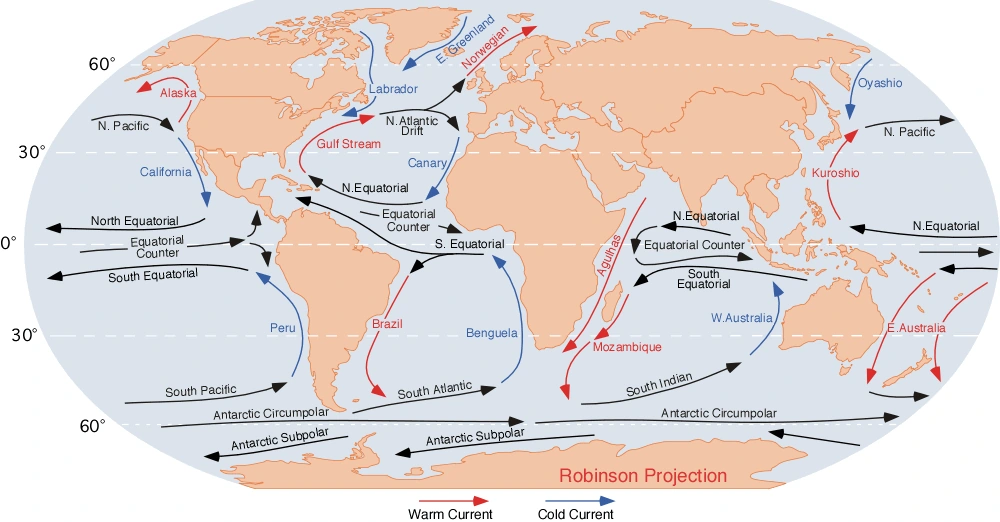
Map study
Global ocean currents: compare warm and cold current pathways and major gyres. Arrow directions and legend matter; local and seasonal currents can differ.
- Read the source legend, scale and reference period before comparing regions.
- Connect spatial patterns to the processes discussed in this topic; this map is a study reference, not live operational data.
Credit: Dr. Michael Pidwirny · Public domain · sourceConverted to WebP on an opaque white background; proportionally resized without cropping. Original cartography and legend retained.
1. Meaning and physical foundations
Upwelling occurs when water from below the surface layer rises towards the ocean surface. It commonly develops because surface water moves away from a region and is replaced from below through mass continuity. The source is often the upper few hundred metres, not necessarily the abyssal ocean. Because temperature generally decreases below the tropical and subtropical mixed layer, upwelled water is usually cooler than the surrounding surface water.
Wind-driven upwelling is explained through wind stress, friction within the water column and Earth's rotation. Wind transfers momentum to surface water; friction transmits some of this motion downward. The changing balance between friction and the Coriolis force produces the idealised Ekman spiral. Although individual layers move in different directions, the depth-integrated movement, called Ekman transport, is approximately perpendicular to the wind: rightward in the Northern Hemisphere and leftward in the Southern Hemisphere.
Upwelling must be distinguished from both horizontal cold currents and thermohaline circulation. A cold current can carry cool water towards lower latitudes without necessarily producing local upward motion. Conversely, upwelling can occur in tropical waters or within large-scale overturning circulation. Downwelling is the contrasting process: surface-water convergence or increased density drives water downward, commonly carrying oxygen into the ocean interior.
- The thermocline is a zone of rapid temperature change with depth; the nutricline is a zone where nutrient concentrations increase rapidly downward.
- A shallow thermocline and nutricline can make nutrient-rich water more accessible to upwelling.
2. Coastal, equatorial and open-ocean mechanisms
Coastal upwelling develops when winds blowing roughly parallel to a coast produce offshore Ekman transport. The displaced surface water is replaced by subsurface water. Along a north–south west coast in the Northern Hemisphere, an equatorward wind commonly produces offshore transport. Along a comparable west coast in the Southern Hemisphere, an equatorward wind can do the same because the Coriolis deflection reverses. Coastline orientation and wind direction must therefore be examined together rather than memorising a single compass direction.
Equatorial upwelling results from divergence on opposite sides of the equator. Under easterly trade winds, surface transport has a northward component just north of the equator and a southward component just south of it. Water moves away from the equatorial belt and is replaced from below. The Coriolis parameter is zero exactly at the equator, so the ordinary mid-latitude Ekman formula should not be applied there directly; the explanation concerns the opposing deflections on either side.
Open-ocean upwelling can also arise from spatial variations in wind stress, expressed as wind-stress curl. These variations create divergent transport and upward Ekman pumping. Cyclonic eddies often lift density surfaces and promote upward nutrient supply, although their effects vary with structure and evolution. Large-scale Southern Ocean upwelling is connected with westerly winds, overturning circulation and eddy processes, demonstrating that upwelling is not restricted to continental coasts.
- Divergence favours upwelling; convergence generally favours downwelling.
- Coastal headlands, shelf width, stratification and remote oceanic waves can modify the strength and location of upwelling.
Typical coastal upwelling and its biological response
- 1. Alongshore winds exert stress on surface water.
- 2. Ekman transport moves surface water offshore.
- 3. Subsurface water rises to replace the displaced water.
- 4. Nutrients enter the sunlit surface layer.
- 5. Phytoplankton production increases when other conditions are favourable.
- 6. Food-web responses can support productive fisheries.
3. Global distribution and Indian Ocean seasonality
Four major eastern-boundary coastal upwelling systems are associated with the California, Canary, Humboldt or Peru–Chile, and Benguela currents. They occur respectively off western North America, northwestern Africa, western South America and southwestern Africa. Their name describes their position on the eastern side of an ocean basin, not the eastern coast of a continent. These systems combine favourable winds, cool surface waters and substantial nutrient supply, although their seasonality and ecological character differ.
The Humboldt system supports highly productive fisheries off Peru and Chile. The Benguela system influences the waters off Namibia and South Africa, while the Canary system extends along northwestern Africa. Cool sea-surface temperatures can stabilise the lower atmosphere, reduce local convection and favour fog. However, adjoining deserts such as the Atacama and Namib cannot be attributed to upwelling alone: subtropical subsidence, atmospheric circulation and, in some places, rain-shadow effects also matter.
The Indian Ocean differs because monsoon winds reverse seasonally. During the southwest monsoon, strong winds and coastal circulation generate intense upwelling off Somalia and Oman. Along India's southwest coast, particularly Kerala and adjoining waters, seasonal upwelling also brings cooler, nutrient-rich water onto the continental shelf. Both local winds and remotely forced coastal waves contribute. Its onset and progression therefore cannot be explained by local wind direction alone.
- The Somali coast is an important exception to the assumption that strong coastal upwelling occurs only along western continental margins.
- Strong freshwater-related stratification in the Bay of Bengal can inhibit vertical nutrient exchange, although local coastal and eddy-driven upwelling still occurs.
| System or region | Location | Key feature |
|---|---|---|
| California | Western North America | Eastern North Pacific boundary; strong seasonal coastal upwelling |
| Canary | Northwestern Africa | Eastern North Atlantic boundary; seasonality varies with latitude |
| Humboldt | Peru and Chile | Eastern South Pacific boundary; major anchoveta fishery |
| Benguela | Namibia and western South Africa | Eastern South Atlantic boundary; productive waters with hypoxia risks |
| Somalia–Oman | Western Arabian Sea | Strong southwest-monsoon-driven seasonal upwelling |
4. Productivity, fisheries and environmental trade-offs
Organic matter sinking from surface waters is decomposed at depth, releasing dissolved nutrients. Upwelling returns part of this nutrient inventory to the euphotic zone, stimulating phytoplankton when light and other conditions are favourable. Phytoplankton support zooplankton, small pelagic fish such as anchovies and sardines, and larger predators. This explains why relatively limited coastal upwelling areas can support fisheries of exceptional economic importance.
High nutrient supply does not guarantee an immediate or uniform rise in fish production. Biological responses depend on light, iron availability, grazing, species composition and whether currents retain organisms near productive habitats or transport them offshore. Very strong winds may disperse plankton and fish larvae. Fisheries management must therefore consider both the physical intensity of upwelling and ecosystem responses rather than treating colder water as a direct measure of future catches.
Upwelling also brings environmental risks. Subsurface water may contain little dissolved oxygen because respiration has consumed oxygen during organic-matter decomposition. Its movement onto continental shelves can intensify hypoxia, stress benthic organisms and occasionally contribute to fish mortality. Upwelled water is often rich in dissolved inorganic carbon, making it relatively acidic and potentially stressful for shell-forming organisms. Nutrient enrichment may favour some harmful algal blooms, but not every productive bloom is harmful.
- The carbon effect is two-sided: phytoplankton can absorb carbon dioxide, while carbon-rich upwelled water can release it to the atmosphere.
- Coastal upwelling should not automatically be labelled either a net carbon sink or a net carbon source; the balance varies.
5. ENSO, observation and examination applications
Under normal tropical Pacific conditions, easterly trade winds favour westward surface flow, warm-water accumulation in the western Pacific and a comparatively shallow thermocline in the east. During El Niño, weakened or altered trade winds and eastward-propagating oceanic disturbances deepen the eastern thermocline. Consequently, upward movement may draw from warmer, less nutrient-rich layers, while weakened divergence can also reduce upwelling. Productivity and fisheries off western South America may suffer, though impacts vary among events and species.
During La Niña, stronger trade winds generally reinforce the usual east–west temperature contrast and favour stronger equatorial upwelling. ENSO should nevertheless not be treated as the sole control over every coastal upwelling system. Local winds, coastal waves, stratification and other climate modes also matter. Similarly, ocean warming strengthens stratification in many regions, but future coastal upwelling depends on competing changes in wind, source-water properties and circulation.
Scientists identify upwelling using satellite sea-surface temperature, ocean-colour estimates of chlorophyll, wind observations, sea-level information and in-situ temperature, salinity, oxygen and nutrient measurements. A cool coastal band together with favourable winds and elevated chlorophyll is stronger evidence than low temperature alone. In India, INCOIS uses satellite-derived ocean information in Potential Fishing Zone advisories; these indicate promising conditions rather than guaranteeing catches or replacing sustainable fishing practices.
- For map questions, identify hemisphere, coastline orientation, prevailing wind and the resulting direction of Ekman transport.
- For statement questions, distinguish nutrient enrichment from oxygen enrichment: upwelled water can be nutrient-rich but oxygen-poor.
Real-world case studies
Peruvian anchoveta and the 1972–73 El Niño
The Humboldt upwelling system supports Peru's anchoveta fishery. The 1972–73 El Niño reduced favourable cold-water habitat and nutrient supply, contributing to a severe fishery collapse. Heavy fishing pressure also played an important role. The episode illustrates how climate variability and excessive exploitation can combine, rather than offering a simple example of environmental change alone.
Seasonal oxygen stress on India's western shelf
During the southwest monsoon, upwelling brings nutrient-rich, relatively oxygen-poor water onto parts of India's western continental shelf. Decomposition of organic matter can further deplete oxygen, producing seasonal hypoxia and, locally, anoxia. Studies by CSIR–National Institute of Oceanography demonstrate why enhanced productivity and deteriorating oxygen conditions may occur together.
Previous year questions
No source-linked PYQ is available here yet. Use the practice questions below.
Practice questions
Practice MCQ 1
A straight coastline runs north–south with land to its east in the Northern Hemisphere. A persistent wind blows southward parallel to this coast. Which outcome is most likely under idealised Ekman conditions?
- A. Onshore transport and coastal downwelling
- B. Offshore transport and coastal upwelling
- C. Offshore transport and coastal downwelling
- D. No net transport because the wind is parallel to the coast
Practice MCQ 2
Consider the following statements: 1. Upwelled water may be nutrient-rich but oxygen-poor. 2. Major eastern-boundary upwelling systems lie along eastern continental coasts. 3. Equatorial upwelling can result from surface-water divergence on opposite sides of the equator. Which statements are correct?
- A. 1 and 2 only
- B. 2 and 3 only
- C. 1 and 3 only
- D. 1, 2 and 3
Practice MCQ 3
Why can El Niño reduce biological productivity in the eastern equatorial Pacific?
- A. It necessarily removes all vertical water movement from the Pacific.
- B. It deepens the eastern thermocline and reduces nutrient delivery to surface waters.
- C. It permanently reverses Earth's Coriolis force.
- D. It prevents sunlight from reaching the entire tropical ocean.
Mains practice · Explain the mechanisms and geographical distribution of oceanic upwelling. Why can upwelling support rich fisheries while also creating environmental stress? Discuss with Indian Ocean examples. (250 words)
- Define upwelling and explain wind stress, Coriolis deflection and offshore Ekman transport.
- Distinguish coastal, equatorial and wind-stress-curl-driven upwelling.
- Locate the four major eastern-boundary systems and monsoonal Somalia–Oman upwelling.
- Explain southwest-coast Indian upwelling, including local winds and remote forcing.
- Connect nutrient supply with phytoplankton, food webs and fisheries.
- Discuss oxygen depletion, acidification, variable ecosystem responses and sustainable management.
Further reading
- NCERT, Fundamentals of Physical Geography, Class XI: Water (Oceans) and Movements of Ocean Water.
- NOAA National Ocean Service: What is upwelling?
- NOAA Pacific Marine Environmental Laboratory: El Niño and La Niña resources.
- Indian National Centre for Ocean Information Services, incois.gov.in: Potential Fishing Zone advisories.
- CSIR–National Institute of Oceanography, nio.res.in: research on Arabian Sea productivity and oxygen depletion.
Preparing for UPSC Civil Services? Get classroom teaching, answer-writing evaluation and mentorship at Pragnya IAS Academy, Ashok Nagar — see why aspirants choose us for IAS coaching in Hyderabad.