
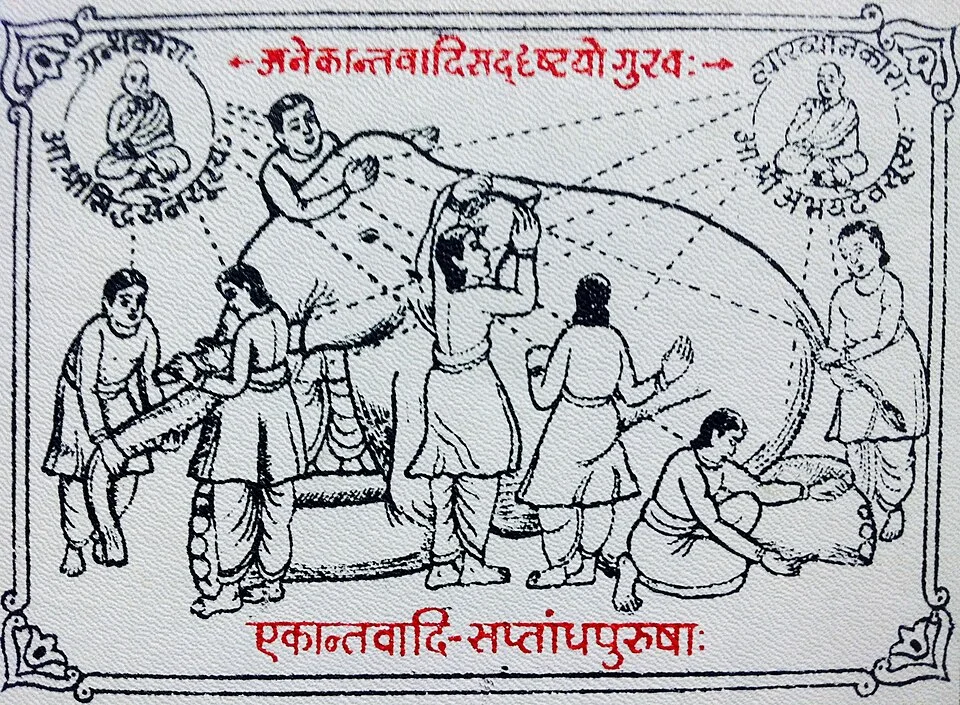
The blind men and elephant parable, identified in the metadata as an illustration of Jain anekantavada.
Credit: romana klee from usa · CC BY-SA 2.0 · sourceResized and converted to WebP; uncropped.
1. Meaning and historical setting
Anekantavada is the Jain doctrine that a real entity has a multiplicity of aspects and therefore cannot be adequately described through a single exclusive assertion. The term combines aneka, meaning many or not one, anta, meaning side or aspect, and vada, meaning doctrine. Its target is ekantavada: an absolutist position that treats one aspect of an object as its complete nature.
The doctrine developed within the shramana intellectual environment of ancient India, in which Jain, Buddhist and other thinkers debated the self, causation, permanence, change and liberation. Jain tradition associates its underlying approach with Mahavira, the twenty-fourth Tirthankara. However, the detailed philosophical terminology and logical arrangements were developed and refined by later teachers; the fully systematised doctrine should not simply be projected back into Mahavira’s lifetime.
Important contributors include Kundakunda, Umasvati or Umasvami, Samantabhadra, Siddhasena Divakara, Akalanka and Mallisena. Dates and the relative chronology of some early authors remain disputed. Umasvati’s Tattvarthasutra provides a foundational account of Jain metaphysics, while later works elaborate the defence of many-sided reality and conditional assertion. Anekantavada is not confined to either the Digambara or the Svetambara tradition.
- Prelims identification: Anekantavada belongs to Jainism, not Buddhism or Advaita Vedanta.
- Historical caution: distinguish the ancient roots of an approach from its later scholastic formulation.
2. Philosophical basis: substance, qualities and modes
Jainism is realist: it accepts a world that exists independently of an individual’s descriptions of it. It also recognises a plurality of real entities, including individual souls. Anekantavada arises from the complex character of these entities, not merely from the fact that people disagree. Its central claim is that reality itself contains aspects which different judgements may capture only partially.
Three useful terms are dravya, or substance; guna, or quality; and paryaya, or mode. A substance possesses qualities and undergoes changing modes. Jain thought consequently describes reality through origination, cessation and persistence: utpada, vyaya and dhrauvya. Something new arises and an earlier state ceases, while an underlying continuity remains. Persistence and change are therefore not necessarily mutually exclusive.
Consider clay shaped into a pot. The pot-form originates and an earlier form disappears, while the material continues through transformation. Likewise, an entity can be called enduring with reference to its substance and changing with reference to its modes. The contradiction disappears once the respect in which each statement is made is clarified.
This reasoning differentiates Jainism from both an uncompromising assertion that everything is wholly permanent and an uncompromising assertion that everything is only momentary. However, it should not be mistaken for a mechanical compromise between rival systems. Jain thinkers advanced their own positive account of reality and criticised competing doctrines when these appeared to universalise a partial insight.
- The same entity can exhibit continuity and transformation in different respects.
- Many-sidedness does not mean that an entity can possess any arbitrarily imagined property.
Applying a many-sided analysis
- 1. Identify the object and the claim being made.
- 2. Specify the standpoint and relevant conditions.
- 3. Examine what aspect the claim captures.
- 4. Consider other evidence-based standpoints.
- 5. Express a qualified judgement without making the partial account absolute.
3. Anekantavada, nayavada and syadvada
These three concepts are closely connected but are not interchangeable. Anekantavada concerns the many-sided character of reality. Nayavada explains the role of a naya, or partial standpoint, in knowing and describing that reality. A standpoint can be useful and valid within its limits; error arises when it claims to represent the whole without qualification.
Syadvada provides a method of conditional assertion. The Sanskrit word syat is best understood here as 'in a certain respect' or 'from a particular standpoint', rather than as a casual 'perhaps'. A statement should identify, explicitly or implicitly, the conditions under which it holds. Relevant conditions include the entity’s own substance, location, time and state.
For example, 'the pot exists' can be valid with reference to its present location and time. 'The pot does not exist' can be valid with reference to another location or an earlier time before its production. These are not assertions that an identical proposition is both true and false under identical conditions. The purpose is to avoid an unqualified statement that erases contextual differences.
The familiar parable of blind men describing different parts of an elephant illustrates the danger of mistaking partial acquaintance for complete knowledge. It is a useful teaching analogy, but versions occur beyond Jain traditions as well. It should not be treated as uniquely Jain evidence or as a substitute for understanding the doctrine’s philosophical basis.
- Anekantavada: reality has many aspects.
- Nayavada: a judgement proceeds from a limited standpoint.
- Syadvada: a judgement is expressed with appropriate conditions.
| Concept | Central concern | Distinguishing feature |
|---|---|---|
| Anekantavada | Nature of reality | Reality cannot be exhausted by one exclusive description |
| Nayavada | Standpoints of judgement | A partial perspective is valid within its proper limits |
| Syadvada | Conditional assertion | Statements require qualification by relevant conditions |
| Saptabhangi | Sevenfold predication | Systematic combinations of assertion, denial and inexpressibility |
| Kevala-jnana | Complete knowledge | Omniscience, unlike ordinary partial apprehension |
4. Saptabhangi: sevenfold conditional predication
Syadvada is commonly explained through saptabhangi, the sevenfold scheme of predication. Each formulation carries the qualification syat. The scheme organises assertion, denial and inexpressibility, together with their combinations, to show the limits of an isolated categorical statement.
Avaktavya, meaning inexpressible or indescribable, requires particular care. It does not mean that nothing can be known about the object. In this setting, it indicates the limitations of expressing jointly relevant aspects in a single unqualified formulation. The formulations involving both existence and non-existence refer to different respects, not to an unrestricted violation of logical consistency.
For examination purposes, learn the structure rather than reducing it to 'seven truths'. The predicates are conditional descriptions of an object. They do not imply seven different objects, seven stages of liberation or seven categories of souls.
- Syad asti: in a certain respect, it exists.
- Syad nasti: in a certain respect, it does not exist.
- Syad asti nasti: in certain respects, it exists and does not exist.
- Syad avaktavyah: in a certain respect, it is inexpressible.
- Syad asti avaktavyah: in certain respects, it exists and is inexpressible.
- Syad nasti avaktavyah: in certain respects, it does not exist and is inexpressible.
- Syad asti nasti avaktavyah: in certain respects, it exists, does not exist and is inexpressible.
5. Knowledge, ethics and examination relevance
Anekantavada encourages intellectual humility because ordinary knowers apprehend reality selectively. Nevertheless, Jainism accepts kevala-jnana, the complete knowledge attained by an omniscient being. Thus, 'human judgements are often partial' must not be confused with 'complete knowledge is impossible'. Nor does the doctrine require abandonment of evidence or acceptance of every assertion.
Its ethical significance lies in resisting dogmatism and listening to other perspectives. Modern interpreters frequently connect it with ahimsa, presenting openness to another person’s standpoint as an intellectual counterpart of non-violence. This is a valuable connection, but the two are distinct: ahimsa is an ethical discipline, whereas anekantavada is primarily a philosophical account of reality and its apprehension.
Anekantavada offers resources for dialogue in a diverse society without implying that all religious or philosophical systems are identical. Jain authors remained committed to Jain teachings on karma, liberation and right conduct. For UPSC, avoid confusing it with agnosticism, absolute relativism or Buddhist dependent origination. The strongest interpretation combines commitment to truth with awareness of the conditions and limits of one’s own statements.
- Common trap: 'All opinions are equally true' is not an adequate definition.
- Common trap: syat indicates qualification, not mere indecision.
- Analytical value: distinguish a genuine contradiction from statements referring to different contexts.
Anekantavada: Partial Perspectives and Qualified Judgements
The supplied metadata links this artwork to the blind men and elephant parable, making it directly relevant to anekantavada. In the parable, different encounters with one elephant yield differing descriptions. Its philosophical value lies not in declaring every description equally correct, but in showing how a partial account becomes misleading when presented as the whole truth. In Jain thought, reality has multiple aspects, and ordinary judgements require qualification by standpoint and conditions.
Three connected concepts should be distinguished. Anekantavada concerns the many-sided character of reality; nayavada explains partial standpoints from which it is described; syadvada expresses judgements conditionally. Here, syat means roughly “in a certain respect,” rather than a merely hesitant “perhaps.” Jain philosophers could therefore discuss permanence and change without asserting an unqualified contradiction: a substance persists while its modes change. This Indian philosophical framework supports intellectual restraint, but it is neither scepticism nor a claim that truth is unattainable. Jainism recognises complete knowledge in its account of omniscience.
- Prelims distinction: anekantavada is especially associated with Jainism; the parable’s circulation across Indian traditions does not make it exclusively Jain.
- Mains application: connect qualified judgement with dialogue and intellectual non-violence, without reducing a metaphysical doctrine to modern political tolerance.
- Evidence limit: the metadata establishes the intended thematic connection, not the artwork’s date, temple location or provenance; the title alone cannot verify these.
Real-world case studies
Haribhadra’s comparative study of philosophies
Haribhadra Suri, generally placed in the eighth century CE, examined multiple Indian philosophical traditions in his Saddarsanasamuccaya. His comparative engagement illustrates how a Jain intellectual could study competing systems while retaining a distinct philosophical position. It provides a concrete example of engagement across traditions, not proof that Jain thinkers considered every doctrine equally correct.
Previous year questions
UPSC Prelims 2009
Anekantavada is a core theory and philosophy of which one of the following?
- A. Buddhism
- B. Jainism
- C. Sikhism
- D. Vaishnavism
Practice questions
Practice MCQ 1
Consider the following statements: 1. Anekantavada recognises multiple aspects of reality. 2. Nayavada concerns partial standpoints. 3. Syadvada holds that every proposition is true without qualification. Which statements are correct?
- A. 1 and 2 only
- B. 2 and 3 only
- C. 1 and 3 only
- D. 1, 2 and 3
Practice MCQ 2
In Jain philosophy, the coexistence of persistence and change is best explained through which distinction?
- A. Creator and creation
- B. Substance and modes
- C. Revelation and sacrifice
- D. Fate and divine grace
Practice MCQ 3
Which statement best captures the relationship between anekantavada and kevala-jnana?
- A. Anekantavada rejects the possibility of complete knowledge.
- B. Kevala-jnana means that every ordinary opinion is infallible.
- C. Ordinary standpoints may be partial, while omniscience remains possible.
- D. Both concepts deny the existence of objective reality.
Mains practice · Explain anekantavada and its relationship with nayavada and syadvada. How can it encourage intellectual tolerance without becoming absolute relativism? Answer in 150 words.
- Define many-sided reality and distinguish it from arbitrary opinion.
- Explain partial standpoints and conditional predication.
- Use persistence of substance and change of modes as an example.
- Connect intellectual humility with dialogue and resistance to dogmatism.
- Note commitment to objective reality, valid knowledge and the possibility of omniscience.
Further reading
- NCERT, Themes in Indian History, Part I: Thinkers, Beliefs and Buildings.
- Umasvati, Tattvarthasutra, especially its account of substance and reality.
- Mallisena, Syadvadamanjari, in a scholarly translation.
- Padmanabh S. Jaini, The Jaina Path of Purification.
- UPSC official website: Civil Services Preliminary Examination previous question papers.
- https://commons.wikimedia.org/wiki/File:Medieval_Jain_temple_Anekantavada_doctrine_artwork.jpg
Preparing for UPSC Civil Services? Get classroom teaching, answer-writing evaluation and mentorship at Pragnya IAS Academy, Ashok Nagar — see why aspirants choose us for IAS coaching in Hyderabad.