
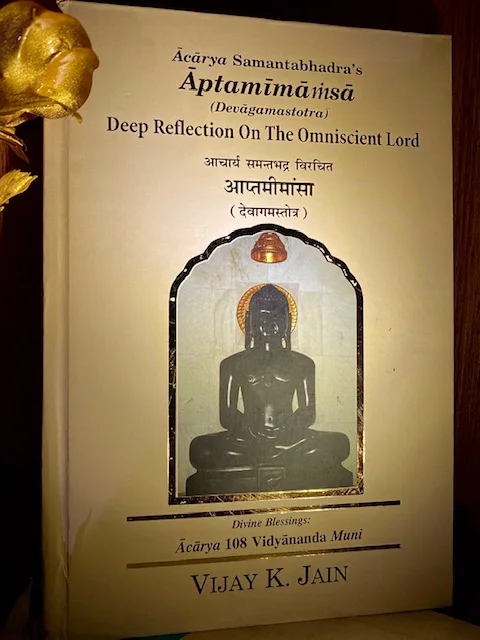
Illustrative textual reference: Samantabhadra’s Āptamīmāṃsā, associated with Jain conditional predication.
Credit: Vikalpprinters · CC BY-SA 4.0 · sourceResized and converted to WebP; uncropped.
1. Meaning and place within Jain philosophy
Syadvada is a distinctive contribution of Jain philosophy to logic and epistemology, the study of knowledge. The term combines syat, used in the sense of ‘in a certain respect’, with vada, meaning doctrine or exposition. It holds that an assertion about a complex object should specify, explicitly or implicitly, the conditions under which it is true. A statement can be valid without exhausting everything that can truthfully be said about its subject.
This approach reflects the Jain understanding that reality contains numerous attributes and changing modes. A person ordinarily encounters only some aspects of an object at a particular time and from a particular standpoint. Consequently, a limited observation becomes misleading when presented as a complete, unconditional account. Syadvada seeks to discipline assertion rather than prevent meaningful statements.
Jain tradition associates its philosophical outlook with the teachings of the Tirthankaras, including Mahavira, the twenty-fourth Tirthankara. However, the formal doctrines of standpoints and sevenfold predication developed through a long commentarial and logical tradition. It is therefore inaccurate to attribute every mature technical formulation directly to Mahavira. For examination purposes, Syadvada should first be identified as Jain, not Buddhist, Vedantic or Charvaka.
- Core concern: how to make valid statements about a many-sided reality.
- Common error: translating Syadvada simply as a doctrine of uncertainty.
2. Philosophical foundations: reality, knowledge and standpoint
Jain metaphysics recognises both continuity and change. A substance, or dravya, persists while its modes, or paryayas, undergo alteration; it also possesses qualities, or gunas. Reality is thus not adequately explained by asserting only permanence or only momentariness. A gold ornament, for example, may retain its material identity as gold while its particular shape changes. Statements about persistence and transformation address different aspects rather than necessarily contradicting each other.
Three doctrines organise this approach. Anekantavada rejects one-sided absolutism by recognising the many-sided character of reality. Nayavada explains how a naya, or partial standpoint, captures a particular aspect of an object. Syadvada provides the language of conditional predication through which such aspect-dependent judgments can be expressed. These doctrines are closely connected but are not interchangeable terms.
A useful analytical framework considers substance, place, time and mode, conventionally expressed as dravya, kshetra, kala and bhava. A pot exists as this particular pot, in a particular location, at a particular time and in a particular condition. It does not exist as another object, at every location, at every time or in every condition. Affirmation and negation become compatible when their different reference conditions are understood.
Jainism also recognises kevala-jnana, or omniscience, as complete knowledge. Syadvada therefore does not imply that truth is inherently unknowable or that all knowledge is equally unreliable. Rather, it addresses the limitations of partial judgments and their expression. A qualified statement still requires a valid standpoint; adding ‘in some respect’ cannot turn an arbitrary or false claim into knowledge.
- Anekantavada: reality is many-sided.
- Nayavada: a standpoint apprehends an aspect of reality.
- Syadvada: an assertion must acknowledge its relevant conditions.
How to construct a conditionally valid judgment
- 1. Identify the object and the property being discussed.
- 2. Specify the relevant standpoint.
- 3. Clarify the conditions of substance, place, time and mode.
- 4. State the judgment with the qualification ‘in this respect’.
- 5. Consider whether a different valid standpoint supports another judgment.
3. Saptabhangi: the sevenfold scheme
The characteristic formulation of Syadvada is saptabhangi, or sevenfold predication. It develops seven qualified ways of speaking about a subject through affirmation, negation and inexpressibility. Each formulation begins with syat. The qualification is essential: removing it can make a carefully restricted judgment appear to be an absolute claim.
Consider a clay pot. It exists with reference to its own identity and present conditions, but does not exist with reference to other identities or conditions. ‘It exists and does not exist’ is not an assertion that the same pot both exists and fails to exist under identical conditions. It brings together judgments whose reference conditions differ. The distinction preserves intelligibility rather than abolishing logical consistency.
Avaktavya, usually translated as ‘inexpressible’ or ‘indescribable’, requires particular care. In a common explanation of saptabhangi, affirmation and negation can be stated successively with their respective qualifications, but cannot be compressed into a single simultaneous, unqualified expression. Inexpressibility here concerns the limitations of such expression; it does not mean that nothing whatsoever can be known or said about the object.
- Syad asti: in a certain respect, it exists or is.
- Syad nasti: in a certain respect, it does not exist or is not.
- Syad asti cha nasti cha: in certain respects, it exists and does not exist.
- Syad avaktavyah: in a certain respect, it is inexpressible.
- Syad asti cha avaktavyah: in certain respects, it exists and is inexpressible.
- Syad nasti cha avaktavyah: in certain respects, it does not exist and is inexpressible.
- Syad asti cha nasti cha avaktavyah: in certain respects, it exists, does not exist and is inexpressible.
| Concept | Primary concern | Examination cue |
|---|---|---|
| Anekantavada | Many-sided nature of reality | Rejects a one-sided, exhaustive account |
| Nayavada | Partial standpoints of judgment | A naya apprehends a particular aspect |
| Syadvada | Conditionally qualified assertion | Uses syat: in a certain respect |
| Saptabhangi | Sevenfold formulation of predication | Combines affirmation, negation and inexpressibility |
| Kevala-jnana | Complete, unobstructed knowledge | Shows that Jainism does not deny complete knowledge |
4. Intellectual development and important thinkers
Jain theories of knowledge developed through engagement with rival Indian philosophical traditions, including Buddhist, Nyaya and Vedanta schools. These debates concerned the nature of substances, change, valid knowledge and the relation between words and reality. Jain thinkers challenged accounts that, in their view, absolutised one aspect of experience while neglecting others.
Samantabhadra’s Aptamimamsa is an important work for understanding Jain non-absolutism and conditional predication. Siddhasena Divakara’s Sanmatitarka is significant for the analysis of standpoints and knowledge. Akalanka, an eighth-century thinker, advanced Jain logic and epistemology through systematic engagement with competing schools. Exact dates for some earlier authors remain disputed and should not be treated as settled facts.
Mallishena’s Syadvadamanjari, composed in 1292 CE, is a major exposition of the doctrine. It comments on Hemachandra’s Anyayogavyavaccheda-dvatrimshika. Its medieval date is a useful reminder that a doctrine rooted in an ancient religious tradition may receive important technical elaboration much later. Syadvada is part of the shared Jain philosophical heritage rather than a distinguishing doctrine of only the Digambara or only the Svetambara tradition.
- Useful author–text association: Mallishena — Syadvadamanjari.
- Avoid treating Jain metaphysics, epistemology and ethics as unrelated compartments.
5. Significance, limitations and examination approach
Syadvada promotes intellectual restraint by requiring speakers to recognise the scope of their claims. It has often been related to the Jain ethic of ahimsa: avoiding dogmatic dismissal of another standpoint can be understood as a form of intellectual non-violence. This is a philosophical and ethical connection, not an identity between a logical doctrine and a rule of conduct.
The doctrine can support dialogue by asking whether apparently opposed claims concern different aspects, times or conditions. Nevertheless, it should not be reduced to the slogan that every opinion is equally true. Jain philosophers defended substantive positions and criticised rival arguments. Nor should Syadvada be equated with modern scientific probability, quantum superposition or the Buddhist doctrine of emptiness merely because all can challenge simple everyday assumptions.
For Prelims, focus on religious affiliation, the meaning of syat, the number seven, and the distinction between reality, standpoint and assertion. Statements describing Syadvada as unconditional contradiction, complete scepticism or the rejection of all valid knowledge are misleading. For analytical answers, explain conditional validity with a concrete example before discussing its relevance to pluralism and respectful debate.
- Not scepticism: qualified knowledge remains possible.
- Not unrestricted relativism: standpoints must be valid and relevant.
- Not contradiction: opposing predicates require different respects or conditions.
Syadvada: Qualified Assertions, Not Mere Uncertainty
The supplied metadata identifies Samantabhadra’s Āptamīmāṃsā as a work employing syadvada to examine philosophical claims and criticise absolutist positions. This makes it directly relevant to Jain philosophy in ancient Indian intellectual history. Syadvada requires an assertion to specify the respect or conditions in which it holds. Here, syāt means “in a certain respect”, rather than simply “perhaps”: the doctrine disciplines judgement instead of treating every claim as equally true.
Three related concepts must be distinguished. Anekantavada concerns reality’s manifold character; nayavada explains partial standpoints from which it is understood; syadvada expresses judgements conditionally. Its sevenfold scheme, saptabhangi, comprises qualified affirmation, negation, affirmation-and-negation, indescribability, and three combinations of indescribability with the preceding forms. A pot, for example, may exist at one place and time but not at another. Such qualifications prevent affirmation and negation from becoming a contradiction in the same respect. The metadata supports this work’s doctrinal relevance, but does not establish the photographed item’s age, manuscript status or archaeological provenance.
- Prelims distinction: Syadvada belongs to Jain philosophy; it should not be identified with Buddhist doctrines or understood as wholesale scepticism.
- Logical caution: The seven predications are qualified formulations, not seven independent realities. “Indescribable” concerns limits of expression, not the claim that nothing can be known.
- Mains application: Explain its contribution to reasoned engagement with competing viewpoints, while avoiding anachronistic claims that it is identical to modern relativism or political pluralism.
Real-world case studies
Mallishena’s Syadvadamanjari
Completed in 1292 CE, this Sanskrit commentary presents Jain philosophical positions through engagement with rival doctrines. It illustrates that Syadvada functioned within rigorous intellectual debate, not merely as a general appeal to tolerance. It also demonstrates the continuing development of ancient Indian philosophical traditions during the medieval period.
Gandhi’s qualified appropriation of anekantavada
In Young India on 21 January 1926, Gandhi described himself as an anekantavadi and syadvadi while expressly distinguishing his interpretation from that of learned scholars. He connected the outlook with seeing another person’s standpoint and with truth and non-violence. This is an example of modern ethical reception, not a substitute for the technical Jain doctrine.
Previous year questions
No source-linked PYQ is available here yet. Use the practice questions below.
Practice questions
Practice MCQ 1
With reference to Jain philosophy, consider the following statements: 1. Anekantavada recognises the many-sided character of reality. 2. Nayavada deals with partial standpoints. 3. Syadvada holds that every assertion is true irrespective of its conditions. Which of the statements given above are correct?
- A. 1 and 2 only
- B. 2 and 3 only
- C. 1 and 3 only
- D. 1, 2 and 3
Practice MCQ 2
The expression ‘syat’ in Jain conditional predication is best understood as:
- A. Nothing can ever be known
- B. In a certain respect
- C. Every proposition is absolutely true
- D. Only momentary entities exist
Practice MCQ 3
Consider the following pairs: 1. Saptabhangi — Sevenfold predication 2. Syadvadamanjari — Mallishena 3. Kevala-jnana — Complete knowledge. How many of the pairs given above are correctly matched?
- A. Only one
- B. Only two
- C. All three
- D. None
Mains practice · Explain the relationship between anekantavada, nayavada and Syadvada. How does conditional predication differ from scepticism and unrestricted relativism? Answer in 150 words.
- Identify the three doctrines with many-sided reality, partial standpoints and qualified assertions respectively.
- Explain syat as ‘in a certain respect’ and mention saptabhangi.
- Use the example of a pot existing under its own conditions but not under other conditions.
- Clarify that opposing judgments do not concern identical respects.
- Distinguish partial but valid knowledge from scepticism and equally valid opinions.
- Conclude with intellectual humility while retaining standards of valid judgment.
Further reading
- NCERT, Themes in Indian History, Part I: Thinkers, Beliefs and Buildings.
- Satischandra Chatterjee and Dhirendramohan Datta, An Introduction to Indian Philosophy: Jain philosophy.
- Padmanabh S. Jaini, The Jaina Path of Purification.
- Mallishena, Syadvadamanjari, translated and annotated by F. W. Thomas.
- Collected Works of Mahatma Gandhi: Young India, 21 January 1926; Gandhi Heritage Portal.
- https://commons.wikimedia.org/wiki/File:%C4%80c%C4%81rya_Samantabhadra%E2%80%99s_%C4%80ptam%C4%ABm%C4%81ms%C4%81_(Dev%C4%81gamastotra).jpg
Preparing for UPSC Civil Services? Get classroom teaching, answer-writing evaluation and mentorship at Pragnya IAS Academy, Ashok Nagar — see why aspirants choose us for IAS coaching in Hyderabad.