

Bara Imambara, Lucknow, India
Credit: Muhammad Mahdi Karim · GFDL 1.2 · source

यह लखनऊ (भारत) में स्थित रूमी दरवाजा है
Credit: Chandra Shekhar Tripathi · CC BY-SA 4.0 · source
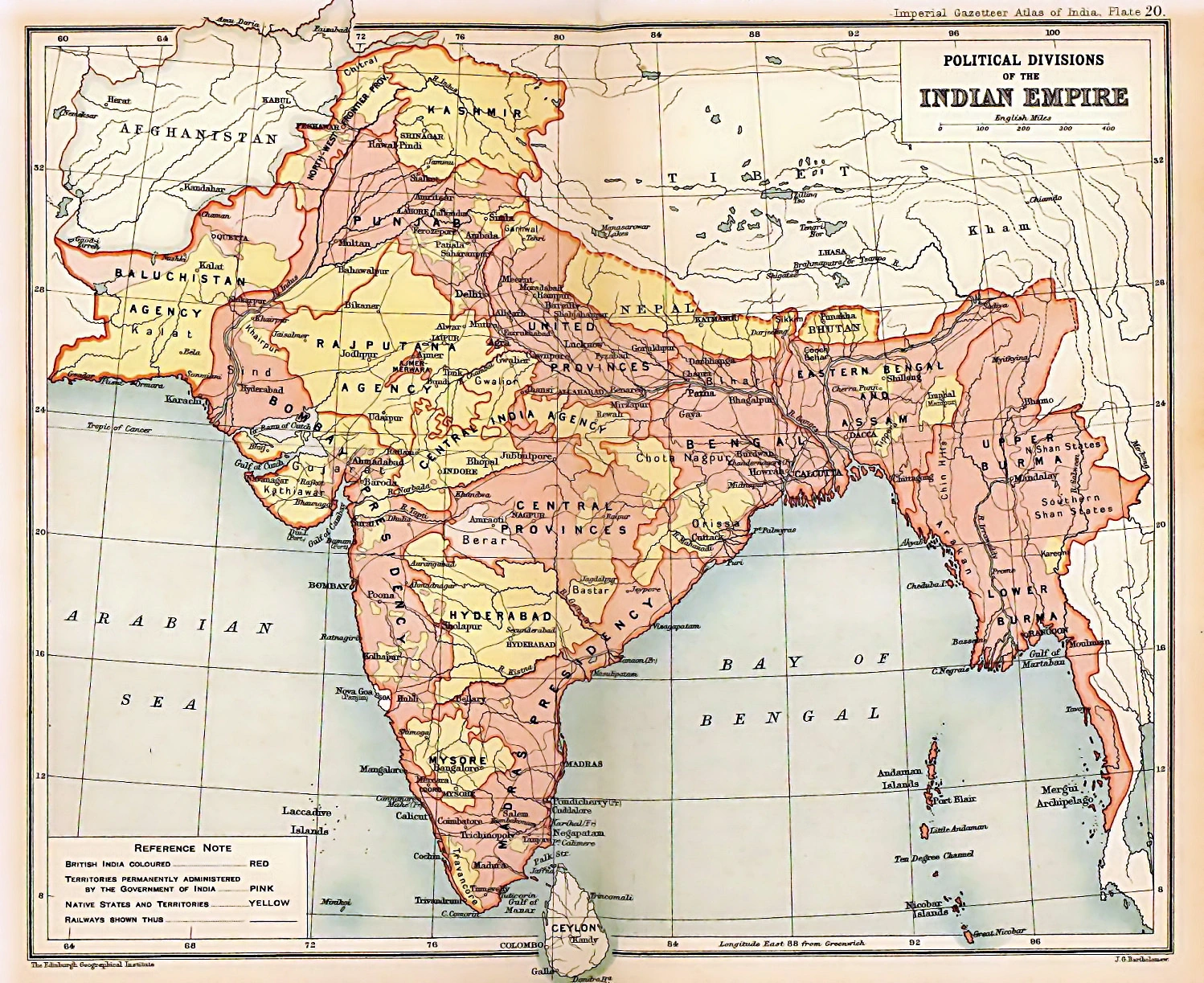
Map study
British Indian Empire in 1909: historical provinces and princely states, not contemporary Indian state boundaries.
- Read the source date and legend before interpreting territorial extent.
- Compare core regions, neighbouring powers and geographic barriers; historical borders and influence are approximate and changed over time.
Credit: Edinburgh Geographical Institute; J. G. Bartholomew and Sons · Public domain · sourceConverted to WebP on an opaque white background; proportionally resized without cropping. Original cartography and legend retained.
1. Geography and emergence of a successor state
Awadh occupied a fertile part of the middle Gangetic plain, broadly corresponding to central and eastern Uttar Pradesh. Its boundaries changed considerably under Mughal, nawabi and British rule, so the historical state should not be equated with a single modern administrative division. Ayodhya-Faizabad and Lucknow were important political and cultural centres. The Gomti, Ghaghara and other rivers supported an agrarian economy, while routes connecting Delhi, Bihar and Bengal gave the region strategic importance.
Awadh had been a Mughal subah, or province. In 1722, Emperor Muhammad Shah appointed Saadat Khan Burhan-ul-Mulk as its governor. Like other eighteenth-century regional rulers, Saadat Khan built practical autonomy without immediately rejecting Mughal sovereignty. Provincial office became the foundation of hereditary power, although imperial titles and recognition continued to provide legitimacy.
Saadat Khan sought greater control over revenue collection, official appointments and military resources. He checked powerful local chiefs, reduced dependence on the imperial administration and used trusted officials to consolidate authority. Awadh is therefore classified as a Mughal successor state, alongside Bengal and Hyderabad, rather than as a kingdom created through an immediate formal declaration of independence.
Timeline
1722
Saadat Khan becomes governor of Awadh and establishes the foundations of autonomous dynastic rule.
1764–1765
Defeat at Buxar is followed by the Allahabad settlement and growing Company influence.
1775
Asaf-ud-Daula shifts the principal court to Lucknow.
1801
Saadat Ali Khan II accepts a subsidiary alliance and major territorial cessions.
1819
Ghazi-ud-Din Haidar assumes the title of king.
1856–1858
Annexation is followed by widespread rebellion and the British recapture of Lucknow.
2. Nawabs, imperial politics and British intervention
Saadat Khan was succeeded in 1739 by his nephew and son-in-law, Safdar Jang. Safdar Jang became Mughal wazir in 1748, illustrating how provincial autonomy coexisted with participation in imperial politics. His successor, Shuja-ud-Daula, ruled from 1754 to 1775 and made Awadh an important actor in north Indian affairs. He supported Ahmad Shah Abdali against the Marathas at the Third Battle of Panipat in 1761.
Shuja-ud-Daula subsequently joined Mir Qasim, the displaced nawab of Bengal, and Mughal emperor Shah Alam II against the East India Company. Their defeat at Buxar on 22 October 1764 decisively altered the balance of power. Under the Allahabad settlement of 1765, Shuja recovered most of his dominions but paid an indemnity and surrendered Allahabad and Kora. The Company initially preferred Awadh as a buffer rather than annexing it outright.
Asaf-ud-Daula succeeded Shuja in 1775 and transferred the principal court to Lucknow. Increasing military payments, Company intervention and the influence of the British Resident progressively restricted the nawab’s freedom. In 1801, Saadat Ali Khan II accepted a subsidiary alliance and surrendered extensive territories, including Rohilkhand and substantial parts of the Ganga-Yamuna Doab, in place of subsidy payments.
From Mughal province to British annexation
- 1. Weakening imperial control enables provincial consolidation
- 2. Hereditary nawabs mobilise land revenue, credit and military resources
- 3. Defeat at Buxar increases Company leverage
- 4. Subsidiary alliance curtails sovereignty and reduces territory
- 5. Annexation disrupts landed, military and courtly interests
- 6. Overlapping grievances contribute to the Revolt of 1857
3. Administration, agriculture and social groups
Awadh’s wealth rested primarily on agricultural surplus. Fertile alluvial soils supported cereals, sugarcane and other crops, while expanding towns created demand for food, textiles and luxury goods. Control over land revenue was central to state-building, but rulers could not simply bypass local landed interests, village elites and credit networks.
Revenue farming, commonly termed ijara, became important. Contractors undertook to pay an agreed amount to the state and collected revenue from an assigned area. This offered rulers predictable receipts and access to advances, but could encourage excessive extraction. Bankers and merchants financed revenue contractors and political authorities, linking agrarian production with urban credit. Awadh’s state formation thus involved financiers as well as soldiers and court officials.
Taluqdars controlled estates or clusters of villages and often maintained armed followers. Their relations with the nawabs alternated between cooperation, bargaining and conflict. They should not be treated as identical to Mughal mansabdars, whose ranks belonged to the imperial service system. Below these powerful intermediaries stood village landholders, cultivators, labourers and artisans, whose burdens varied according to local arrangements.
The ruling house was Shia Muslim, but administration and commerce drew upon Hindu and Muslim groups, including Kayasthas, Brahmins, merchants and bankers. Awadhi remained important in everyday and literary life, while Persian dominated formal administration and Urdu gained increasing cultural prominence.
| Ruler | Reign | Key association |
|---|---|---|
| Saadat Khan | 1722–1739 | Founder of the autonomous dynasty |
| Safdar Jang | 1739–1754 | Mughal wazir from 1748 |
| Shuja-ud-Daula | 1754–1775 | Buxar and the Allahabad settlement |
| Asaf-ud-Daula | 1775–1797 | Lucknow court and Bara Imambara |
| Saadat Ali Khan II | 1798–1814 | Subsidiary alliance of 1801 |
| Wajid Ali Shah | 1847–1856 | Last ruler; deposed during annexation |
4. Lucknow, architecture and composite culture
Lucknow developed into a major centre of architecture, literature, performance and elite sociability. Nawabi patronage supported poets, musicians, dancers, calligraphers and craft workers. Its culture is often described as Ganga-Jamuni tehzeeb: a historically evolving pattern of interaction across religious and linguistic communities. This concept indicates cultural sharing, not the absence of hierarchy or conflict.
Asaf-ud-Daula commissioned the Bara Imambara during the famine of 1784. Its complex includes a great vaulted hall, the Bhul Bhulaiya labyrinth and a stepwell. The nearby Rumi Darwaza became another emblem of Lucknow. An imambara is principally a congregation and mourning hall associated with Shia observances, particularly Muharram; it is not simply another name for a mosque.
Muhammad Ali Shah commissioned the Chota Imambara in the nineteenth century. Urdu poetry, especially the marsiya or elegy commemorating Karbala, flourished through poets such as Mir Anis and Mirza Dabeer. Wajid Ali Shah, the last ruler, patronised Kathak, music and theatrical performances. These traditions, together with chikankari embroidery and Awadhi cuisine, show how courtly demand sustained specialised urban occupations.
5. Kingship, annexation and the Revolt of 1857
In 1819, Ghazi-ud-Din Haidar assumed the title of king with British encouragement, formally distancing Awadh from Mughal sovereignty. This enhancement of ceremonial status did not reverse its dependence on the Company. British control over defence and external relations, together with pressure through the Resident, had already weakened independent decision-making.
In February 1856, Governor-General Dalhousie annexed Awadh on grounds of alleged misgovernment and deposed Wajid Ali Shah. The annexation was not an application of the Doctrine of Lapse: the issue was not the absence of a recognised heir. Wajid Ali Shah subsequently settled at Metiabruz near Calcutta. Annexation disrupted the court, military establishments and livelihoods dependent on royal patronage.
British revenue arrangements after annexation challenged many taluqdars, while cultivators faced their own grievances. Large numbers of Bengal Army sepoys came from Awadh and neighbouring areas, connecting military discontent with village society. During the Revolt of 1857, Begum Hazrat Mahal supported the proclamation of her son Birjis Qadr as ruler and became a prominent resistance leader. Lucknow witnessed the siege of the Residency and major military operations. British forces recaptured the city in March 1858, although resistance continued elsewhere.
Real-world case studies
Bara Imambara: patronage and famine employment
Construction of the Bara Imambara began under Asaf-ud-Daula during the famine of 1784 and provided employment. It illustrates how monumental patronage could combine religious purposes, political legitimacy and relief through public works. Popular stories about its construction should be distinguished from securely established architectural and historical facts.
Taluqdars and the reversal of colonial policy
The post-annexation revenue settlement deprived many taluqdars of control over estates. Their participation helped give the 1857 rebellion a strong rural dimension in Awadh, although responses differed locally. After suppressing the revolt, British authorities restored or recognised the rights of many cooperating taluqdars, turning landed magnates into important supports of colonial rule.
Previous year questions
No source-linked PYQ is available here yet. Use the practice questions below.
Practice questions
Practice MCQ 1
Consider the following statements about Awadh: 1. Its autonomous dynasty emerged from a Mughal provincial governorship. 2. Its ruler received the Diwani of Bengal after the Battle of Buxar. 3. Its annexation in 1856 was justified by the British on grounds of alleged misgovernment. Which statements are correct?
- A. 1 and 2 only
- B. 1 and 3 only
- C. 2 and 3 only
- D. 1, 2 and 3
Practice MCQ 2
Which of the following pairs is incorrectly matched?
- A. Asaf-ud-Daula — Bara Imambara
- B. Ghazi-ud-Din Haidar — Assumption of kingship in 1819
- C. Saadat Ali Khan II — Subsidiary alliance of 1801
- D. Wajid Ali Shah — Leadership of Awadh’s forces at Buxar
Practice MCQ 3
In the context of eighteenth-century Awadh, the term ijara principally referred to:
- A. A hereditary religious office
- B. A system of revenue farming
- C. A rank in the imperial military hierarchy
- D. A hall for Muharram congregations
Mains practice · Awadh illustrates both the vitality of eighteenth-century regional states and the disruptive effects of colonial expansion. Discuss. Answer in 250 words.
- Explain successor-state formation within the framework of nominal Mughal sovereignty.
- Discuss agricultural resources, revenue farming, financiers and negotiated relations with taluqdars.
- Use Lucknow’s architecture, literary culture and performing arts as evidence of regional vitality.
- Trace the erosion of sovereignty through Buxar, the 1801 alliance and annexation.
- Connect the grievances of sepoys, taluqdars, cultivators and court-dependent groups with 1857.
- Avoid reducing Awadh either to a decadent court or to a socially harmonious cultural ideal.
Further reading
- NCERT, Our Pasts II: Eighteenth-Century Political Formations.
- NCERT, Our Pasts III: From Trade to Territory; When People Rebel.
- NCERT, Themes in Indian History, Part III: Rebels and the Raj.
- Satish Chandra, History of Medieval India.
- Uttar Pradesh Tourism official website: Lucknow heritage monuments.
Preparing for UPSC Civil Services? Get classroom teaching, answer-writing evaluation and mentorship at Pragnya IAS Academy, Ashok Nagar — see why aspirants choose us for IAS coaching in Hyderabad.