

This is a photo of ASI monument number
Credit: Ajit Kumar Majhi · CC BY-SA 4.0 · source

This is a photo of ASI monument number
Credit: Vikas Singh · CC BY-SA 4.0 · source
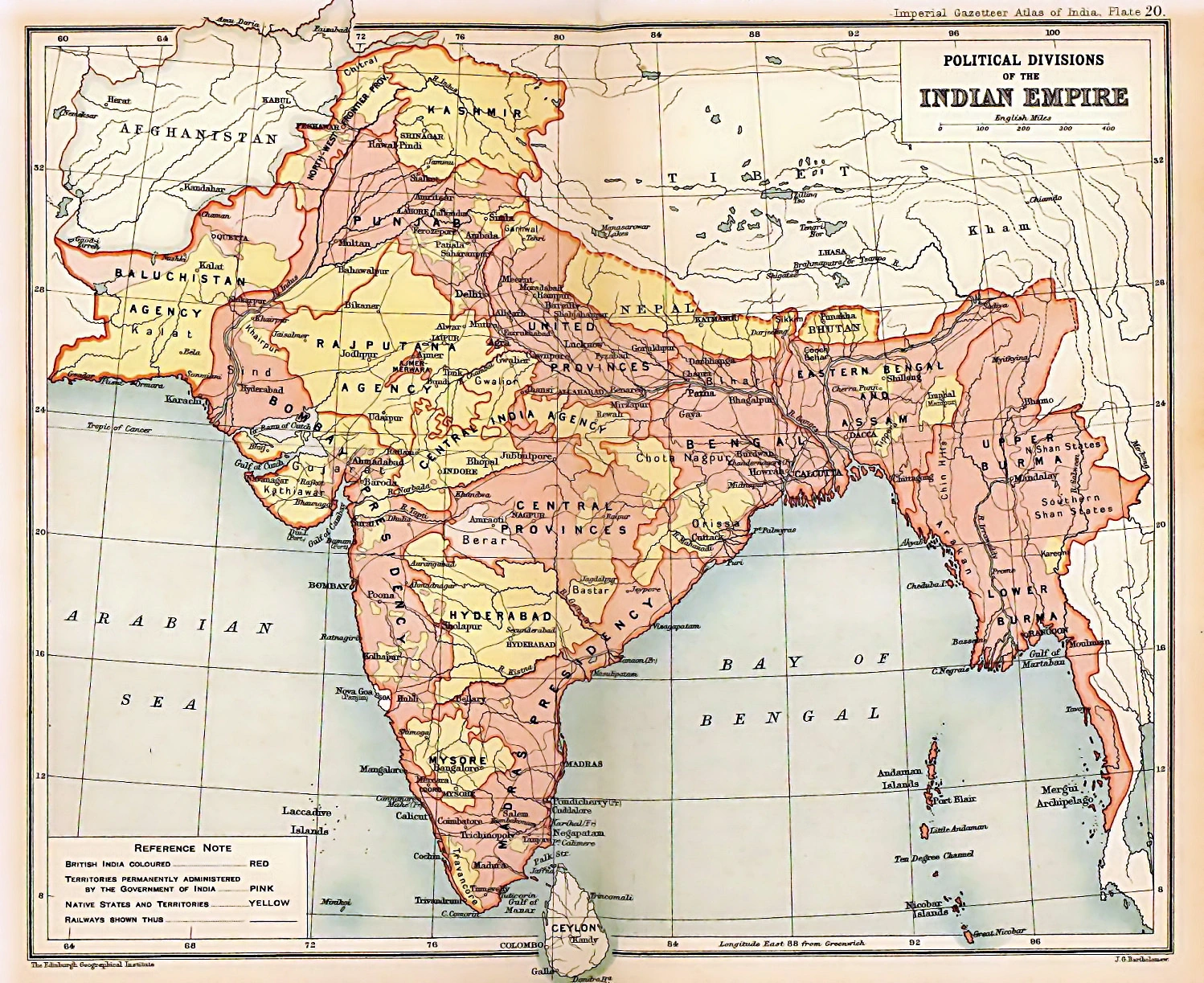
Map study
British Indian Empire in 1909: historical provinces and princely states, not contemporary Indian state boundaries.
- Read the source date and legend before interpreting territorial extent.
- Compare core regions, neighbouring powers and geographic barriers; historical borders and influence are approximate and changed over time.
Credit: Edinburgh Geographical Institute; J. G. Bartholomew and Sons · Public domain · sourceConverted to WebP on an opaque white background; proportionally resized without cropping. Original cartography and legend retained.
1. Geography and the formation of a regional kingdom
Bengal’s historical landscape extended across much of present-day Bangladesh and West Bengal, although political boundaries changed frequently. The Ganga–Brahmaputra–Meghna river system created fertile alluvial plains, navigable waterways and shifting channels. Rivers supported rice cultivation and commerce but complicated overland campaigning and administrative control. Western and northern centres such as Lakhnauti-Gaur and Pandua initially dominated sultanate politics; eastern deltaic settlements became increasingly important as cultivation and Mughal power expanded.
Before the Turkish conquest, the Sena dynasty controlled substantial parts of Bengal. Around 1204–1205, Muhammad Bakhtiyar Khalji attacked Nadia, associated with Lakshmanasena, and subsequently established his authority around Lakhnauti. Sena rule continued in parts of eastern Bengal. Thus, the fall of Nadia should not be equated with an immediate conquest of the entire region.
During the thirteenth and early fourteenth centuries, Bengal’s governors repeatedly asserted independence from Delhi. Distance, difficult communications and a strong local resource base encouraged this tendency. Balban suppressed Tughril’s rebellion in 1281, but Delhi’s control remained uneven. By the fourteenth century, Lakhnauti, Satgaon and Sonargaon had emerged as competing political centres. Their consolidation provided the foundation for an independent Bengal Sultanate.
- Prelims distinction: Nadia was associated with the Sena court; Lakhnauti became an early centre of Turkish authority.
- Historical Bengal was a changing political region, not an exact equivalent of either modern West Bengal or Bangladesh.
Timeline
Around 1204–1205
Bakhtiyar Khalji attacks Nadia; Turkish authority develops around Lakhnauti.
1352
Shamsuddin Ilyas Shah consolidates the principal centres of Bengal.
1494–1519
Reign of Alauddin Husain Shah.
1538
Sher Shah captures Gaur and ends Husain Shahi rule.
1576
Mughals defeat Daud Khan Karrani at Rajmahal.
1610
Islam Khan establishes his headquarters at Dhaka.
1666
Mughal forces capture Chittagong from Arakan.
2. The Bengal Sultanate and its ruling houses
Shamsuddin Ilyas Shah brought the principal centres of Bengal under his authority in 1352 and established the Ilyas Shahi dynasty’s regional supremacy. Firuz Shah Tughlaq’s campaigns failed to secure lasting submission, demonstrating the limits of Delhi’s authority. The Bengal sultans used sovereign titles and issued coins in their own names. Sikandar Shah, Ilyas Shah’s successor, commissioned the monumental Adina Mosque at Pandua in the fourteenth century.
The fifteenth century witnessed dynastic interruptions as well as continuity in regional kingship. Raja Ganesha rose to power in the early fifteenth century, and his son ruled as Jalaluddin Muhammad Shah after embracing Islam. The Ilyas Shahi line was later restored. A brief period of Habshi rule, from 1487 to 1494, reflected the political importance of military slaves and palace elites of African origin.
Alauddin Husain Shah founded the Husain Shahi dynasty in 1494. His reign and that of his son Nusrat Shah are associated with territorial ambitions, commercial prosperity and literary activity. Campaigns linked Bengal with Odisha, Kamata and the Brahmaputra valley, although claims of conquest should not be confused with permanent control. Sher Shah captured Gaur in 1538, ending Husain Shahi rule. After Sur power declined, Afghan rulers, particularly the Karranis, maintained Bengal’s independence until Mughal intervention.
- Major sequence: Ilyas Shahi rule, intervening rulers and restoration, Habshi rule, Husain Shahi rule, Afghan ascendancy, Mughal conquest.
- Coins, inscriptions and surviving buildings are essential evidence for reconstructing Bengal’s political history.
Agrarian expansion in the eastern delta
- 1. River shifts create opportunities for settlement
- 2. Forests and wetlands are brought under cultivation
- 3. Cultivators, chiefs and religious leaders establish settlements
- 4. Markets and revenue networks expand
- 5. New agrarian communities reshape regional society
3. Mughal conquest and provincial consolidation
Akbar’s expansion into Bengal confronted Daud Khan Karrani. Mughal forces defeated him at Tukaroi in 1575, followed by a settlement that temporarily left him Odisha. Renewed conflict culminated in the Battle of Rajmahal in 1576, where Daud was defeated and subsequently executed. This ended the independent Afghan sultanate, but effective Mughal control over the whole delta took several more decades.
Resistance came from Afghan chiefs and the Baro-Bhuiyans, a shifting grouping of powerful landed chiefs rather than a permanently fixed body of exactly twelve rulers. Isa Khan, based in the Bhati region of eastern Bengal, was their best-known leader. River forts, fleets and knowledge of waterways helped these chiefs resist imperial armies. Under Jahangir, the governor Islam Khan established his headquarters at Dhaka in 1610 and subdued Musa Khan and other opponents.
Bengal became a major revenue-producing and manufacturing province. Mughal administration combined imperial officers, revenue arrangements and cooperation with local zamindars. Under Shah Jahan and Aurangzeb, imperial activity extended further along the eastern frontier. Mir Jumla campaigned in Assam, while Shaista Khan’s forces captured Chittagong from Arakan in 1666. These developments strengthened Mughal authority over important riverine and coastal routes.
- Rajmahal, 1576, marks a decisive dynastic defeat, not the instantaneous completion of Mughal administration.
- Isa Khan and Musa Khan belong to the history of regional resistance during Mughal consolidation.
| Centre | Principal association |
|---|---|
| Nabadwip or Nadia | Sena political centre; birthplace of Chaitanya |
| Gaur or Lakhnauti | Major political centre under successive ruling houses |
| Pandua | Sultanate capital; Adina Mosque |
| Sonargaon | Eastern political and textile centre |
| Dhaka | Mughal headquarters from 1610; fine cotton manufacture |
| Chittagong | Strategic port captured by the Mughals in 1666 |
4. Agrarian society, trade and religious change
Bengal’s economy rested on rice agriculture, supplemented by sugar, textiles and other products. River transport connected villages with markets, weaving centres and ports. Satgaon was important in the earlier period, while Hooghly rose as channels and commercial networks changed. Sonargaon and Dhaka became notable textile centres. Fine cotton fabrics, including muslin, linked Bengal to Indian Ocean markets; silk also became important in its commercial economy.
Agricultural expansion involved forest clearance, settlement formation and the movement of cultivators into the eastern delta. Local chiefs, zamindars, religious figures and revenue officials participated in these processes. The spread of Islam cannot be reduced to conquest or forced conversion alone. Sufi shrines, rural religious leadership, patronage and the creation of new agrarian communities all contributed, with considerable variation across time and place.
Bengal also sustained Hindu, Buddhist and diverse local religious traditions. Chaitanya’s Krishna-centred devotion emphasised emotional bhakti and congregational singing, or sankirtana. His movement drew participants from different social backgrounds but did not eliminate caste distinctions throughout society. Muslim and Hindu communities interacted through language, agrarian life, artisanal production and sacred landscapes, while retaining distinct institutions and sometimes experiencing conflict.
- Portuguese traders became active in sixteenth-century Bengal; Shah Jahan’s forces attacked their settlement at Hooghly in 1632.
- Avoid projecting the Permanent Settlement of 1793 onto the institutions of medieval Bengal.
5. Literature, architecture and regional identity
Persian functioned as a language of courtly culture and administration, while Bengali expanded as a literary medium. Krittivasa’s Bengali Ramayana helped adapt an epic tradition for a regional audience. Maladhar Basu composed Sri Krishna Vijaya and received patronage under the Bengal sultans. Kabindra Parameshwar produced a Bengali Mahabharata adaptation under Paragal Khan, an official associated with Husain Shah’s rule. Such patronage illustrates that political and literary cultures did not follow rigid religious boundaries.
Mangalkavya literature celebrated deities such as Manasa and Chandi and offers evidence of regional social values and livelihood patterns. Vaishnava poetry and biographies of Chaitanya further enriched Bengali literature. These texts should be read critically: devotional and courtly works communicate social ideals and claims rather than straightforward statistical descriptions of society.
Bengal’s architecture responded to abundant clay, heavy rainfall and limited local building stone. Brick construction, terracotta ornament, curved cornices and regional roof forms became characteristic. Important monuments include the Adina Mosque at Pandua, the Eklakhi Mausoleum and the Chhota Sona Mosque at Gaur. Later terracotta temples at Bishnupur under the Malla rulers developed distinctive chala and ratna forms. Regional architecture combined wider Islamic or Sanskritic traditions with local materials and building practices.
- Location trap: Adina Mosque is at Pandua, not Dhaka.
- Architectural identification: Bengal is especially associated with terracotta decoration and curved roof or cornice profiles.
Real-world case studies
Adina Mosque: architecture and sovereignty
Built under Sikandar Shah around 1373–1375, the Adina Mosque at Pandua used monumental scale and a vast congregational plan to express royal authority. It demonstrates Bengal’s participation in wider Islamic architectural traditions alongside regional building practices.
Isa Khan and riverine resistance
Isa Khan’s resistance in Bhati illustrates how ecology influenced state formation. Waterways, fleets and dispersed strongholds enabled regional chiefs to challenge Mughal forces. Later consolidation required naval operations and political accommodation, not merely victory in a single land battle.
Previous year questions
No source-linked PYQ is available here yet. Use the practice questions below.
Practice questions
Practice MCQ 1
Which ruler consolidated the principal political centres of Bengal under his authority in 1352?
- A. Shamsuddin Ilyas Shah
- B. Alauddin Husain Shah
- C. Daud Khan Karrani
- D. Islam Khan
Practice MCQ 2
Consider the following statements: 1. The Battle of Rajmahal in 1576 ended the independent Afghan sultanate of Bengal. 2. The Baro-Bhuiyans constituted a permanently fixed council of exactly twelve Mughal officials. Which is correct?
- A. 1 only
- B. 2 only
- C. Both 1 and 2
- D. Neither 1 nor 2
Practice MCQ 3
Which of the following pairs is incorrectly matched?
- A. Adina Mosque — Pandua
- B. Chaitanya — Gaudiya Vaishnavism
- C. Maladhar Basu — Sri Krishna Vijaya
- D. Chittagong’s Mughal conquest — Balban
Mains practice · Explain how geography, political autonomy and cultural interaction shaped medieval Bengal’s regional identity. Answer in 250 words.
- Explain the economic and military significance of the delta and river networks.
- Discuss the consolidation of the Bengal Sultanate and its sovereign institutions.
- Connect Mughal expansion with resistance by regional chiefs.
- Examine agrarian settlement, maritime commerce and religious change.
- Use Bengali literature, Chaitanya’s movement and terracotta architecture as examples.
Further reading
- Satish Chandra, Medieval India, NCERT.
- NCERT, Our Pasts–II: chapters on the Delhi Sultans, Mughal Empire, devotional traditions and regional cultures.
- Richard M. Eaton, The Rise of Islam and the Bengal Frontier, 1204–1760.
- Banglapedia, Asiatic Society of Bangladesh: entries on Bengal Sultanate, Ilyas Shah, Husain Shah and Baro-Bhuiyans.
- Archaeological Survey of India: monument information on Adina Mosque and the Bishnupur temples.
Preparing for UPSC Civil Services? Get classroom teaching, answer-writing evaluation and mentorship at Pragnya IAS Academy, Ashok Nagar — see why aspirants choose us for IAS coaching in Hyderabad.