
![Locally called Kallanai, the Grand Anicut dam was built on the Cauvery River in the c. 100 BC – c. 100 AD[1][2][3] by Chola king, Karikalan. This massive structure was later reinforced by the British.](https://thumb.wikimedia.org/wikipedia/commons/thumb/5/5b/Grand_Anicut_kallanai.JPG/960px-Grand_Anicut_kallanai.JPG?utm_source=commons.wikimedia.org&utm_campaign=imageinfo&utm_content=thumbnail)
Locally called Kallanai, the Grand Anicut dam was built on the Cauvery River in the c. 100 BC – c. 100 AD[1][2][3] by Chola king, Karikalan. This massive structure was later reinforced by the British.
Credit: Beckamrajeev · CC BY-SA 3.0 · source
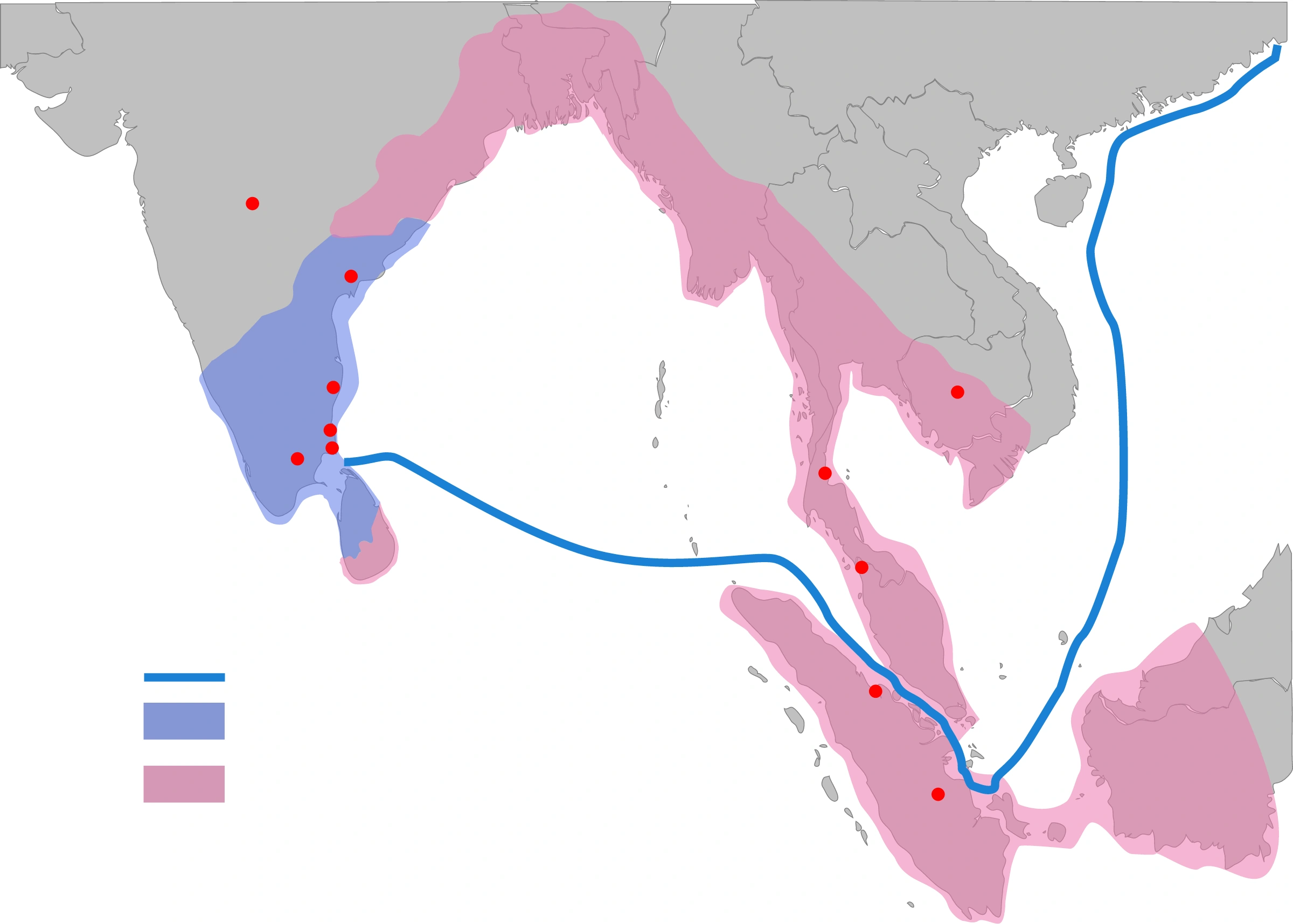
Map study
Chola expansion: distinguish mainland territory, subordinate regions and maritime influence through the source legend.
- Read the source date and legend before interpreting territorial extent.
- Compare core regions, neighbouring powers and geographic barriers; historical borders and influence are approximate and changed over time.
Credit: Nipuna Weerasinghe · CC BY-SA 4.0 · sourceConverted to WebP on an opaque white background; proportionally resized without cropping. Original cartography and legend retained.
1. Early Cholas: ancient roots and the evidence
The Cholas were one of the three major Tamil ruling lineages conventionally grouped as the muvendars: Cheras, Cholas and Pandyas. Ashoka’s third-century BCE inscriptions mention the Cholas among southern neighbours outside his directly administered empire. This establishes their early historical presence, but does not demonstrate uninterrupted rule by a single dynasty down to the imperial Cholas of the ninth to thirteenth centuries.
Sangam poems, particularly those in the Pattinappalai and Purananuru, preserve traditions of Chola rulers, warfare, patronage and commerce. Uraiyur, near present-day Tiruchirappalli, was an inland political centre; Kaveripattinam or Puhar, near the Kaveri’s mouth, was a port. Karikala is the best-known early Chola ruler. Tradition credits him with constructing the Kallanai, or Grand Anicut, across the Kaveri, although precise dating and the attribution of particular structural phases require caution.
Sangam literature is not a continuous political chronicle, and its chronology remains debated. Archaeology, inscriptions and external accounts must therefore supplement literary reconstruction. The tiger was the Chola dynastic emblem. Later imperial genealogies invoked prestigious ancestors, but genealogical claims should not automatically be treated as proof of continuous political control.
Timeline
Third century BCE
Ashoka’s edicts mention the Cholas among southern neighbouring polities.
Around 850 CE
Vijayalaya captures Thanjavur and establishes the imperial dynasty’s territorial base.
Around 897 CE
Aditya I defeats Aparajita and ends Pallava supremacy.
919 and 921 CE
Uttaramerur inscriptions record assembly committee procedures under Parantaka I.
949 CE
Rashtrakutas defeat the Cholas at Takkolam.
985–1014 CE
Rajaraja I’s reign marks a major phase of imperial consolidation.
2. From regional obscurity to imperial revival
After the early historic period, Chola political history becomes less clear. The interval conventionally associated with the Kalabhras is poorly documented and should not be described as a complete absence of political or cultural activity. By the sixth century, the Pallavas of Kanchipuram and the Pandyas of Madurai dominated much of the Tamil region. Lesser Chola chiefs survived, while Telugu-Choda lineages in the Andhra region also claimed Chola ancestry.
Vijayalaya emerged during the ninth-century contest between Pallavas and Pandyas. Around the mid-ninth century, often dated approximately 850 CE, he seized Thanjavur from the Muttaraiyars, a regional ruling family generally associated with Pallava overlordship. Thanjavur’s position in the fertile delta gave the new dynasty access to agricultural resources and important routes. Tradition also associates Vijayalaya with a temple to the goddess Nishumbhasudini.
His successor Aditya I initially participated in Pallava-led regional alliances. He subsequently defeated and killed Aparajita around 897 CE, ending Pallava supremacy and annexing Tondaimandalam. Parantaka I, who ruled approximately 907–955 CE, expanded southwards and assumed the title Maduraikonda after taking Madurai. However, the Rashtrakuta victory at Takkolam in 949 CE checked Chola expansion and killed the crown prince Rajaditya.
Foundations of Chola expansion
- 1. Control of Thanjavur and the Kaveri delta
- 2. Expansion of irrigated cultivation and settlements
- 3. Mobilisation of agrarian revenue and local elite support
- 4. Growth of temples, administrative institutions and exchange
- 5. Military consolidation and wider imperial expansion
3. Agrarian foundations and political organisation
The Kaveri delta was the material foundation of Chola power. River channels, embankments, tanks and canals supported intensive wet-rice cultivation. Agricultural expansion involved clearing land, establishing settlements and maintaining waterworks. Its success depended on both royal patronage and local cooperation; the hydraulic economy should not be attributed solely to centrally directed construction.
Brahmadeya grants created settlements endowed to Brahmanas, while devadana grants supported temples. Such grants could carry revenue privileges and helped organise cultivation, settlement and elite networks. Landholding peasants, including influential Vellala groups, were important in agrarian society. These arrangements also produced inequalities: access to land, ritual status and administrative participation was uneven, and cultivators and labourers did not enjoy identical rights.
The nadu, a grouping of settlements, was an important territorial and agrarian unit. The ur generally represented an ordinary village assembly, the sabha or mahasabha was associated with Brahmana settlements, and the nagaram with mercantile organisation. These bodies were not interchangeable, and their authority varied across time and place. In the mature empire, larger divisions included mandalams and valanadus; valanadu organisation is especially associated with Rajaraja I. Avoid projecting every later administrative feature back to Vijayalaya’s reign.
| Term | Principal association | Caution |
|---|---|---|
| Ur | Ordinary village assembly | Not synonymous with a Brahmana sabha |
| Sabha | Assembly of a Brahmana settlement | Participation was restricted |
| Nagaram | Mercantile organisation | Not a provincial administrative division |
| Nadu | Territorial grouping of settlements | Important for agrarian organisation |
| Variyam | Administrative committee | Not a territorial unit |
4. Inscriptions and the limits of local self-government
Chola inscriptions are indispensable evidence for land transactions, taxation, irrigation, temple endowments and local administration. Many were engraved on temple walls, giving transactions a durable public record. They also contain royal titles and claims of conquest, which must be read as political statements rather than entirely neutral narratives. Copper-plate charters, including the later Thiruvalangadu plates, combine grant information with dynastic genealogy.
The Uttaramerur inscriptions of Parantaka I, dated 919 and 921 CE, describe the constitution of committees in a Brahmana village assembly. Under the kudavolai procedure, eligible names written on palm-leaf tickets were placed in a pot and selected by lot. Eligibility involved conditions relating to property, residence, age and learning. Failure to submit accounts and specified misconduct could disqualify individuals and, in certain circumstances, their relatives.
Committees, called variyams, supervised responsibilities such as tanks, gardens and annual administration. This evidence demonstrates organised local management and accountability, but not universal adult franchise or modern parliamentary democracy. Participation was restricted, and the inscriptions concern a particular institutional setting. Local assemblies operated within a monarchy that demanded revenue, confirmed arrangements and could intervene; local autonomy and royal authority therefore coexisted.
5. Religious, commercial and cultural foundations
The Cholas inherited a religious landscape shaped by the Tamil Bhakti movement, particularly the Shaiva Nayanars and Vaishnava Alvars. Royal support was strongly associated with Shaivism, but religious patronage was not exclusively Shaiva. Temples became centres of worship, landholding, employment, redistribution and record-keeping. Endowments supported lamps, offerings, festivals, musicians and other services, linking devotion with the regional economy.
Chola architecture developed from earlier South Indian traditions, especially Pallava structural temples. Early Chola shrines were generally smaller than the monumental temples of the eleventh century. Rajaraja I’s Brihadisvara temple at Thanjavur, completed around 1010 CE, represents the mature development of these foundations rather than the beginning of Chola architecture. Bronze images, especially forms of Shiva as Nataraja, exemplify the lost-wax casting tradition and the importance of processional worship.
Ports and merchant networks connected the agrarian hinterland with Indian Ocean commerce. Organisations such as Manigramam and Ainnurruvar linked traders across regions, although their prominence and inscriptions varied over time. Rajaraja I and Rajendra I later enlarged Chola military and maritime power. Rajendra’s expedition against Srivijaya in 1025 CE belongs to this mature imperial phase; it should not be confused with the dynasty’s ninth-century foundation.
Real-world case studies
Uttaramerur: accountability without universal suffrage
Uttaramerur in present-day Tamil Nadu preserves detailed rules for committee selection and disqualification. Its accounting requirements illustrate institutional accountability, while property and social qualifications demonstrate why village self-government must not be equated with modern democracy.
Kallanai: inherited irrigation infrastructure
The Kallanai near Tiruchirappalli illustrates the long history of water diversion in the Kaveri delta. Traditionally associated with Karikala, it was maintained and modified across subsequent periods. It highlights how later states benefited from inherited infrastructure rather than creating agrarian prosperity from nothing.
Previous year questions
No source-linked PYQ is available here yet. Use the practice questions below.
Practice questions
Practice MCQ 1
Which sequence correctly represents the early imperial Chola succession?
- A. Vijayalaya → Aditya I → Parantaka I
- B. Aditya I → Vijayalaya → Parantaka I
- C. Parantaka I → Vijayalaya → Aditya I
- D. Vijayalaya → Parantaka I → Aditya I
Practice MCQ 2
Consider these statements about Uttaramerur: 1. Its well-known committee inscriptions belong to Parantaka I’s reign. 2. Kudavolai involved selection by lot from eligible names. 3. All adult residents could participate irrespective of property or social qualification. Which are correct?
- A. 1 only
- B. 1 and 2 only
- C. 2 and 3 only
- D. 1, 2 and 3
Practice MCQ 3
Which pair is incorrectly matched?
- A. Puhar — Early Chola port
- B. Takkolam — Rashtrakuta victory over the Cholas
- C. Nagaram — Brahmana village assembly
- D. Devadana — Land endowed to a temple
Mains practice · Explain how agrarian resources, local institutions and regional political competition laid the foundations of Chola power. Answer in 250 words.
- Locate the revival under Vijayalaya within Pallava–Pandya competition.
- Explain the importance of Thanjavur, delta irrigation and agricultural surplus.
- Discuss brahmadeyas, temples and landed elite networks.
- Differentiate ur, sabha, nagaram and nadu.
- Use Uttaramerur to assess accountability and restricted participation.
- Conclude with consolidation under Aditya I and Parantaka I, noting the setback at Takkolam.
Further reading
- NCERT, Our Pasts II, chapter on Kings and Kingdoms.
- K. A. Nilakanta Sastri, The Colas.
- Archaeological Survey of India, South Indian Inscriptions series.
- UNESCO World Heritage Centre, Great Living Chola Temples.
Preparing for UPSC Civil Services? Get classroom teaching, answer-writing evaluation and mentorship at Pragnya IAS Academy, Ashok Nagar — see why aspirants choose us for IAS coaching in Hyderabad.