
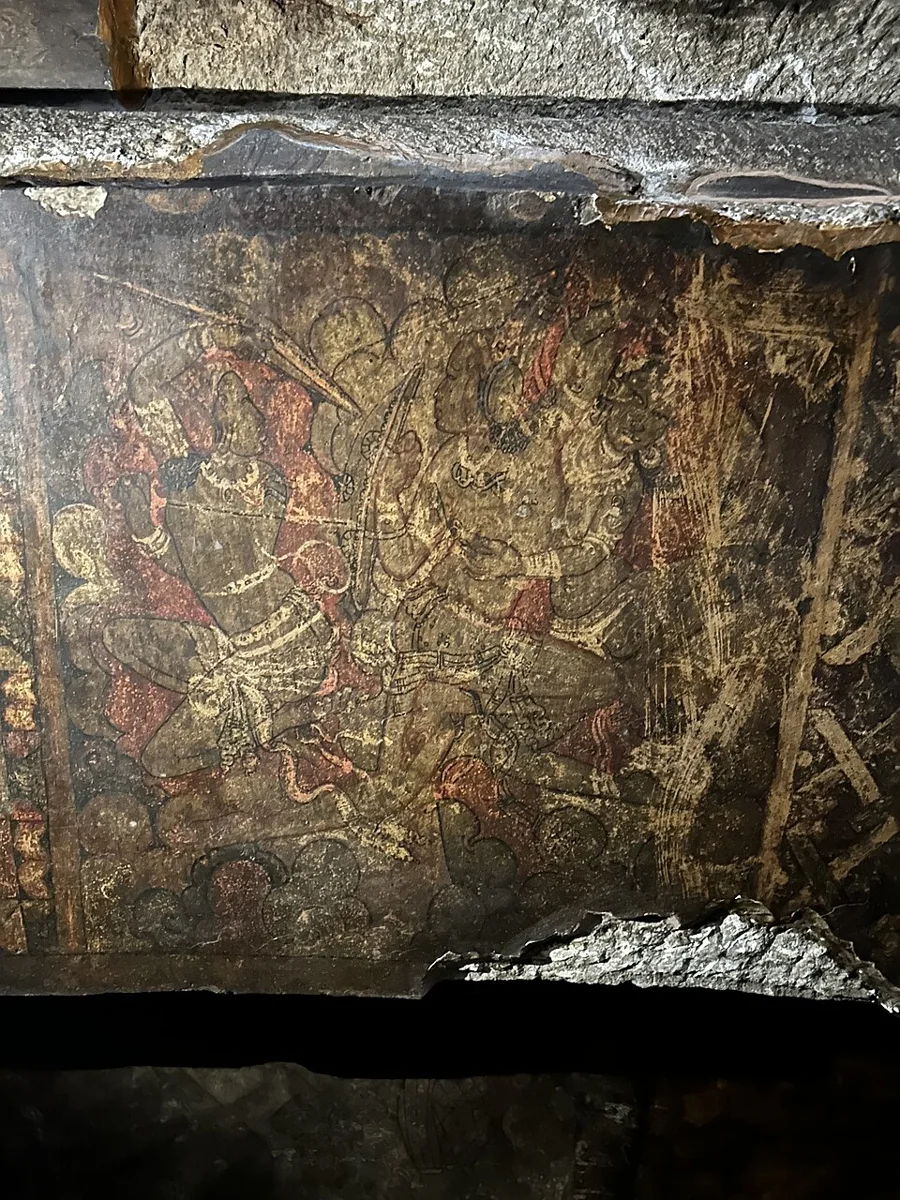
Ellora mural attributed in the supplied metadata to the Rashtrakuta period.
Credit: Arjunullas · CC BY 4.0 · sourceResized and converted to WebP; uncropped.
Map study
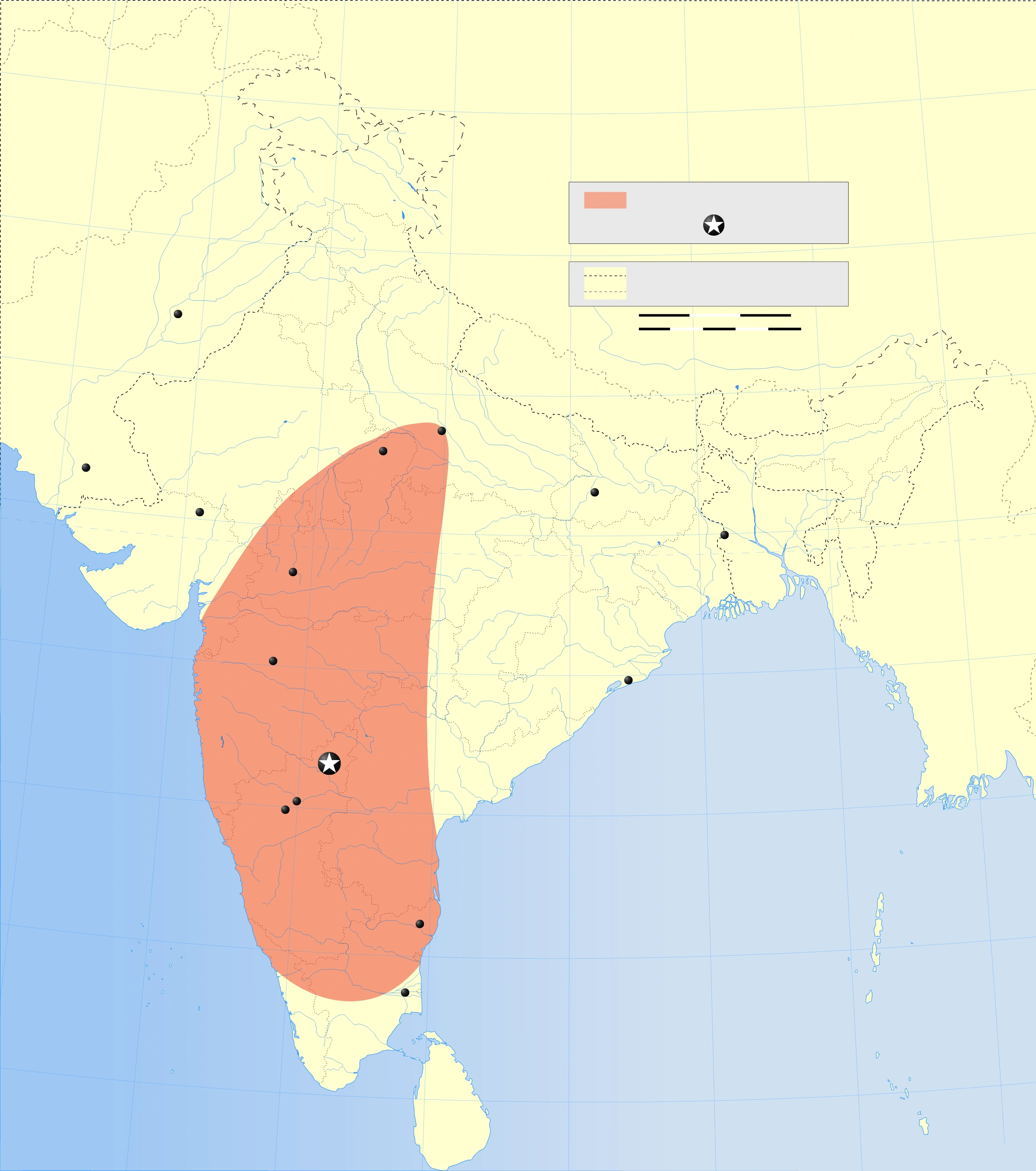
Rashtrakuta Empire: locate the Deccan core and compare northward expansion in this historical reconstruction.
- Read the source date and legend; distinguish territory, influence and geographic location.
- Historical boundaries and reference memberships are not live political or operational data.
Credit: Planemad · CC BY-SA 3.0 · sourceConverted to WebP on an opaque white background; proportionally resized without cropping. Original cartography and legend retained.
Origins, geography and historical sources
The imperial Rashtrakutas emerged in the eighth-century Deccan from the political world dominated by the Badami Chalukyas. Dantidurga, initially a subordinate chief, consolidated his position through military campaigns and displaced Chalukya authority around 753 CE. The dynasty's remote origins remain debated. References to similarly named groups in earlier records should not automatically be treated as proof of an uninterrupted imperial lineage.
Their core territories lay across substantial parts of present-day Karnataka and Maharashtra. At different times, their authority extended into Gujarat, central India and adjoining regions, while campaigns reached much farther. Manyakheta became the principal capital under Amoghavarsha I. Distinguish this Deccan base from Kannauj, a northern centre over which the Rashtrakutas sought influence rather than maintaining an enduring capital.
Copper-plate grants, stone inscriptions, literary works, monuments and external accounts provide the main evidence. Genealogies and royal eulogies describe conquests but require critical reading because they exaggerate victory and universal sovereignty. Ninth- and tenth-century Arabic accounts refer to a powerful ruler called Balhara, generally associated with the Rashtrakutas. These accounts help place the dynasty within Indian Ocean commercial and diplomatic networks.
- Regional focus: the Deccan plateau, with important connections to Gujarat and the western coast.
- Source caution: a successful campaign, a tributary relationship and direct territorial administration were not identical.
Timeline
Around 753 CE
Dantidurga displaces Badami Chalukya supremacy and establishes imperial Rashtrakuta power.
Eighth century, reign of Krishna I
Construction of the monolithic Kailasa temple at Ellora is commissioned.
Late eighth–early ninth centuries
Dhruva and Govinda III intervene in northern India during the tripartite struggle.
Approximately 814–878 CE
Amoghavarsha I rules; Manyakheta and literary patronage gain prominence.
949 CE
Krishna III defeats Chola forces at Takkolam.
972–973 CE
Manyakheta is sacked by Siyaka; Tailapa II subsequently establishes Western Chalukya supremacy.
Political expansion and the struggle for Kannauj
Dantidurga's successor Krishna I consolidated the new kingdom and is remembered above all for the Kailasa temple at Ellora. Dhruva subsequently carried Rashtrakuta power into northern India, defeating the Gurjara-Pratihara ruler Vatsaraja and the Pala ruler Dharmapala. His campaigns established the Rashtrakutas as participants in the tripartite struggle, the prolonged rivalry involving these three dynasties.
Kannauj's attraction combined political prestige with access to the resources and communications of the Gangetic plain. Its association with Harsha strengthened its symbolic importance. The contest was not one uninterrupted war, nor did its participants exercise equal or permanent control over the city. Rashtrakuta interventions often disrupted northern rivals without producing sustained administration of the Gangetic heartland.
Govinda III, who ruled approximately from 793 to 814 CE, continued this expansion and defeated the Pratihara ruler Nagabhata II. Amoghavarsha I, approximately 814–878 CE, is better known for consolidating the kingdom and supporting scholarship, though his reign also involved rebellions and warfare. Krishna III revived southern military expansion and defeated the Cholas at Takkolam in 949 CE. After his reign, succession problems and attacks weakened the state. The Paramara ruler Siyaka sacked Manyakheta in 972, and Tailapa II displaced Rashtrakuta supremacy around 973.
- Tripartite struggle: Rashtrakutas of the Deccan, Gurjara-Pratiharas of western and northern India, and Palas of eastern India.
- Takkolam was a Rashtrakuta victory over the Cholas; the Chola prince Rajaditya died in the battle.
How Rashtrakuta imperial power operated
- 1. Military expansion established royal supremacy.
- 2. Subordinate chiefs provided tribute and armed support.
- 3. Revenue and grants sustained political and religious institutions.
- 4. Courtly and regional patronage supported temples and scholarship.
- 5. Powerful subordinates could challenge the dynasty when central authority weakened.
Administration, agrarian society and commerce
Rashtrakuta kings used titles expressing universal sovereignty, but effective rule depended on a hierarchy of officers, local elites and subordinate chiefs. Administrative records mention units such as rashtra, vishaya and grama, although terminology and territorial arrangements varied. Samantas supplied military assistance and tribute while retaining considerable local authority. Their cooperation enabled expansion, but their ambitions could also destabilise the kingdom.
Agriculture formed the principal economic base. Land revenue supported the court, army and administration, while grants to Brahmanas, temples and religious institutions transferred specified revenues or privileges. Copper-plate charters recorded boundaries, beneficiaries and exemptions. Such grants could promote cultivation, settlement and religious patronage while strengthening landed intermediaries. They should be analysed individually rather than assumed to convey identical rights everywhere.
The period is important to debates about early medieval Indian feudalism. Land grants, political decentralisation and the growth of intermediary rights support some aspects of that interpretation. However, inscriptions and overseas accounts also indicate continuing exchange, merchant activity and prosperous centres. Western coastal routes linked the Deccan to the Arabian Sea, facilitating trade in textiles, valuable goods and horses. Agrarian expansion and commercial networks could therefore develop together rather than representing mutually exclusive economic systems.
- Use samanta for a subordinate ruler or chief, not as an exact equivalent of a modern salaried official.
- The emergence of regional political powers did not imply complete economic isolation.
| Ruler | Key association | Distinction to remember |
|---|---|---|
| Dantidurga | Foundation of imperial power | Displaced Badami Chalukya authority |
| Krishna I | Kailasa temple, Ellora | Eighth-century monolithic Shiva temple |
| Dhruva | Northern campaigns | Defeated Vatsaraja and Dharmapala |
| Govinda III | Expansion into northern India | Defeated Nagabhata II |
| Amoghavarsha I | Manyakheta and Kavirajamarga | Kannada literary patronage and Jain connections |
| Krishna III | Battle of Takkolam, 949 CE | Victory over Chola forces |
Religion, literature and intellectual life
Rashtrakuta patronage embraced multiple religious traditions. Shaivism and Vaishnavism received support, while Jain teachers and institutions held an especially influential position at certain courts. Amoghavarsha I is closely associated with Jainism and the teacher Jinasena. Nevertheless, the religious preference of an individual king should not be confused with an exclusive state religion or a uniform identity among all subjects.
Kannada developed as a major literary language alongside Sanskrit. Kavirajamarga, composed around 850 CE and associated with Amoghavarsha I and the scholar Srivijaya, discusses poetics and literary usage. It is among the earliest surviving major Kannada works, not proof that Kannada writing began only in the ninth century. The coexistence of Sanskrit cosmopolitan learning and regional-language expression is central to understanding early medieval cultural change.
Jinasena composed the Adipurana, and Gunabhadra completed the larger Mahapurana tradition through the Uttarapurana. Mahaviracharya's Ganitasarasangraha, a ninth-century mathematical work, belongs to this intellectual environment. Pampa, celebrated for Adipurana and Vikramarjuna Vijaya, flourished under Arikesari II of the Vemulavada Chalukyas, a Rashtrakuta subordinate. This distinction matters: literary production occurred across interconnected regional courts, not only through direct imperial patronage.
- High-value association: Amoghavarsha I, Kavirajamarga, Kannada.
- High-value association: Mahaviracharya, Ganitasarasangraha, mathematics.
Art, architecture and early medieval significance
The most celebrated Rashtrakuta monument is the Kailasa temple at Ellora, generally attributed to Krishna I in the eighth century. Dedicated to Shiva, it was excavated from a single rock mass. Its architecture imitates a structural temple complex, including a Dravida-style superstructure, a Nandi pavilion, subsidiary shrines and extensive sculpture. Excavation proceeded broadly from the upper rock surface downward, demanding careful planning before the surrounding mass was removed.
Ellora contains Buddhist, Hindu and Jain monuments created across several centuries. The entire complex must not be attributed to one dynasty or religious community. Its later Jain caves also belong to the broader cultural environment of the Rashtrakuta age. UNESCO recognises Ellora as a World Heritage Site. For examinations, distinguish Ellora in Maharashtra from Elephanta near Mumbai, and avoid treating all western Indian rock-cut monuments as Rashtrakuta commissions.
The dynasty illustrates the importance of the Deccan in subcontinental politics, rather than viewing it merely as a bridge between north and south. Its history connects mobile armies, regional courts, religious endowments, maritime exchange and vernacular literary growth. These institutions and cultural practices continued under successor powers, particularly the Western Chalukyas, making Rashtrakuta rule a crucial component of early medieval Indian foundations.
- Kailasa is rock-cut and monolithic, not a temple assembled primarily from separately quarried masonry blocks.
- Political fragmentation and major artistic achievement were compatible features of the period.
Rashtrakuta Art: Ellora Beyond Rock-Cut Architecture
The supplied metadata identifies this image as a Rashtrakuta-period mural at Ellora, making it relevant to the dynasty’s artistic context. Rashtrakuta cultural history should not be reduced to monumental stone carving alone: painting also contributed to the decoration and religious meaning of sacred spaces. The Kailasa temple at Ellora, generally associated with Krishna I, is a central example of Rashtrakuta architectural patronage. However, this mural’s precise location, patron and relationship to that temple cannot be established from the supplied description.
Ellora helps situate the Rashtrakutas within the wider religious and cultural landscape of early medieval India. Its Buddhist, Hindu and Jain monuments belong to different phases; the entire complex should not be assigned to one dynasty or reign. Rashtrakuta rulers supported multiple religious and literary traditions, including Jain scholarship and Sanskrit and Kannada writing. Such patronage could express devotion while also reinforcing royal prestige and relationships with religious communities. The metadata tentatively interprets the mural’s subject as an elopement and battle involving heavenly figures. That uncertainty must be retained: this description alone cannot establish a particular narrative, deity or historical event.
- Prelims distinction: Ellora’s Kailasa is associated with Rashtrakuta patronage; not every Ellora excavation is Rashtrakuta.
- Mains linkage: Examine artistic patronage alongside royal legitimation, religious institutions and regional literary development.
- Evidence limit: A period attribution does not independently identify a mural’s commissioner, exact date or narrative subject.
Real-world case studies
Kailasa at Ellora: architecture as royal patronage
Cave 16 transforms a rock mass into a monumental temple complex. Its association with Krishna I links technical expertise and Shaiva devotion to imperial prestige. It also demonstrates why rock-cut technique and architectural style are separate categories: a monolithic excavation can reproduce Dravida structural forms.
Pampa and the Vemulavada court
Pampa's patron Arikesari II belonged to a subordinate Chalukya line within the Rashtrakuta political sphere. His career illustrates how regional courts fostered Kannada literature and Jain learning, warning against attributing every contemporary cultural achievement directly to the imperial court.
Previous year questions
No source-linked PYQ is available here yet. Use the practice questions below.
Practice questions
Practice MCQ 1
Consider the following pairs: 1. Dantidurga — Displacement of Badami Chalukya supremacy; 2. Krishna I — Kailasa temple at Ellora; 3. Amoghavarsha I — Victory at Takkolam. Which pairs are correctly matched?
- A. 1 and 2 only
- B. 2 and 3 only
- C. 1 and 3 only
- D. 1, 2 and 3
Practice MCQ 2
With reference to the tripartite struggle, consider the following statements: 1. It involved the Rashtrakutas, Palas and Gurjara-Pratiharas. 2. Kannauj possessed political prestige and strategic importance. 3. The Rashtrakutas permanently shifted their imperial capital to Kannauj. Which statements are correct?
- A. 1 only
- B. 1 and 2 only
- C. 2 and 3 only
- D. 1, 2 and 3
Practice MCQ 3
Which statement about Rashtrakuta cultural history is correct?
- A. Kavirajamarga is a Sanskrit treatise on temple construction.
- B. Ganitasarasangraha is associated with Mahaviracharya.
- C. All Ellora caves were excavated under Krishna I.
- D. Pampa was patronised by the Pala ruler Dharmapala.
Mains practice · The Rashtrakutas combined far-reaching military ambitions with a regionally rooted political and cultural order. Discuss. Answer in 250 words.
- Locate their Deccan core and Manyakheta capital.
- Explain northern interventions and the tripartite struggle.
- Mention Krishna III's southern expansion and Takkolam.
- Analyse dependence on samantas, agrarian revenues and grants.
- Use Kailasa, Kavirajamarga and Pampa's regional court as cultural examples.
- Distinguish military reach from durable direct administration.
Further reading
- NCERT, Our Pasts II, chapter Kings and Kingdoms.
- R. S. Sharma, India's Ancient Past.
- Upinder Singh, A History of Ancient and Early Medieval India.
- Archaeological Survey of India: Ellora Caves.
- UNESCO World Heritage Centre: Ellora Caves.
- https://commons.wikimedia.org/wiki/File:Rashtrakuta_mural_at_Ellora.jpg
Preparing for UPSC Civil Services? Get classroom teaching, answer-writing evaluation and mentorship at Pragnya IAS Academy, Ashok Nagar — see why aspirants choose us for IAS coaching in Hyderabad.