

Brihadisvara Temple during Maha Shivaratri
Credit: Original: Rainer Halama Derivative work: UnpetitproleX · CC BY-SA 4.0 · source

Nataraja from Tamil Nadu, India. Chola Dynasty
Credit: Wikimedia Commons · Public domain · source
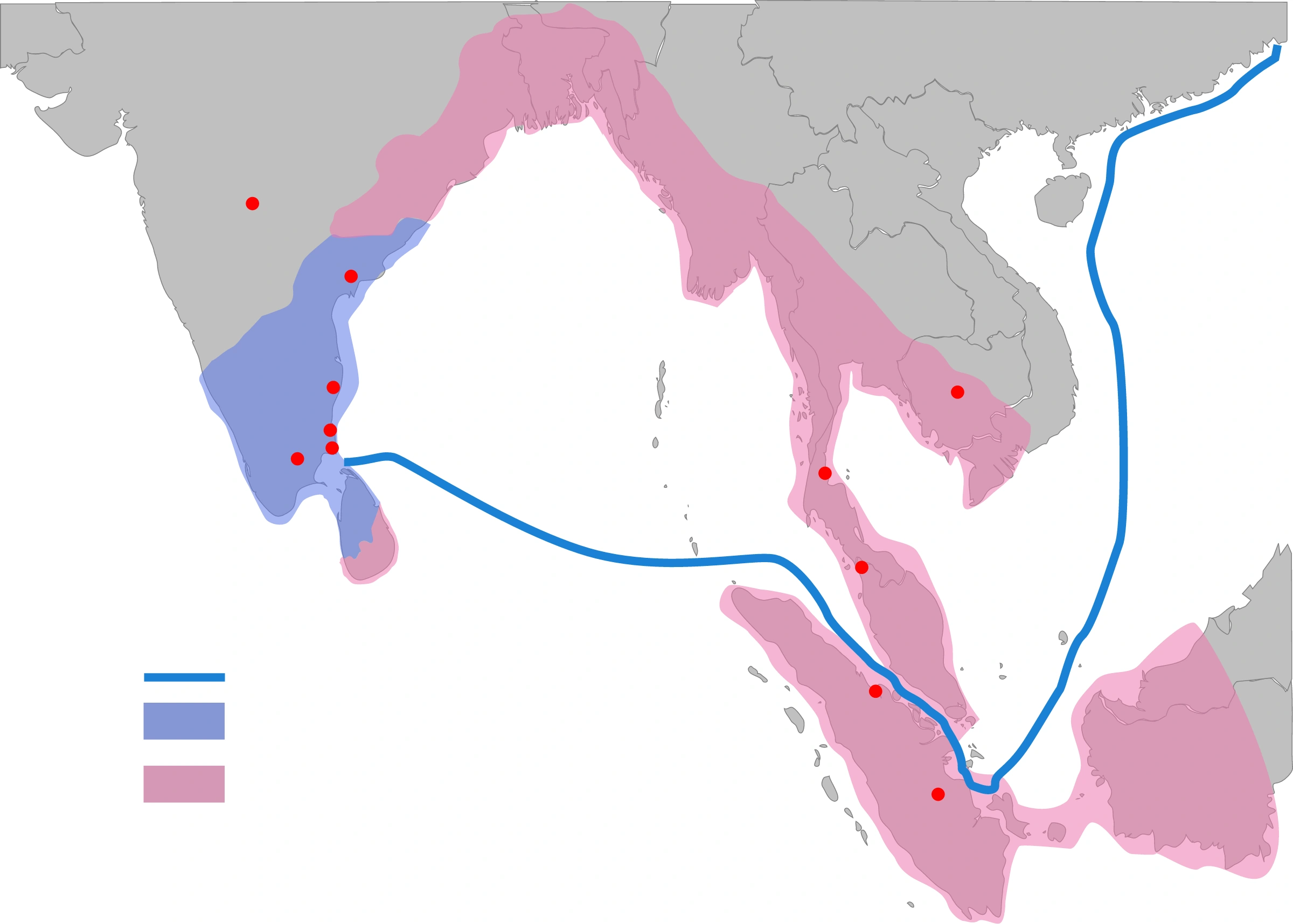
Map study
Chola expansion: distinguish mainland territory, subordinate regions and maritime influence through the source legend.
- Read the source date and legend before interpreting territorial extent.
- Compare core regions, neighbouring powers and geographic barriers; historical borders and influence are approximate and changed over time.
Credit: Nipuna Weerasinghe · CC BY-SA 4.0 · sourceConverted to WebP on an opaque white background; proportionally resized without cropping. Original cartography and legend retained.
1. Early Cholas: sources, geography and historical setting
The Cholas were one of the three principal crowned dynasties of ancient Tamilakam, alongside the Cheras and Pandyas. Their early core lay in the fertile Kaveri valley and delta of present-day Tamil Nadu. This riverine environment supported intensive agriculture, dense settlement and access to the Bay of Bengal. The tiger was the characteristic Chola dynastic emblem.
Ashoka’s third-century BCE inscriptions provide an early external reference to the Cholas. Their appearance among neighbouring southern peoples does not mean that they were Mauryan provinces. Sangam anthologies, especially the Purananuru and Pattinappalai, illuminate rulers, warfare, patronage and urban life. However, these poems were composed and compiled over time; their narratives cannot always be converted into precise political chronology.
Uraiyur, near modern Tiruchirappalli, was an inland royal centre. Kaveripattinam, also called Puhar, was an important coastal centre associated with maritime commerce. Karikala is the best-known early Chola ruler, celebrated for military success and traditionally credited with constructing the Kallanai across the Kaveri. His exact dates remain disputed. Evidence for early Chola political power becomes less clear after the Sangam period, so the early and imperial phases should not be treated as one continuously documented empire.
- Source distinction: Sangam poetry is literary evidence; inscriptions and archaeology provide different, complementary kinds of evidence.
- Chronology caution: Karikala belongs to the early Chola tradition, not the imperial dynasty founded by Vijayalaya.
Timeline
Third century BCE
Ashokan inscriptions mention the Cholas among southern neighbouring polities.
Early centuries CE
Sangam traditions describe early Chola rulers and centres such as Uraiyur and Puhar.
Mid-ninth century
Vijayalaya establishes the foundation of imperial Chola power at Thanjavur.
919 and 921
Uttaramerur inscriptions record rules governing assembly committees.
1010
Rajaraja I’s Brihadisvara temple at Thanjavur is consecrated.
1025
Rajendra I attacks Srivijaya and associated Southeast Asian ports.
1279
Conventional end of Chola rule following Pandya expansion.
2. Imperial expansion and maritime power
Vijayalaya captured Thanjavur around the mid-ninth century, laying the foundation of renewed Chola power. Aditya I ended Pallava supremacy in the northern Tamil region. Parantaka I expanded Chola influence, but the Rashtrakuta victory at Takkolam in 949 checked Chola ambitions. These developments show that imperial growth involved prolonged competition with the Pallavas, Pandyas, Rashtrakutas and, subsequently, the Western Chalukyas.
Rajaraja I, who ruled from 985 to 1014, greatly strengthened the kingdom through conquest, revenue organisation and temple patronage. He extended Chola power into northern Sri Lanka and other southern regions. Rajendra I, his son, assumed sole rule in 1014 after a period as co-regent. He extended the conquest of Sri Lanka and led a northern expedition reaching the Ganga region. The title Gangaikonda Chola and his new capital, Gangaikondacholapuram, commemorated this achievement.
In 1025, Rajendra launched a naval expedition against Srivijaya and associated ports in Southeast Asia, including Kadaram in the Malay Peninsula. This demonstrates substantial maritime capacity but should not be interpreted as permanent Chola rule over all Southeast Asia. Commercial interests, strategic rivalry and royal prestige provide possible contexts. Kulottunga I, who became king in 1070, represented the Chola–Eastern Chalukya dynastic connection. Later Chola power weakened amid Pandya resurgence and Hoysala intervention; the dynasty conventionally ends in 1279.
- Distinguish Rajaraja’s conquest of northern Sri Lanka from Rajendra’s further expansion on the island.
- Chola overseas warfare and Tamil merchant activity were connected developments, but merchants were not simply agents of state conquest.
Simplified kudavolai committee-selection process
- 1. Identify candidates meeting prescribed qualifications
- 2. Exclude candidates affected by disqualification rules
- 3. Place palm-leaf tickets bearing eligible names in a pot
- 4. Draw tickets to select committee members
- 5. Assign committee responsibilities and require accountability
3. Administration, village institutions and inscriptions
The Chola monarchy operated through royal officers, regional authorities, local assemblies and influential landed groups. Inscriptions record territorial divisions such as mandalam, valanadu, nadu and individual settlements. Their organisation varied across time and region. Land surveys, assessment and detailed revenue records supported taxation, while royal orders and grants were frequently engraved on temple walls or copper plates.
Local institutions were differentiated. The ur generally represented an ordinary agrarian settlement; the sabha or mahasabha was associated with a Brahmadeya, a settlement endowed to Brahmanas; and the nagaram represented mercantile interests in a town. The nadu brought together settlements and local landed interests. These institutions managed matters such as irrigation, endowments, revenue and disputes, but their authority operated within a larger political and social hierarchy.
The Uttaramerur inscriptions of Parantaka I, notably those dated 919 and 921, describe eligibility rules, committee arrangements and the kudavolai method of selection. Names of qualified candidates were written on palm-leaf tickets and drawn from a pot. Property, learning, age and conduct shaped eligibility. Failure to submit accounts and specified misconduct could lead to disqualification. Committees, called variyams, supervised functions including tanks and gardens. These records demonstrate sophisticated corporate administration, not universal adult franchise or modern electoral democracy.
- Uttaramerur provides evidence for a particular Brahmana assembly; its arrangements should not automatically be generalised to every Chola village.
- Meikeerthis, or royal eulogistic introductions in inscriptions, help reconstruct campaigns but must be read critically because they celebrate royal achievements.
| Monument | Patron | Location | Prelims significance |
|---|---|---|---|
| Brihadisvara temple | Rajaraja I | Thanjavur | Consecrated in 1010; monumental vimana |
| Brihadisvara temple | Rajendra I | Gangaikondacholapuram | Associated with the new imperial capital |
| Airavatesvara temple | Rajaraja II | Darasuram | Twelfth-century sculptural and architectural refinement |
4. Agrarian economy, trade and society
Agriculture was the economic foundation of Chola power. The Kaveri delta benefited from river channels, embankments and irrigated wet-rice cultivation, while tanks were important elsewhere. Maintaining irrigation required cooperation among assemblies, cultivators, donors and political authorities. Land revenue was a major source of state income, supplemented by commercial dues and other levies. Rates and obligations differed; a single uniform tax rate should not be assumed for the whole empire.
Land categories reflected social and institutional relationships. Brahmadeya denoted land granted to Brahmanas, while devadana referred to grants to deities or temples. Temples accumulated land and resources through royal and private donations. They employed priests, musicians, dancers, accountants and artisans, and supported redistribution and craft production. Their economic importance also reflected unequal access to land, labour obligations and social hierarchy.
Merchant organisations such as Ainnurruvar, also known as the Five Hundred of Ayyavole, and Manigramam participated in long-distance commerce. Tamil merchants operated across South India and overseas networks linking Sri Lanka and Southeast Asia. Textiles, spices and other commodities circulated through these networks. Nagapattinam was a major maritime and religious centre. Royal support for a Buddhist monastery established there through Srivijayan patronage illustrates diplomacy and religious accommodation within a predominantly Shaiva royal environment.
5. Architecture, bronzes and cultural significance
Chola rulers developed the Dravida tradition of temple architecture. Characteristic elements include a sanctum, a rising vimana above it, pillared halls and enclosed precincts. Rajaraja I’s Brihadisvara temple at Thanjavur, consecrated in 1010, is particularly associated with its monumental stone vimana and extensive inscriptions. In major Chola temples, the sanctum tower is visually dominant; the overwhelming prominence of gateway towers is more characteristic of many later South Indian temple complexes.
Rajendra I’s temple at Gangaikondacholapuram and Rajaraja II’s Airavatesvara temple at Darasuram demonstrate later developments in scale, sculptural treatment and architectural refinement. Together with Thanjavur’s Brihadisvara, they form UNESCO’s Great Living Chola Temples. The designation recognises monuments that retain active ritual traditions rather than surviving solely as archaeological remains.
Chola metal images are celebrated for technical skill and expressive form. Bronze icons were produced using the lost-wax technique, in which a wax model is replaced by molten metal within a mould. Nataraja represents Shiva as the cosmic dancer: the drum signifies creation, fire destruction, and the subdued figure beneath his foot ignorance. Many metal icons were intended for processions. Shaiva devotional traditions received substantial patronage, but Vaishnavism, Jainism and Buddhism also formed part of the wider religious landscape. Sekkizhar’s twelfth-century Periyapuranam narrates the lives of the Shaiva Nayanmars.
Real-world case studies
Thanjavur temple inscriptions as an economic archive
Brihadisvara’s inscriptions record gifts of land, gold and livestock, together with arrangements for lamps, ritual services and personnel. They show how a royal monument functioned through sustained resource mobilisation and organised labour, making temples valuable sources for economic as well as art history.
Nagapattinam and connections with Srivijaya
The Leiden copper plates record Chola support for a Buddhist establishment at Nagapattinam founded through Srivijayan patronage. Alongside Rajendra’s later maritime campaign, this evidence demonstrates that Chola–Southeast Asian relations included both cooperation and conflict.
Previous year questions
No source-linked PYQ is available here yet. Use the practice questions below.
Practice questions
Practice MCQ 1
With reference to the Cholas, consider the following statements: 1. They are mentioned in Ashokan inscriptions. 2. Vijayalaya founded the imperial Chola line. 3. Karikala commissioned the Brihadisvara temple at Thanjavur. Which statements are correct?
- A. 1 and 2 only
- B. 2 and 3 only
- C. 1 and 3 only
- D. 1, 2 and 3
Practice MCQ 2
Which description best explains the kudavolai system documented at Uttaramerur?
- A. Universal voting by all adult village residents
- B. Selection by lot from eligible candidates for assembly committees
- C. Appointment of naval officers through competitive examinations
- D. Auctioning of temple lands to overseas merchants
Practice MCQ 3
Consider the following pairs: 1. Gangaikondacholapuram — Rajendra I 2. Airavatesvara temple, Darasuram — Rajaraja II 3. Srivijaya expedition of 1025 — Parantaka I. How many pairs are correctly matched?
- A. Only one
- B. Only two
- C. All three
- D. None
Mains practice · Chola temples were institutions of political authority and economic organisation as well as centres of worship. Discuss with examples. Answer in 250 words.
- Explain royal patronage and monumental architecture as expressions of legitimacy.
- Examine land grants, endowments, agricultural surplus and temple employment.
- Discuss links with assemblies, merchants and specialised crafts.
- Use Thanjavur inscriptions and Chola processional bronzes as evidence.
- Recognise social hierarchy and avoid presenting temples as uniformly inclusive institutions.
Further reading
- NCERT, Our Pasts II, chapter on Kings and Kingdoms.
- NCERT, An Introduction to Indian Art, Part I, chapters on temple architecture and Indian bronze sculpture.
- Archaeological Survey of India, South Indian Inscriptions series.
- UNESCO World Heritage Centre, Great Living Chola Temples.
- K. A. Nilakanta Sastri, The Colas.
Preparing for UPSC Civil Services? Get classroom teaching, answer-writing evaluation and mentorship at Pragnya IAS Academy, Ashok Nagar — see why aspirants choose us for IAS coaching in Hyderabad.