

The Modern Review Vol 3 (January to June 1908)
Credit: Ramananda Chatterjee · Public domain · source

Haileybury College at Hertford Heath
Credit: Chris Hunt · CC BY-SA 2.0 · source
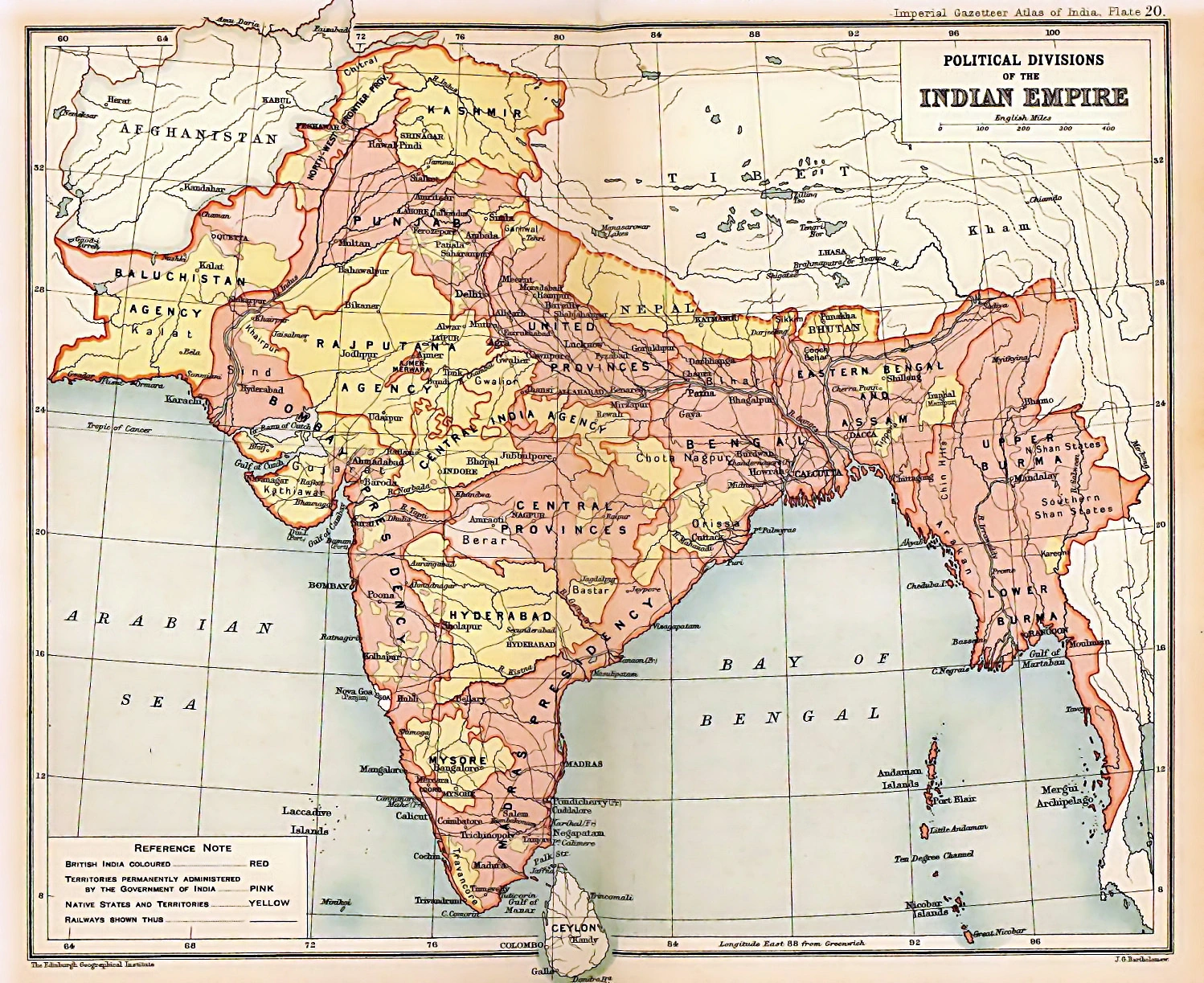
Map study
British Indian Empire in 1909: historical provinces and princely states, not contemporary Indian state boundaries.
- Read the source date and legend before interpreting territorial extent.
- Compare core regions, neighbouring powers and geographic barriers; historical borders and influence are approximate and changed over time.
Credit: Edinburgh Geographical Institute; J. G. Bartholomew and Sons · Public domain · sourceConverted to WebP on an opaque white background; proportionally resized without cropping. Original cartography and legend retained.
1. From Company merchants to territorial administrators
The East India Company initially employed servants for commercial work, with ranks such as writer, factor and merchant. Recruitment depended on nomination and patronage rather than an open examination. As the Company acquired political authority, especially after obtaining the Diwani of Bengal, Bihar and Orissa in 1765, its servants increasingly performed revenue, judicial and executive functions. Private trade, gifts and the opportunities created by conquest encouraged corruption and conflicts of interest.
Warren Hastings helped reorganise revenue and judicial administration, but Cornwallis, Governor-General from 1786 to 1793, gave the higher service a more regulated institutional character. He raised salaries, prohibited private trade and acceptance of presents, and stressed discipline and promotion by seniority. These measures sought to create officials whose livelihoods depended on their official careers rather than private commercial gains.
Professionalisation was accompanied by racial exclusion. Higher appointments were largely reserved for Europeans, while Indians staffed subordinate offices and supplied much of the practical knowledge needed for administration. The covenanted service consisted of officials who entered formal covenants with the Company and occupied senior positions. The uncovenanted service covered a varied range of lower appointments and offered greater, though limited, access to Indians.
- The Cornwallis Code of 1793 reorganised administration and justice and separated revenue collection from judicial functions at the district level.
- High salaries and service discipline were intended to reduce corruption, not to establish accountability to the Indian population.
- The district collector emerged as a central revenue officer; under later arrangements, collectors commonly also exercised magistracy and executive authority.
Timeline
1786–1793
Cornwallis professionalised the higher Company service while reinforcing European dominance.
1853–1855
The Charter Act, Macaulay Committee and first open competitive examination established the new recruitment framework.
1863
Satyendranath Tagore qualified for the ICS.
1886–1887
The Aitchison Commission examined public services and recommended their reclassification.
1922
ICS examinations began to be held in India as well as England.
1924–1926
The Lee Commission reported; India’s first Public Service Commission was subsequently established.
2. Training and the transition to competitive recruitment
Lord Wellesley established Fort William College at Calcutta in 1800 to train Company servants, particularly in Indian languages and administrative knowledge. The Company’s directors subsequently created the East India College in England in 1806, initially at Hertford and later at Haileybury. Training became more systematic, but entry continued to depend on nomination.
The Charter Act of 1833 declared that religion, place of birth, descent or colour should not by themselves disqualify a person from Company employment. This principle did not immediately dismantle European monopoly over higher offices. The decisive legislative change came with the Charter Act of 1853, which removed the directors’ recruitment monopoly and provided the basis for open competition.
The Macaulay Committee of 1854 recommended a competitive examination emphasising a broad liberal education. The first open competition took place in London in 1855. After the transfer of government to the Crown in 1858, the elite service became firmly identified as the Indian Civil Service. Competitive selection reduced patronage but did not make recruitment socially or racially equal.
- Prelims distinction: 1853 concerns the legislative opening; 1854 concerns the Macaulay Committee; 1855 concerns the first open competitive examination.
- Fort William College and Haileybury were training institutions, not public service commissions.
- The Indian Civil Service should not be confused with the Indian Civil Services Act, 1861, which reserved specified senior posts for members of the covenanted service.
Evolution of the higher civil services
- 1. Company commercial employment and patronage
- 2. Territorial administration and covenanted service
- 3. Cornwallis’s disciplinary and salary reforms
- 4. Competitive recruitment from 1855
- 5. Gradual Indianisation and examination in India
- 6. Public service commissions and constitutional services
3. Indianisation and nationalist criticism
Indians were formally eligible for competitive recruitment, but the examination’s location in London imposed substantial travel and living costs. Its English educational orientation and demanding preparation requirements further restricted access. The upper age limit was progressively reduced, reaching 19 in 1878 during Lytton’s viceroyalty. This particularly disadvantaged Indians who needed time to obtain suitable education and travel abroad.
Satyendranath Tagore’s success in 1863 demonstrated that the service was not legally closed to Indians. Nevertheless, Indian representation remained small. Nationalists demanded simultaneous examinations in India and England, a higher age limit and a greater Indian share in senior appointments. The Indian Association, founded in 1876, and subsequently the Indian National Congress made civil-service reform an important political issue.
The Statutory Civil Service introduced under Lytton in 1879 provided a limited nomination-based route for Indians of recognised standing to certain higher offices. It was not equivalent to opening the ICS examination in India. The Aitchison Commission of 1886–87 recommended discontinuing this arrangement and reorganising services into Imperial, Provincial and Subordinate categories.
The Islington Commission, appointed in 1912 and reporting in 1915, proposed that 25 per cent of superior posts be filled by Indians, through direct recruitment and promotion. Reform remained gradual. In 1922, the ICS examination began to be held in India as well as England. Indianisation widened participation, but officials continued to operate within a colonial chain of command.
- Nationalist criticism combined demands for racial equality, representative administration and reduced expenditure on highly paid European officials.
- The economic critique linked overseas recruitment, pensions and remittances to the drain of wealth.
- Indianisation meant increasing Indian participation; it did not automatically mean democratic control of the bureaucracy.
| Body | Date | Principal significance |
|---|---|---|
| Macaulay Committee | 1854 | Recommended the framework for open competitive recruitment. |
| Aitchison Commission | 1886–87 | Recommended Imperial, Provincial and Subordinate service classification. |
| Islington Commission | 1912–15 | Recommended 25 per cent Indian representation in superior posts. |
| Lee Commission | 1923–24 | Recommended faster Indianisation and establishment of a public service commission. |
4. Functions, hierarchy and the colonial economy
The ICS occupied senior positions in district administration, provincial governments and the central secretariat. The collector or district magistrate became the most visible representative of state authority. Responsibilities included land revenue, maintenance of public order, supervision of subordinate administration and coordination during scarcity or famine. The exact combination of powers varied across provinces and periods.
Civil servants translated colonial economic objectives into everyday administration. They supervised revenue settlements, enforced regulations and supplied information through district reports, surveys and statistical returns. Their work helped consolidate territorial control and secure predictable income for the government. Administrative knowledge was therefore both a governing resource and an instrument of domination.
The bureaucracy also performed public functions, including famine relief, sanitation, education and support for infrastructure. These activities must be evaluated alongside fiscal conservatism, limited popular accountability and the coercive requirements of imperial rule. During nationalist movements, district officials implemented restrictive legislation, prohibited meetings and supervised arrests through the police machinery.
The ICS was only one component of the administrative system. Police, forest, engineering, education and other departments had distinct services, while Indian clerks, revenue personnel and provincial officers carried out much of the routine work. Describing the ICS as the entire colonial bureaucracy obscures this wider institutional structure.
- The description of the service as a steel frame highlights its role in sustaining administrative continuity and imperial authority.
- Centralisation coexisted with substantial discretion exercised by district officers.
- For historical evaluation, distinguish administrative efficiency from political legitimacy and public accountability.
5. Public service commissions and the postcolonial legacy
The Government of India Act, 1919 provided for a public service commission. The Lee Commission of 1923–24 examined the superior civil services and recommended accelerated Indianisation. For the ICS, its proposed recruitment distribution was 40 per cent British direct recruits, 40 per cent Indian direct recruits and 20 per cent promotion from provincial services. It also supported establishing the commission envisaged by the 1919 Act.
The first Public Service Commission in India was established on 1 October 1926, with Sir Ross Barker as chairman. Its role was primarily advisory. The Government of India Act, 1935 provided for a Federal Public Service Commission and Provincial Public Service Commissions, strengthening the institutional basis of recruitment and service consultation.
Independent India retained a permanent, merit-based bureaucracy while transforming its constitutional purpose. The Indian Administrative Service succeeded the ICS as the principal generalist all-India administrative service. Sardar Vallabhbhai Patel defended all-India services as instruments of national unity. Articles 315–323 of the Constitution concern public service commissions, while Article 312 provides for creating all-India services under specified conditions.
The legacy therefore involved both continuity and change: district administration, competitive recruitment and career service persisted, but authority now derived from a democratic Constitution rather than imperial sovereignty. Civil servants became responsible for implementing policies framed by elected governments, subject to constitutional and legal safeguards.
- Do not confuse the founding of the Public Service Commission in 1926 with the commencement of the constitutional UPSC in 1950.
- The IAS is an all-India service, not merely a central service.
- A balanced Mains answer should connect institutional continuity with changes in accountability, representation and developmental responsibilities.
Real-world case studies
Satyendranath Tagore: formal access and practical barriers
Tagore qualified in 1863 and subsequently served in the Bombay Presidency. His career illustrates the opening created by competition, while the small number of Indian entrants demonstrates how examination location, expense and educational inequalities restricted access.
Surendranath Banerjea and civil-service agitation
Banerjea entered the ICS after contesting an age-related disqualification but was later dismissed from service. He became a leading public campaigner. The Indian Association’s agitation against restrictive recruitment conditions connected an elite employment issue with wider demands for equal treatment under colonial rule.
Previous year questions
No source-linked PYQ is available here yet. Use the practice questions below.
Practice questions
Practice MCQ 1
Which measure provided the legislative basis for replacing nomination with open competition in recruitment to the Company’s higher civil service?
- A. Charter Act of 1813
- B. Charter Act of 1833
- C. Charter Act of 1853
- D. Government of India Act, 1858
Practice MCQ 2
Consider the following statements: 1. Cornwallis introduced open competitive examinations for the higher civil service. 2. The Aitchison Commission recommended classification into Imperial, Provincial and Subordinate services. 3. The ICS examination began to be held in India in 1922. Which statements are correct?
- A. 1 and 2 only
- B. 2 and 3 only
- C. 1 and 3 only
- D. 1, 2 and 3
Practice MCQ 3
Arrange these events chronologically: 1. Establishment of India’s first Public Service Commission. 2. Satyendranath Tagore qualifies for the ICS. 3. First open competitive civil-service examination in London. 4. Lee Commission report.
- A. 3–2–4–1
- B. 2–3–1–4
- C. 3–4–2–1
- D. 2–3–4–1
Mains practice · Competitive recruitment professionalised the colonial civil services without making them representative or democratically accountable. Discuss. Answer in 250 words.
- Trace the shift from patronage and Cornwallis’s reforms to competition after 1853.
- Explain professionalisation through examinations, training, salaries and service rules.
- Assess racial exclusion, London-based examinations, age restrictions and unequal educational access.
- Discuss revenue extraction, coercion and accountability to colonial superiors.
- Examine nationalist demands, Indianisation and public service commissions.
- Conclude by distinguishing merit-based recruitment from representative and democratic administration.
Further reading
- NCERT, Modern India, Bipan Chandra: administrative organisation and nationalist politics.
- Bipan Chandra and others, India’s Struggle for Independence.
- Union Public Service Commission official website: Historical Perspective.
- Report of the Royal Commission on the Superior Civil Services in India, 1924.
- Constitution of India, Articles 312 and 315–323, Legislative Department.
Preparing for UPSC Civil Services? Get classroom teaching, answer-writing evaluation and mentorship at Pragnya IAS Academy, Ashok Nagar — see why aspirants choose us for IAS coaching in Hyderabad.