

Overcrowded train transferring refugees during the partition of India, 1947. This was considered to be the largest migration in human history.
Credit: Unknown authorUnknown author · Public domain · source

A Constituent Assembly of India meeting in 1950. B.R. Ambedkar can be seen seated top-right.
Credit: Unknown authorUnknown author · Public domain · source
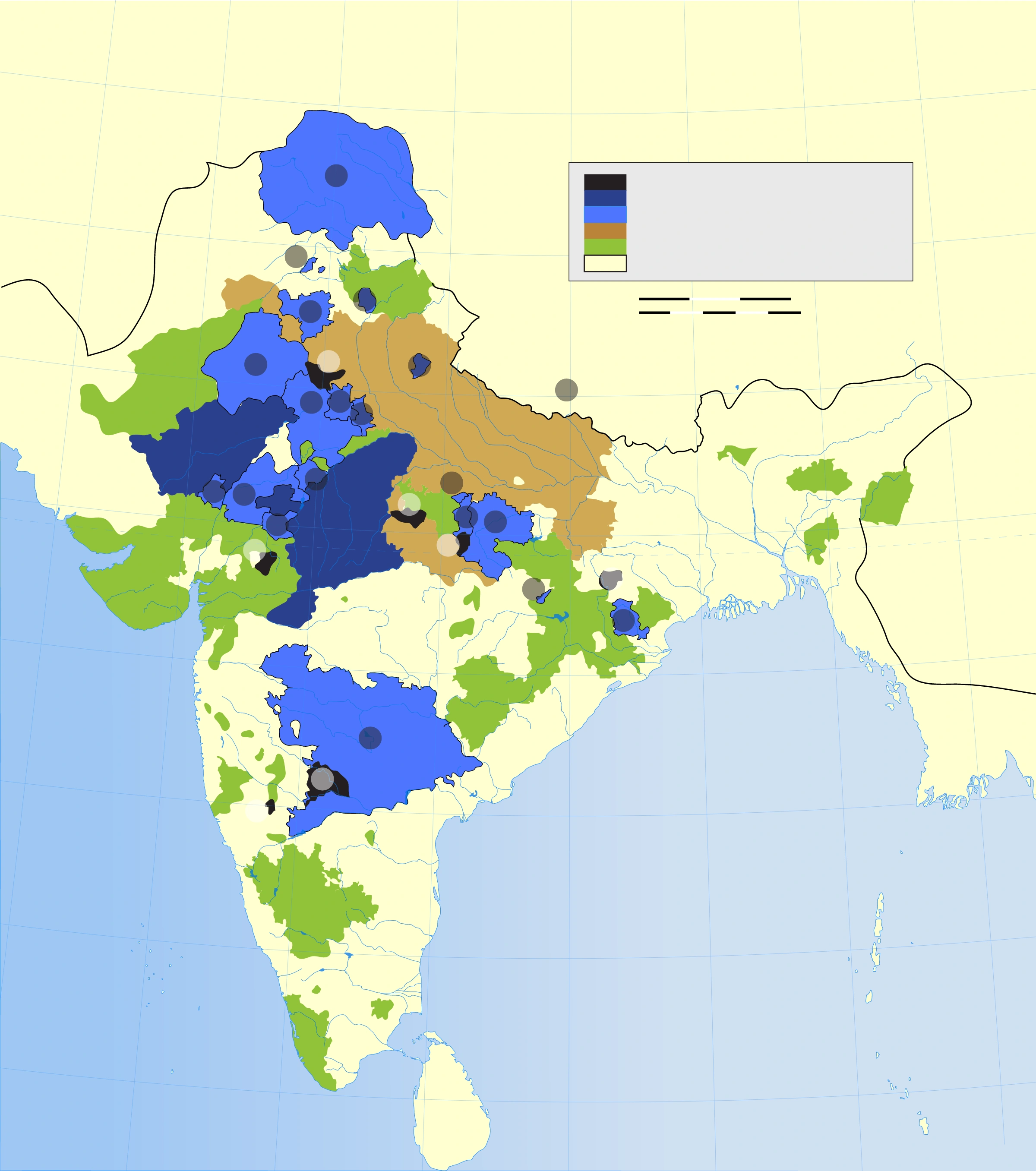
Map study
Princely state alignments during the 1857 uprising: compare regional participation through the legend. Not every battle or uprising centre is shown, and local participation was not uniform.
- Read the legend and reference date before interpreting regional patterns.
- Relate the map to the article’s topic; verify current administrative boundaries or data separately.
Credit: Planemad · CC BY-SA 3.0 · sourceConverted to WebP on an opaque white background; proportionally resized without cropping. Original cartography and legend retained.
1. End of colonial rule and establishment of sovereignty
The most direct consequence of the national movement was the termination of British rule. Political associations, constitutional agitation, revolutionary activity, mass satyagraha, labour and peasant struggles, and resistance within sections of the armed forces progressively weakened colonial legitimacy. Independence cannot, however, be attributed to one organisation or event alone. The Second World War exhausted Britain economically, altered international power relations and intensified the difficulty of governing India without Indian consent.
The Indian Independence Act, 1947 ended British authority and established India and Pakistan as independent Dominions. Dominion status did not mean that India remained a colony: legislative sovereignty passed to the new Dominion, while the British monarch temporarily remained the constitutional head, represented by a Governor-General. The Constituent Assembly also functioned as the Dominion legislature. The Government of India Act, 1935, with adaptations, provided an interim governmental framework.
The movement thus produced both a rupture and institutional continuity. Foreign political control ended, but administrative services, courts, police structures and many existing laws continued. Nationalist leaders used these inherited institutions while attempting to make them accountable to representative government. A recurring examination distinction is therefore between independence in 1947, constitutional adoption in 1949 and the establishment of the republic in 1950.
- Immediate political result: transfer of sovereign authority.
- Longer-term institutional result: replacement of colonial legitimacy with constitutional and electoral legitimacy.
Timeline
March 1931
Karachi Congress adopted a resolution linking Fundamental Rights with a national economic programme.
9 December 1946
Constituent Assembly met for the first time.
3 June 1947
Partition plan announced.
18 July 1947
Indian Independence Act received royal assent.
15–17 August 1947
India became independent on 15 August; Radcliffe boundary awards were published on 17 August.
26 November 1949–26 January 1950
Constitution adopted, followed by its general commencement and India's transition to a republic.
2. Partition, displacement and territorial consolidation
Independence coincided with Partition, the gravest human tragedy associated with the transfer of power. Communal polarisation, competing claims to political representation, the Muslim League's demand for Pakistan, the breakdown of constitutional negotiations and British decisions concerning withdrawal contributed to the division. Partition was not an inevitable expression of an unchanging religious divide, nor should it be explained through a single cause.
The 3 June Plan of 1947 accepted the partition of British India. Punjab and Bengal were divided, and the Radcliffe boundary awards were made public on 17 August 1947, after independence. Estimates vary, but roughly 14–18 million people crossed the new borders in the surrounding years. Massacres, abductions, sexual violence, dispossession and the separation of families created long-lasting social trauma. Refugee rehabilitation became an urgent responsibility involving housing, employment, property claims and the rebuilding of livelihoods.
Territorial consolidation presented a separate challenge. The lapse of British paramountcy did not automatically merge princely states into India or Pakistan. Sardar Vallabhbhai Patel and V. P. Menon played central roles in securing accessions and reorganising states. Instruments of Accession generally transferred authority over defence, external affairs and communications. Junagadh, Hyderabad and Jammu and Kashmir involved distinct disputes and responses. Integration strengthened the Union, while the Kashmir conflict helped shape enduring India–Pakistan tensions.
- Partition of British Indian provinces and integration of princely states were legally distinct processes.
- Political independence did not immediately resolve every territorial question; French and Portuguese possessions followed different trajectories.
From nationalist aspirations to constitutional government
- 1. Anti-colonial mobilisation challenges foreign rule
- 2. Rights and representative-government demands gain legitimacy
- 3. Independence transfers sovereign authority
- 4. Constitution establishes democratic institutions and citizenship rights
- 5. Elections and legislation pursue an unfinished reform agenda
3. Constitutional democracy and the expansion of citizenship
The freedom struggle helped establish representative government, civil liberties and popular sovereignty as central political expectations. Nationalists had repeatedly opposed arbitrary detention, censorship and racial discrimination. The Nehru Report of 1928 and the Karachi Congress resolution of 1931 anticipated important elements of the later constitutional settlement. Karachi linked political freedom with civil rights, religious neutrality, labour protection and economic justice.
The Constitution transformed these aspirations into enforceable Fundamental Rights, parliamentary institutions, an independent judiciary and a federal system with a strong Union. Equality before law, prohibitions on specified forms of discrimination, freedoms of expression and association, and constitutional remedies sought to replace colonial subjecthood with citizenship. Article 17 abolished untouchability. Directive Principles articulated social and economic goals, although they were not made judicially enforceable.
Universal adult franchise was particularly significant in a society marked by widespread poverty and illiteracy. Colonial electoral arrangements had restricted participation through qualifications such as property and education and had employed separate electorates. Independent India adopted a common electoral framework with reserved legislative seats for Scheduled Castes and Scheduled Tribes, not separate electorates for them. The first general elections were held in 1951–52. These outcomes drew on nationalist politics but also reflected autonomous anti-caste struggles, minority claims and B. R. Ambedkar's constitutional thought.
- Article 326 originally provided adult suffrage at age 21; the Sixty-first Constitutional Amendment later reduced it to 18.
- The word 'secular' entered the Preamble in 1976, but religious freedom and non-discriminatory citizenship were present in the original constitutional framework.
| Dimension | Achievement or change | Important qualification |
|---|---|---|
| Sovereignty | British rule ended in 1947 | Republic established only in 1950 |
| Territory | Partition and princely-state integration | Different legal and political processes |
| Citizenship | Universal adult franchise and Fundamental Rights | Social inequalities persisted |
| Economy | National control over development policy | Reconstruction required later laws and institutions |
| Administration | Indian democratic leadership | Substantial colonial institutional continuity |
4. Social mobilisation and an unfinished economic agenda
The movement widened political participation beyond the early educated elite. Peasants, workers, traders, students, women and many marginalised communities entered public life through campaigns, organisations and local struggles. Boycotts, processions, volunteer networks and constructive work created experience in collective action. Women such as Sarojini Naidu, Kamaladevi Chattopadhyay and Aruna Asaf Ali challenged the notion that political leadership belonged exclusively to men, although participation did not eliminate patriarchal inequalities.
Anti-colonial economic criticism also influenced post-independence priorities. Dadabhai Naoroji's drain theory and subsequent nationalist analyses connected Indian poverty with colonial extraction, revenue demands and unequal economic relations. Swadeshi encouraged indigenous enterprise and economic self-reliance. These arguments helped legitimise planning, industrialisation, infrastructure development and a substantial public-sector role after independence. The National Planning Committee, established in 1938, illustrates that discussions of reconstruction preceded the transfer of power.
These aspirations were contested. Gandhian emphasis on village industries differed from centralised industrial planning, while socialist and communist currents demanded more extensive redistribution. Abolition of intermediary tenures and other land reforms subsequently challenged agrarian hierarchies, but implementation varied considerably. Poverty, landlessness, caste oppression and gender inequality persisted. Independence therefore created political opportunities for transformation rather than automatically achieving social and economic equality.
- Political mobilisation broadened citizenship claims but did not produce equal participation everywhere.
- The Planning Commission, established in 1950, was a post-independence institution, not an organisation of the colonial-period movement.
5. International influence and limits of the nationalist legacy
India's freedom struggle contributed to the wider delegitimisation of imperialism. Its scale and its prominent use of non-violent mass action offered examples to movements elsewhere. Gandhian methods influenced leaders such as Martin Luther King Jr., although these methods were adapted to different political settings. India's independence also strengthened Asian and African expectations of sovereignty; it did not, by itself, cause every subsequent process of decolonisation.
Anti-imperialism, racial equality and international solidarity became important influences on Indian foreign policy. Independent India supported decolonisation and opposed apartheid. Its eventual policy of non-alignment sought autonomy in international decision-making rather than membership of either Cold War bloc. Non-alignment should not be confused with isolationism or passive neutrality: India participated in international institutions and took positions on major global issues.
The domestic legacy was similarly complex. The Congress emerged with extensive organisational networks and the prestige of the freedom struggle, contributing to its early electoral dominance. Yet the movement had contained liberals, socialists, revolutionaries, religious reformers and competing visions of nationhood. National unity therefore coexisted with ideological diversity. A balanced assessment recognises sovereign democracy as a major achievement while treating communal conflict, unequal social power and inherited coercive institutions as unresolved challenges.
- For examination purposes, separate direct outcomes, inherited institutions and policies developed after independence.
Real-world case studies
Faridabad: rehabilitation after Partition
Faridabad was established in 1949 as a rehabilitation township for displaced people from Pakistan. Housing and employment-oriented reconstruction illustrate how Partition transformed independence into an immediate challenge of welfare, urban planning and livelihood creation.
Hyderabad: integration after independence
Hyderabad did not accede to India in August 1947. Following failed negotiations and escalating conflict, Indian military action, known as Operation Polo, brought it under Indian control in September 1948. The episode, accompanied by serious communal violence, demonstrates that integration was not uniformly peaceful or completed on independence day.
Previous year questions
No source-linked PYQ is available here yet. Use the practice questions below.
Practice questions
Practice MCQ 1
Consider the following statements: 1. India became a republic on 15 August 1947. 2. The Indian Independence Act provided for the lapse of British paramountcy over princely states. 3. The Constituent Assembly also performed legislative functions after independence. Which statements are correct?
- A. 1 and 2 only
- B. 2 and 3 only
- C. 1 and 3 only
- D. 1, 2 and 3
Practice MCQ 2
Which Congress session adopted the 1931 resolution linking Fundamental Rights with an economic programme?
- A. Lahore
- B. Lucknow
- C. Karachi
- D. Haripura
Practice MCQ 3
Which statement best describes the constitutional electoral settlement after independence?
- A. Property qualifications were retained for parliamentary voting.
- B. Separate electorates were established for Scheduled Castes.
- C. Voting rights were restricted to literate citizens.
- D. Adult suffrage accompanied reserved seats for Scheduled Castes and Scheduled Tribes.
Mains practice · The Indian national movement achieved political emancipation but left an unfinished agenda of social and economic transformation. Discuss. Answer in 250 words.
- Explain sovereignty, constitutional democracy and universal adult franchise.
- Connect Karachi's rights programme with constitutional commitments.
- Assess Partition, rehabilitation and territorial consolidation.
- Examine persistent caste, gender and agrarian inequalities.
- Distinguish nationalist aspirations from subsequent policy implementation.
- Conclude that independence enabled, but did not complete, transformation.
Further reading
- NCERT, Themes in Indian History, Part III: Mahatma Gandhi and the Nationalist Movement; Framing the Constitution.
- Bipan Chandra and others, India's Struggle for Independence.
- Bipan Chandra, Mridula Mukherjee and Aditya Mukherjee, India Since Independence.
- Legislative Department, Government of India: Constitution of India.
- UK legislation website: Indian Independence Act, 1947.
- Parliament Digital Library: Constituent Assembly Debates.
Preparing for UPSC Civil Services? Get classroom teaching, answer-writing evaluation and mentorship at Pragnya IAS Academy, Ashok Nagar — see why aspirants choose us for IAS coaching in Hyderabad.