
Map study
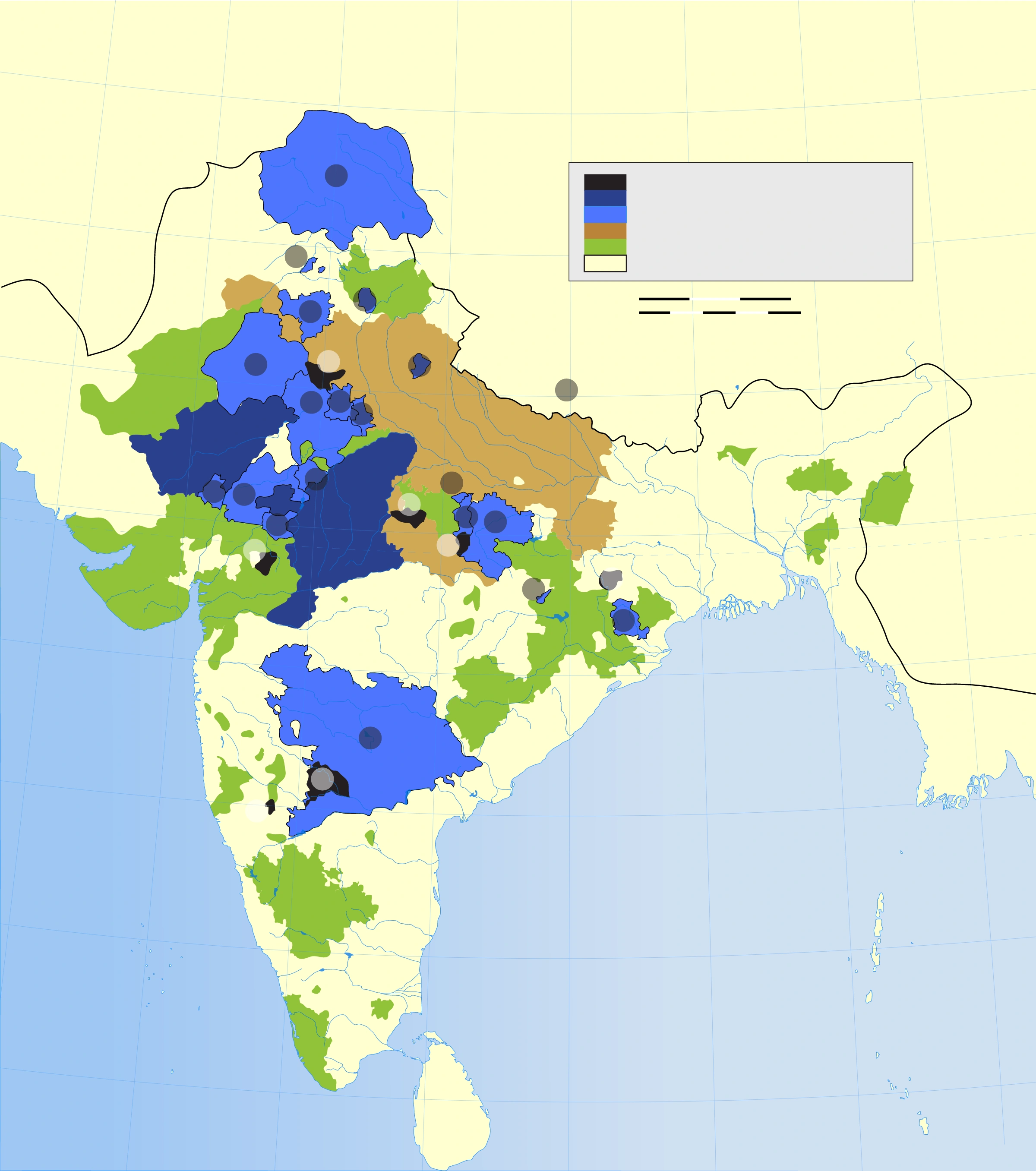
Princely state alignments during the 1857 uprising: compare regional participation through the legend. Not every battle or uprising centre is shown, and local participation was not uniform.
- Read the legend and reference date before interpreting regional patterns.
- Relate the map to the article’s topic; verify current administrative boundaries or data separately.
Credit: Planemad · CC BY-SA 3.0 · sourceConverted to WebP on an opaque white background; proportionally resized without cropping. Original cartography and legend retained.
1. Mapping the movement: early political centres
Centres of nationalism were not simply places where famous leaders lived. Presidency capitals provided newspapers, colleges, professional associations and political meeting spaces; district towns connected these networks with peasants, workers and traders. A location could also acquire different roles across successive phases. Bombay, for example, hosted the first Congress session, became a major labour centre and witnessed the launch of Quit India.
In Bengal, Calcutta was associated with Surendranath Banerjea and Ananda Mohan Bose, who founded the Indian Association in 1876. The Indian National Conference met there in 1883, before the establishment of Congress. Bombay’s political leadership included Dadabhai Naoroji, Pherozeshah Mehta and K. T. Telang. The Bombay Presidency Association was formed in 1885; Congress first assembled that December at Gokuldas Tejpal Sanskrit College.
Poona was a major centre of political education and public debate. Mahadev Govind Ranade was closely associated with the Poona Sarvajanik Sabha, founded in 1870. Gopal Krishna Gokhale established the Servants of India Society at Poona in 1905. In Madras, G. Subramania Iyer, P. Ananda Charlu and M. Viraraghavachari helped establish the Madras Mahajana Sabha in 1884. These associations articulated demands concerning representation, expenditure, civil services and administrative accountability.
- Keep historical and present-day names together: Bombay–Mumbai, Calcutta–Kolkata, Poona–Pune and Madras–Chennai.
- Congress session president, local organiser and movement leader are distinct categories; they should not be treated as interchangeable.
Timeline
1885
First Congress session at Bombay, presided over by W. C. Bonnerjee.
1905–1908
Swadeshi mobilisation spread from Bengal to centres including Poona, Punjab and Tuticorin.
1917–1918
Champaran, Ahmedabad and Kheda established Gandhi’s early Indian campaign network.
1930
Salt campaigns at Dandi and Vedaranyam; revolutionary armoury raid at Chittagong.
1942–1946
Quit India, underground resistance, parallel governments, INA trials and the naval uprising marked the final phase.
2. Swadeshi, assertive nationalism and Home Rule
The partition of Bengal took effect on 16 October 1905 and made Bengal the principal centre of the Swadeshi and boycott movement. Calcutta connected public meetings, nationalist newspapers, indigenous enterprise and national education. Surendranath Banerjea, Bipin Chandra Pal and Aurobindo Ghose were important leaders. Rabindranath Tagore supported public mobilisation through songs and symbolic observances. At Barisal, now in Bangladesh, Ashwini Kumar Dutta’s Swadesh Bandhab Samiti developed an influential local organisational network.
Outside Bengal, Bal Gangadhar Tilak mobilised opinion from Poona through Kesari and the Mahratta, public festivals and political campaigns. Lala Lajpat Rai and Ajit Singh were prominent in Punjab, where agrarian grievances contributed to agitation in 1907. In southern India, V. O. Chidambaram Pillai promoted the Swadeshi Steam Navigation Company at Tuticorin in 1906; Subramania Siva worked alongside him in political mobilisation. Tuticorin also witnessed the Coral Mills labour struggle in 1908.
The Home Rule movement created two overlapping but organisationally separate networks in 1916. Tilak’s league operated principally in Maharashtra, excluding Bombay city, Karnataka, the Central Provinces and Berar. Annie Besant’s league covered much of the remaining country, with Madras and Adyar as important centres. Their territorial division is more useful for examination purposes than assuming that both leagues worked everywhere. The Lucknow Congress of 1916 reunited the Congress factions and endorsed the Congress–Muslim League agreement.
- Lal–Bal–Pal refers to Lala Lajpat Rai, Bal Gangadhar Tilak and Bipin Chandra Pal.
- Barisal and Chittagong lie in present-day Bangladesh; Lahore lies in Pakistan.
How to identify a centre–leader pair
- 1. Locate the place on a historical and present-day map
- 2. Identify the movement and year
- 3. Separate national leadership from local organisation
- 4. Connect the place with its distinctive grievance or action
- 5. Check nearby centres and similar events for possible confusion
3. Gandhian centres: from local grievances to national campaigns
Gandhi’s early campaigns established a distinctive relationship between local grievances and national politics. At Champaran in Bihar in 1917, indigo cultivators challenged oppressive plantation arrangements, including tinkathia. Raj Kumar Shukla brought the issue to Gandhi’s attention; Rajendra Prasad, Brajkishore Prasad and other local workers supported the campaign. Ahmedabad’s 1918 textile mill dispute involved Gandhi and Anasuya Sarabhai, while Kheda’s revenue struggle that year brought Gandhi and Vallabhbhai Patel into close collaboration.
Non-Cooperation widened the movement’s geography after 1920. In Awadh, Baba Ramchandra and the Oudh Kisan Sabha mobilised peasants against excessive demands and oppressive landlord practices; Jawaharlal Nehru engaged with these struggles. Chauri Chaura in Gorakhpur district became nationally significant after protesters killed policemen in February 1922, prompting Gandhi to suspend the mass campaign. It was a turning point, not a Congress session venue.
Bardoli in Gujarat became associated with Vallabhbhai Patel’s successful 1928 campaign against enhanced land revenue. Civil Disobedience began with Gandhi’s march from Sabarmati Ashram to Dandi, where he broke the salt law on 6 April 1930. C. Rajagopalachari led a corresponding march to Vedaranyam in the Madras Presidency. At Dharasana, Abbas Tyabji and subsequently Sarojini Naidu provided leadership after Gandhi’s arrest. In the North-West Frontier Province, Khan Abdul Ghaffar Khan’s Khudai Khidmatgars made Peshawar an important centre of non-violent resistance.
- Distinguish Ahmedabad’s industrial dispute from Kheda’s agrarian revenue campaign, although both occurred in 1918.
- Dandi, Dharasana and Vedaranyam were separate locations within the wider salt campaign.
| Centre and year | President | Distinguishing feature |
|---|---|---|
| Calcutta, 1906 | Dadabhai Naoroji | Swaraj articulated as the Congress goal |
| Surat, 1907 | Rash Behari Ghosh | Split between Moderates and Extremists |
| Lucknow, 1916 | Ambica Charan Mazumdar | Congress reunion and Congress–League pact |
| Belgaum, 1924 | M. K. Gandhi | Only Congress session presided over by Gandhi |
| Lahore, 1929 | Jawaharlal Nehru | Purna Swaraj resolution |
| Karachi, 1931 | Vallabhbhai Patel | Resolution on fundamental rights and national economic programme |
4. Revolutionary networks and overseas centres
Revolutionary nationalism developed through mobile networks rather than isolated regional organisations. Bengal’s Anushilan Samiti and Jugantar groups connected Calcutta with district centres. Muzaffarpur in Bihar was the site of the 1908 attack by Khudiram Bose and Prafulla Chaki targeting magistrate Douglas Kingsford; the attack instead killed two British women. The Alipore conspiracy trial in Calcutta involved Aurobindo Ghose, who was acquitted, and several other revolutionaries.
In northern India, the Hindustan Republican Association organised the Kakori train action near Lucknow in 1925. Ram Prasad Bismil, Ashfaqulla Khan, Rajendra Lahiri and Roshan Singh were executed following the case. The Hindustan Socialist Republican Association emerged in 1928. Bhagat Singh and Batukeshwar Dutt threw bombs in the Central Legislative Assembly in Delhi in April 1929, while Bhagat Singh, Rajguru and Sukhdev were executed at Lahore in March 1931. At Chittagong, Surya Sen led the armoury raid of April 1930; Kalpana Dutt and Pritilata Waddedar were important participants in the wider revolutionary movement.
Overseas, Shyamji Krishna Varma founded India House in London in 1905; V. D. Savarkar became closely associated with it. The Ghadar movement developed among Indian migrants in North America in 1913, with San Francisco as its headquarters and Sohan Singh Bhakna and Lala Har Dayal as key figures. During the Second World War, Singapore became central to the Indian National Army, initially organised under Mohan Singh and later reorganised under Subhas Chandra Bose.
- Separate the place of an action from the place of a trial or execution.
- The INA trials took place at Delhi’s Red Fort, not at its Southeast Asian organisational centres.
5. Quit India and the final phase
The All India Congress Committee adopted the Quit India resolution at Bombay’s Gowalia Tank Maidan on 8 August 1942. The arrest of senior leaders encouraged decentralised resistance. Aruna Asaf Ali became associated with hoisting the Congress flag at the venue, while Usha Mehta helped operate the underground Congress Radio in Bombay. Jayaprakash Narayan and Ram Manohar Lohia were prominent in underground activity.
Parallel governments provide particularly important centre–leader pairs. Ballia in the United Provinces was associated with Chittu Pandey and a short-lived administration. The Tamralipta Jatiya Sarkar at Tamluk in Bengal involved Satish Chandra Samanta, Sushil Kumar Dhara and Ajoy Mukherjee. Satara in Maharashtra developed the Prati Sarkar associated with Nana Patil. These were locally rooted experiments, not a single centrally administered alternative government.
Women’s participation extended beyond prominent national figures. Matangini Hazra was killed while leading a procession at Tamluk in September 1942, and Kanaklata Barua was killed during a flag procession at Gohpur in Assam. In the final phase, the Royal Indian Navy ratings’ uprising began in Bombay in February 1946 and spread to other naval establishments, including Karachi. Such developments demonstrate why the movement’s geography must include workers, service personnel and local organisers alongside Congress leadership.
- For revision, build linked entries: place, present-day state or country, year, leader and distinguishing event.
- Avoid reducing an entire province to one leader: overlapping political, social and revolutionary networks were common.
Real-world case studies
Bardoli: local organisation and national recognition
In 1928, cultivators in Bardoli resisted an enhanced revenue assessment under Vallabhbhai Patel’s leadership. Organised non-payment, village coordination and social solidarity sustained the campaign. Its success strengthened Patel’s national standing and illustrates how a specific fiscal grievance could generate wider political mobilisation.
Tamluk: resistance with administrative functions
The Tamralipta Jatiya Sarkar, established in December 1942, continued until 1944. Alongside resistance, it undertook relief and local administrative activities. Its duration and organisation distinguish it from the brief parallel government at Ballia.
Previous year questions
UPSC Prelims 2021
Shah Nawaz Khan, Prem Kumar Sehgal and Gurbaksh Singh Dhillon are remembered as:
- A. Leaders of the Swadeshi and Boycott Movement
- B. Members of the Interim Government formed in 1946
- C. Members of the Constituent Assembly’s Drafting Committee
- D. Officers of the Indian National Army
Practice questions
Practice MCQ 1
Consider the following pairs: 1. Barisal — Ashwini Kumar Dutta; 2. Vedaranyam — C. Rajagopalachari; 3. Ballia — Nana Patil. Which pairs are correctly matched?
- A. 1 and 2 only
- B. 2 and 3 only
- C. 1 and 3 only
- D. 1, 2 and 3
Practice MCQ 2
Which is the correct chronological sequence of these events?
- A. Champaran campaign → Kakori action → Bardoli campaign → Chittagong armoury raid
- B. Kakori action → Champaran campaign → Chittagong armoury raid → Bardoli campaign
- C. Champaran campaign → Bardoli campaign → Kakori action → Chittagong armoury raid
- D. Bardoli campaign → Champaran campaign → Kakori action → Chittagong armoury raid
Practice MCQ 3
With reference to overseas centres of Indian nationalism, consider these statements: 1. India House in London was founded by Shyamji Krishna Varma. 2. San Francisco was a headquarters of the Ghadar movement. 3. The first INA was organised under Subhas Chandra Bose in London. Which statements are correct?
- A. 1 only
- B. 1 and 2 only
- C. 2 and 3 only
- D. 1, 2 and 3
Mains practice · The expansion of India’s national movement involved both geographical diffusion and diversification of leadership. Discuss with examples from 1905 to 1942. Answer in 250 words.
- Begin with Swadeshi’s Bengal base and its expansion to Punjab, Maharashtra and southern India.
- Explain how Gandhian campaigns connected local agrarian and industrial grievances with national demands.
- Include revolutionary, overseas and frontier networks.
- Discuss women, peasants, workers and local organisers rather than only prominent national leaders.
- Use Quit India’s underground networks and parallel governments to illustrate decentralisation.
- Conclude that shared nationalist objectives coexisted with regional diversity in methods and leadership.
Further reading
- NCERT, Our Pasts–III: The Making of the National Movement, 1870s–1947.
- NCERT, Themes in Indian History, Part III: Mahatma Gandhi and the Nationalist Movement.
- Bipan Chandra and others, India’s Struggle for Independence.
- Ministry of Culture, Amrit Mahotsav portal: regional freedom-struggle histories.
- National Archives of India: Abhilekh Patal digital records.
Preparing for UPSC Civil Services? Get classroom teaching, answer-writing evaluation and mentorship at Pragnya IAS Academy, Ashok Nagar — see why aspirants choose us for IAS coaching in Hyderabad.