

Eran, Varaha und Garuda-Säule
Credit: ArnoldBetten · Public domain · source

The Yashodharman vijayastambha site, also called the Mandsaur victory pillar site or Sondhni pillar site, has 6th-century pillars and ruins from a lost Hindu temple. The pillars have an Aulikara era i
Credit: Ms Sarah Welch · CC0 · source
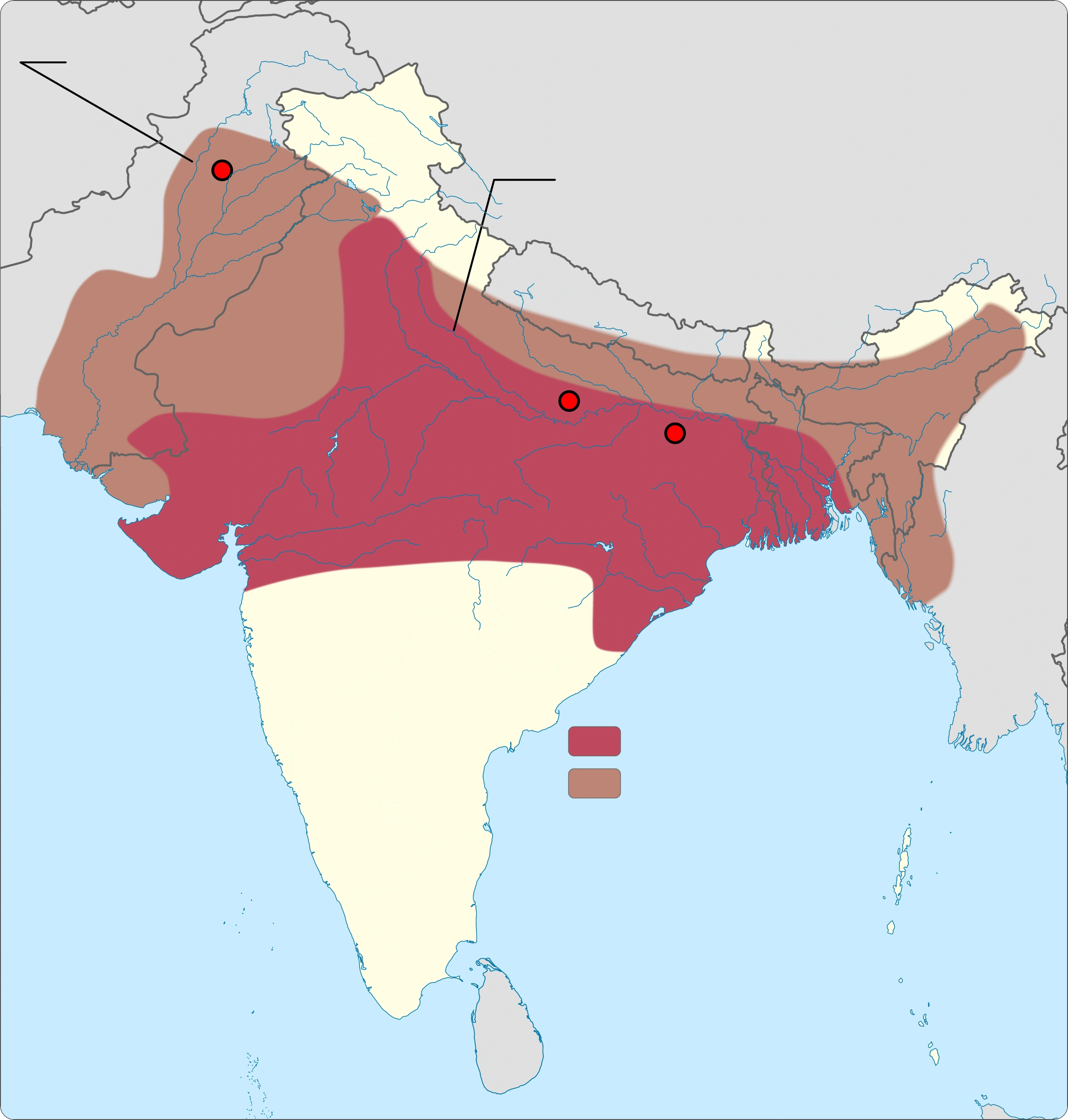
Map study
Gupta Empire and tributaries: use the legend to distinguish direct rule from tributary relationships.
- Read the source date and legend before interpreting territorial extent.
- Compare core regions, neighbouring powers and geographic barriers; historical borders and influence are approximate and changed over time.
Credit: Goran tek-en · CC BY-SA 4.0 · sourceConverted to WebP on an opaque white background; proportionally resized without cropping. Original cartography and legend retained.
1. Nature and chronology of the decline
Gupta decline was a process of territorial contraction and political fragmentation extending from the later fifth into the sixth century CE. The empire had integrated much of northern India through conquest, tribute, alliances and provincial administration. However, its control was never equally direct everywhere. When the imperial centre weakened, tributary chiefs and provincial authorities could retain resources locally and assert independence. Decline therefore means the erosion of imperial supremacy, not the immediate disappearance of every Gupta ruler or institution.
Kumaragupta I’s reign, approximately 415–455 CE, was followed by military and succession pressures. Skandagupta restored royal fortunes and checked hostile forces, including the Hunas. His achievements demonstrate that Gupta power remained formidable in the mid-fifth century. They also indicate that maintaining the empire required substantial military effort. References to the Pushyamitras in discussions of his campaigns require caution because the relevant reading and identification have been debated.
After Skandagupta’s death around 467 CE, the succession becomes difficult to reconstruct. Purugupta, Kumaragupta II, Budhagupta, Narasimhagupta and other rulers are known from inscriptions, seals and coins, but their exact relationships and territorial authority are not always clear. Budhagupta’s records show that Gupta authority still extended across important areas during approximately 476–495 CE. Vishnugupta is among the last known imperial Guptas, ruling into the mid-sixth century. A single universally accepted terminal date is therefore misleading.
Timeline
Approximately 455–467 CE
Skandagupta restores imperial fortunes and resists Huna pressure.
Approximately 476–495 CE
Budhagupta’s inscriptions attest continuing authority across substantial territories.
Around 500 CE
Toramana’s expansion reaches central India; his authority is attested at Eran.
510 CE
Bhanugupta’s Eran inscription records Goparaja’s death in battle.
Approximately 532 CE
Yashodharman’s Mandsaur pillars proclaim victories, including Mihirakula’s submission.
Mid-sixth century CE
Gupta imperial supremacy largely disappears; regional kingdoms dominate.
2. Political and military causes
Succession uncertainty weakened the continuity of central authority. Genealogies do not supply a simple, uncontested sequence after Kumaragupta I, and the existence of different royal branches suggests competition within the dynasty. However, incomplete evidence should not be converted into a detailed narrative of continuous civil war. The secure conclusion is that later emperors were less able to maintain the political cohesion achieved by their predecessors.
Huna incursions intensified these weaknesses. The groups entering India are generally associated with the Alchon Hunas; treating every Central Asian Huna group as identical obscures important distinctions. Skandagupta checked an earlier assault, but renewed expansion under Toramana affected northwestern and central India around the beginning of the sixth century. Toramana’s inscription on the colossal boar at Eran in present-day Madhya Pradesh provides direct evidence of his authority there.
Mihirakula succeeded Toramana and is associated with further conflict in northern India. His Gwalior inscription documents his rule, while later Buddhist accounts portray him as a persecutor. Such literary descriptions need comparison with contemporary evidence. Yashodharman of Malwa claimed Mihirakula’s submission around 532 CE. Xuanzang’s later account also credits a ruler named Baladitya of Magadha with defeating him, but its chronology and details remain debated.
The Hunas were thus an important accelerator, not a complete explanation. The Guptas had resisted them successfully earlier, and defeating Huna rulers did not restore Gupta imperial unity. Regional powers inherited the political advantages created by warfare and the weakening of the imperial centre.
Interacting mechanisms of fragmentation
- 1. Succession uncertainty and external military pressure
- 2. Costly warfare and loss of effective territorial control
- 3. Reduced central access to revenue and local resources
- 4. Stronger provincial rulers and regional elites
- 5. Independent kingdoms replace Gupta paramountcy
3. Fiscal pressures, land grants and regional autonomy
Sustained warfare and the loss of productive territories probably reduced resources available to the imperial centre. Frontier defence, armies and provincial administration required revenue. Yet no surviving empire-wide budget allows the financial burden to be measured precisely. Changes in gold coin weight, fineness and circulation must also be examined issue by issue; a simple claim that all later Gupta coins became progressively lighter or worthless is inaccurate.
Land grants to religious beneficiaries expanded during the Gupta and post-Gupta periods. Some transferred revenue rights and granted exemptions from particular taxes or official interference. Such arrangements could reduce the centre’s immediate access to local revenue and strengthen intermediaries. Nevertheless, grants could also encourage cultivation, consolidate authority in frontier areas and integrate local elites. They were not merely gifts that automatically destroyed the state.
Historians have linked these changes to the development of early medieval landed hierarchies, sometimes using the framework of Indian feudalism. The extent of urban decline, commercial contraction and dependence on land remains debated and varied regionally. Damodarpur copper plates from Bengal reveal functioning administration, land transactions and local participation rather than an economy that had simply ceased to operate.
Political fragmentation became clearer as provincial and regional ruling houses consolidated power. The Maitrakas established themselves at Valabhi in Gujarat, while the Aulikaras rose in Malwa. The Maukharis became prominent around Kannauj, and the Later Guptas competed for authority in eastern parts of northern India. The term samanta increasingly denoted subordinate rulers, but the fully developed arrangements of later centuries should not be projected uniformly onto Gupta administration.
| Source | Association | Historical significance |
|---|---|---|
| Bhitari pillar inscription | Skandagupta; Uttar Pradesh | Dynastic restoration and conflict with Hunas |
| Junagadh inscription | Skandagupta; Gujarat | Provincial government and reservoir repair |
| Eran boar inscription | Toramana; Madhya Pradesh | Huna authority in central India |
| Eran inscription of 510 CE | Bhanugupta and Goparaja | Battle with an unnamed opponent; early inscriptional evidence of sati |
| Mandsaur pillar inscriptions | Yashodharman; Madhya Pradesh | Regional ascendancy and claimed submission of Mihirakula |
4. Evidence and its limits
Inscriptions provide the firmest chronological anchors, but royal eulogies exaggerate victories and universal sovereignty. Skandagupta’s Bhitari inscription presents him as the restorer of dynastic fortunes. His Junagadh inscription records provincial administration and the repair of the Sudarshana reservoir under Parnadatta and his son Chakrapalita. Together, they show military pressure alongside continued administrative capacity, not inevitable collapse already completed during his reign.
The Eran inscription of Bhanugupta, dated to 510 CE, mentions a battle in which Goparaja died and records that his wife entered the funeral fire. It is an important early inscriptional attestation of sati, not proof that the practice originated then or was universal. Since the enemy is unnamed, describing this inscription alone as conclusive evidence of a Gupta defeat by Toramana goes beyond its wording.
Coins, seals, copper plates and archaeological remains help reconstruct changing authority and economic networks. Literary narratives, including Xuanzang’s seventh-century account and the much later Rajatarangini, preserve valuable traditions but cannot be treated as contemporary reports of every event. For examination purposes, distinguish directly attested facts from plausible historical interpretation.
5. Consequences and early medieval foundations
The disappearance of Gupta paramountcy produced several competing centres rather than an immediate replacement empire. Gujarat, Malwa, the middle Gangetic plain and Bengal followed different political trajectories. Competition among the Maukharis, Later Guptas and other powers formed part of the background to Harsha’s rise in 606 CE. Harsha’s kingdom was a new political formation, not a straightforward revival of Gupta rule.
Important continuities accompanied this fragmentation. Sanskrit political culture, Brahmanical patronage, Buddhist institutions, temple building and administrative terminology survived under regional dynasties. Landholding rights and relations between rulers, religious beneficiaries and local elites became increasingly important. The transition should therefore be understood as the regionalisation of political power and institutional change, not as a uniform dark age following a golden age.
- For Prelims, connect inscriptions with rulers and places rather than relying only on broad causes.
- Avoid monocausal explanations: invasion, succession problems, fiscal constraints and regional autonomy reinforced one another.
- Political decline does not automatically establish cultural decline or the disappearance of trade.
Real-world case studies
Valabhi: emergence of a regional centre
The Maitrakas established power at Valabhi from the late fifth century, beginning with Bhatarka, who bore the title senapati. Their subsequent consolidation illustrates how military leadership could develop into regional kingship. Valabhi later became an important political and educational centre.
Malwa: victory without imperial restoration
Yashodharman’s success against Mihirakula strengthened a regional ruler rather than the Gupta emperor. His own supremacy proved short-lived, showing that defeating an invading power did not automatically recreate a durable northern Indian empire.
Previous year questions
No source-linked PYQ is available here yet. Use the practice questions below.
Practice questions
Practice MCQ 1
Which inscription directly attests Toramana’s authority in central India?
- A. Allahabad pillar inscription of Samudragupta
- B. Eran boar inscription
- C. Aihole inscription of Pulakeshin II
- D. Junagadh inscription of Rudradaman
Practice MCQ 2
Consider the following statements: 1. Skandagupta resisted Huna incursions. 2. Bhanugupta’s Eran inscription explicitly names Toramana as the opposing ruler. 3. Yashodharman claimed the submission of Mihirakula. Which statements are correct?
- A. 1 and 2 only
- B. 2 and 3 only
- C. 1 and 3 only
- D. 1, 2 and 3
Practice MCQ 3
Which statement best explains the relationship between Gupta decline and land grants?
- A. Every grant transferred complete political sovereignty.
- B. Grants abolished agriculture-based revenue collection.
- C. Grants could strengthen local beneficiaries while also facilitating agrarian expansion.
- D. Grants prove that trade disappeared throughout India.
Mains practice · The decline of the Gupta Empire was a process of regionalisation rather than merely the result of Huna invasions. Discuss. Answer in 250 words.
- Explain the prolonged, geographically uneven erosion of imperial authority.
- Assess succession uncertainty and the military pressure of Toramana and Mihirakula.
- Discuss fiscal constraints and land grants without assuming uniform economic collapse.
- Illustrate regionalisation through Valabhi, Malwa and Kannauj.
- Use inscriptions critically, distinguishing claims from established facts.
- Conclude with political fragmentation alongside institutional and cultural continuity.
Further reading
- R. S. Sharma, Ancient India, old NCERT: Gupta administration and the transition to the early medieval period.
- Upinder Singh, A History of Ancient and Early Medieval India: chapters on the Gupta and post-Gupta periods.
- D. C. Sircar, Select Inscriptions Bearing on Indian History and Civilization, Volume I.
- Archaeological Survey of India, Corpus Inscriptionum Indicarum, Volume III: inscriptions of the early Gupta kings and their successors.
Preparing for UPSC Civil Services? Get classroom teaching, answer-writing evaluation and mentorship at Pragnya IAS Academy, Ashok Nagar — see why aspirants choose us for IAS coaching in Hyderabad.