
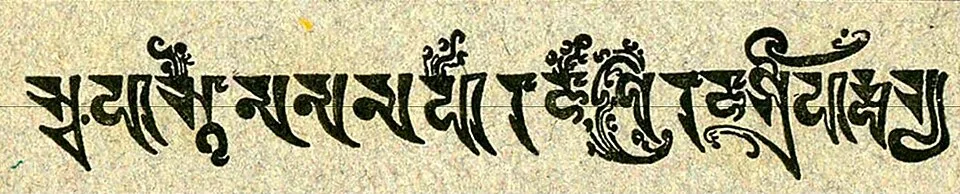
Harsha’s royal authentication formula, identified in the metadata as an extract from the Banskhera copper-plate inscription.
Credit: Emperor Harsha (Harshavardhan) · Public domain · sourceResized and converted to WebP; uncropped.
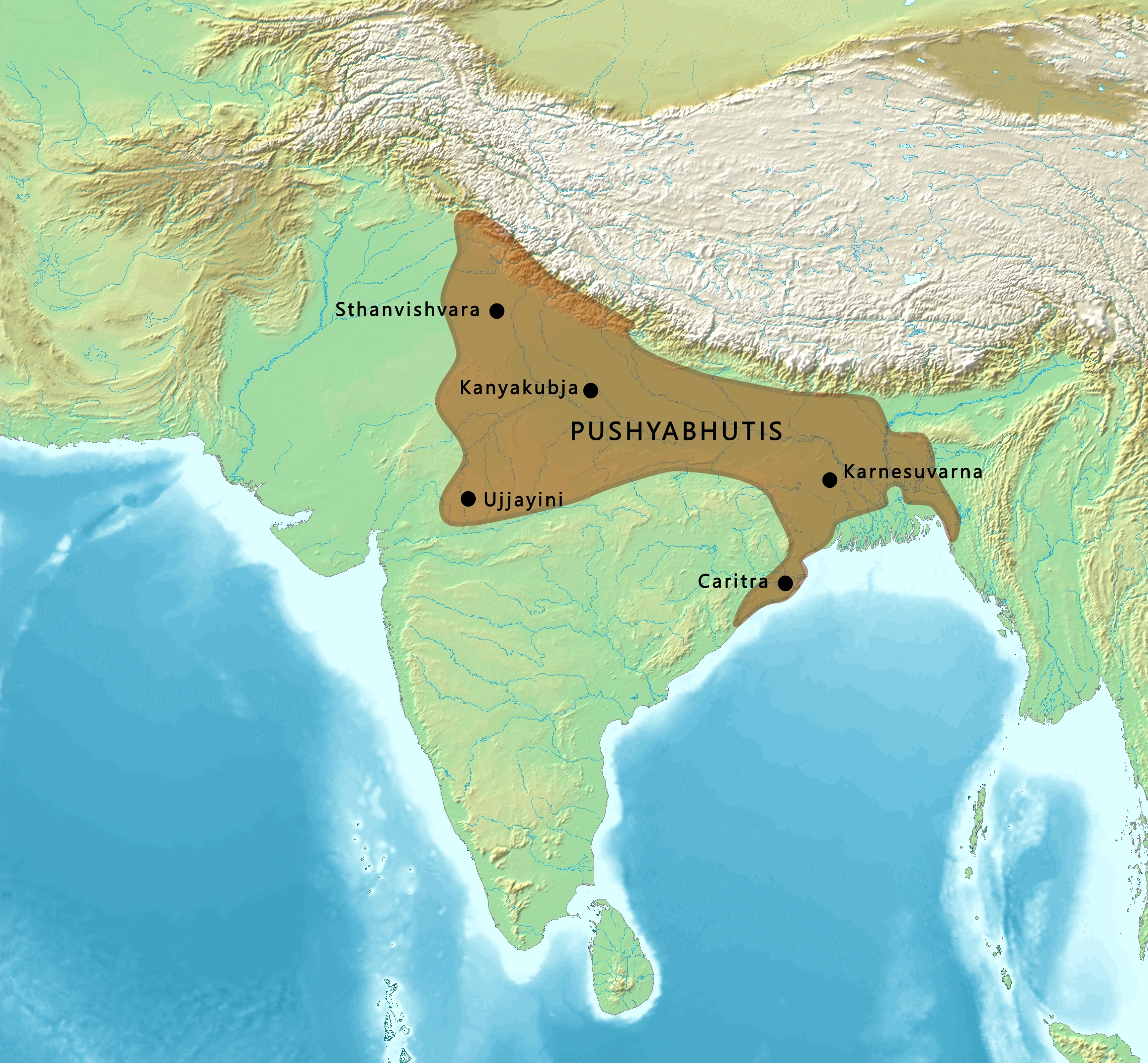
Map study
Pushyabhuti polity: regional context for Harsha; direct administration and political influence were not necessarily identical.
- Read the source date and legend; distinguish territory, influence and geographic location.
- Historical boundaries and reference memberships are not live political or operational data.
Credit: Koba-chan; DEMIS base map · CC BY-SA 3.0 · sourceConverted to WebP on an opaque white background; proportionally resized without cropping. Original cartography and legend retained.
1. Sources and historical setting
After Gupta imperial authority weakened, northern India contained several competing powers: the later Guptas, the Maukharis of Kannauj, the rulers of Gauda in Bengal, the Maitrakas of Valabhi and the Pushyabhutis of Thanesar. Harsha emerged within this multipolar setting. His reign did not recreate the Gupta Empire across the subcontinent; it established a powerful northern monarchy whose influence varied between directly administered territories and subordinate or allied states.
Banabhatta’s Harshacharita is an ornate Sanskrit court biography. It describes Harsha’s ancestry, family crises and early rise, but does not provide a complete chronological account of his reign. Its literary conventions and praise of the patron require careful interpretation. Bana’s Kadambari is a Sanskrit prose romance, not another historical biography of Harsha.
Xuanzang, also known as Hiuen Tsang, travelled in India approximately between 630 and 644 CE. His account offers information on political conditions, religious establishments, education and society. As a Buddhist pilgrim who received royal support, he paid particular attention to Buddhist institutions and Harsha’s generosity. The Banskhera grant of 628 CE and Madhuban grant of 631 CE supply more precise evidence about genealogy, administrative designations and land donations. These sources should be read together rather than treated as equally neutral descriptions.
- Harshacharita: courtly biography with historical material, not a modern objective history.
- Xuanzang’s account: especially valuable for religion, pilgrimage, Nalanda and royal assemblies.
- Copper plates and seals: evidence for titles, officials, territorial units and grants.
Timeline
Around 606 CE
Harsha succeeds Rajyavardhana at Thanesar amid the family and political crisis involving Kannauj.
628 CE
Banskhera copper-plate grant records a land donation under Harsha.
Around 630 CE
Pulakeshin II checks Harsha’s southern advance; the event is celebrated in the Aihole inscription of 634 CE.
631 CE
Madhuban copper-plate grant provides evidence of Harsha’s genealogy and administration.
Around 643 CE
Xuanzang participates in the major assemblies associated with Kannauj and Prayaga.
Around 647 CE
Harsha dies; his political formation does not survive under an effective successor.
2. Accession, expansion and the boundaries of power
Harsha’s father Prabhakaravardhana strengthened the position of Thanesar. His elder brother Rajyavardhana succeeded him, while their sister Rajyashri married the Maukhari ruler Grahavarman of Kannauj. A succession of crises followed: Devagupta of Malava killed Grahavarman, Rajyashri was imprisoned, and Rajyavardhana marched against the attackers. Rajyavardhana was subsequently killed in circumstances associated by the court tradition with Shashanka of Gauda. The hostile nature of this evidence warrants caution about the precise sequence and responsibility.
Harsha ascended the throne around 606 CE, conventionally at about sixteen years of age. He rescued Rajyashri from the Vindhya region and subsequently assumed authority over Kannauj. His association with both Thanesar and Kannauj gave him a strong position in the upper Gangetic plain. Kannauj became his principal royal centre and later remained a major focus of early medieval political competition.
Harsha allied with Bhaskaravarman of Kamarupa, in present-day Assam, against their common rival Shashanka. His authority eventually extended over much of northern India, but the status of individual regions differed and claims of universal conquest are exaggerated. Kamarupa was an ally rather than simply an annexed province. Harsha’s attempt to advance southward was checked by Pulakeshin II, probably around 630 CE. Ravikirti’s Aihole inscription, dated 634 CE, celebrates the Chalukya success. The Narmada is conventionally associated with the southern limit of Harsha’s expansion.
- Do not confuse Harsha’s northern predominance with control over the Deccan or far south.
- Gauda under Shashanka and Kamarupa under Bhaskaravarman were distinct political powers.
- The Aihole inscription belongs to Pulakeshin II’s political context, not to Harsha’s own court.
Formation and limits of Harsha’s power
- 1. Post-Gupta regional competition
- 2. Dynastic crisis at Thanesar and Kannauj
- 3. Harsha’s accession and acquisition of Kannauj
- 4. Northern expansion through warfare and alliances
- 5. Southern advance checked by Pulakeshin II
- 6. Political fragmentation after Harsha’s death
3. Administration, land grants and society
Harsha retained a monarchy supported by ministers, military officers and territorial administrators. Inscriptions refer to administrative units such as bhukti, vishaya and village. Officials included uparikas and vishayapatis, associated with provincial and district administration. Royal tours, reported by Xuanzang, helped the ruler inspect conditions and maintain contact with religious institutions and local authorities. Nevertheless, royal mobility did not imply a uniformly centralised bureaucracy.
The increasing importance of subordinate chiefs, often designated samantas, is central to understanding this period. Such chiefs could acknowledge royal supremacy while retaining local authority and supplying military assistance. Land grants to Brahmanas and religious establishments assigned specified revenue rights and privileges. This could alter the relationship between cultivators, local beneficiaries and the royal treasury. Historians connect these developments with early medieval political decentralisation, though the label 'Indian feudalism' remains an interpretative framework rather than an uncontested description.
Xuanzang describes relatively moderate revenue demands and mentions a one-sixth share of agricultural produce. Such statements should not be converted into a uniform tax rate for every locality. Agriculture underpinned the economy, while towns, pilgrimage centres and exchange networks remained important. Evidence of decline at some older urban sites coexisted with the prominence of centres such as Kannauj. Social life displayed caste distinctions and exclusion; Xuanzang’s descriptions of communities living outside settlements reveal inequalities alongside accounts of royal charity.
- Key terms: bhukti, vishaya, uparika, vishayapati and samanta.
- Land grants are evidence for revenue arrangements and social power, not merely royal generosity.
- Avoid treating Xuanzang’s observations as a statistical survey of the entire kingdom.
| Source | Association | Historical value and caution |
|---|---|---|
| Harshacharita | Banabhatta | Early career and court; incomplete and strongly eulogistic. |
| Xuanzang’s travel account | Chinese Buddhist pilgrim | Religion, education and society; shaped by pilgrimage interests. |
| Banskhera and Madhuban grants | Harsha’s administration | Dated records of grants, genealogy, officials and territorial units. |
| Aihole inscription, 634 CE | Ravikirti and Pulakeshin II | External evidence of conflict; celebrates the Chalukya patron. |
4. Religion, education and literary patronage
Harsha’s religious affiliations cannot be reduced to a simple choice between Hinduism and Buddhism. His inscriptions employ Shaiva language, while Xuanzang presents him as a major patron of Mahayana Buddhism. The royal family itself displayed different devotional preferences. Harsha supported Buddhist monks as well as Brahmanas and other religious beneficiaries, illustrating the overlapping religious patronage characteristic of many early Indian courts.
The Kannauj assembly, generally placed around 643 CE, prominently honoured Mahayana teaching and Xuanzang. It should be distinguished from the quinquennial charitable gathering at Prayaga, at the confluence of the Ganga and Yamuna. At Prayaga, Harsha distributed wealth to religious communities and the needy. Xuanzang’s description includes honour paid to the Buddha, Surya and Shiva, making the gathering important evidence for plural patronage rather than exclusive Buddhist identity.
Nalanda flourished as a major Buddhist centre of learning during this period, and Harsha supported it. However, he did not found Nalanda: its development preceded his reign. Xuanzang studied there under the scholar Shilabhadra. Sanskrit court culture also prospered. Bana enjoyed royal patronage, and three Sanskrit plays are traditionally attributed to Harsha: Priyadarsika and Ratnavali, both courtly romances, and Nagananda, which centres on Jimutavahana’s compassionate self-sacrifice. Traditional attribution should not be confused with certainty about every detail of composition.
- Kannauj: major religious assembly associated with Xuanzang and Mahayana Buddhism.
- Prayaga: periodic distribution of gifts with a broader religious and charitable character.
- Nalanda: supported by Harsha, but established before his reign.
5. Legacy and examination perspective
Harsha died around 647 CE without an effective successor capable of preserving his political formation. Northern India again witnessed competition among regional powers. This outcome highlights the importance of personal kingship, alliances and subordinate rulers in sustaining his supremacy. Calling him the 'last great Hindu emperor' is misleading: it obscures his Buddhist patronage, overlooks later powerful rulers and imposes a religious label on a complex political order.
Harsha’s reign is best understood as a transition rather than a sharp boundary between ancient and medieval India. It combined Sanskrit literary prestige and inherited administrative terminology with expanding land grants, influential regional chiefs and changing political geography. For Prelims, identify source–author pairs, distinguish Thanesar from Kannauj, and remember that Pulakeshin II checked Harsha rather than the reverse. For analytical answers, contrast the expansive language of court narratives with the more specific information in inscriptions.
- Bana wrote Harshacharita; Harsha is traditionally associated with three plays.
- Xuanzang visited during Harsha’s reign; Faxian visited India earlier, during the Gupta period.
- Kannauj’s later tripartite struggle involved the Palas, Gurjara-Pratiharas and Rashtrakutas, not Harsha.
Harsha: Royal Authority and Copper-Plate Evidence
The supplied metadata identifies this image as Harsha’s signature from the Banskhera copper-plate inscription. Its quoted Sanskrit formula, beginning with svahasto mama, invokes the ruler’s own hand and uses the imperial title maharajadhiraja. This makes the image directly relevant to how Harsha’s authority was expressed and authenticated in documentary records. However, a reproduced extract and its catalogue description alone cannot establish whether the surviving lettering was personally incised by the king; royal authentication and the physical engraving of a charter are distinct acts.
Copper-plate grants provide evidence for land donations, beneficiaries, administrative arrangements and royal titulature in early seventh-century northern India. Read alongside Banabhatta’s Harshacharita and Xuanzang’s account, they help distinguish formal claims of sovereignty from the practical exercise of power. An imperial title does not prove uniform control over every region, just as a religious donation does not by itself establish an exclusive religious identity. For Harsha, such records illuminate the post-Gupta foundations of early medieval governance, but conclusions about wider economic change require comparison across multiple grants rather than reliance on one signature.
- Source criticism: Inscriptions are documentary evidence, but their praise formulas and claims of legitimacy still require critical interpretation.
- Prelims distinction: Sanskrit is a language, not a script; the metadata’s tentative Nagari identification should not be treated as settled palaeography.
- Mains application: Use grants to analyse authority, patronage and intermediaries; avoid treating every land donation as automatic proof of a single, uniform feudal system.
Real-world case studies
Banskhera grant: administration beyond courtly praise
The copper plate dated to Harsha’s year 22, corresponding to 628 CE, records a village grant to Brahmanas and preserves his sign-manual. Its official designations and instructions about revenue rights allow historians to examine how royal decisions affected local administration. Unlike a literary claim of universal conquest, it provides specific, geographically grounded evidence.
Aihole inscription: reading a rival’s victory claim
Ravikirti’s inscription at the Meguti Jain temple in Aihole, Karnataka, praises Pulakeshin II and celebrates his success against Harsha. It demonstrates why a ruler’s history cannot be reconstructed solely from his own court literature. However, as a Chalukya eulogy, it too requires critical reading.
Previous year questions
No source-linked PYQ is available here yet. Use the practice questions below.
Practice questions
Practice MCQ 1
Consider the following pairs: 1. Harshacharita — Banabhatta; 2. Aihole inscription of 634 CE — Ravikirti; 3. Ratnavali — Xuanzang. How many pairs are correctly matched?
- A. Only one
- B. Only two
- C. All three
- D. None
Practice MCQ 2
With reference to Harsha’s political relations, consider the following statements: 1. Bhaskaravarman of Kamarupa was his ally. 2. Pulakeshin II checked his southern expansion. 3. His empire directly administered the entire Indian peninsula. Which statements are correct?
- A. 1 and 2 only
- B. 2 and 3 only
- C. 1 and 3 only
- D. 1, 2 and 3
Practice MCQ 3
Which statement best describes religion and education during Harsha’s reign?
- A. Harsha founded Nalanda and prohibited Brahmanical worship.
- B. Faxian presided over Harsha’s Kannauj assembly.
- C. Harsha supported Buddhism while also extending patronage to other religious beneficiaries.
- D. The Prayaga gathering was exclusively a military council.
Mains practice · Harsha’s reign illustrates both the possibilities and limitations of political consolidation in post-Gupta northern India. Discuss with reference to the available sources. Answer in 250 words.
- Explain the post-Gupta setting and the significance of Thanesar and Kannauj.
- Discuss expansion, the Kamarupa alliance and the challenge from Gauda.
- Use the conflict with Pulakeshin II to identify geographical limits.
- Examine administration, samantas and land grants without assuming uniform decentralisation.
- Compare Bana and Xuanzang with copper plates and the Aihole inscription.
- Conclude with the fragility of consolidation after 647 CE and its early medieval continuities.
Further reading
- NCERT, Our Pasts–I, chapter: New Empires and Kingdoms.
- R. S. Sharma, India’s Ancient Past, Oxford University Press.
- Upinder Singh, A History of Ancient and Early Medieval India, Pearson.
- Banabhatta, The Harshacharita, translated by E. B. Cowell and F. W. Thomas.
- Archaeological Survey of India, Epigraphia Indica, editions of the Banskhera, Madhuban and Aihole inscriptions.
- https://commons.wikimedia.org/wiki/File:Signature_of_Emperor_Harsha_(Harshavardhana_of_the_Pushyabhuti_Dynasty,_reign_606-647_C.E.).jpg
Preparing for UPSC Civil Services? Get classroom teaching, answer-writing evaluation and mentorship at Pragnya IAS Academy, Ashok Nagar — see why aspirants choose us for IAS coaching in Hyderabad.