

Nadir Shah on the Peacock Throne after his defeat of Muhammad Shah. Media & Support: Opaque watercolor on paper Display Dimensions: 12 1/8 in. x 16 9/16 in. (30.8 cm x 42.1 cm) Credit Line: Edwin Bin
Credit: AnonymousUnknown author · Public domain · source

This file has been provided by the British Library from its digital collections. Links to the British Library's website may be broken as the library recovers from a October 2023 cyber attack, and will
Credit: Sir Thomas Metcalfe, 4th Baronet · Public domain · source
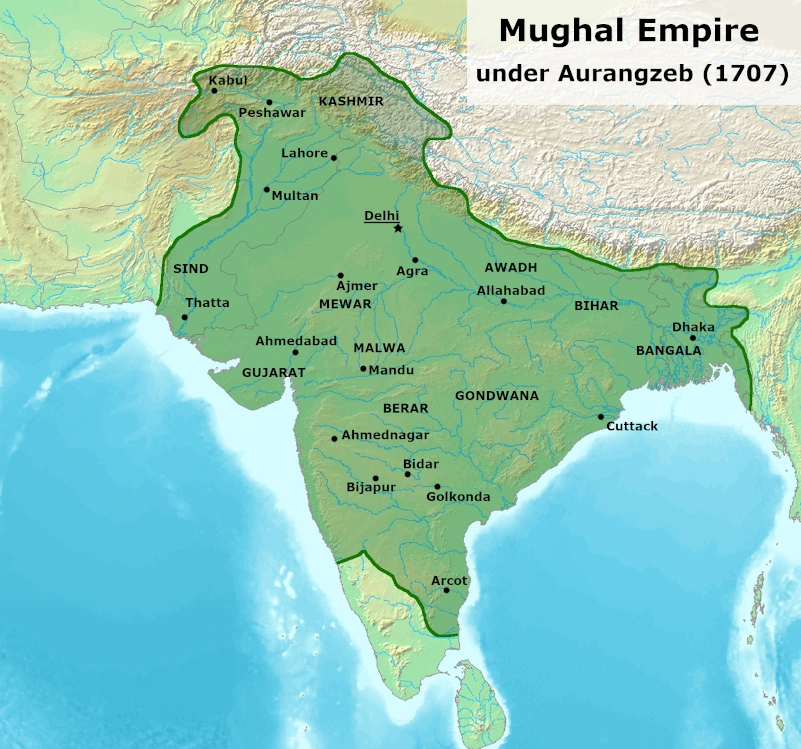
Map study
Mughal Empire in 1707 near the end of Aurangzeb’s reign; this is not Babur’s or Akbar’s territorial extent.
- Read the source date and legend before interpreting territorial extent.
- Compare core regions, neighbouring powers and geographic barriers; historical borders and influence are approximate and changed over time.
Credit: Avantiputra7 · CC BY-SA 4.0 · sourceConverted to WebP on an opaque white background; proportionally resized without cropping. Original cartography and legend retained.
1. Nature and chronology of imperial decline
Mughal decline involved the erosion of effective central control over provinces, taxation and military resources. It did not mean that economic activity or administration disappeared everywhere. Many regional states retained Mughal institutions, employed former imperial officials and acknowledged the emperor’s nominal sovereignty. For examination purposes, distinguish the decline of the imperial centre from the fortunes of individual regions and from the later establishment of British supremacy.
Aurangzeb’s long reign, from 1658 to 1707, brought the empire to its greatest territorial extent but also exposed its administrative limits. After his death, Bahadur Shah I, who ruled from 1707 to 1712, attempted accommodation with important political groups. His short reign could not resolve inherited problems. Repeated succession conflicts after 1712 strengthened influential nobles and made the throne increasingly dependent on competing military and court networks.
Under Muhammad Shah, who ruled from 1719 to 1748, provincial autonomy became entrenched and Nadir Shah invaded. Yet the imperial office remained a source of legitimacy. Regional rulers sought titles, appointments and recognition from Delhi, while coins and public prayers could continue to acknowledge the emperor. The dynasty survived long after its capacity to govern most of India had vanished.
Timeline
1707
Aurangzeb dies; Bahadur Shah I wins the succession struggle.
1719
Farrukhsiyar is deposed; Muhammad Shah eventually ascends the throne.
1722–1724
Saadat Khan establishes his position in Awadh; Nizam-ul-Mulk consolidates autonomy in the Deccan.
1739
Nadir Shah defeats the Mughals at Karnal and sacks Delhi.
1761–1765
Panipat checks Maratha expansion; Buxar and the diwani grant strengthen Company power.
1803
The British capture Delhi.
1857–1858
The revolt is suppressed, Mughal rule ends, and Bahadur Shah II is exiled.
2. Structural pressures: warfare, revenue and the nobility
The Deccan campaigns were a major source of imperial overstretch. Aurangzeb annexed Bijapur in 1686 and Golconda in 1687, but eliminating these kingdoms did not end resistance. Maratha forces dispersed, recovered forts and attacked communications, making permanent occupation expensive. The emperor’s prolonged presence in the Deccan placed heavy demands on the treasury, supply arrangements and personnel, while weakening sustained supervision of northern affairs.
Mughal administration depended on the mansabdari-jagirdari system. Mansabdars held graded ranks and military obligations; many received revenue assignments called jagirs rather than cash salaries. A jagir was an assignment of revenue rights, not normally hereditary ownership of the land. Competition for productive assignments intensified when the number and claims of nobles outpaced readily available revenue resources. Differences between assessed revenue, or jama, and actual collections, or hasil, complicated payments and military maintenance.
Historians describe these pressures as a jagirdari crisis, although its intensity and operation varied across regions. Frequent transfers and uncertain tenure could encourage short-term extraction by revenue assignees. Peasant distress, zamindar resistance and disrupted cultivation could then reduce collections further. The problem was therefore not simply that the empire lacked land: it struggled to convert territorial claims into dependable revenue and effective military service.
A reinforcing cycle of imperial weakness
- 1. Prolonged warfare increases expenditure.
- 2. Revenue shortfalls intensify competition for productive jagirs.
- 3. Military maintenance and central supervision weaken.
- 4. Provincial elites retain more resources and authority.
- 5. Reduced central income further limits imperial intervention.
3. Political conflicts and the limits of single-cause explanations
Mughal succession lacked an established rule automatically awarding the throne to the eldest son. Princes mobilised nobles, soldiers and provincial resources to contest power. Such struggles had occurred before 1707, but became more damaging as fiscal and military flexibility diminished. Court factions commonly described as Turani, Irani and Hindustani competed for appointments and influence; these labels should not be mistaken for completely fixed or internally united political parties.
The Sayyid brothers, Abdullah Khan and Husain Ali Khan, became prominent kingmakers during the 1710s. They helped Farrukhsiyar obtain the throne in 1713 and removed him in 1719. Their ascendancy illustrates how powerful nobles could control imperial succession. However, describing all later emperors as equally incapable obscures the deeper constraints on their authority and the independent ambitions of provincial elites.
Aurangzeb’s religious policies, including the reimposition of jizya in 1679 and temple destruction in particular contexts, contributed to political alienation. Rajput conflicts, Maratha resistance, Sikh mobilisation and Jat uprisings also involved territorial rights, taxation, local autonomy and leadership. Religious policy alone cannot explain the empire’s decline: Hindu nobles continued to serve the state, and several conflicts crossed religious boundaries. A balanced answer connects political decisions with structural pressures rather than attributing collapse to one ruler or community.
| Power | Principal figure | Relationship with Mughal authority |
|---|---|---|
| Bengal | Murshid Quli Khan | Provincial administration became effectively autonomous while retaining imperial recognition. |
| Awadh | Saadat Khan | Appointment as governor in 1722 laid the basis of an autonomous dynasty. |
| Hyderabad | Nizam-ul-Mulk | Consolidated effective autonomy in 1724 while acknowledging nominal Mughal sovereignty. |
| Marathas | Shahu and the Peshwas | Expanded through warfare, revenue claims and negotiated imperial concessions. |
4. Regionalisation and foreign invasions
Provincial governors increasingly retained revenues and built their own military establishments. Bengal under Murshid Quli Khan, Awadh under Saadat Khan from 1722, and Hyderabad under Nizam-ul-Mulk from 1724 became important successor states. Their rulers generally preserved nominal allegiance to the emperor while exercising substantial autonomy. These states differed from powers such as the Marathas, whose expansion developed through sustained opposition to Mughal authority as well as negotiation with it.
Regionalisation was not uniformly synonymous with disorder. Some courts fostered cultivation, trade, banking, architecture and literary culture. Merchants and financiers redirected support towards rulers capable of providing security and enforcing contracts. Nevertheless, warfare and competing revenue demands damaged particular districts, and the weakening centre increasingly struggled to coordinate military action. The eighteenth century therefore combined political fragmentation with significant regional economic and cultural vitality.
Nadir Shah defeated the Mughals at Karnal in February 1739 and subsequently sacked Delhi, removing the Peacock Throne and immense treasure. Ahmad Shah Durrani’s repeated invasions further destabilised northwestern and northern India. At the Third Battle of Panipat in 1761, he defeated the Marathas. This checked their northern advance but did not restore effective Mughal rule; Maratha influence later recovered, including their role in Shah Alam II’s return to Delhi in 1772.
5. Company expansion and historical interpretation
The East India Company did not create the initial crisis of Mughal authority, but exploited the resulting political landscape. Plassey in 1757 enabled intervention in Bengal’s government. At Buxar in 1764, Company forces defeated the combined army of Mir Qasim, Shuja-ud-Daula and Shah Alam II. The emperor’s grant of diwani in 1765 supplied a legal claim to revenue collection in Bengal, Bihar and Orissa.
British occupation of Delhi in 1803 placed Shah Alam II under Company protection. The emperor’s political power was minimal, but his symbolic standing remained visible when rebels rallied around Bahadur Shah II during 1857. Following the suppression of the revolt, the British ended the dynasty and exiled him to Rangoon in 1858.
Historians differ over the relative importance of agrarian exploitation, jagirdari pressures, elite competition and regional transformation. The strongest explanation combines these factors. Mughal decline did not make British conquest inevitable: Company success also required military organisation, financial resources, diplomacy and victories over powerful Indian states.
Real-world case studies
Hyderabad: autonomy within an imperial framework
Nizam-ul-Mulk defeated Mubariz Khan at Shakar Kheda in 1724 and consolidated control over the Deccan. Hyderabad illustrates how a successor state could become practically independent without immediately rejecting the emperor’s nominal sovereignty.
Bengal: imperial legitimacy serving Company expansion
Shah Alam II’s diwani grant in 1765 legitimised Company revenue collection in Bengal, Bihar and Orissa. An emperor with limited coercive power could still confer valuable legal authority, which the Company used to strengthen its own territorial position.
Previous year questions
No source-linked PYQ is available here yet. Use the practice questions below.
Practice questions
Practice MCQ 1
Regarding the Mughal jagirdari system, consider the following statements: 1. A jagir normally represented hereditary ownership of agricultural land. 2. Jama referred to assessed revenue, while hasil referred to actual collections. Which of the statements given above is/are correct?
- A. 1 only
- B. 2 only
- C. Both 1 and 2
- D. Neither 1 nor 2
Practice MCQ 2
Which of the following is the correct chronological order?
- A. Nadir Shah’s invasion, Aurangzeb’s death, Battle of Buxar, Third Battle of Panipat
- B. Aurangzeb’s death, Nadir Shah’s invasion, Third Battle of Panipat, Battle of Buxar
- C. Aurangzeb’s death, Third Battle of Panipat, Nadir Shah’s invasion, Battle of Buxar
- D. Nadir Shah’s invasion, Battle of Buxar, Aurangzeb’s death, Third Battle of Panipat
Practice MCQ 3
Which statement best describes the relationship between eighteenth-century Mughal successor states and the emperor?
- A. They necessarily abolished all Mughal administrative institutions.
- B. They remained entirely dependent on Delhi for revenue and military decisions.
- C. They could exercise substantial autonomy while recognising nominal imperial sovereignty.
- D. They emerged only after the British captured Delhi.
Mains practice · The decline of Mughal central authority was accompanied by regional political reconstruction rather than uniform collapse. Discuss. 250 words.
- Distinguish imperial decline from regional economic or administrative decline.
- Explain Deccan warfare, fiscal pressures, succession conflicts and elite competition.
- Use Bengal, Awadh and Hyderabad to illustrate institutional continuity and autonomy.
- Discuss uneven economic outcomes and the disruptive effects of invasions.
- Explain why Company conquest required additional military, financial and diplomatic advantages.
Further reading
- NCERT, Our Pasts II, Eighteenth-Century Political Formations.
- Satish Chandra, Medieval India: From Sultanat to the Mughals, Part II.
- Satish Chandra, Parties and Politics at the Mughal Court, 1707–1740.
- Irfan Habib, The Agrarian System of Mughal India, 1556–1707.
Preparing for UPSC Civil Services? Get classroom teaching, answer-writing evaluation and mentorship at Pragnya IAS Academy, Ashok Nagar — see why aspirants choose us for IAS coaching in Hyderabad.