
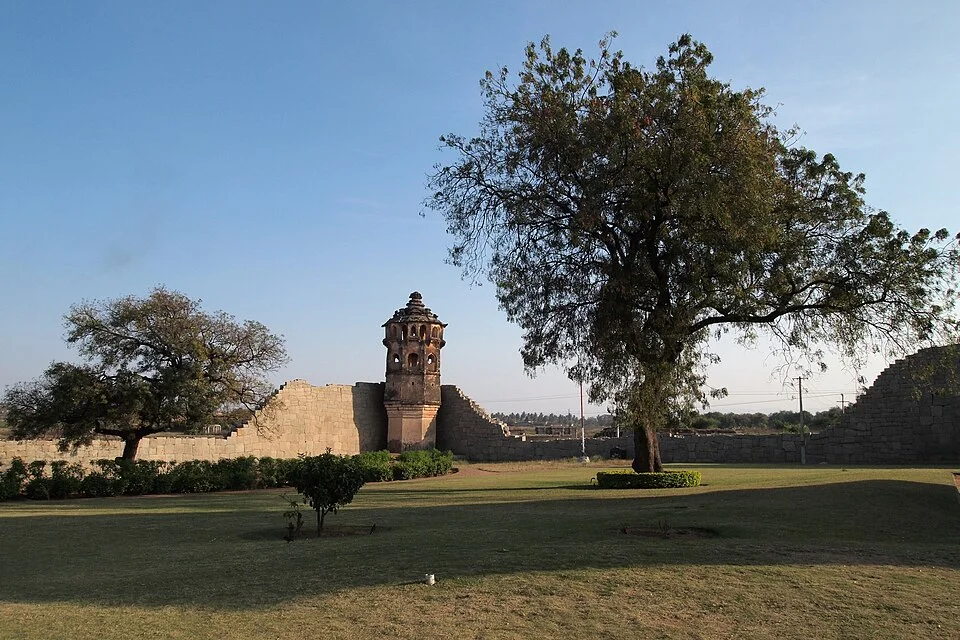
Watchtower in the conventionally named Zenana Enclosure at Hampi, the Vijayanagara capital.
Credit: Vyacheslav Argenberg · CC BY 4.0 · sourceResized and converted to WebP; uncropped.
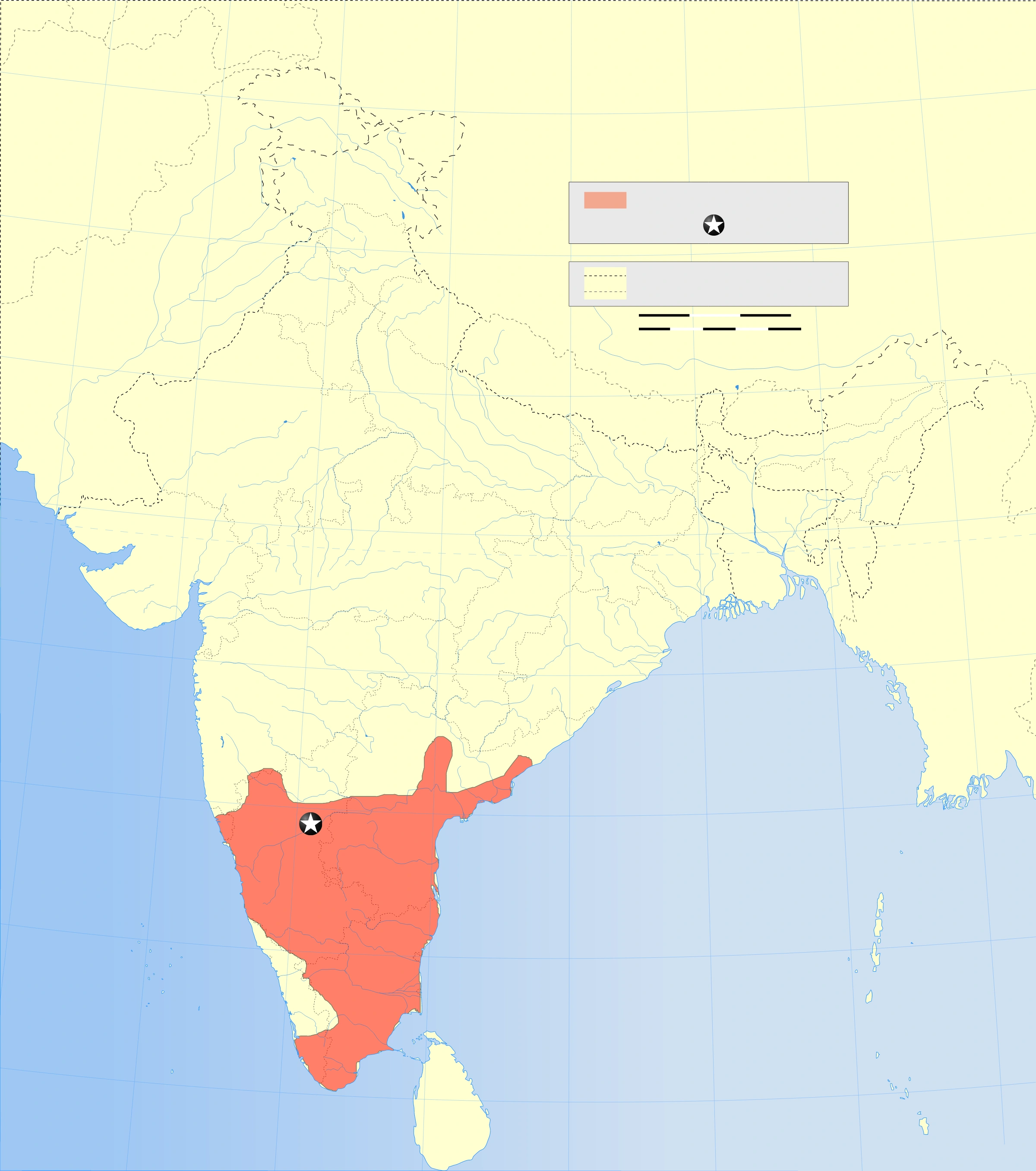
Map study
Vijayanagara Empire: regional extent in the source reconstruction; territorial control changed through time.
- Read the source date and legend before interpreting territorial extent.
- Compare core regions, neighbouring powers and geographic barriers; historical borders and influence are approximate and changed over time.
Credit: Nikel3012 · CC0 · sourceConverted to WebP on an opaque white background; proportionally resized without cropping. Original cartography and legend retained.
1. Origins, geography and sources
Vijayanagara developed during the political reorganisation of the Deccan and southern India following the expansion and subsequent weakening of Delhi Sultanate authority. Harihara I and Bukka I established the kingdom in 1336 according to the conventional chronology. Accounts of their earlier careers and the precise role of the religious teacher Vidyaranya differ across traditions; these should not be treated as equally secure historical facts. The kingdom incorporated territories and institutions associated with earlier powers, including the Hoysalas.
The capital’s location combined strategic protection with access to resources. Granite ridges, the Tungabhadra River and substantial fortifications provided defensive advantages. Cultivated valleys, tanks and canals supported a large urban population. Control of routes connecting the interior with ports on both coasts helped rulers secure horses, revenue and prestige goods.
Evidence includes inscriptions, coins, literary compositions, temple records, archaeological remains and foreign accounts. Nicolo Conti visited in the early fifteenth century; the Persian envoy Abdur Razzaq described the kingdom during Devaraya II’s reign. Domingo Paes observed Krishnadevaraya’s capital, while Fernao Nuniz recorded historical traditions in the sixteenth century. Their descriptions are valuable but reflect differing interests and sometimes exaggerated estimates.
Timeline
1336
Conventional foundation of Vijayanagara under Harihara I and Bukka I.
1485
Saluva Narasimha establishes Saluva rule.
1505
Beginning of Tuluva dynastic rule.
1509–1529
Reign of Krishnadevaraya; victory at Raichur in 1520.
1565
Defeat at Talikota and subsequent devastation of the capital.
Later sixteenth–seventeenth centuries
Aravidu rule continues from successor capitals amid growing regional autonomy.
2. Dynasties, expansion and political conflict
The Sangamas consolidated the early empire. Devaraya II, who ruled approximately from 1422 to 1446, was an important military and cultural patron. Accounts associate him with employing Muslim cavalrymen and archers, illustrating the pragmatic recruitment of military expertise. Saluva Narasimha displaced the Sangamas in 1485; the Tuluva dynasty subsequently gained power in 1505. Dynastic change did not automatically replace the underlying institutions of government.
Krishnadevaraya brought the empire to a high point between 1509 and 1529. He campaigned against the Gajapatis of Odisha, captured Udayagiri and Kondavidu, and defeated the ruler of Bijapur at Raichur in 1520. The fertile Raichur Doab between the Krishna and Tungabhadra rivers was repeatedly contested. Warfare also concerned forts, ports, agricultural resources and access to the imported warhorses essential for cavalry.
After Krishnadevaraya and Achyutadevaraya, Aliya Rama Raya exercised effective authority under the nominal ruler Sadashiva Raya. His interventions in Deccan sultanate politics contributed to a hostile coalition. At Talikota, also called Rakshasi-Tangadi, in 1565, the coalition defeated Vijayanagara and Rama Raya was killed. The capital was subsequently plundered. Aravidu rulers continued from centres including Penukonda and Chandragiri, while regional Nayaka powers became increasingly autonomous.
- Avoid reducing conflict to a simple Hindu–Muslim binary: alliances, soldiers and political interests frequently crossed religious boundaries.
- Distinguish the destruction of the imperial capital in 1565 from the later decline of Aravidu political authority.
Working of the amara-nayaka system
- 1. Ruler assigns territorial revenue rights to a commander
- 2. Commander collects revenue from the assigned territory
- 3. Revenue maintains military contingents and local obligations
- 4. Commander provides troops, tribute and court attendance
- 5. Growing regional resources can strengthen autonomous power
3. Administration and the amara-nayaka system
The king stood at the centre of government, supported by ministers, military commanders, court officials and provincial authorities. Royal legitimacy drew on conquest, protection of religious institutions, public ceremonies and claims to uphold dharma. Actual control varied across regions and depended on negotiations with local chiefs, landed groups and religious establishments.
The amara-nayaka system connected revenue rights with military service. Amara-nayakas were commanders assigned territories from which they collected revenue. They retained resources for maintaining troops, horses and elephants, remitted a portion to the ruler and appeared at court with gifts. Some revenue supported temples and irrigation. Their assignments were not simply modern private ownership of land.
The system enabled expansion without a uniformly centralised bureaucracy, but powerful commanders could build regional bases. Over time, some offices and territorial claims became increasingly hereditary. The later Nayaka states of Madurai and Thanjavur emerged from this wider political environment. For comparison with the Delhi Sultanate’s iqta, focus on revenue assignments and military obligations without assuming that the institutions were identical.
| Traveller | Period or association | Important distinction |
|---|---|---|
| Nicolo Conti | Early fifteenth century | Italian merchant and traveller |
| Abdur Razzaq | 1440s; Devaraya II | Envoy from the Timurid court at Herat |
| Domingo Paes | Around 1520–1522; Krishnadevaraya | Described the capital, markets and royal ceremonies |
| Fernao Nuniz | 1530s; Achyutadevaraya | Portuguese chronicler who recorded earlier dynastic history |
4. Agriculture, trade and social relations
Agriculture financed the state and sustained cities, armies and temples. Land revenue was important, alongside customs, commercial levies and occupational taxes. Assessment and collection varied by locality, cultivation and land category. Rulers, commanders, temples and local communities supported tanks, wells and canals. Hydraulic works in and around the capital demonstrate the connection between water management, agricultural production and political authority.
Trade linked inland markets with the Arabian Sea and Bay of Bengal. Horses arrived through maritime networks involving Arab and Persian merchants and, increasingly after the Portuguese capture of Goa in 1510, Portuguese traders. Textiles, rice, spices and precious stones circulated through regional and overseas exchange. Gold coins, commonly called varahas or pagodas, were important instruments of high-value transactions.
Society was differentiated by caste, occupation, wealth and access to power. Brahmanas received land grants and served as scholars and officials; merchants, cultivators, artisans and pastoral groups sustained production and exchange. Women participated in agriculture, craft work, commerce and courtly life, but opportunities were unequal. Inscriptions and travellers record temple women and sati, yet neither practice should be generalised to all women or regions. Temples organised employment, redistribution and social hierarchy as well as worship.
5. Religion, literature and courtly culture
Vijayanagara rulers patronised several religious traditions rather than one uniform sectarian establishment. Virupaksha, a form of Shiva, was closely associated with the capital’s sacred identity. Vaishnava institutions also received extensive support, notably under Krishnadevaraya, who made major donations to Tirupati. Royal patronage strengthened temples as landed institutions and connected the monarchy with influential religious communities.
Sanskrit, Telugu, Kannada and Tamil literary cultures flourished through overlapping courtly and religious networks. Krishnadevaraya’s Telugu Amuktamalyada centres on Andal’s devotion to Vishnu and includes reflections on kingship. His court is traditionally associated with eight Telugu poets, the Ashtadiggajas, including Allasani Peddana. In Kannada-speaking regions, the Haridasa devotional tradition included Purandaradasa and Kanakadasa. Literary achievement should therefore be understood as multilingual and regionally diverse, not confined to the imperial court.
6. Hampi: architecture and urban landscape
Hampi’s remains reveal sacred, royal and residential zones, although these categories overlapped. Monumental temple complexes developed tall raya gopurams, pillared mandapas and kalyana mandapas for ceremonial marriages of deities. The Vitthala temple is famous for its stone chariot, a Garuda shrine, while the Hazara Rama temple contains Ramayana reliefs. Long bazaar streets near temples linked ritual activity with commerce.
The Mahanavami Dibba was an elevated ceremonial platform associated with royal display and festival activity. Structures conventionally called the Lotus Mahal and Elephant Stables incorporate arches and domes, showing interaction with wider Deccan architectural traditions. Multiple defensive walls enclosed not only buildings but also agricultural land. Tanks, channels and stepped water structures further demonstrate that Vijayanagara architecture must be studied as an urban landscape rather than merely a collection of temples.
Hampi: Royal Architecture and Cultural Exchange
The supplied metadata identifies a watchtower in Hampi’s conventionally named Zenana Enclosure and describes its style as Indo-Islamic. This makes it directly relevant to Vijayanagara’s capital and architectural culture. Hampi was not simply a temple settlement: its surviving remains include royal compounds, defensive works, water-management structures and commercial spaces. Reading these together helps explain how imperial authority depended on controlling access, sustaining an urban population and linking courtly activity with religious institutions.
The Indo-Islamic attribution offers a starting point for studying architectural exchange across the Deccan. Vijayanagara’s political rivalry with neighbouring sultanates did not prevent the circulation of artisans, construction techniques or courtly forms. However, a stylistic label does not establish a builder’s religious identity or prove direct copying from a particular court. Nor should the conventional term ‘Zenana Enclosure’ be treated as conclusive evidence that every structure within it served women’s residential seclusion. The metadata’s broad fourteenth-century reference should not be assigned automatically to this individual tower; a building-specific chronology requires stronger documentation.
- Prelims distinction: Vijayanagara architecture includes both temple and courtly traditions; not every Hampi monument is a religious structure.
- Mains connection: Use architectural exchange to challenge a rigid Hindu–Muslim binary while retaining the importance of warfare, patronage and political competition.
- Evidence limit: Site names and image descriptions are starting points; inscriptions, archaeological studies and critically assessed travellers’ accounts are needed to establish functions and chronology.
Real-world case studies
Water management in the capital
The Kamalapuram tank and Tungabhadra-linked channels supported cultivation and supplied parts of the capital. Archaeological evidence of channels and water structures demonstrates how engineering, topography and political investment sustained a major inland city.
Tirupati and royal legitimacy
Krishnadevaraya’s donations to the Venkateswara temple at Tirupati are documented in inscriptions. They illustrate how royal patronage connected devotion, resource redistribution and the public assertion of sovereignty.
Previous year questions
UPSC Mains 2016 · GS-I
Krishnadeva Raya, the king of Vijayanagar, was not only an accomplished scholar himself but was also a great patron of learning and literature. Discuss.
- Explain his authorship of the Telugu Amuktamalyada.
- Discuss Telugu court literature and poets such as Allasani Peddana.
- Situate his patronage within a wider multilingual scholarly environment.
- Connect literary patronage with kingship, devotional traditions and prestige.
Practice questions
Practice MCQ 1
Which is the correct chronological sequence of Vijayanagara dynasties?
- A. Sangama–Tuluva–Saluva–Aravidu
- B. Sangama–Saluva–Tuluva–Aravidu
- C. Saluva–Sangama–Aravidu–Tuluva
- D. Tuluva–Sangama–Saluva–Aravidu
Practice MCQ 2
Consider these statements: 1. Amara-nayakas maintained military contingents using assigned revenues. 2. Talikota immediately extinguished all Vijayanagara political authority. 3. The Raichur Doab lies between the Krishna and Tungabhadra rivers. Which are correct?
- A. 1 and 2 only
- B. 2 and 3 only
- C. 1 and 3 only
- D. 1, 2 and 3
Practice MCQ 3
Which monument-feature pair is correctly matched?
- A. Hazara Rama temple–Ramayana reliefs
- B. Mahanavami Dibba–Portuguese trading warehouse
- C. Vitthala temple–Buddhist chaitya hall
- D. Lotus Mahal–Rock-cut Jain cave
Mains practice · Vijayanagara’s strength rested on the interaction of military organisation, agrarian resources and sacred institutions. Examine. Answer in 250 words.
- Introduce the empire’s regional reach and varied sources of authority.
- Explain amara-nayaka revenue rights and military obligations.
- Link irrigation and agricultural expansion with fiscal resources.
- Discuss temples as landed, economic and legitimising institutions.
- Include horse imports, ports and commercial taxation.
- Conclude with tensions between imperial integration and regional autonomy.
Further reading
- NCERT, Themes in Indian History Part II, An Imperial Capital: Vijayanagara.
- NCERT, Our Pasts II, Devotional Paths to the Divine.
- UNESCO World Heritage Centre, Group of Monuments at Hampi.
- Archaeological Survey of India, Hampi monument descriptions.
- Satish Chandra, Medieval India: From Sultanat to the Mughals, Part I.
- https://commons.wikimedia.org/wiki/File:Hampi,_India,_Watch_Tower,_The_Zenana_Enclosure,_Vijayanagara_Empire.jpg
Preparing for UPSC Civil Services? Get classroom teaching, answer-writing evaluation and mentorship at Pragnya IAS Academy, Ashok Nagar — see why aspirants choose us for IAS coaching in Hyderabad.