
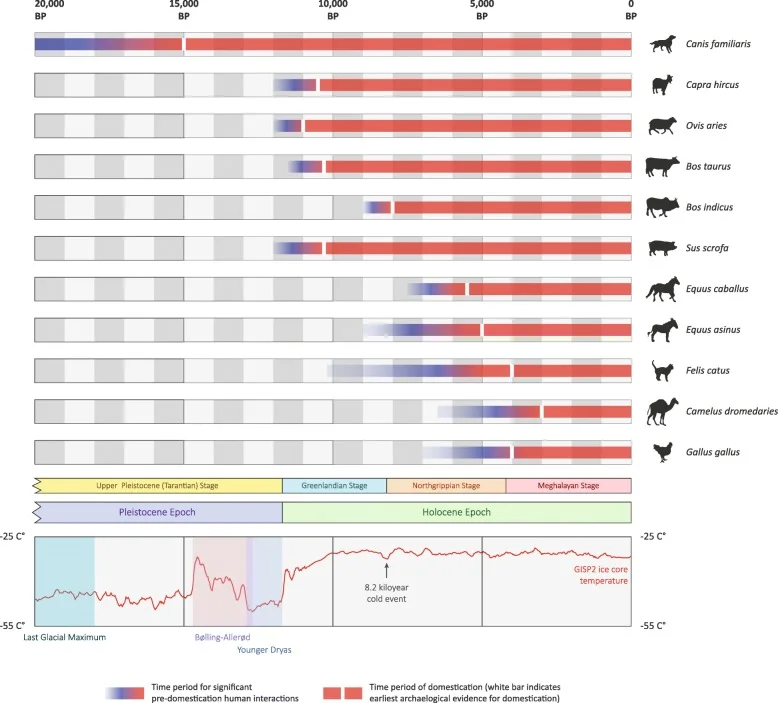
Comparative timeline of selected animal domestication processes, with climatic context.
Credit: Gillian P. McHugo, Michael J. Dover, and David E. MacHugh · CC BY 4.0 · sourceResized and converted to WebP; uncropped.
1. Meaning and mechanisms of domestication
Domestication is an evolutionary relationship in which human activities reshape the reproduction, behaviour or physical characteristics of another species over generations. It differs from taming: a wild elephant accustomed to human commands is tamed, but this alone does not establish a domesticated breeding population. Similarly, collecting wild grain is gathering, while sowing and tending it is cultivation. Cultivation may continue for a considerable period before archaeologists can identify domesticated plant characteristics.
Selection need not begin as a conscious attempt to transform a species. When people repeatedly harvest particular plants, retain seeds and sow them near settlements, some inherited traits become more common. In cereals, an important change is a non-shattering seed head, which retains ripe grains rather than dispersing them naturally. Larger seeds and reduced dormancy may also develop, although not every crop displays the same combination of traits.
Animal domestication can develop through several relationships. Some animals, such as dogs, probably became associated with human camps before systematic herding. Sheep, goats and cattle were increasingly managed for meat and later, in varying contexts, milk, wool, traction and transport. Human control over breeding and survival favoured manageable behaviour. Changes in body size, horn form and population structure can reveal this process, but no single characteristic conclusively establishes domestication.
- Gathering: collecting naturally occurring plant resources without necessarily managing their reproduction.
- Cultivation: preparing land, sowing, tending or otherwise encouraging plant growth.
- Herding: managing animal groups; pastoralism is a livelihood substantially dependent on livestock.
- Domestication: inherited population-level change associated with sustained human management.
Timeline
Before the beginnings of agriculture
Dog domestication precedes that of the principal agricultural livestock; exact origins remain debated.
About 9700 BCE
Beginning of the Holocene, providing the environmental background to many early food-production transitions.
About 7000 BCE
Early farming and herding communities are established at Mehrgarh.
Fourth–third millennia BCE onward
Distinct regional Neolithic and agro-pastoral traditions develop across several parts of the subcontinent.
About 2600–1900 BCE
Mature Harappan urbanism rests on food-producing economies established through much earlier developments.
2. Origins and the transition to food production
The beginnings of food production belong to a broad transformation spanning the end of the Pleistocene and the early Holocene. The Holocene began about 11,700 years ago. Changes in temperature, rainfall and the distribution of plants and animals altered subsistence opportunities. However, climate alone cannot explain domestication. Population pressures, risk management, ecological knowledge, social relationships and the attraction of dependable food supplies also influenced local decisions.
Domestication occurred through multiple regional histories rather than a single worldwide invention. Southwest Asia was an early centre for wheat, barley, sheep and goats. China had major trajectories involving rice and millets. Other crops were domesticated in Africa and the Americas. Movement of people, seeds, animals and knowledge subsequently carried food-production practices beyond their initial centres. In South Asia, introduced domesticates interacted with local plants, animals and established hunter-gatherer traditions.
V. Gordon Childe popularised the expression Neolithic Revolution to describe the profound consequences of food production. The term is useful for its long-term significance but can mislead if interpreted as a sudden event. Many communities combined small-scale cultivation with hunting, fishing and gathering. Some settled before farming became important, while pastoral groups could remain mobile. Thus, a permanent village is not by itself proof of agriculture, and agriculture does not automatically imply urbanisation or a state.
A possible pathway to crop domestication, not a universal sequence
- 1. Repeated gathering and detailed knowledge of wild plants
- 2. Protection, tending and cultivation of useful stands
- 3. Repeated harvesting, seed retention and sowing
- 4. Selection increases the frequency of useful inherited traits
- 5. Domesticated crops become integrated into regional subsistence systems
3. Regional evidence from the Indian subcontinent
Mehrgarh lies near the Bolan Pass on the Kachi plain of present-day Pakistan. Its early occupation, beginning around 7000 BCE, provides evidence of mud-brick buildings, storage, burials and an economy involving barley, wheat and livestock. Its earliest phase was aceramic, meaning pottery was absent. Sheep, goats and cattle became important in the settlement’s economy. Mehrgarh predates the Mature Harappan civilisation by several millennia and should not be mistaken for an already urban Harappan centre.
In the Vindhyan and middle Ganga regions, sites such as Koldihwa, Mahagara and Lahuradewa are central to discussions of early rice use and cultivation. Very early rice finds from Lahuradewa have been reported, but the relationship between rice collection, cultivation and fully developed domestication remains debated. Textbook references to early rice at Koldihwa should likewise be read with attention to dating and identification. Mahagara has yielded evidence interpreted as a cattle enclosure, illustrating the importance of animal management.
Kashmir’s Neolithic settlements, including Burzahom and Gufkral, combined farming and herding with hunting. Wheat, barley and domesticated animals formed part of regional subsistence. Burzahom is especially associated with pit dwellings, bone tools and animal burials. In the southern Deccan, sites such as Utnur, Budihal and the Sanganakallu–Kupgal complex illustrate cattle-centred agro-pastoral traditions. Ash mounds are commonly interpreted as the products of repeated burning of accumulated cattle dung. Indigenous small millets and pulses contributed to southern farming economies.
Eastern and northeastern evidence adds further variety. Chirand in Bihar has Neolithic deposits with farming-related remains and bone tools. Daojali Hading in Assam is known for ground stone tools and cord-marked pottery, with cultural connections towards eastern and southeastern Asia. Such material connections should not automatically be treated as proof of a specific domesticated crop without direct botanical evidence.
| Site or region | Present-day location | Principal relevance |
|---|---|---|
| Mehrgarh | Balochistan, Pakistan | Early wheat–barley farming and livestock management; an initial aceramic phase |
| Koldihwa and Mahagara | Uttar Pradesh | Rice-related evidence and cattle management; early chronology requires caution |
| Lahuradewa | Uttar Pradesh | Early rice use and cultivation debates; rice presence does not alone prove domestication |
| Burzahom | Kashmir | Mixed farming, herding and hunting; pit dwellings and animal burials |
| Utnur and Budihal | Telangana and Karnataka respectively | Southern Neolithic cattle keeping and ash-mound traditions |
4. How archaeologists identify domestication
Archaeobotany studies ancient plant remains, including charred grains, seeds, chaff, phytoliths and pollen. Flotation separates small organic remains from excavated soil, improving recovery. Seed measurements and changes in cereal rachis structure can help distinguish wild and domesticated forms. Rice spikelet bases may provide clues about shattering behaviour. However, preservation is uneven, and a crop impression in pottery generally supplies less information than a well-preserved, securely dated assemblage.
Zooarchaeologists analyse animal bones, teeth, horn cores and age-at-death patterns. A herd-management strategy may involve slaughtering many young males while retaining breeding females. Yet hunting can also produce selective age and sex profiles, so interpretation requires multiple lines of evidence. Ancient DNA can investigate ancestry and population movement, while stable isotopes can illuminate animal diets, mobility and management. Lipid residues in pottery may identify the processing of animal fats, including dairy products.
Radiocarbon dating is crucial for chronology. Directly dating a seed or bone usually provides a stronger association than relying only on charcoal from nearby soil, although both require careful context. Calibrated dates account for variations in atmospheric radiocarbon. For examination purposes, distinguish the earliest reported occurrence of a plant, evidence of its cultivation and secure evidence of domestication. These represent different archaeological claims, not interchangeable milestones.
5. Consequences and examination significance
Food production increased the possibility of storing supplies and supporting larger communities. It encouraged investment in houses, storage facilities and fields, while livestock provided mobile wealth and protection against some crop failures. Over time, farming could support occupational specialisation and exchange. Nevertheless, surplus did not inevitably generate political hierarchy. Property relations, social inequalities and state formation emerged through additional historical processes rather than directly from the domestication of plants or animals.
The transition also brought costs. Dependence on a narrower food base could increase vulnerability to crop failure and nutritional deficiencies. Dense settlement, waste accumulation and closer contact with animals created conditions favourable to some infectious diseases. Land clearance, grazing and repeated cultivation transformed local environments. Mobile pastoralists and settled cultivators often exchanged products and used complementary ecological zones rather than existing as entirely separate societies.
- Avoid treating the Neolithic as one uniform chronological stage across India.
- Do not infer domestication solely from grinding stones, sickles or the presence of animal bones.
- Keep early farming at Mehrgarh distinct from Mature Harappan urbanism, conventionally dated approximately 2600–1900 BCE.
- Remember that domesticated crops such as maize and potato originated in the Americas and were not components of prehistoric Indian agriculture.
Animal Domestication: Processes, Timelines and Evidence
The supplied metadata describes a timeline linking selected animal domestication processes with climate and human–animal interactions. This is directly relevant as a comparative framework, rather than as evidence for particular Indian sites. Domestication is not simply taming an individual animal: it involves sustained relationships across generations that can produce heritable changes in a population. Hunting, protection, controlled breeding and herding may represent different forms of interaction, but they should not automatically be arranged into one universal sequence.
For prehistoric South Asia, the key question is how local communities incorporated managed animals into their livelihoods. Mehrgarh is important for studying early farming and herding, while other regions followed distinct trajectories. Archaeologists assess domestication through combinations of skeletal measurements, age and sex profiles, settlement contexts and, where preservation permits, genetic or isotopic evidence. No single indicator is always decisive: changes in animal size can also reflect environmental conditions, and bones at a settlement may derive from hunting. A timeline therefore simplifies processes that were geographically uneven and whose dating remains dependent on available evidence.
- Prelims distinction: taming concerns an individual; domestication concerns populations across generations. Herding and sedentary village life need not develop together.
- Mains linkage: climatic change may alter habitats and resources, but temporal overlap alone does not establish that climate caused domestication.
- Indian evidence limit: use a comparative timeline to frame questions, not to assign domestication dates or origins to Indian species without site-specific archaeological support.
Real-world case studies
Mehrgarh: food production before pottery
Mehrgarh’s earliest aceramic occupation demonstrates that pottery was not a prerequisite for farming or settled life. Mud-brick architecture, storage and plant and animal remains show how archaeologists reconstruct subsistence from combined evidence rather than a single diagnostic object.
Southern ash mounds: evidence beyond crop remains
At southern Neolithic sites such as Utnur and Budihal, ash deposits associated with burnt cattle dung illuminate livestock management and the organisation of settlement space. Whether particular burning episodes involved routine disposal, seasonal practices or ritual requires site-specific interpretation.
Previous year questions
No source-linked PYQ is available here yet. Use the practice questions below.
Practice questions
Practice MCQ 1
With reference to prehistoric food production, consider the following statements: 1. Cultivation can precede the appearance of domesticated plant traits. 2. Taming a wild animal necessarily creates a domesticated population. 3. A non-shattering seed head is an important domestication trait in several cereals. Which of the statements given above are correct?
- A. 1 and 2 only
- B. 1 and 3 only
- C. 2 and 3 only
- D. 1, 2 and 3
Practice MCQ 2
Consider the following pairs: 1. Mehrgarh — Early aceramic farming settlement 2. Burzahom — Kashmir Neolithic settlement 3. Utnur — Southern Neolithic ash-mound site. How many of the pairs are correctly matched?
- A. Only one
- B. Only two
- C. All three
- D. None
Practice MCQ 3
Which of the following offers the strongest basis for identifying domesticated cereals at a prehistoric site?
- A. Grinding stones without associated plant remains
- B. Permanent houses near a river
- C. Any grain impression on an undated potsherd
- D. Securely dated plant remains showing diagnostic changes in seed-dispersal structures
Mains practice · The transition to food production in the Indian subcontinent was a mosaic of regional developments rather than a single Neolithic Revolution. Discuss with archaeological examples. (250 words)
- Distinguish gathering, cultivation, herding and domestication.
- Explain the long-term significance and limitations of the Neolithic Revolution concept.
- Use Mehrgarh to illustrate early northwestern farming and herding.
- Discuss rice-related evidence from the Vindhyan–Ganga region while acknowledging chronological and identification debates.
- Contrast Kashmir’s mixed subsistence with southern cattle-centred agro-pastoralism.
- Highlight the continued importance of hunting and gathering and the non-uniform appearance of pottery and settled life.
- Conclude that environmental diversity, local innovation and interregional exchange shaped multiple pathways.
Further reading
- NCERT, Our Pasts–I, chapter From Gathering to Growing Food.
- R. S. Sharma, India’s Ancient Past, chapters on Stone Age cultures and early food production.
- Upinder Singh, A History of Ancient and Early Medieval India, sections on the Neolithic and Chalcolithic.
- Archaeological Survey of India, Indian Archaeology—A Review, excavation reports on relevant prehistoric sites.
- Dorian Q Fuller, Agricultural Origins and Frontiers in South Asia: A Working Synthesis, Journal of World Prehistory.
- https://commons.wikimedia.org/wiki/File:Domestication_Timeline.jpg
Preparing for UPSC Civil Services? Get classroom teaching, answer-writing evaluation and mentorship at Pragnya IAS Academy, Ashok Nagar — see why aspirants choose us for IAS coaching in Hyderabad.