
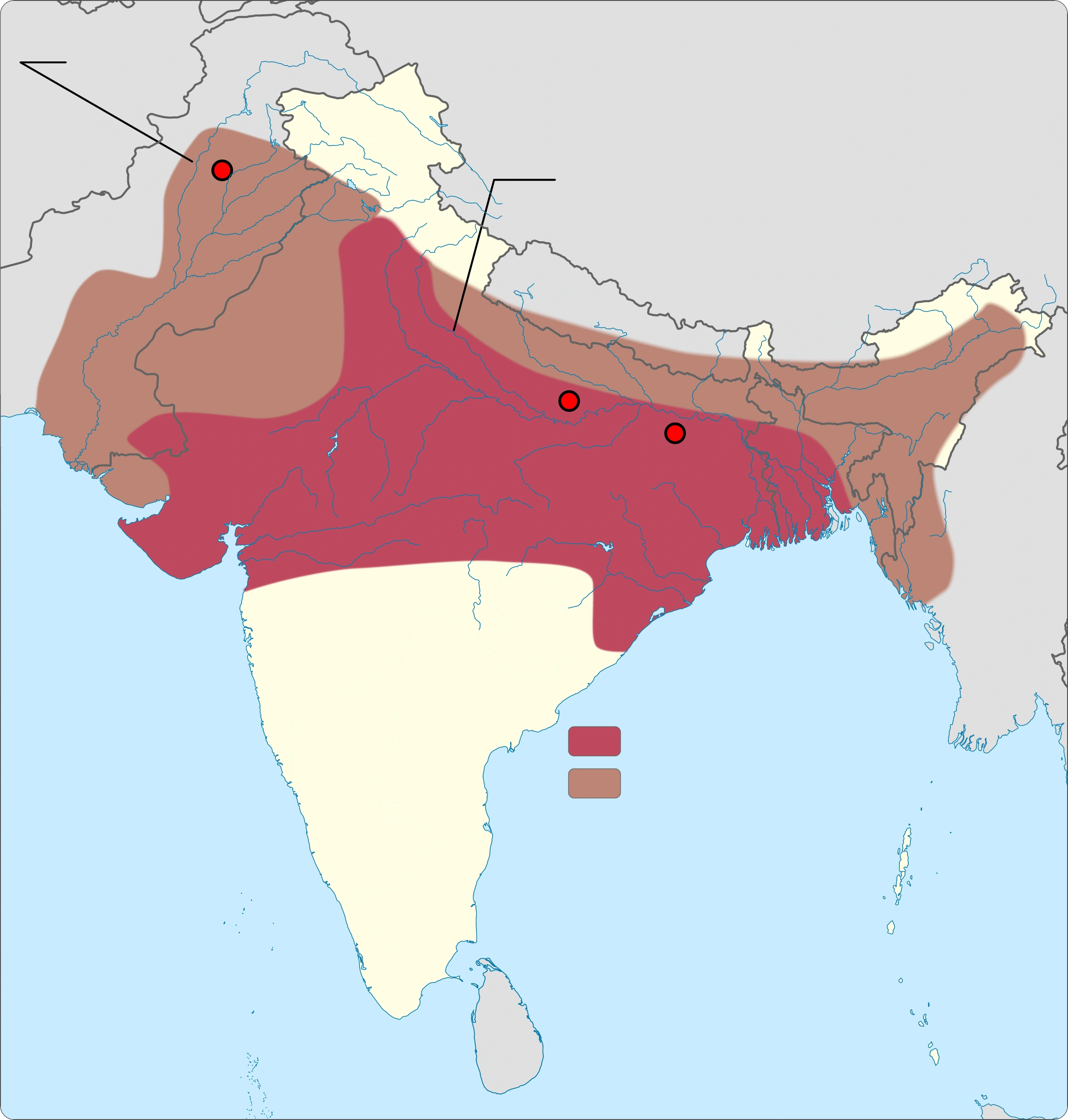
Map study
Gupta Empire and tributaries: use the legend to distinguish direct rule from tributary relationships.
- Read the source date and legend before interpreting territorial extent.
- Compare core regions, neighbouring powers and geographic barriers; historical borders and influence are approximate and changed over time.
Credit: Goran tek-en · CC BY-SA 4.0 · sourceConverted to WebP on an opaque white background; proportionally resized without cropping. Original cartography and legend retained.
1. Sources and the economic setting
The Gupta Empire emerged in the fourth century CE and exercised its strongest influence over northern and parts of central India. Its economic history must be reconstructed from inscriptions, coins, seals, archaeological remains and literary texts. These sources illuminate different activities: royal coins communicate sovereignty, copper plates record particular transactions, and excavated settlements reveal production and consumption. No single source provides an empire-wide economic survey.
Important evidence includes the Damodarpur copper plates of northern Bengal, the Mandsaur inscription of silk weavers and the Junagadh inscription recording repairs to Sudarshana Lake under Skandagupta. Dharmashastra texts discuss property, inheritance, debt and taxation, but prescribe ideal arrangements rather than necessarily describing everyday practice. Faxian, who travelled in India around 399–414 CE, supplies valuable observations, although his account is geographically selective and shaped by his Buddhist interests.
The traditional description of Gupta rule as a golden age is most defensible for particular achievements in art, literature and elite culture. It should not be extended automatically to living standards. Royal patronage and rich gold issues coexisted with cultivators' tax obligations, labour demands and social inequalities. For examinations, distinguish evidence of elite wealth from evidence of prosperity across the population.
2. Agriculture, landholding and irrigation
Cultivation supported both the state and most households. Rice was important in wetter eastern regions, while wheat, barley, pulses, oilseeds and other crops reflected local conditions. Cattle supplied draught power and manure. Agricultural expansion involved bringing uncultivated land under the plough, organising settlements and developing water resources. References to different land categories show that productivity, existing cultivation and availability for transfer mattered administratively.
Ownership was not a simple choice between absolute royal ownership and unrestricted private ownership. Rulers claimed revenue and exercised authority over transfers, while cultivators, individual holders, communities and religious beneficiaries possessed different interests in land. Some Damodarpur records show applicants purchasing land through officially supervised procedures before dedicating it to religious purposes. Local records and recognised rights therefore mattered alongside royal sovereignty.
The Damodarpur plates mention measurements such as the kulyavapa and, in certain transactions, a price of three dinaras per kulyavapa. Such figures are local evidence, not universal Gupta prices or standard acreages. Transactions could involve checking whether the proposed transfer conflicted with existing claims or fiscal interests. Religious dedication was therefore embedded in an administrative and agrarian setting.
Rainfall remained fundamental, but irrigation reduced agricultural risk. Wells, tanks and reservoirs supplemented natural water supplies. The restoration of Sudarshana Lake in Saurashtra after damage in 455–456 CE illustrates official involvement in maintaining a major water resource. It demonstrates the importance of infrastructure, but does not establish that all irrigation was centrally constructed or managed.
One possible economic pathway of a revenue-bearing land grant
- 1. Ruler authorises a grant with specified rights and exemptions
- 2. Beneficiary receives land or designated revenue claims
- 3. Cultivation and settlement may expand
- 4. Produce, dues or services support the beneficiary
- 5. Control over rural surplus becomes more locally differentiated
3. Revenue, land grants and cultivators
Bhaga denoted the ruler's share of agricultural produce. One-sixth is a frequently cited normative share in ancient texts, but actual demands varied with locality, time and additional dues. Other fiscal terms include bhoga, kara, hiranya, uparikara and udranga. Their meanings are not always uniform or securely established: hiranya is commonly associated with monetary payment, while bhoga may indicate supplies or customary provisions. Avoid treating every term as a precisely defined empire-wide tax.
Grants to Brahmanas and religious establishments became increasingly important. Agrahara commonly denotes a privileged Brahmana land grant or settlement. Depending on their terms, grants could provide revenue exemptions, assign income to beneficiaries or restrict interference by royal officials. Their implications must be read inscription by inscription: not every Gupta grant conveyed identical fiscal, administrative or judicial powers.
Land grants served several purposes. They supported religious merit and political legitimacy, rewarded beneficiaries and could promote cultivation in new areas. However, assigning revenue to intermediaries could reduce direct royal access to resources and increase the layers of claims over rural producers. Vishti, or compulsory labour, is another important institution. It should be distinguished from slavery, although it could impose substantial burdens.
These developments underlie the debate about Indian feudalism. R. S. Sharma emphasised land grants, dependent peasants, labour obligations and declining trade in explaining early medieval change. Other historians stress regional variation, continuing exchange and the integrative role of grants. The balanced conclusion is that Gupta institutions contributed to later transformations, not that a uniform European-style feudal order appeared everywhere at once.
| Evidence | Economic significance | Interpretive caution |
|---|---|---|
| Damodarpur copper plates | Land prices, transfer procedures and local administrative participation | Northern Bengal evidence cannot automatically be generalised across the empire |
| Mandsaur silk-weavers inscription | Guild migration, collective wealth and religious patronage | One successful guild does not represent all artisans |
| Junagadh inscription of Skandagupta | Repair of Sudarshana Lake and official attention to water infrastructure | Does not prove universal state control of irrigation |
| Gupta gold and silver coins | Royal authority, high-value exchange and regional monetary practices | Coin abundance is not equivalent to mass prosperity |
| Faxian's account | Observations on social conditions and the use of cowries | Selective travel evidence rather than a comprehensive survey |
4. Crafts, guilds and commercial networks
Textile manufacture, metalworking, pottery, ivory working and other crafts supplied everyday and elite demand. The iron pillar at Mehrauli, generally associated with the Gupta age, demonstrates sophisticated ironworking. Nevertheless, a monumental technical achievement cannot by itself establish the scale of ordinary industrial output. Production took place through households, specialised artisans and occupational organisations.
Shrenis, or guilds, helped organise particular crafts and trades. Inscriptions show that some could hold funds and maintain continuing obligations. An endowment might entrust capital to a guild in return for regular supplies to a shrine. Such arrangements reveal credit-like and deposit functions, but describing guilds as modern banks would be misleading. Their operations were connected to occupational solidarity, reputation and local institutions.
Damodarpur records name figures such as the nagarashreshthin, sarthavaha and prathama-kulika in district-level administration. These titles are generally associated with a leading urban merchant or banker, a caravan merchant and a chief artisan respectively. Their participation indicates the institutional standing of commercial and artisanal interests. The Mandsaur silk weavers also demonstrate occupational mobility and collective religious patronage.
Trade linked agrarian hinterlands with towns, pilgrimage centres and ports. Gujarat and the western coast participated in Indian Ocean exchange, while eastern connections involved Bengal and routes towards Southeast Asia. Changes in Roman demand affected older trade patterns, but overseas commerce did not simply stop after the early centuries CE. Some towns contracted, whereas other centres remained active or gained importance.
5. Coinage, monetisation and historical interpretation
Gupta rulers issued celebrated gold dinaras bearing royal portraits, deities and types such as the archer, horse sacrifice and musician. These coins advertise political authority and ritual claims as well as facilitating high-value payments. Their weight and gold content varied across reigns and issues. Coin finds are consequently valuable evidence, but must be assessed through chronology, distribution and metallurgical study.
Silver coinage became important in western territories after Chandragupta II defeated the Western Kshatrapas around the beginning of the fifth century. Gupta silver issues adapted established regional conventions. Copper coins were comparatively limited in the surviving record. Faxian refers to cowries in exchange, reminding us that everyday transactions could operate through media quite different from royal gold currency.
The coexistence of gold coins, cowries, payments in kind and locally recorded monetary valuations suggests uneven monetisation. Gold might circulate among rulers, military elites, merchants and religious beneficiaries without becoming the normal medium of village transactions. Likewise, a decline in particular coin types does not automatically prove the disappearance of markets, since other payment arrangements could continue.
For Prelims, the most useful framework connects agriculture, revenue, grants, guilds and coins while keeping their evidence distinct. Gupta economic history reveals active exchange alongside an overwhelmingly agrarian base. Its early medieval significance lies in changing control over rural surplus and the expansion of landed religious institutions, rather than in a single, simultaneous collapse of trade, towns and state power.
Real-world case studies
Mandsaur silk weavers: mobility and corporate patronage
An inscription from Dashapura, modern Mandsaur in Madhya Pradesh, records silk weavers who migrated from Lata in western India. Their guild built a Sun temple in 437–438 CE and repaired it in 473–474 CE. The record illustrates artisan mobility, sustained corporate identity and investment of occupational wealth in religious patronage. It complicates any claim that Gupta-period craft groups were uniformly immobile or commercially inactive.
Sudarshana Lake: infrastructure across dynasties
Sudarshana Lake near Girnar in Gujarat originated under Mauryan authority and was repaired under the Western Kshatrapa ruler Rudradaman. Skandagupta's Junagadh inscription records another restoration in 455–456 CE, undertaken by Chakrapalita, son of the provincial governor Parnadatta. The reservoir illustrates long-term dependence on maintained infrastructure and the political importance of protecting water supplies.
Previous year questions
No source-linked PYQ is available here yet. Use the practice questions below.
Practice questions
Practice MCQ 1
With reference to the Gupta economy, consider the following statements: 1. Abundant gold coinage necessarily indicates that ordinary village transactions were predominantly conducted in gold. 2. Damodarpur copper plates provide evidence of officially supervised land transactions. 3. Some guilds accepted endowments linked to continuing religious obligations. Which of the statements given above are correct?
- A. 1 and 2 only
- B. 2 and 3 only
- C. 1 and 3 only
- D. 1, 2 and 3
Practice MCQ 2
Which one of the following pairs is correctly matched?
- A. Vishti — Compulsory labour
- B. Kulyavapa — A category of gold coin
- C. Sarthavaha — A royal irrigation reservoir
- D. Shreni — The ruler's customary share of agricultural produce
Practice MCQ 3
Consider the following statements about Gupta-period economic evidence: 1. The Mandsaur silk-weavers inscription records artisan migration and collective temple patronage. 2. Gupta silver coinage in western India drew upon Western Kshatrapa conventions. 3. Sudarshana Lake was first constructed under Skandagupta. Which of the statements given above are correct?
- A. 1 only
- B. 2 and 3 only
- C. 1 and 2 only
- D. 1, 2 and 3
Mains practice · The Gupta economy combined commercial sophistication with changes that contributed to early medieval agrarian structures. Discuss with reference to inscriptions and coinage. Answer in 250 words.
- Establish agriculture and land revenue as the economic foundation.
- Use Damodarpur plates to explain land transfers and local institutions.
- Discuss grants, fiscal privileges and vishti without assuming uniform provisions.
- Use Mandsaur guild activity and coinage to demonstrate continuing exchange.
- Distinguish high-value gold circulation from everyday monetisation.
- Present the Indian feudalism debate and conclude with regional variation and gradual change.
Further reading
- R. S. Sharma, India's Ancient Past, Oxford University Press.
- Upinder Singh, A History of Ancient and Early Medieval India, Pearson.
- NCERT, Themes in Indian History, Part I: Kings, Farmers and Towns.
- Archaeological Survey of India, Corpus Inscriptionum Indicarum, Volume III: inscriptions of the early Gupta kings.
- Reserve Bank of India, Monetary Museum: Indian coinage and monetary history.
Preparing for UPSC Civil Services? Get classroom teaching, answer-writing evaluation and mentorship at Pragnya IAS Academy, Ashok Nagar — see why aspirants choose us for IAS coaching in Hyderabad.