

Asoka pillar at Allahabad in India
Credit: Rust, Thomas Alfred (1841 - 1904) · Public domain · source

Junagadh rock inscription of Skandagupta
Credit: Ministry of Culture · Public domain · source
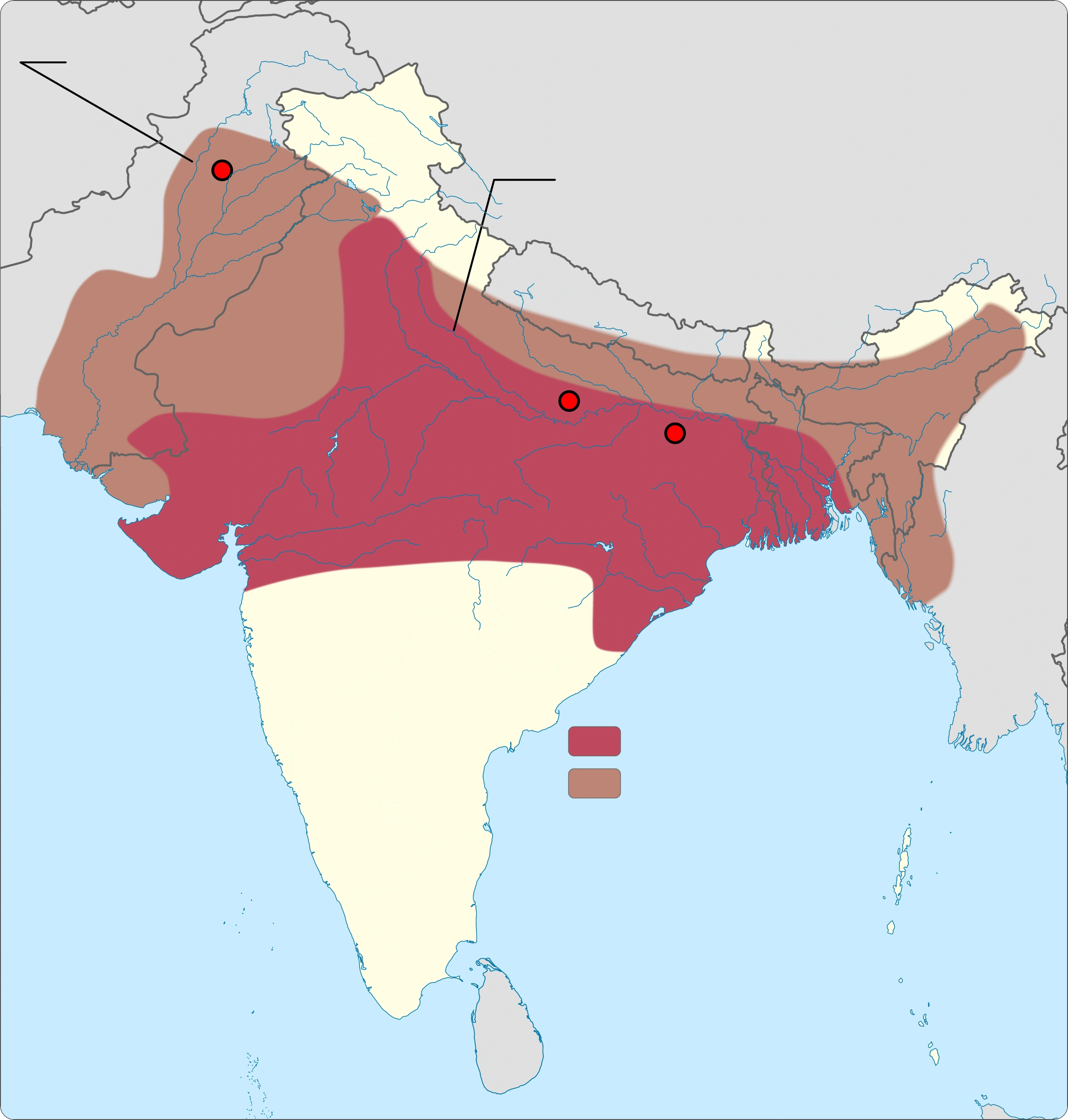
Map study
Gupta Empire and tributaries: use the legend to distinguish direct rule from tributary relationships.
- Read the source date and legend before interpreting territorial extent.
- Compare core regions, neighbouring powers and geographic barriers; historical borders and influence are approximate and changed over time.
Credit: Goran tek-en · CC BY-SA 4.0 · sourceConverted to WebP on an opaque white background; proportionally resized without cropping. Original cartography and legend retained.
1. Sources and the character of Gupta rule
Gupta administration must be reconstructed from scattered evidence rather than from a surviving administrative manual. Important sources include the Prayaga Prashasti of Samudragupta, the Damodarpur copper plates, the Junagadh inscription of Skandagupta, seals from Vaishali and royal coinage. Dharmashastra texts explain normative ideas about kingship, taxation and justice, but should not automatically be treated as descriptions of actual practice.
The Prayaga Prashasti, composed by Harishena, presents an empire with different degrees of control. Some northern rulers were defeated and their territories incorporated; defeated rulers of Dakshinapatha were released and reinstated. Frontier rulers and other political communities acknowledged supremacy through tribute, obedience and attendance. Consequently, the boundaries of imperial influence were wider than those of direct administration.
Compared with the Mauryan ideal of close bureaucratic supervision, Gupta government allowed greater space for local elites and subordinate powers. Nevertheless, describing it simply as weak or completely decentralised is misleading. Royal appointments, military campaigns, provincial oversight and documented land transactions show continuing imperial authority. Administrative arrangements also differed between the Gangetic heartland, Bengal and western India.
- Source caution: prashastis celebrate royal achievements and require critical reading.
- Exam distinction: political suzerainty did not necessarily mean direct territorial administration.
2. Kingship, central officials and military organisation
Kingship was normally hereditary, although succession was not invariably governed by strict primogeniture. Titles such as Maharajadhiraja and Paramabhattaraka expressed imperial superiority. Religious imagery, royal genealogies and ceremonies such as Samudragupta’s ashvamedha strengthened legitimacy. The king was expected to protect subjects, uphold dharma, dispense justice and maintain political order.
Ministers and high officers assisted the ruler, but their titles cannot always be mapped onto modern departments. Kumaramatya designated an important category of officers serving in different contexts, not simply the king’s son. Sandhivigrahika was associated with peace, war and diplomatic affairs. Mahadandanayaka indicated a high command or authority connected with coercive functions; its precise responsibilities require contextual interpretation.
Harishena illustrates the concentration of offices: the Prayaga inscription identifies him as kumaramatya, sandhivigrahika and mahadandanayaka. Some offices also passed within families. These practices could strengthen influential service lineages, although neither hereditary recruitment nor the combination of offices was universal.
Military power rested on forces under royal control as well as support from subordinate rulers. Infantry, cavalry and elephants were important. Coins depicting kings with weapons reinforce a martial image, but are not reliable numerical evidence for army composition. Gupta forces should therefore not be reconstructed mechanically from Mauryan descriptions or epic military classifications.
Illustrative land-purchase procedure in Bengal copper-plate records
- 1. Applicant requests purchase of specified land
- 2. Record keepers verify its status and availability
- 3. Administrative authority approves the transaction
- 4. Required payment is made
- 5. Boundaries and transfer are formally recorded
3. Provinces, districts and local institutions
A bhukti was a major provincial division, commonly administered by an uparika. Districts were generally called vishayas and were associated with a vishayapati. Below them lay smaller territorial units and villages; terms such as vithi occur in particular regions. This hierarchy is best understood through inscriptions, not assumed to have existed identically everywhere.
The Damodarpur records describe Kotivarsha-vishaya within Pundravardhana-bhukti. District administration involved an adhikarana, or administrative body. Named participants included the nagara-shreshthin, a leading banker or merchant; the sarthavaha, associated with caravan merchants; the prathama-kulika, a leading artisan; and the prathama-kayastha, a chief scribe. Their presence demonstrates the administrative importance of commercial, craft and scribal elites.
These bodies were not elected municipal councils in the modern democratic sense. Their membership reflected social and economic standing, while their actions remained connected to provincial and royal authority. Likewise, references to guilds do not establish that every guild controlled a town’s government.
At village level, headmen, elders and locally prominent landholders helped manage affairs, identify boundaries and participate in transactions. Mahattaras and kutumbins appear in relevant records. Pustapalas maintained or checked documentary information relating to land. Such evidence highlights the importance of written records and local knowledge, while the exact powers of these groups varied by region.
| Term | Usual identification | Qualification |
|---|---|---|
| Bhukti | Province | Often associated with an uparika |
| Vishaya | District | Commonly associated with a vishayapati |
| Kumaramatya | High-ranking officer | Not necessarily a prince |
| Sandhivigrahika | Officer concerned with peace and war | Could hold additional offices |
| Pustapala | Record keeper | Important in documented land transactions |
4. Revenue, land transactions and justice
Agricultural surplus was a major foundation of state revenue. Bhaga denoted the ruler’s share of produce; one-sixth is a frequently cited normative rate, not a proven uniform assessment across the empire. Terms such as bhoga, kara, uparikara and udranga also occur in fiscal discussions and inscriptions. Their meanings depended on context, so fixed translations should be used cautiously.
Revenue could be collected in produce or money, and trade-related levies added to state resources. Gupta gold coins demonstrate important monetary activity, but do not prove that all taxes or salaries were paid in gold. Vishti, or compulsory labour, was another burden imposed on people and could serve public or official requirements.
Land transfers often required procedural checks. Bengal copper plates record applications to acquire land, verification by record keepers, payment where a sale was involved, demarcation and authorisation. A purchased plot subsequently dedicated to a religious purpose should not be confused with a direct royal donation of land. The legal character of each transaction must be established from its wording.
Justice was associated with the king and his officers, while family, guild and local institutions could handle certain disputes. Faxian, who travelled in India in the early fifth century, described relatively mild government in the regions he observed. His account is valuable but cannot establish empire-wide rules or prove the complete absence of severe punishment.
5. Land grants and early medieval foundations
Grants to Brahmanas and religious institutions could transfer revenue claims, specify exemptions and sometimes restrict the entry of royal personnel. The rights conveyed differed between charters and periods. Revenue exemption, administrative immunity and judicial authority are separate privileges and should not be assumed to occur together in every grant.
Such arrangements helped extend cultivation, support religious establishments and integrate local elites into political networks. They could also reduce direct royal access to revenue and increase the authority of beneficiaries over cultivators. Hereditary offices and reliance on subordinate rulers created additional intermediaries between the ruler and rural society.
Historians have connected these developments with Indian feudalism, particularly through arguments about land grants, dependent peasants and decentralisation. The interpretation remains debated because monetisation, trade, regional institutions and the extent of transferred rights varied. Gupta administration is best viewed as an important foundation for early medieval changes, not as a fully formed and uniform feudal system.
The later samanta order should likewise not be projected backwards unchanged. Subordinate rulers existed under the Guptas, but the term samanta and its institutional significance evolved. A strong examination answer separates evidence for Gupta-period practices from developments that became more prominent after Gupta imperial decline.
Real-world case studies
Damodarpur: local elites within imperial administration
Fifth-century Damodarpur copper plates from Bengal connect provincial authority, district administration and local economic elites. Their land-transaction procedures show that decentralisation could coexist with documentary scrutiny and formal approval.
Sudarshana lake: provincial responsibility for public works
Skandagupta’s Junagadh inscription records the repair of Sudarshana lake’s damaged embankment by Chakrapalita, son of Parnadatta, the royal governor of Saurashtra. It demonstrates provincial responsibility for infrastructure and the continuing reach of imperial appointments.
Previous year questions
No source-linked PYQ is available here yet. Use the practice questions below.
Practice questions
Practice MCQ 1
With reference to Gupta administration, consider: 1. Bhukti commonly denoted a province. 2. Kumaramatya necessarily meant the king’s son. 3. Pustapalas were associated with land records. Which statements are correct?
- A. 1 and 2 only
- B. 1 and 3 only
- C. 2 and 3 only
- D. 1, 2 and 3
Practice MCQ 2
The participation of a nagara-shreshthin, sarthavaha and prathama-kulika in district administration primarily indicates:
- A. Universal adult franchise in Gupta towns
- B. Complete independence of guilds from the king
- C. Participation of economic elites in administration
- D. Replacement of district officers by Buddhist monks
Practice MCQ 3
Which statement about Gupta-period land grants is most accurate?
- A. Every grant transferred complete judicial sovereignty
- B. Every religious endowment originated as a royal donation
- C. All grants abolished cultivators’ obligations
- D. The rights conveyed must be established from each charter
Mains practice · Gupta administration combined imperial authority with powerful regional and local intermediaries. Discuss with reference to inscriptional evidence. (250 words)
- Distinguish direct rule from tributary relationships using the Prayaga Prashasti.
- Explain royal officials, provinces and districts.
- Use Damodarpur to demonstrate elite participation and record-based administration.
- Use Junagadh to illustrate provincial public works.
- Assess land grants and hereditary offices without assuming uniform decentralisation.
- Conclude with continuity and change towards early medieval political structures.
Further reading
- R. S. Sharma, India’s Ancient Past, Oxford University Press.
- Upinder Singh, A History of Ancient and Early Medieval India.
- NCERT, Our Pasts–I, chapter New Empires and Kingdoms.
- Corpus Inscriptionum Indicarum, Volume III, Inscriptions of the Early Gupta Kings and Their Successors.
- Epigraphia Indica, editions and studies of the Damodarpur copper-plate inscriptions.
Preparing for UPSC Civil Services? Get classroom teaching, answer-writing evaluation and mentorship at Pragnya IAS Academy, Ashok Nagar — see why aspirants choose us for IAS coaching in Hyderabad.