
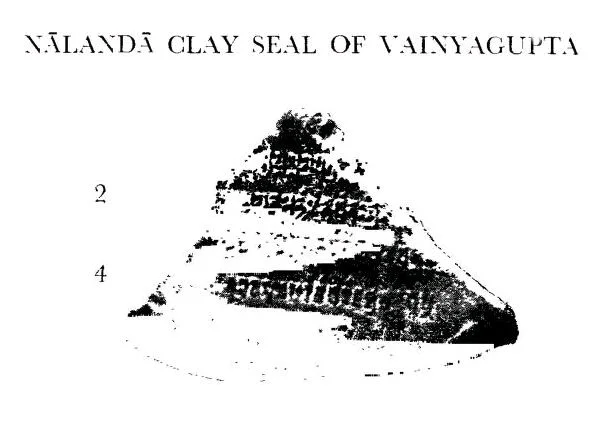
Clay seal attributed to Vainyagupta from Nalanda, according to the supplied metadata.
Credit: John Faithfull Fleet (1847 –1917) · Public domain · sourceResized and converted to WebP; uncropped.
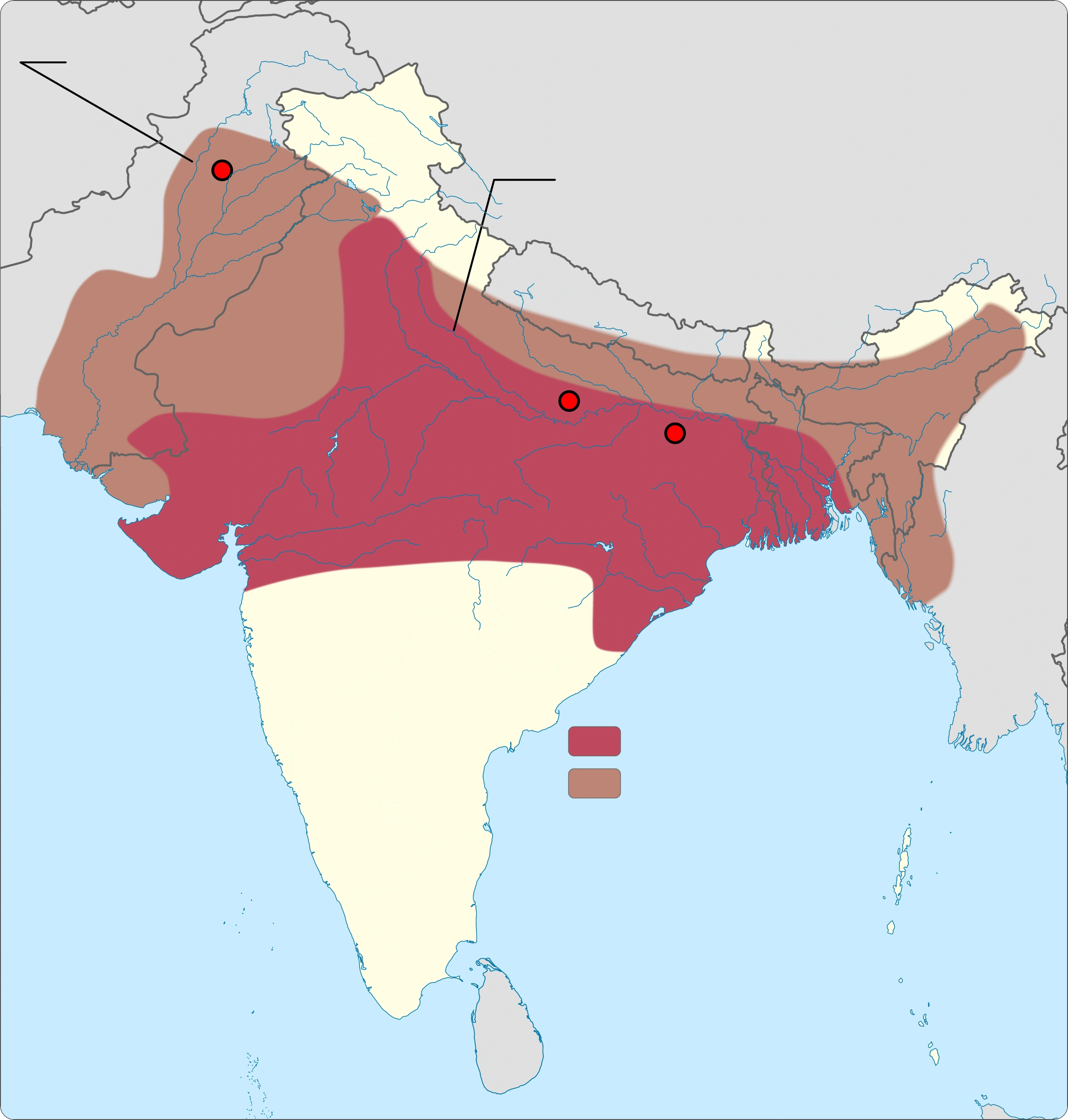
Map study
Gupta Empire and tributaries: use the legend to distinguish direct rule from tributary relationships.
- Read the source date and legend before interpreting territorial extent.
- Compare core regions, neighbouring powers and geographic barriers; historical borders and influence are approximate and changed over time.
Credit: Goran tek-en · CC BY-SA 4.0 · sourceConverted to WebP on an opaque white background; proportionally resized without cropping. Original cartography and legend retained.
1. Origins, chronology and historical sources
Gupta political origins remain debated. The dynasty emerged in the middle Gangetic region, but proposals locating its earliest homeland specifically in eastern Uttar Pradesh, Magadha or Bengal are not conclusively established. Later genealogies identify Sri Gupta and Ghatotkacha as predecessors of Chandragupta I. Both bore the title Maharaja, whereas Chandragupta I adopted Maharajadhiraja, indicating a more ambitious claim to sovereignty. Their precise territories and relationship with contemporary powers are uncertain.
Chandragupta I, conventionally dated to about 319–335 CE, married Kumaradevi of the Lichchhavi lineage. The alliance strengthened Gupta prestige and probably aided territorial consolidation, although its exact political benefits cannot be reconstructed. Coins depicting the royal couple and bearing the name of the Lichchhavis advertise this connection. Samudragupta’s description as Lichchhavi-dauhitra, or daughter’s son of the Lichchhavis, further highlights its importance. The Gupta era began in 319–320 CE; its association with Chandragupta I’s accession is conventional rather than explicitly recorded in a contemporary foundation account.
Gupta history rests on inscriptions, coins, seals, archaeology and literary testimony. Royal prashastis praise achievements and must not be read as neutral chronicles. The Prayaga Prashasti, Mehrauli iron-pillar inscription, Junagadh inscription and Bhitari pillar inscription are major sources. Copper-plate charters illuminate land transactions and administration. Faxian offers valuable observations on Buddhist institutions and society, but his religious interests and travel route limit the geographical representativeness of his account.
- Prelims distinction: Chandragupta I was a Gupta ruler; Chandragupta Maurya founded the Mauryan Empire several centuries earlier.
- Regnal dates are approximate, especially for the earliest and later Gupta rulers.
Timeline
319–320 CE
Beginning of the Gupta era, conventionally linked to Chandragupta I.
c. 335–375 CE
Samudragupta expands Gupta power through northern conquests and a southern expedition.
c. 375–415 CE
Chandragupta II defeats the Western Kshatrapas; Faxian visits India.
c. 415–455 CE
Kumaragupta I maintains the empire.
c. 455–467 CE
Skandagupta confronts military threats and oversees restoration of the Sudarshana lake.
Late fifth–sixth centuries CE
Huna expansion and regional political fragmentation accompany Gupta imperial decline.
2. Samudragupta: conquest and differentiated sovereignty
Samudragupta, who ruled approximately from 335 to 375 CE, greatly expanded Gupta power. His main political record is the Prayaga Prashasti, also called the Allahabad Pillar inscription. Harishena, its composer, served as a senior official and held the office of sandhivigrahika, associated with peace and war. The Sanskrit eulogy occupies a pillar that also carries Ashokan inscriptions; therefore, the pillar’s original erection must not be attributed to Samudragupta.
The inscription distinguishes several categories of rulers and political relationships. Kings of Aryavarta were defeated and their kingdoms absorbed or brought under more direct control. Twelve rulers of Dakshinapatha were captured and then released or reinstated. These included Vishnugopa of Kanchi. Frontier kingdoms, such as Samatata, Davaka, Kamarupa and Nepala, and various corporate polities acknowledged Gupta superiority through tribute, attendance or obedience. Forest rulers were subordinated, while distant powers maintained diplomatic relations.
This classification demonstrates that Samudragupta did not uniformly annex every region reached by his armies. The southern expedition established prestige and submission without creating continuous Gupta provincial administration across the peninsula. His ashvamedha coins proclaimed sacrificial sovereignty, while lyrist coins depict him playing a stringed instrument. The older description of him as the ‘Napoleon of India’ is a modern comparison, not an ancient title, and obscures the distinctive character of his political arrangements.
- High-yield association: Samudragupta — Harishena — Prayaga Prashasti — differentiated treatment of conquered rulers.
- Political submission, diplomatic contact and direct annexation should not be treated as identical.
Broad trajectory of Gupta political power
- 1. Regional kingdom under early Guptas
- 2. Dynastic consolidation through the Lichchhavi alliance
- 3. Samudragupta’s conquests and tributary relationships
- 4. Chandragupta II’s western expansion and matrimonial diplomacy
- 5. Military pressures and succession problems
- 6. Regionalisation of power during the sixth century
3. Chandragupta II: western expansion and imperial prestige
Chandragupta II, approximately 375–415 CE, consolidated the empire and defeated the Western Kshatrapas, extending Gupta authority into Malwa, Gujarat and adjoining western territories. This improved access to western commercial centres and maritime routes. Gupta silver issues adapted features of Kshatrapa coinage, showing how conquest could be followed by monetary accommodation. Chandragupta II is closely associated with the title Vikramaditya, though that title was used by other rulers and cannot alone establish an identification.
Matrimonial diplomacy complemented warfare. Chandragupta II married the Naga princess Kuberanaga. Their daughter Prabhavatigupta married the Vakataka ruler Rudrasena II and subsequently governed as regent for her sons. Her charters reveal Gupta dynastic prestige within the Vakataka realm, but the Vakatakas remained a separate ruling house rather than simply a Gupta province.
Faxian travelled in India during Chandragupta II’s reign, approximately between 399 and 414 CE, seeking Buddhist texts and disciplinary traditions. The Mehrauli iron-pillar inscription records victories of a king named Chandra, generally identified with Chandragupta II, although the identification is inferential. The Ramagupta episode, known from literary fragments and supported in part by numismatic and inscriptional evidence for a ruler of that name, remains disputed in its details. Similarly, the famous list of nine gems at Vikramaditya’s court should not be treated as a securely established contemporary roster.
- Do not confuse Faxian’s Gupta-period visit with Xuanzang’s seventh-century visit during Harshavardhana’s age.
- Kalidasa is generally placed in the Gupta age, but his exact patron and chronology remain debated.
| Ruler | Key evidence | Principal association |
|---|---|---|
| Chandragupta I | Royal-couple coinage | Lichchhavi marriage alliance |
| Samudragupta | Prayaga Prashasti; lyrist coins | Conquests; musical accomplishment |
| Chandragupta II | Western silver coinage | Defeat of Western Kshatrapas |
| Kumaragupta I | Mahendraditya coin legends | Imperial continuity |
| Skandagupta | Bhitari and Junagadh inscriptions | Military resistance; lake restoration |
4. Kumaragupta I, Skandagupta and imperial contraction
Kumaragupta I, approximately 415–455 CE, maintained a large empire and issued varied coin types. He used the title Mahendraditya, and some coins prominently display Karttikeya and the peacock. The initial foundation of Nalanda Mahavihara is traditionally associated with Shakraditya, often identified with Kumaragupta I; this identification requires qualification rather than categorical assertion.
Skandagupta, approximately 455–467 CE, confronted serious military pressures. His Bhitari pillar inscription describes the restoration of dynastic fortunes and conflict with the Hunas. Its reference to another adversary is conventionally read as Pushyamitras, although the reading has been debated. His Junagadh inscription records the repair of the Sudarshana lake embankment in Saurashtra after storm damage. Parnadatta was the provincial governor, and his son Chakrapalita supervised the local restoration.
After Skandagupta, succession disputes, regional assertion and external incursions contributed to shrinking imperial authority. Later rulers included Purugupta, Budhagupta, Narasimhagupta and Vishnugupta, but their exact sequence and overlapping spheres are not always clear. Huna rulers Toramana and Mihirakula became major powers in parts of northern and central India around the late fifth and early sixth centuries. Gupta imperial power faded during the sixth century; its decline was a prolonged regional process, not a single event caused exclusively by invasion.
- Sudarshana lake connects three periods: construction under the Mauryas, repair under Rudradaman I and restoration under Skandagupta.
- The later Gupta dynasty of Magadha should not automatically be identified as a direct continuation of the imperial Gupta family.
5. Kingship, administration and early medieval foundations
Gupta rulers projected universal sovereignty through titles, sacrifices, genealogy and divine symbolism. Many used the designation Paramabhagavata and Garuda imagery, indicating Vaishnava affiliation. Nevertheless, Buddhist and Jain institutions continued to function. Religious patronage was plural, and individual royal affiliations should not be converted into a claim that all subjects followed a single religion.
Administration combined royal officials with provincial, district and local institutions. Bhukti commonly denoted a province and vishaya a district; uparikas and vishayapatis appear as associated officials. The Damodarpur copper plates from Bengal reveal land transactions and participation by urban notables, including merchants and artisans. Administrative arrangements varied across regions, and the imperial centre relied on subordinate rulers as well as directly administered territories.
Land grants, growing hereditary tendencies in offices and the increasing importance of regional elites helped shape early medieval political structures. These developments were gradual and uneven. The description of the Gupta age as a ‘golden age’ captures major achievements in Sanskrit literature, art and science, but should not imply uniform prosperity or equality. Social hierarchy, gender restrictions and regional differences require equal attention when evaluating the dynasty’s historical significance.
- Exam method: distinguish courtly claims of universal rule from evidence of actual territorial administration.
- Coins indicate political imagery and monetary practices; their abundance alone cannot prove prosperity across all social groups.
Vainyagupta: Reconstructing Later Gupta Rule
The supplied metadata identifies this object as a clay seal of Vainyagupta from Nalanda, making it directly relevant to the study of Gupta rulers. Vainyagupta belongs to the less familiar phase of Gupta history after the major imperial reigns. Such sealings matter because royal names, titles and genealogical statements, where preserved and securely read, can help historians reconstruct succession and political relationships. They supplement the better-known evidence of coins and monumental inscriptions rather than merely illustrating a ruler’s biography.
For Indian history, the key question is how later Gupta authority operated as imperial cohesion weakened. A ruler’s seal associated with Nalanda may contribute to this investigation, but its presence alone does not establish direct rule over the entire surrounding region, continuous possession of an institution, or personal religious allegiance. Those arguments require the published reading, archaeological context and corroborating records. Here, the title and description establish the image’s subject, not the seal’s full inscription or circumstances of discovery. This distinction is especially useful in Mains answers, where material evidence should support a qualified argument rather than an uncritical narrative of either imperial continuity or sudden collapse.
- Separate Vainyagupta from similarly named Gupta rulers; shared name endings do not establish identical reigns or territories.
- Distinguish royal titles and genealogical claims from independently demonstrated political control.
- Use a verified transcription before assigning specific titles, relatives or religious affiliations to this seal.
Real-world case studies
Sudarshana lake: infrastructure across dynasties
The Junagadh records connect one reservoir with Mauryan, Western Kshatrapa and Gupta rule. Skandagupta’s inscription describes restoration through provincial and local officials, illustrating both administrative delegation and the importance of public works to royal legitimacy.
Prabhavatigupta’s regency
Prabhavatigupta’s copper-plate charters foreground her Gupta ancestry while documenting authority within the Vakataka kingdom. They demonstrate the political importance of dynastic marriage and a royal woman’s exercise of power without proving Gupta annexation of the Deccan.
Previous year questions
No source-linked PYQ is available here yet. Use the practice questions below.
Practice questions
Practice MCQ 1
Which ruler is correctly matched with the source associated with him?
- A. Chandragupta I — Aihole inscription
- B. Samudragupta — Prayaga Prashasti
- C. Kumaragupta I — Hathigumpha inscription
- D. Skandagupta — Nasik inscription of Gautami Balashri
Practice MCQ 2
Consider the following statements: 1. Samudragupta reinstated defeated rulers of Dakshinapatha. 2. Chandragupta II defeated the Western Kshatrapas. 3. Faxian visited India during Skandagupta’s reign. Which statements are correct?
- A. 1 and 2 only
- B. 2 and 3 only
- C. 1 and 3 only
- D. 1, 2 and 3
Practice MCQ 3
The Junagadh inscription of Skandagupta is especially important for information about:
- A. The first Buddhist council
- B. The composition of the Arthashastra
- C. Restoration of the Sudarshana lake
- D. The foundation of the Chola navy
Mains practice · Gupta imperial expansion rested on accommodation as well as conquest. Discuss with reference to the policies of Gupta rulers. Answer in 250 words.
- Introduce the distinction between direct annexation and broader political supremacy.
- Explain the Lichchhavi alliance under Chandragupta I.
- Contrast Samudragupta’s Aryavarta and Dakshinapatha policies.
- Discuss frontier tribute and diplomatic relationships.
- Connect Chandragupta II’s western conquest with Vakataka matrimonial diplomacy.
- Conclude with the strengths and limits of a politically differentiated empire.
Further reading
- R. S. Sharma, Ancient India, old NCERT Class XI.
- NCERT, Our Pasts I, chapter New Empires and Kingdoms.
- Upinder Singh, A History of Ancient and Early Medieval India.
- Archaeological Survey of India, Corpus Inscriptionum Indicarum, Volume III: inscriptions of the early Gupta kings.
- National Museum, New Delhi: numismatic collections and Gupta coin displays.
- https://commons.wikimedia.org/wiki/File:Nalanda_clay_seal_of_Vainyagupta.jpg
Preparing for UPSC Civil Services? Get classroom teaching, answer-writing evaluation and mentorship at Pragnya IAS Academy, Ashok Nagar — see why aspirants choose us for IAS coaching in Hyderabad.