
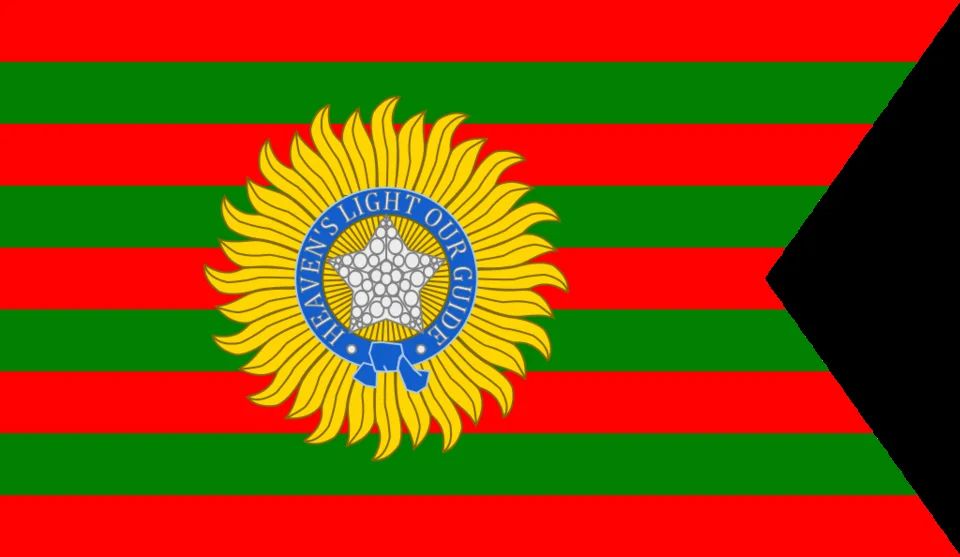
Illustrative rendering identified as a Home Rule Movement flag variant with the Star of India.
Credit: Bharata-indstar · CC BY-SA 4.0 · sourceResized and converted to WebP; uncropped.
Historical setting and the meaning of Home Rule
The Home Rule Movement emerged during a period of organisational weakness in Indian nationalism. The Surat split of 1907 had separated the Moderates and Extremists, while repression following the Swadeshi movement had restricted political activity. The Indian Councils Act, 1909 expanded legislative councils but did not establish responsible government. Annual Congress meetings and constitutional petitions appeared inadequate to nationalists seeking continuous political mobilisation.
The First World War, beginning in 1914, created a new setting. India supplied troops, money and materials to the British war effort, strengthening expectations of political concessions. Wartime taxation, rising prices and economic disruption widened discontent. Britain’s language of liberty and the rights of nations also offered Indian leaders an argument against colonial subordination.
Drawing inspiration from Irish Home Rule, the movement sought Indian control over domestic government while retaining a connection with the British Empire. It was therefore distinct from both revolutionary attempts to overthrow British rule and the later Congress objective of purna swaraj. Its central innovation was sustained public agitation: self-government was presented as a political right, rather than a reward that Indians should passively await for wartime loyalty.
Timeline
June 1914
Tilak returned after imprisonment at Mandalay.
April 1916
Tilak established his Home Rule League at Belgaum.
September 1916
Besant formally launched her Home Rule League at Madras.
December 1916
The Lucknow Congress witnessed Moderate–Extremist reunion and the Congress–League agreement.
June–September 1917
Besant’s internment triggered protests; she was released in September.
20 August 1917
The Montagu Declaration announced responsible government as a gradual policy objective.
1918–1920
The agitation declined; Gandhi later assumed leadership of the All India Home Rule League, renamed the Swarajya Sabha in 1920.
Tilak, Besant and the two leagues
Bal Gangadhar Tilak returned to India in June 1914 after imprisonment at Mandalay. He sought to rebuild nationalist activity and restore cooperation with Congress leaders. Annie Besant, an Irish-born theosophist and political activist, had meanwhile emerged as a forceful advocate of Indian self-government. Her association with the Theosophical Society, headquartered at Adyar in Madras, gave her access to an existing network, although the society and the Home Rule League were separate organisations.
Tilak established his league in April 1916 at Belgaum. Its area included Maharashtra except Bombay city, Karnataka, the Central Provinces and Berar. Organised into six branches, it relied on speaking tours, pamphlets and local workers. Tilak connected self-government with education in Indian languages and argued against caste exclusion and untouchability. His agitation was not simply a continuation of religiously framed political mobilisation.
Besant formally founded her league in September 1916, with Madras as its principal centre. It operated in the rest of India, including Bombay city. The two leagues were not rival organisations: their territorial division limited duplication and enabled cooperation. Besant’s associates included George Arundale and B. P. Wadia. The movement also drew younger nationalists, including Jawaharlal Nehru, into more active politics.
From political stagnation to renewed mobilisation
- 1. Post-Surat divisions and dissatisfaction with the 1909 reforms
- 2. Wartime pressures and rising expectations of self-government
- 3. Formation of two cooperating Home Rule Leagues in 1916
- 4. Political education through branches, newspapers and meetings
- 5. Repression and protests broaden nationalist participation in 1917
- 6. Reform debates and leadership difficulties contribute to decline
Programme, methods and social reach
The leagues sought to make the demand for self-government a familiar public issue. They organised lectures, public meetings, discussion groups, reading rooms and libraries. Pamphlets explained colonial economic exploitation, the shortcomings of existing political institutions and the advantages of representative government. Vernacular publication helped political arguments travel beyond a narrowly English-speaking audience.
Newspapers were central to this work. Besant used New India and Commonweal, while Tilak’s political journalism through Kesari and The Mahratta supported nationalist mobilisation. Local branches offered an organisational framework between major political conferences. Campaigning thus became more continuous and decentralised than a politics confined to resolutions at annual Congress sessions.
The movement remained predominantly constitutional and agitational. It did not launch a nationwide programme of refusing taxes, withdrawing from government institutions or violating colonial laws comparable to later Gandhian movements. Nevertheless, its insistence on self-government as a right made it more assertive than earlier petition-based politics. Lawyers, students, teachers, journalists and other educated groups formed its main support. Outreach extended into smaller towns and some rural areas, but most peasants and industrial workers were not organised as autonomous social constituencies. Its expanded reach should therefore not be mistaken for a fully developed mass movement.
| Feature | Tilak’s league | Besant’s league |
|---|---|---|
| Formal establishment | April 1916, Belgaum | September 1916, Madras |
| Territorial sphere | Maharashtra excluding Bombay city; Karnataka; Central Provinces; Berar | Remaining India, including Bombay city |
| Associated newspapers | Kesari and The Mahratta | New India and Commonweal |
| Organisation | Six branches supported by tours and local workers | Wider branch network, drawing partly on theosophical contacts |
| Common objective | Self-government within the British Empire | Self-government within the British Empire |
Congress reunion, repression and the constitutional response
The movement contributed to the political atmosphere surrounding the Lucknow Congress of December 1916. Moderates and Extremists reunited, while Congress and the Muslim League agreed on a joint constitutional scheme through the Lucknow Pact. These were related but distinct developments: Congress reunion ended an internal organisational division; the pact represented an agreement between two political organisations and accepted separate electorates for Muslims.
The colonial government responded to Home Rule agitation with restrictions on meetings, publications and the movement of leaders. In June 1917, the Madras government interned Besant, B. P. Wadia and George Arundale. The action provoked protests and drew previously hesitant leaders towards the campaign. Repression temporarily enlarged the movement’s appeal by turning civil liberties and the treatment of its leaders into public issues.
On 20 August 1917, Secretary of State Edwin Montagu announced the policy of progressively realising responsible government in India within the British Empire. The declaration reflected several pressures, including wartime circumstances and nationalist agitation; it should not be attributed solely to the leagues. It offered neither immediate responsible government nor a fixed timetable. Besant’s release in September and her election as Congress president at Calcutta in December marked the high point of her national prominence.
Decline, limitations and historical significance
The movement lost momentum during 1918. The promise of constitutional reform encouraged some Moderate supporters to adopt a wait-and-see approach. Disagreements arose over how to respond to the Montagu–Chelmsford proposals published in 1918. Besant’s shifting position on reform and further agitation weakened organisational direction. Tilak’s departure for England in connection with his libel case against Valentine Chirol also removed an important leader from day-to-day campaigning.
Its organisational limitations became clearer as political conditions changed. Branch activity was uneven, leadership remained heavily dependent on prominent individuals, and the leagues lacked a broad programme addressing the immediate demands of peasants and workers. The Rowlatt agitation of 1919 and Gandhi’s subsequent Non-Cooperation Movement shifted nationalism towards larger-scale mobilisation using different methods.
Nevertheless, the leagues helped overcome political stagnation, popularised self-government and trained organisers who participated in subsequent campaigns. They strengthened links between provincial centres and national politics and helped restore cooperation across older Congress divisions. In 1920, Gandhi became president of the All India Home Rule League, which was renamed the Swarajya Sabha. For examination purposes, the movement is best understood as a bridge between Swadeshi-era nationalism and Gandhian mass politics, not as either an immediate independence campaign or merely an extension of Moderate petitioning.
Home Rule: Symbols, Self-Government and Political Mobilisation
The supplied metadata identifies this image as a flag of the Indian Home Rule Movement, specifically a variant associated with the Star of India. It is directly relevant as an illustration of nationalist political symbolism. Flags could give a shared identity to campaigns organised through meetings, newspapers and local branches. However, this digital rendering alone cannot establish when, where or how widely this particular variant was used, or whether it enjoyed uniform acceptance across the movement.
The leagues associated with Bal Gangadhar Tilak and Annie Besant demanded self-government within the British Empire, rather than the later Congress goal of complete independence. Their significance lay in making constitutional demands the subject of sustained public mobilisation beyond annual Congress sessions. Symbolic identification should therefore be connected with political education and organisation, not treated as evidence of universal popular participation. The movement helped revive nationalist activity and encouraged cooperation across political divisions, while its reach remained uneven.
- Prelims distinction: Home Rule meant self-government within an imperial framework; do not equate it with the later Purna Swaraj demand.
- Organisational distinction: Tilak and Besant led separate leagues with broadly complementary areas of activity, not a single centrally unified organisation.
- Evidence and Mains use: A flag illustrates political identity; assess mobilisation through corroborating records of branches, publications, meetings and participation.
Real-world case studies
Besant’s internment: repression and mobilisation
The Madras government’s internment of Besant and her associates in June 1917 sought to contain agitation. Instead, it generated meetings, resolutions and wider support for Home Rule. The episode shows how repression could temporarily unite nationalists, although protest over a leader’s detention did not automatically create a durable mass organisation.
Lucknow, 1916: two forms of political cooperation
At Lucknow, Congress reunited its Moderate and Extremist wings while also reaching an agreement with the Muslim League. The Home Rule campaign helped create a cooperative atmosphere, but the two outcomes must be distinguished. The Lucknow Pact included Congress acceptance of separate electorates, illustrating both the possibilities and longer-term complications of negotiated political unity.
Previous year questions
No source-linked PYQ is available here yet. Use the practice questions below.
Practice questions
Practice MCQ 1
With reference to the Home Rule Leagues, consider the following statements: 1. Tilak’s league was established before Besant’s league. 2. Bombay city fell within Besant’s territorial sphere. 3. Both leagues demanded immediate separation from the British Empire. Which statements are correct?
- A. 1 and 2 only
- B. 2 and 3 only
- C. 1 and 3 only
- D. 1, 2 and 3
Practice MCQ 2
Which pair of newspapers was associated with Annie Besant’s Home Rule campaign?
- A. Kesari and The Mahratta
- B. New India and Commonweal
- C. Young India and Harijan
- D. Al-Hilal and Al-Balagh
Practice MCQ 3
The Montagu Declaration of 20 August 1917 is best described as:
- A. An immediate grant of dominion status to India
- B. A commitment to progressive responsible government within the British Empire
- C. The legislation that introduced provincial autonomy under the Government of India Act, 1935
- D. An acceptance of complete independence within a fixed timetable
Mains practice · The Home Rule Movement formed a bridge between Swadeshi-era nationalism and Gandhian mass politics. Discuss its contribution and limitations. Answer in 250 words.
- Set the context: the Surat split, repression, limited reforms and the First World War.
- Explain the common objective and complementary territorial organisation of the two leagues.
- Highlight continuous political education, vernacular propaganda and local branches.
- Discuss Congress reunion and the wider atmosphere of political cooperation.
- Assess the effects of repression and the qualified significance of the Montagu Declaration.
- Identify uneven social reach, leadership dependence and divisions over reforms.
- Conclude with its organisational legacy without equating it with later mass civil disobedience.
Further reading
- Bipan Chandra and others, India’s Struggle for Independence, chapter on the Home Rule Movement.
- Bipan Chandra, History of Modern India, discussion of wartime nationalism and Home Rule.
- Sumit Sarkar, Modern India 1885–1947, sections on nationalism during the First World War.
- NCERT, Our Pasts–III, The Making of the National Movement: 1870s–1947.
- UK Parliament, Historic Hansard, statement on Indian constitutional policy, 20 August 1917.
- https://commons.wikimedia.org/wiki/File:Flag_of_Indian_Home_Rule_movement_(with_the_Star_of_India).png
Preparing for UPSC Civil Services? Get classroom teaching, answer-writing evaluation and mentorship at Pragnya IAS Academy, Ashok Nagar — see why aspirants choose us for IAS coaching in Hyderabad.