

Iltutmish Tomb in Delhi 1860
Credit: Samuel Bourne (30 October 1834 – 24 April 1912) · Public domain · source

Firoz Shah Kotla, Delhi
Credit: Mydust · CC BY-SA 4.0 · source
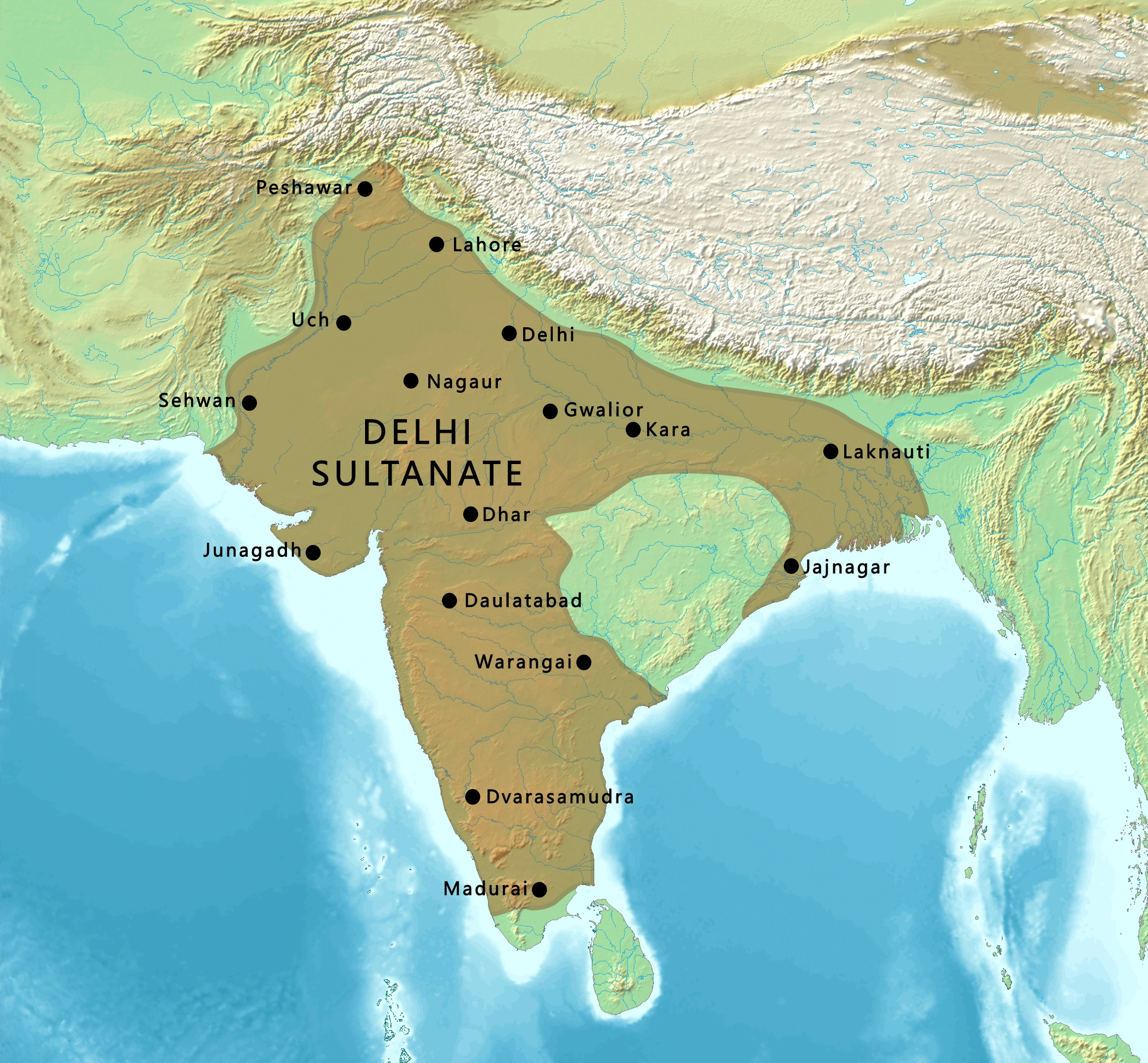
Map study
Delhi Sultanate territorial overview: regional orientation, not the exact boundary of every Sultan’s reign.
- Read the source date and legend before interpreting territorial extent.
- Compare core regions, neighbouring powers and geographic barriers; historical borders and influence are approximate and changed over time.
Credit: Koba-chan; DEMIS base map · CC BY-SA 3.0 · sourceConverted to WebP on an opaque white background; proportionally resized without cropping. Original cartography and legend retained.
1. Meaning, origins and consolidation
The Arabic term iqta referred to an assignment made by a ruler. In the Delhi Sultanate, it generally meant the assignment of revenue from a specified territory to an officer in return for service. The essential distinction is between a claim on revenue and ownership of the soil. Cultivators continued to cultivate their holdings, while the assignee received authority to collect the state’s dues, subject to the terms of his appointment. Consequently, translating iqta simply as a private estate is misleading.
Related arrangements had developed in West Asia, particularly under earlier Islamic dynasties, before Turkish rule became established in northern India. The Delhi rulers adapted this institutional tradition to Indian agrarian conditions. Iltutmish is especially associated with its consolidation because he distributed territorial assignments among commanders and used them to establish authority over conquered regions. He did not invent the institution.
The system addressed a practical problem of medieval state formation: how to support cavalry commanders and administer distant territories without collecting every payment at Delhi and then redistributing it in cash. By connecting service obligations with locally collected revenue, iqta assignments helped the Sultanate extend its authority. Their actual operation nevertheless varied by period, region and the strength of the reigning sultan.
- Exam distinction: an iqta was primarily a fiscal and service arrangement, not automatically a hereditary landed property.
- Avoid assuming that every iqta had the same size or that every holder possessed identical powers.
Timeline
Before the thirteenth century
Iqta arrangements developed in the Islamic world before their adaptation in northern India.
1211–1236
Iltutmish consolidated territorial revenue assignments as a foundation of Sultanate administration.
1266–1287
Balban emphasised royal control and enforcement of military service obligations.
1296–1316
Alauddin Khalji tightened fiscal supervision and military inspection while retaining provincial iqta arrangements.
1351–1388
Firuz Shah Tughlaq encouraged hereditary succession in service arrangements and expanded reliance on revenue assignments.
2. Duties of the muqti and the revenue mechanism
A muqti holding a substantial territorial charge performed both military and administrative functions. He maintained troops, upheld order, enforced the ruler’s authority and protected communications within his jurisdiction. When summoned, he was expected to provide military service to the sultan. Provincial authority was not necessarily undivided: accountants, judicial officers and other appointees could exercise separate functions or report to the centre.
The revenue collected from an iqta financed the holder’s sanctioned remuneration, the maintenance of his prescribed military establishment and recognised administrative expenditure. The remaining amount was to be remitted to the central treasury as surplus, often termed fawazil. This was the ideal administrative arrangement, not proof that every muqti regularly paid the full amount due. Concealment of collections and exaggeration of expenditure were recurring sources of conflict.
The central finance department, the Diwan-i Wizarat, supervised fiscal administration and scrutinised accounts. Estimates of an assignment’s resources helped determine the obligations placed upon its holder. Military supervision involved the Diwan-i Arz, although inspection practices became more systematic under particular rulers. The iqta system thus connected agricultural production, provincial collection, central accounting and cavalry maintenance.
The muqti normally depended on existing rural intermediaries and local revenue personnel rather than personally collecting dues from every cultivator. Indian agrarian society therefore retained considerable continuity beneath the upper layer of Sultanate administration. Local resistance, harvest conditions and the influence of village headmen affected the revenue actually realised.
- Conceptual revenue sequence: collections minus authorised remuneration and expenditure equals the surplus due to the centre.
- The assessed capacity of an iqta and its actual collections could differ substantially.
Idealised working of a major iqta
- 1. Sultan appoints an officer and assigns a revenue-bearing territory.
- 2. Revenue capacity and service obligations are determined.
- 3. Muqti collects state dues through the local administrative network.
- 4. Authorised receipts support troops, remuneration and administration.
- 5. Accounts and military obligations are scrutinised.
- 6. Surplus is remitted; the holder remains liable to transfer or removal.
3. Central control and changes under successive rulers
The sultan sought to prevent assignments from becoming independent principalities. Appointment, dismissal and transfer were important controls. A transferable officer was less likely to acquire permanent local roots than a hereditary ruler. Financial scrutiny and demands for surplus further asserted that the territory remained under the sovereign’s authority. In practice, distant governors could exploit political crises to withhold revenue or seek independence.
Balban, who ruled from 1266 to 1287, emphasised royal authority and sought to enforce service obligations. Accounts of his scrutiny of old military assignments in the Doab reveal concern about grants being enjoyed without effective military service, including cases where descendants or dependants continued to benefit. Such episodes show the tension between the state’s claim to conditional service and beneficiaries’ attempts to preserve assignments within families.
Alauddin Khalji, who ruled from 1296 to 1316, strengthened central fiscal and military control. Expansion of directly administered revenue arrangements in the core region, tighter accounting and payment of his standing army in cash reduced dependence on loosely supervised intermediaries. Branding of horses, or dagh, and descriptive rolls of soldiers, or chehra, helped check fraudulent military musters. However, it is incorrect to conclude that he abolished the iqta system throughout the Sultanate.
Under the Tughlaqs, provincial assignments continued, but their operation was affected by changing assessments, political expansion and conflict over collections. Firuz Shah Tughlaq, who ruled from 1351 to 1388, favoured hereditary succession in offices and military service arrangements and made extensive use of revenue assignments. These tendencies weakened some earlier checks, although the later fragmentation of the Sultanate cannot be explained by hereditary assignments alone.
- Do not attach dagh and chehra to the original creation of the iqta institution; they were instruments of military regulation.
- Changes were not a simple, uninterrupted movement from strict centralisation to complete decentralisation.
| Term | Meaning | Important distinction |
|---|---|---|
| Iqta | Territorial revenue assignment associated with service | Did not ordinarily confer land ownership |
| Muqti or iqtadar | Holder of an iqta | Major holders exercised military and administrative authority |
| Khalisa | Territory whose revenue was reserved for the central treasury | Not an assignment to a provincial revenue holder |
| Fawazil | Surplus payable after authorised expenses | Not the entire gross collection |
| Mughal jagir | Revenue assignment operating within Mughal administration | Related to, but not identical with, Sultanate iqta arrangements |
4. Iqta, khalisa and related institutions
Khalisa referred to revenue-bearing territory reserved for direct collection on behalf of the central treasury rather than assigned to an iqta holder. Both khalisa and iqta territory belonged within the sultan’s political domain; their distinction concerned the collection and disposal of revenue. A territory could be transferred between these categories as policy and administrative needs changed.
Smaller revenue assignments could support individual soldiers or subordinate personnel without giving them the broad governing powers exercised by major provincial muqtis. Textbook descriptions often emphasise large administrative iqtas, but the wider world of service assignments was more varied. Religious and charitable grants also existed and should not automatically be classified as military iqtas.
The Mughal jagir offers a useful comparison because it too generally assigned revenue rather than ownership. Nevertheless, the Mughal jagirdari system developed within a more elaborate mansabdari framework, with rank, salary claims and military obligations linked through imperial regulations. Similarly, comparisons with European feudalism must remain qualified: iqta holders were ideally appointed and transferable officers, not necessarily hereditary proprietors exercising permanently autonomous jurisdiction.
- Iqta versus khalisa: assigned revenue versus revenue reserved for the central treasury.
- Iqta versus jagir: a broad institutional resemblance, but different administrative settings and historical development.
5. Historical significance and examination approach
The iqta system enabled the Sultanate to mobilise agrarian resources for warfare and government. It supported cavalry forces, provided a mechanism for rewarding commanders and extended state authority beyond Delhi. At the same time, combining revenue collection with military command gave provincial officers resources that could be used against the centre. The institution was therefore both an instrument of integration and a potential source of centrifugal power.
Its consequences for cultivators depended on assessment, collection practices and effective supervision. An officer anxious to meet official demands or maximise his own receipts could intensify extraction. Yet the mere existence of an iqta does not establish that peasants were serfs or that all customary rights disappeared. For objective questions, separate the legal nature of the assignment from the holder’s practical power, and distinguish general institutional features from policies associated with individual rulers.
- High-yield themes: revenue rights, service obligations, transferability, surplus remittance and central supervision.
- Common traps: land ownership, universal hereditary succession, complete abolition under Alauddin and identity with Mughal mansabdari.
Real-world case studies
Balban and military assignments in the Doab
Ziyauddin Barani’s account of Balban describes scrutiny of assignments originally connected with military service but subsequently enjoyed by ageing holders or their dependants. The episode illustrates how conditional grants could acquire hereditary expectations. As with other court chronicles, its details should be read critically rather than treated as a statistical description of every iqta.
Bengal and the limits of central control
The rebellion of Tughril, Balban’s governor in Bengal, during the late 1270s and early 1280s illustrates the difficulty of controlling distant military governors. Balban personally intervened to suppress it. Distance, provincial military resources and access to revenue could allow a delegated governor to challenge Delhi, demonstrating a structural risk of provincial command.
Previous year questions
No source-linked PYQ is available here yet. Use the practice questions below.
Practice questions
Practice MCQ 1
With reference to the iqta system of the Delhi Sultanate, consider the following statements: 1. An iqta ordinarily conferred proprietary ownership of the assigned land. 2. A major iqta holder was expected to maintain troops and perform administrative duties. 3. The holder could be transferred by the sultan. Which of the statements given above are correct?
- A. 1 and 2 only
- B. 2 and 3 only
- C. 1 and 3 only
- D. 1, 2 and 3
Practice MCQ 2
In the fiscal administration of the Delhi Sultanate, fawazil most appropriately referred to:
- A. Revenue permanently exempted for religious establishments
- B. The personal cavalry of the sultan
- C. Surplus revenue remittable by an iqta holder after authorised expenditure
- D. Land held as hereditary private property by village headmen
Practice MCQ 3
Which one of the following statements is correct?
- A. Iltutmish invented the iqta institution without any earlier precedent.
- B. Alauddin Khalji abolished all provincial iqtas.
- C. Khalisa revenue was reserved for the central treasury rather than assigned to an iqta holder.
- D. Sultanate iqta holders were ranked through the Mughal mansabdari system.
Mains practice · The iqta system strengthened the Delhi Sultanate while also creating challenges to central authority. Explain. Suggested length: 250 words.
- Define iqta as a conditional revenue assignment rather than proprietary landownership.
- Explain its contribution to military finance, provincial administration and territorial integration.
- Discuss transfers, accounting, surplus remittance and military inspection as central controls.
- Show how local military resources, concealed revenue and hereditary claims could weaken supervision.
- Use Balban’s enforcement efforts, Alauddin’s reforms and Firuz Shah’s hereditary tendencies as examples.
- Conclude that outcomes depended on political circumstances and the effectiveness of central oversight.
Further reading
- NCERT, Our Pasts II, chapter on the Delhi Sultans.
- Satish Chandra, Medieval India: From Sultanat to the Mughals, Part I.
- Peter Jackson, The Delhi Sultanate: A Political and Military History.
- IGNOU eGyanKosh, history study units on the administration and economy of the Delhi Sultanate.
Preparing for UPSC Civil Services? Get classroom teaching, answer-writing evaluation and mentorship at Pragnya IAS Academy, Ashok Nagar — see why aspirants choose us for IAS coaching in Hyderabad.