
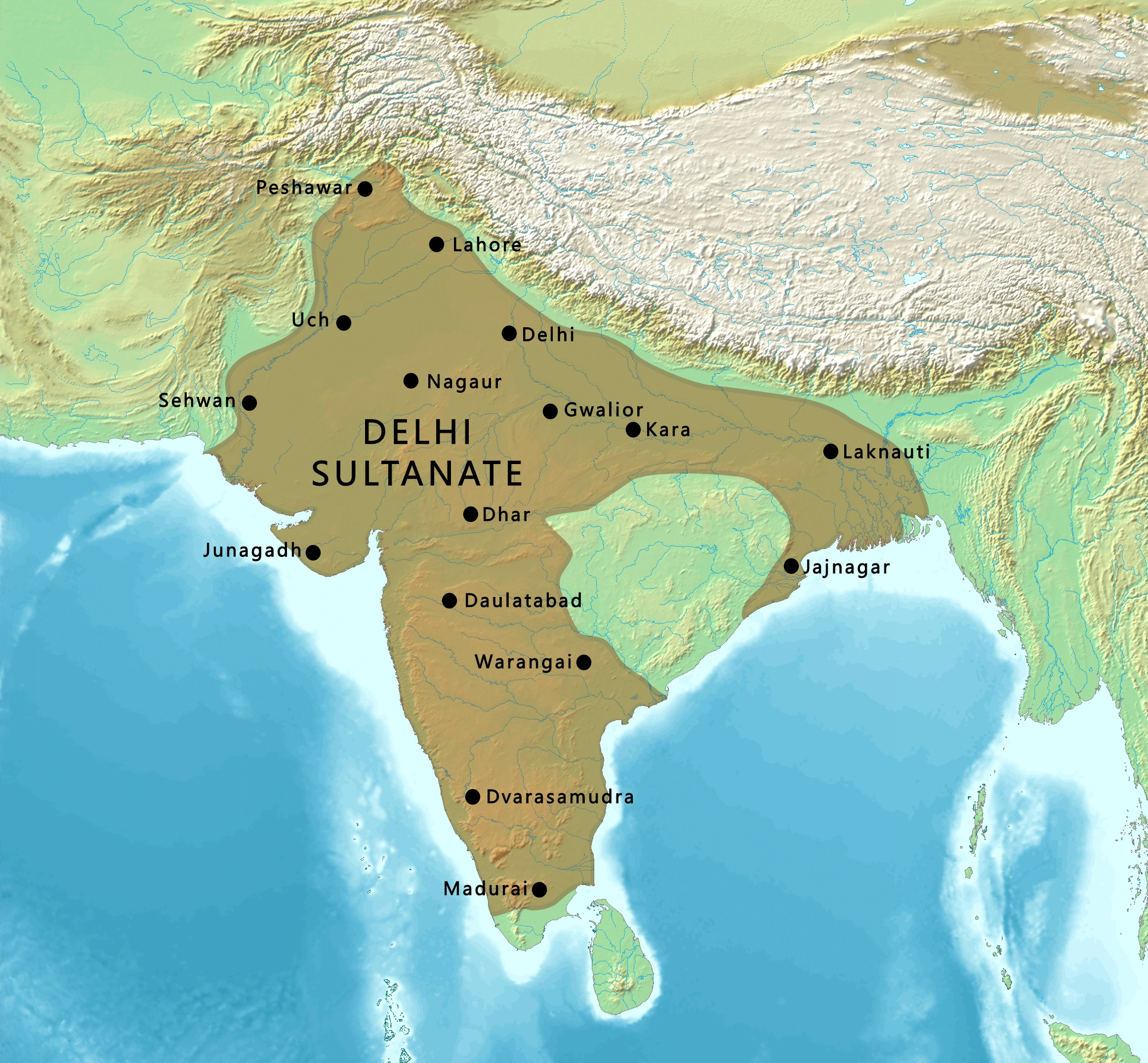
Map study
Delhi Sultanate territorial overview: regional orientation, not the exact boundary of every Sultan’s reign.
- Read the source date and legend before interpreting territorial extent.
- Compare core regions, neighbouring powers and geographic barriers; historical borders and influence are approximate and changed over time.
Credit: Koba-chan; DEMIS base map · CC BY-SA 3.0 · sourceConverted to WebP on an opaque white background; proportionally resized without cropping. Original cartography and legend retained.
1. Origins and the character of Afghan rule
The Lodis emerged during the political fragmentation that followed the decline of Tughlaq authority and Timur’s invasion of Delhi in 1398. The Sayyids, who ruled Delhi from 1414 to 1451, controlled a relatively restricted territory. Regional states such as Jaunpur, Gujarat, Malwa and Bengal exercised independent power. The Lodi achievement was therefore a partial reconstruction of the Delhi Sultanate, not the recovery of the entire territory once claimed by the Khaljis or Tughlaqs.
Bahlul Lodi belonged to an Afghan ruling family established in Punjab and held Sirhind before becoming sultan. He acquired influence through military service, alliances and the recruitment of Afghan followers. In 1451, he assumed power at Delhi after the last Sayyid ruler, Alam Shah, had withdrawn to Badaun. The transfer illustrates how provincial military commanders could turn declining central authority into an opportunity for dynastic advancement.
Afghan political traditions shaped relations between the ruler and his nobles. Leading chiefs expected consultation, recognition of status and a share in offices and revenue assignments. Bahlul cultivated an image of accessibility and treated important Afghan nobles as companions rather than merely servants. Nevertheless, Lodi government remained a monarchy operating through established Sultanate institutions; it should not be described as a democratic federation of tribes.
- Prelims distinction: the Sayyids preceded the Lodis; the Sur dynasty was a later Afghan dynasty, not the immediate successor of the Lodis.
- Analytical theme: the tension between monarchical centralisation and aristocratic expectations runs through all three Lodi reigns.
Timeline
1451
Bahlul Lodi establishes Lodi rule at Delhi.
1479
Bahlul defeats Husain Shah Sharqi and takes Jaunpur.
1489
Sikandar Lodi succeeds Bahlul.
1504
Sikandar establishes Agra as a major royal centre.
1517
Ibrahim Lodi succeeds Sikandar.
21 April 1526
Babur defeats Ibrahim at the First Battle of Panipat.
2. Bahlul Lodi: consolidation through accommodation
Bahlul Lodi’s principal task was to secure Delhi and recover neighbouring territories. He used conciliation alongside force, accommodating local chiefs and distributing responsibilities among trusted Afghan associates. His authority depended heavily on personal relationships and military cooperation. This approach enabled expansion but also preserved the strength of nobles whose support later rulers could not take for granted.
The prolonged contest with the Sharqi kingdom of Jaunpur was the major military struggle of his reign. Jaunpur controlled the rich eastern Gangetic region and competed with Delhi for supremacy in northern India. Bahlul decisively defeated Husain Shah Sharqi and took Jaunpur in 1479, although Sharqi resistance did not immediately disappear. The acquisition substantially enlarged the political and agrarian resources available to the Lodis.
Bahlul placed his son Barbak Shah in charge of Jaunpur. After Bahlul’s death in 1489, another son, Nizam Khan, became sultan as Sikandar Lodi. The resulting contest with Barbak demonstrated the difficulty of maintaining unity when royal relatives possessed strong provincial bases. For examination purposes, associate Bahlul with the establishment of Afghan rule and the conquest of Jaunpur, rather than with Agra or Panipat.
From internal tensions to dynastic defeat
- 1. Afghan nobles retain strong provincial and personal power bases
- 2. Ibrahim demands stricter subordination
- 3. Rebellions and rival claims weaken cooperation
- 4. Opponents seek Babur’s intervention
- 5. Babur combines political opportunity with superior battlefield coordination
- 6. Defeat at Panipat ends Lodi rule
3. Sikandar Lodi: administration, expansion and cultural policy
Sikandar Lodi is generally regarded as the most effective ruler of the dynasty. He subdued challenges within the royal family, consolidated control over Jaunpur and extended Lodi influence into Bihar. His reign strengthened the connection between Delhi and the middle Gangetic plain. Campaigns around Dholpur and the Gwalior region also reflected the importance of controlling routes and strongholds south of the Yamuna.
He sought tighter supervision of provincial officers and nobles through intelligence gathering, scrutiny of accounts and stricter court discipline. The Gaz-i-Sikandari, a standard measuring unit associated with his reign, is important in the history of land measurement. Its use should not be confused with Akbar’s later revenue arrangements. Lodi administration remained dependent on officials and local intermediaries, and there was no uniformly implemented modern system of land assessment.
Sikandar founded Agra as a major royal centre in 1504 and subsequently made it an important seat of government. Its position on the Yamuna facilitated access to the Gangetic plain, Rajasthan and central India. This strategic shift anticipated Agra’s later prominence under the Mughals. Sikandar also patronised Persian literary culture and composed poetry under the pen name Gulrukhi.
His religious policy combined patronage of Islamic learning with measures described in chronicles as orthodox and discriminatory. Accounts record the destruction of temples and restrictions on certain non-Muslim practices. Administrative effectiveness should therefore not be equated with religious tolerance. At the same time, court chronicles require critical reading because their authors often presented royal conduct through ideals of kingship and religious legitimacy.
| Ruler | Principal association | Political approach or challenge |
|---|---|---|
| Bahlul Lodi | Foundation of the dynasty; acquisition of Jaunpur | Accommodation of Afghan chiefs |
| Sikandar Lodi | Agra; Gaz-i-Sikandari; consolidation in the east | Stronger administrative supervision |
| Ibrahim Lodi | Noble rebellions; First Battle of Panipat | Centralisation without durable aristocratic support |
4. Ibrahim Lodi and the collapse at Panipat
Ibrahim Lodi succeeded Sikandar in 1517. His attempts to impose stricter obedience on Afghan nobles intensified existing tensions. The imprisonment, removal or punishment of influential figures generated suspicion and rebellion. Conflict involving his brother Jalal further exposed the fragility of succession arrangements. Provincial opposition became especially serious in Punjab and the eastern territories.
Daulat Khan Lodi, the governor of Punjab, and Alam Khan, Ibrahim’s uncle and a claimant to the throne, sought Babur’s assistance against Ibrahim. Their actions helped open the way for intervention, but Babur was not simply an invited arbitrator. He possessed independent territorial ambitions and had already undertaken expeditions into north-western India. Opposition from Rana Sanga of Mewar also constrained Lodi power.
At the First Battle of Panipat on 21 April 1526, Babur defeated Ibrahim, who died fighting. Babur combined field artillery and matchlockmen with carts and defensive barriers, while mobile cavalry executed enveloping movements associated with tulughma tactics. Ibrahim’s larger force could not effectively exploit its numerical strength. Exact army totals in contemporary narratives are uncertain. The battle ended Lodi rule and established Mughal power at Delhi and Agra, though Babur still had to defeat major rivals.
- Avoid a single-cause explanation: noble dissension, provincial resistance, leadership and battlefield organisation mattered alongside firearms.
- Panipat did not end Afghan political activity; Afghan chiefs remained important and later rallied under Sher Shah Sur.
5. Architecture, sources and historical significance
Lodi architecture continued late Sultanate traditions while developing forms later elaborated under the Mughals. Tombs commonly followed square or octagonal plans, with prominent domes, verandahs, corner features and occasional coloured tile decoration. Mosques used arches and multiple bays within relatively compact compositions. These buildings should be distinguished from the large marble mausoleums of the mature Mughal period.
Delhi’s Lodhi Garden preserves several useful examples, including Sikandar Lodi’s tomb and the Bara Gumbad complex. Sikandar’s tomb was built during Ibrahim’s reign within a walled garden enclosure. The garden also contains the tomb of Muhammad Shah, a Sayyid ruler: its modern location does not make it a Lodi monument. The identity of the person buried in Shish Gumbad remains uncertain.
Persian narratives such as the Tarikh-i-Daudi, later historical compilations and Babur’s memoirs help reconstruct the period. They should be compared with inscriptions, coins and surviving monuments. The Lodis are historically significant as the bridge between the fragmented fifteenth-century Sultanate and Mughal expansion, and as an example of the difficulty of reconciling a centralising monarchy with a powerful military aristocracy.
Real-world case studies
Agra: geography and state-building
Sikandar’s establishment of Agra in 1504 connected royal power more closely to the Yamuna corridor and the eastern territories. It demonstrates how a new political centre could improve strategic access without representing an entirely new administrative system.
Lodhi Garden: identifying monuments correctly
Muhammad Shah’s tomb belongs to the Sayyid period, whereas Sikandar Lodi’s tomb belongs to the Lodi period. Their presence in the same modern park illustrates why architectural attribution must rely on patronage, inscriptions and dating rather than present-day place names.
Previous year questions
No source-linked PYQ is available here yet. Use the practice questions below.
Practice questions
Practice MCQ 1
Which ruler is correctly paired with an event of his reign?
- A. Bahlul Lodi: Foundation of Agra in 1504
- B. Sikandar Lodi: Consolidation of Lodi influence in Bihar
- C. Ibrahim Lodi: Acquisition of Jaunpur in 1479
- D. Sikandar Lodi: First Battle of Panipat
Practice MCQ 2
Consider the following statements: 1. The Lodis were the first Afghan dynasty of the Delhi Sultanate. 2. Afghan chiefs’ expectations of consultation complicated royal centralisation. 3. The Sur dynasty immediately preceded Lodi rule. Which statements are correct?
- A. 1 and 2 only
- B. 2 and 3 only
- C. 1 and 3 only
- D. 1, 2 and 3
Practice MCQ 3
Regarding monuments in Delhi’s Lodhi Garden, which statement is correct?
- A. Every major tomb in the garden belongs to the Lodi dynasty.
- B. Muhammad Shah’s tomb commemorates a Mughal emperor.
- C. Sikandar Lodi’s tomb stands within a walled garden enclosure.
- D. Shish Gumbad is securely identified as Ibrahim Lodi’s tomb.
Mains practice · The fall of the Lodi dynasty resulted from political fragmentation as much as military innovation. Discuss. Answer in 150 words.
- Explain Afghan nobles’ expectations of status and consultation.
- Contrast Bahlul’s accommodation with Ibrahim’s coercive centralisation.
- Mention provincial rebellions and the roles of Daulat Khan and Alam Khan.
- Assess Babur’s independent ambitions, artillery, defensive arrangements and cavalry tactics.
- Conclude that internal division and battlefield effectiveness reinforced one another.
Further reading
- Satish Chandra, Medieval India: From Sultanat to the Mughals, Part One.
- NCERT, Themes in Indian History, Part II, for wider medieval historical context.
- Archaeological Survey of India: information on Delhi’s protected monuments and Lodi-period architecture.
- Babur, Baburnama, for the campaigns culminating in Panipat; read critically as a ruler’s memoir.
Preparing for UPSC Civil Services? Get classroom teaching, answer-writing evaluation and mentorship at Pragnya IAS Academy, Ashok Nagar — see why aspirants choose us for IAS coaching in Hyderabad.