

Amber Fort in Jaipur, India
Credit: A.Savin · FAL · source

Mughal Empire at its maximum extent under Aurangzeb, 1707. Source: Schwartzberg, Joseph E. A Historical Atlas of South Asia (University of Minnesota, 1992), Plate VI.A (p.44–46) and XIV.4 (p.148) See
Credit: Avantiputra7 · CC BY-SA 4.0 · source
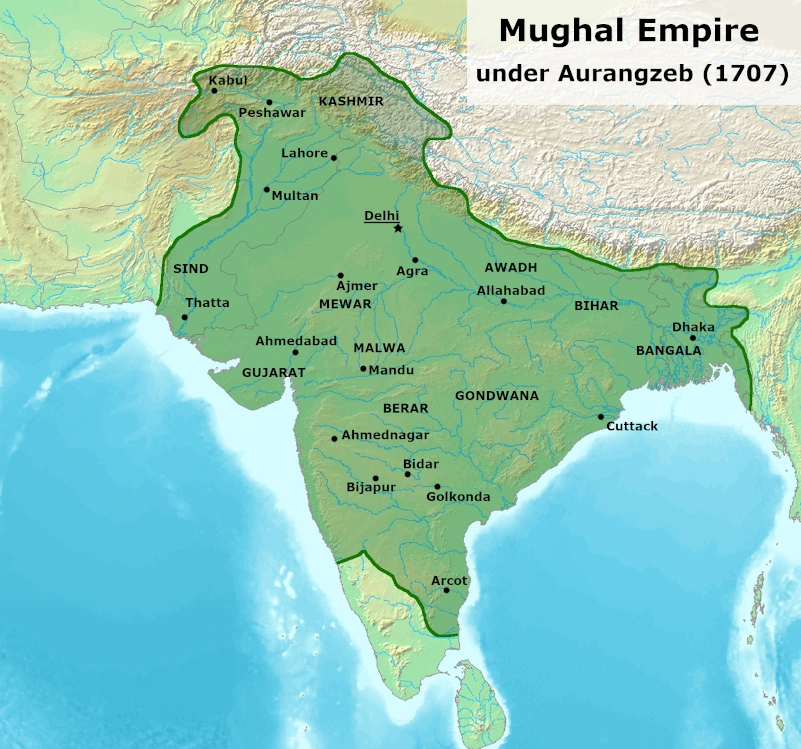
Map study
Mughal Empire in 1707 near the end of Aurangzeb’s reign; this is not Babur’s or Akbar’s territorial extent.
- Read the source date and legend before interpreting territorial extent.
- Compare core regions, neighbouring powers and geographic barriers; historical borders and influence are approximate and changed over time.
Credit: Avantiputra7 · CC BY-SA 4.0 · sourceConverted to WebP on an opaque white background; proportionally resized without cropping. Original cartography and legend retained.
1. Meaning, origins and place in the Mughal state
A jagir was an assignment of revenue from a defined area, commonly comprising one or more parganas or parts of them. The emperor authorised the assignee to receive specified revenue against an approved salary or obligation. It was not normally a grant of the soil itself: cultivators retained their customary claims, while zamindars could retain hereditary local rights and revenue-related privileges within the same territory.
The arrangement had precedents in earlier Indo-Islamic revenue assignments, especially the Delhi Sultanate’s iqta system. However, treating iqta and jagir as identical obscures differences in administration and historical context. Under Akbar, jagir assignments became closely integrated with the more systematically organised mansabdari establishment and revenue assessment machinery. The system continued under his successors, although its operation varied considerably across regions.
Jagirdari allowed the empire to maintain a large service nobility without paying every official directly from the treasury. It also distributed the work of revenue collection. Its central contradiction was that nobles needed dependable income, whereas the emperor sought to prevent them from becoming territorially entrenched. Transfers, accounting procedures and imperial supervision attempted to reconcile these competing requirements.
- The assignment concerned revenue entitlement, not unrestricted territorial sovereignty.
- Jagirdari should not be equated with British-era Permanent Settlement zamindari or with European feudal landownership.
Timeline
1556–1605
Under Akbar, jagir allocation became closely integrated with the developing mansabdari and revenue systems.
1658–1707
Aurangzeb’s reign witnessed expanding service claims and prolonged warfare, intensifying pressure on revenue assignments.
1686–1687
Bijapur and Golconda were annexed; additional territory brought both potential revenue and substantial administrative challenges.
After 1707
Succession struggles and regionalisation weakened imperial control, while revenue-assignment practices persisted in successor states.
2. Relationship with mansabdari and military service
Mansabdari ranked imperial servants and determined their position and remuneration. In its developed form, the zat rank indicated personal status and the basis of personal pay, while the sawar rank related to cavalry obligations and the corresponding allowance. Actual obligations could be modified by regulations and concessions. A mansabdar could receive remuneration in cash, through a jagir, or through arrangements combining these methods.
Where payment was through a jagir, the administration sought to match the assignment’s assessed revenue with the sanctioned claim. The official used the proceeds to meet personal establishment costs and prescribed service expenses. The jagir was thus a fiscal support for imperial service, not itself a military rank. A change in rank or salary could require adjustment of the revenue assignment.
Military inspection remained important because revenue entitlement did not guarantee that the required contingent was maintained. Horse branding, known as dagh, and descriptive rolls of soldiers, known as chehra, sought to discourage substitution and fictitious musters. These belonged to the broader mansabdari control system. Transfers of jagirs similarly aimed to limit prolonged local entrenchment, although they could also weaken incentives for long-term agricultural improvement.
- Not every mansabdar was necessarily paid through a jagir at every stage of service.
- Do not infer an official’s rank merely from the geographical size of a jagir: assessed productivity mattered more than area alone.
Simplified operation of a salary jagir
- 1. Imperial appointment determines rank, remuneration and service obligations.
- 2. Revenue authorities identify an assignment with an appropriate recorded jama.
- 3. The emperor authorises the jagir assignment.
- 4. The jagirdar’s agents collect revenue through local arrangements under applicable regulations.
- 5. Realised revenue supports the official’s establishment and prescribed service expenses.
- 6. Accounts, service performance and changing imperial needs inform adjustment, transfer or resumption.
3. Revenue administration and local relationships
The distinction between jama and hasil is fundamental. Jama was the assessed or recorded revenue demand; hasil was the amount actually realised. An assignment attractive on paper could yield less because of crop failure, resistance, warfare, inflated assessment or weak administrative control. Consequently, two assignments with similar recorded jama could differ substantially in practical value.
Jagirdars collected revenue through agents and local arrangements, subject in principle to imperial rules. They were not free to impose any demand they wished. Provincial revenue authorities, accounting officials and records maintained through institutions such as qanungos and village patwaris formed part of the administrative environment. Implementation varied: the zabt system was important in major regions, but a jagir was not defined by any single method of assessment.
The jagirdar and zamindar occupied different positions. A jagirdar held an assignment from the imperial government; a zamindar generally possessed hereditary local claims, social authority and revenue-related rights. Zamindars might assist collection, negotiate with assignees or resist them. Some also served as mansabdars, so categories could overlap in an individual without becoming institutionally identical.
Peasants ultimately supplied the agrarian surplus sustaining this structure. Excessive demands, short-term extraction and conflicts among officials and local intermediaries could encourage flight, resistance or cultivation decline. However, outcomes were not uniform: local bargaining, agricultural conditions and effective supervision also shaped the burden.
| Term | Meaning | Key distinction |
|---|---|---|
| Mansab | Official rank in imperial service | Rank, not a territorial revenue assignment |
| Tankhwah jagir | Revenue assignment against salary | Normally transferable and non-hereditary |
| Watan jagir | Recognised hereditary homeland of a serving chief | Exception to the ordinary transferability rule |
| Khalisa | Revenue reserved for the imperial treasury | Not assigned as an individual officer’s salary jagir |
| Zamindari | Hereditary local rights and authority linked to land and revenue | Distinct from an imperial jagir assignment |
| Jama and hasil | Assessed revenue and actual realisation respectively | Recorded value could exceed practical yield |
4. Types of assignment and imperial controls
Tankhwah jagirs were salary assignments and ordinarily transferable. A transfer changed the person entitled to receive the designated revenue; it did not necessarily replace existing village institutions or erase customary local claims. Imperial authorities could resume or redistribute assignments, making continued enjoyment dependent on service and political favour.
Watan jagirs were associated with the hereditary homelands of chiefs, particularly Rajput rulers incorporated into Mughal service. They recognised a different relationship from the ordinary transferable salary assignment. A chief might retain a watan jagir and also receive additional assignments elsewhere. Their hereditary character qualified the general rule that jagirs were non-hereditary, but did not mean complete independence from imperial authority.
Mashrut assignments were conditional upon specified obligations or circumstances. Revenue-free grants for religious, scholarly or charitable purposes, often discussed under terms such as madad-i-maash, should be distinguished from ordinary service jagirs. Terminology and administrative treatment changed across periods, making rigid textbook classifications potentially misleading.
Khalisa comprised revenue reserved for the imperial treasury. Territory could move between khalisa and jagir allocation as fiscal needs changed. It is therefore incorrect to describe all Mughal revenue-paying territory as permanently divided into fixed ownership categories. The distinction concerned the destination and administration of revenue more than separate kinds of landownership.
5. Jagirdari crisis and historical interpretation
During the later seventeenth and early eighteenth centuries, pressure increased on the distribution of remunerative jagirs. The expanding service establishment generated additional salary claims. Aurangzeb’s prolonged Deccan campaigns, including the annexations of Bijapur in 1686 and Golconda in 1687, enlarged imperial territory but also increased military costs and administrative commitments.
Territorial conquest did not automatically produce securely collectable revenue. Warfare and resistance could make newly acquired assignments difficult to exploit, while nominal assessments overstated their practical yield. Nobles therefore competed for productive jagirs, and some faced delays in obtaining assignments. Be-jagiri refers to the condition of being without a jagir despite an entitlement or expectation of assignment.
Satish Chandra emphasised tensions in the mansab-jagir structure in explaining Mughal political decline. Irfan Habib highlighted agrarian exploitation and conflicts within the revenue system. M. Athar Ali’s work on the Mughal nobility helps contextualise the changing composition and claims of imperial service elites. These approaches illuminate related but not identical processes.
The crisis should not be reduced to an absolute shortage of land or a single-cause explanation of imperial decline. Collectability, accounting, warfare, political competition and regional conditions mattered. After 1707, succession struggles and weakening central control further disturbed assignments. Jagirdari nevertheless continued in altered forms within successor states rather than disappearing immediately with declining Mughal power.
- Prelims trap: more conquered territory did not necessarily mean more dependable revenue.
- Analytical distinction: a shortage of productive assignments was not simply a physical shortage of land.
Real-world case studies
Rajput integration and watan jagirs
The Kachhwaha house of Amber illustrates how Mughal service could coexist with hereditary territorial authority. Its rulers entered the imperial mansabdari structure while retaining their homeland position. Watan arrangements and additional service assignments helped integrate regional ruling houses without making their hereditary domains identical to ordinary transferable jagirs.
Deccan expansion and uncertain revenue
The conquest of Bijapur and Golconda increased the territory available for assignment, but prolonged campaigning and Maratha resistance complicated revenue collection. The Deccan demonstrates why nominal jama and actual hasil must be distinguished: a large territorial acquisition could increase imperial commitments without generating proportionately dependable income.
Previous year questions
No source-linked PYQ is available here yet. Use the practice questions below.
Practice questions
Practice MCQ 1
With reference to Mughal jagirdari, consider the following statements: 1. An ordinary salary jagir conveyed proprietary ownership of the assigned land. 2. A mansabdar could receive remuneration in cash rather than through a jagir. 3. Ordinary salary jagirs were liable to transfer. Which of the statements given above are correct?
- A. 1 and 2 only
- B. 2 and 3 only
- C. 1 and 3 only
- D. 1, 2 and 3
Practice MCQ 2
Which one of the following pairs is incorrectly matched?
- A. Jama: Assessed revenue
- B. Hasil: Revenue actually realised
- C. Khalisa: Revenue reserved for the imperial treasury
- D. Watan jagir: An invariably non-hereditary salary assignment
Practice MCQ 3
Which one of the following best explains why Mughal territorial expansion could coexist with a jagirdari crisis?
- A. Newly conquered territories were legally prohibited from becoming jagirs.
- B. Every jagir became hereditary following conquest.
- C. Additional service claims and collection difficulties could outpace dependable revenue.
- D. Mansabdars ceased to require revenue for military obligations.
Mains practice · Explain how the jagirdari system supported Mughal imperial integration while also generating tensions within the empire. Discuss in 250 words.
- Define jagir as a revenue assignment and distinguish it from mansab and landownership.
- Explain its role in financing officials and military obligations.
- Discuss transfers as a means of limiting local entrenchment.
- Use watan jagirs to illustrate accommodation of regional chiefs.
- Examine jama-hasil discrepancies, collection pressures and competing service claims.
- Connect Deccan warfare with fiscal strain without presenting jagirdari crisis as the sole cause of decline.
Further reading
- NCERT, Themes in Indian History, Part II, chapter Peasants, Zamindars and the State.
- Satish Chandra, Medieval India: From Sultanat to the Mughals, Part II.
- Irfan Habib, The Agrarian System of Mughal India, 1556–1707.
- M. Athar Ali, The Mughal Nobility under Aurangzeb.
- IGNOU eGyanKosh, study units on Mughal administrative institutions and agrarian relations.
Preparing for UPSC Civil Services? Get classroom teaching, answer-writing evaluation and mentorship at Pragnya IAS Academy, Ashok Nagar — see why aspirants choose us for IAS coaching in Hyderabad.